Desert Online General Trading LLC
Dubai, United Arab Emirates
Desert Online General Trading LLC
Dubai, United Arab Emirates


⚡ Elevate your DIY game with gold-standard prototyping!
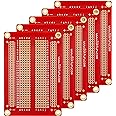
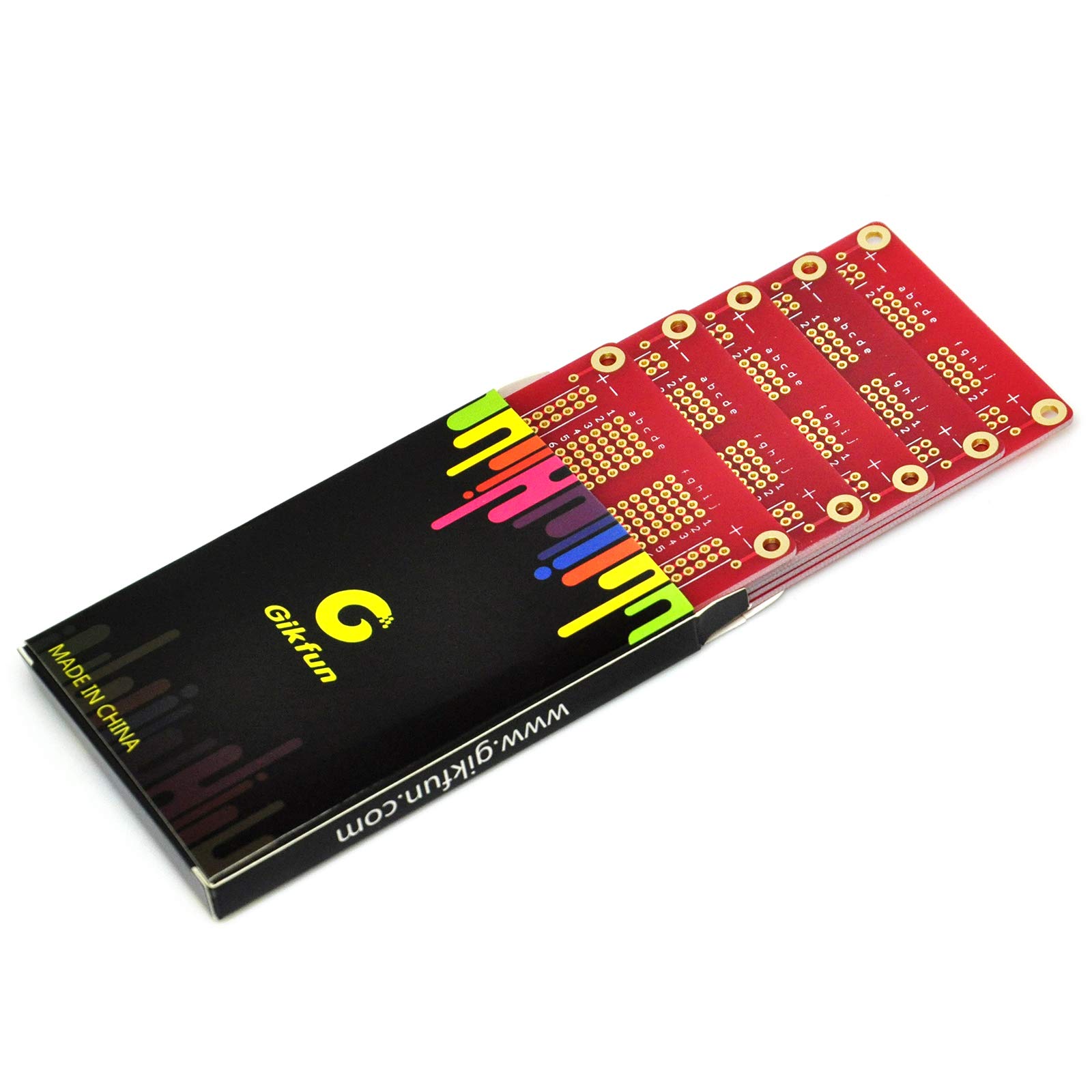
The Gikfun Solder-able Breadboard PCB Kit (5-pack) features a high-quality gold-plated finish to prevent oxidation and ensure easy soldering. Its through-plated holes enhance durability, making it ideal for preserving prototypes created on solderless breadboards. Compatible with popular MCU boards like Arduino Nano, Pro Mini, NodeMCU, and Raspberry Pi GPIO, this compact and lightweight kit is perfect for professional-grade DIY electronics projects.


| Wireless Type | Bluetooth |
| Brand | Gikfun |
| Item model number | ABCD |
| Hardware Platform | Arduino |
| Operating System | Linux |
| Item Weight | 3.2 ounces |
| Package Dimensions | 3.9 x 2.7 x 0.4 inches |
| Processor Brand | Gikfun |
| Number of Processors | 1 |
| Manufacturer | Esooho |
| ASIN | B071R3BFNL |
| Is Discontinued By Manufacturer | No |
| Date First Available | April 19, 2017 |
G**N
Saves time. Easy to move from a Prototype to a Hard-Wired Design
Like many electronic hobbyists, I use "proto-boards" to tryout a design. Of course, the designs may be simple or complex. In this case, I was prototyping an Arduino-based LED controller for an outdoor display. I needed only an Arduino NANO, 3 FETs, and 3 resistors. So, a small proto board worked out well.With my design tested, I needed to make a hard-wired equivalent. In the past, I used similar sized pwbs which are cheap and readily available. The problem is that, although the other pwbs are cheap, each "pad" is independent. So, if you need jumpers, you have to add them manually. This board simulates a small proto board with pads already "jumpered". So, if you have a working design based upon a proto board design of this size, you can easily and quickly transfer it to a soldered up design using these boards.Not having to solder additional jumpers seems like a simple thing to do. But, from past experience,, it's extra work and it's easy to make mistakes, and, you can end up with a lot of extra wires. With this board, design to fab is quick and should work. I also like the fact that they have larger mounting holes as well as gold plating.Good quality and seemed like a good price for 5.
M**G
Highly Recommended!
These are great boards. Their hole pattern matches solderless breadboards of the same size. You prototype on a breadboard, then when you are happy, you can solder a version on this board. The soldermask is great and makes it easier to solder. The copper is thick enough that you can rework connections a few times at least without having the copper foil tear off the substrate. You can also use an exacto knife to cut the foil between holes when necessary. The mounting holes are also great, and make it easy to mechanically attach the board inside a box.
S**G
Great boards for arduino
These are nice sturdy boards for my Arduino projects. They work great with the Jashem ip65 enclosure box and the chinese knock-off Arduino nano's I use (wyph mini nano v3.0).The board is a perfect fit sandwiched between the lid and base of the enclosure box, but the corner holes just need a tiny bit of drilling adjustment to match up with the enclosure holes.The boards are sturdy and held up to soldering. They also look really nice.
R**K
Gikfun Prototyping Boards - Nice!
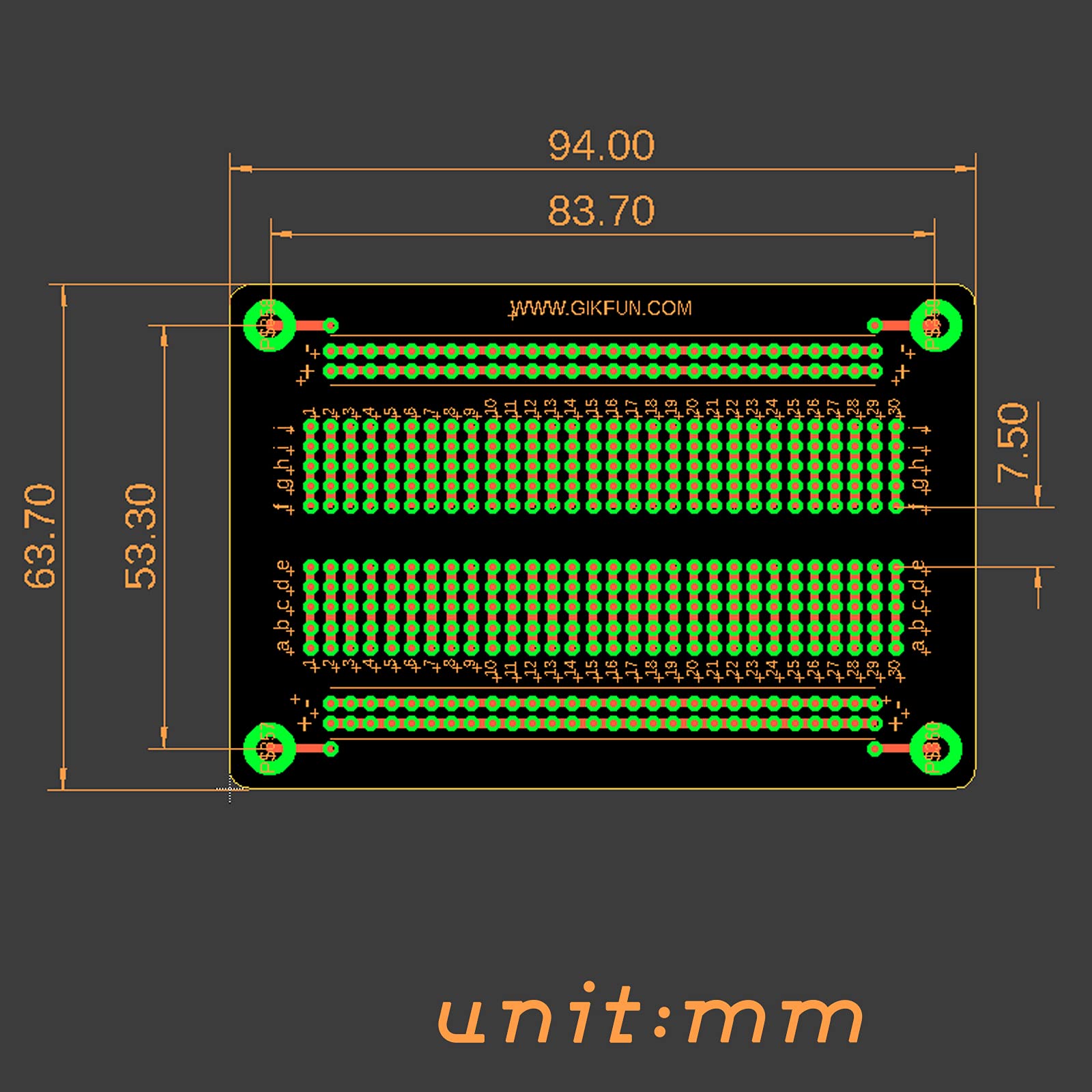
The Gikfun prototyping boards are nicely made. They are constructed on heavy duty double sided glass-epoxy board. The boards are 9.5cm long, 6.5cm wide and 1.25mm (50 mil) thick. The boards are stiff and strong. The holes are plated through and gold flashed. There is also solder mask around the holes to help prevent solder bridges. The rows are both numbered (rows) and lettered (columns) to help prevent making connection errors. Unlike other prototype boards, the Gikfun prototype boards are well made, well designed, well thought out and obviously designed by someone who has actually done prototyping and knows what features are needed. They are also very inexpensive compared to similar boards of different brands.I give them both thumbs up!
C**K
Good breadboard for early prototyping and/or simple projects
I know these are hated in certain electronics communities, but I think that they are a godsend. For simple personal one-off projects, just design it on a normal breadboard, and when you are done, solder it to this board identically, and it should work almost exactly as it did in the breadboard. It's much faster than trying to get a custom board made, and much easier to make changes to if necessary.These particular boards seem pretty well made. The traces/vias are numbered the same as a typical breadboard. I haven't had any traces lift, and they take solder well.
P**E
Cheap but still good quality
These are a clone of the Sparkfun solderable breadboards, with the exact same dimensions and layout. This is fine, because Sparkfun designs are open-source, so these are a good value if you need a lot of them. The only downside is that with these, the silkscreen labels for the rows and columns are only printed on one side.Other than that, they are perfectly functional and I haven't had any issues. The connected rows (+, -) and each 5-pin row are connected by traces on both sides, so if you screw up like I do a lot and have to desolder the pads over and over, you don't have to worry as much about breaking the traces.
J**E
No problem soldering to it.
I purchased these boards to build some small projects. I put them in my parts bin and recently took one out to build a project I saw in an electronic magazine. I had no trouble soldering to the board. Unlike some boards, the columns of the board are all connected on each side of the board. Thus installing an IC or in my case an Arduino Nano gave me plenty of open and connected spots to solder wires. No of the copper material lifted during soldering or unsoldering when I made a couple of connection errors. I will purchase more when I run out.
R**B
Good quality boards
I am happy with these boards; they solder well. The pad spacing is consistent; plated through holes seem to be well done.I wish the silk screen lettering & numbering was on both sides. This would help with top-and-bottom wiring arrangements. Also, it would be helpful to include an easy way to connect both power rails on each side of the board, together (such as with a small jumper) instead of having to run wires all the way across the board. These wires take up precious board space.But I am happy with the quality of these boards.
Trustpilot
2 days ago
2 weeks ago