
DOWNLOAD THE APP


Customer Services
Copyright © 2025 Desertcart Holdings Limited
DOWNLOAD THE APP
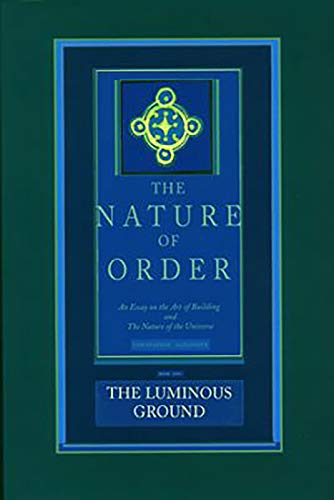
The Nature of Order: An Essay on the Art of Building and the Nature of the Universe, Book 4 - The Luminous Ground (Center for Environmental Structure, Vol. 12)
J**E
An exceptional man
I discovered Christopher Alexander around 1986 when I read A Pattern Language and The Timeless Way of Building. A Pattern Language was our guide in designing our strawbale house, built in 1997. I fell in love with him then, and these books simply increased my profound admiration for him and joy in his work.Christopher Alexander is a fellow of the American Academy of Arts and Sciences, an architect, a builder, and the author of many books and technical papers. He is the winner of the first medal for research ever awarded by the American Institute of Architects, and after 40 years of teaching is Professor Emeritus at the University of California, Berkeley. He trained in Physics and Mathematics at Cambridge and was part of the group of scientists who developed systems theory along with Herbert Simon. He has been investigating the interaction between science and architecture all of his life, and this beautiful four-volume work contains the results of his research.Although many of Alexander's ideas are subtle and require thoughtful reflection, the basic thesis of these four volumes might be stated: everything that exists contains "life," and the degree to which "life" is manifest in any particular can be "objectively" determined by probing one's "subjective" world.Book Four describes a new cosmology uniting matter and consciousness. In order for us to make the changes that will preserve and extend the beauty of the world (in the midst of trucks and prefab), we must change our world-view. As one reviewer said, Alexander gives us "an effective theoretical basis with which to combat the billboard." First he discusses the weakness of the present world-picture, listing its ten tacit assumptions. For example, tacit assumption 1 is: What is true is only the body of those facts which can be represented as lifeless mechanisms. He adds that this assumption has the offshoot assumption that value is subjective. He closes the book with eleven new cosmological assumptions, one of which is: Everything matters. Another: Whenever we undertake an act of construction we have the ability to make the world more alive or less alive, more harmonious or less harmonious. He says, "The idea, then, is that every part of our physical world is shadowed by this parallel domain of I-stuff, and that each part of our ordinary world, if it is given the right structure, will lift the flap or open the door, and give us a glimpse into that domain." (By "I-stuff" Alexander is hypothesizing that there is underlying all matter a "Ground" - single and personal.) He adds, "All the efforts I have made have, at their heart, just this one intention: to bring back our awe . . and to allow us to begin again to make things in the world which can intensify this awe."Christopher Alexander's tireless work, his brilliance, his humility, his humanity give me deep hope in a time when it is so easy to lose heart. These are books to be read slowly, savored. One reviewer suggested that this is one of the few works to be remembered 500 years hence. I suggest that it is one of the works to be read and absorbed now in order for there to be a 500 years hence for us.I have reviewed Books One, Two, and Three at their respective sites.
J**N
Unique reference. Worthwhile purchase. Brilliant author. This is the best of the series.
This is a great book covering aspects of architecture that are often difficult to describe. Interestingly enough, the author seems to have a challenge describing many of those complicated states of architecture as he relates it to ‘life’. Although the translation of the subject gets lost at times, the ideas he has are invaluable.
N**D
An acute observer of life
I LOVE this book. It is a treasure. Christopher Alexander's penetrating observations are deeply informed by an open heart. His writing is accessible, and his observations and conclusions profound.
P**L
An amazing book that makes one look at life in a ...
A must read. An amazing book that makes one look at life in a different way. Not only thoughtful, but ground-breaking.It was one of the inspirations that led to writing my book The Art of Leading Collectively: Co-Creating a Sustainable, Socially Just Future
A**M
the luminous ground
grat finish of 4 book seriesa must for any designer worth their payif you can not think outside of the box that architecture school traps you in then this in not for youonly creative people must read
M**O
lifechanging
it changed the lenses i look at the world through. what a gift!
A**I
A Profoundly Eloquent Glimpse of Life's Depth...
*** Original review: May 20, 2004 ***Those who know me know that I am not prone to making either quick judgements or vacuous statements, so my friends (at least) will know that both the title of this mini-review and the few words that follow are far from whimsical: Alexander's Nature of Order, and in particular this fourth volume which I have recently received and simply cannot put down, are in my humble opinion, destined to rank as one of this *world's* great literary/philosophical achievements. What Alexander has produced is nothing short of a brilliant vision for the transcendent reality that lies beneath and beyond conventional categories. I write this as a Ph.D. physicist, with two graduate-level mathematical physics texts under my belt (both on complex systems), and semi-pro photographer with 30 years of experience of trying to capture "beauty" in nature. Alexander's work has provided a tentative -- but oh so deep -- glimpse of an answer to my own philosophical struggles as scientist and artist: physics and art are but two sides of a vastly richer coin, and are merely pointers to an infinitely rich *life* that pervades this universe; indeed, the life that *is* this universe. Every human being who has ever sincerely pondered the question "Why?" when looking up at the sky, while admiring a pretty flower, or looking into a mirror, can do no better than to curl up by a fireplace with a hot cup of tea, open up volume four of this incredible set of books and start using the musings lovingly offered here to look within for answers. Truly a remarkable achievement. I have never met Christopher Alexander, but can honestly say that I have been deeply touched by this preternaturally wise soul.***** Musings added Sep 1, 2005 *******Having now read the entire opus (I-IV), and currently on my 3rd reading of volume I, I am fully convinced that Alexander's Nature of Order is an absolutely stunning achievement of the highest caliber. I also concur with a quote that appears on the inner flap of the books, to the effect that while very few (if any) philosophical/conceptual works (and their authors) are likely to be remembered 500 years hence, there is a strong possibility that Alexander's Opus WILL be remembered as a precursor to what our present day (only partially overlapping fields of) "science" & "art" will have evolved to in 500 years (a unified, wholistic body of "Sci-Art" in which the schism between objective & subjective / inner & outer no longer exists).What Alexander presents in these books is a tentative first stab at a magnificent new CONCEPT; not a mathematical or physical theory (though rudiments of what might go into a more formal description are also discussed). Although many of Alexander's ideas are quite subtle and require thoughtful reflection to fully comprehend and integrate into (ironically) a whole (new worldview), the basic thesis is original and profound: EVERYTHING that exists contains "life", and the degree (lesser or greater) to which life is manifest in "X" can be *objectively* determined by probing one's *subjective* (inner) world. Nature is seen, in this view, simply as the totality of life, continually unfolding; and beauty (as generated by local life-forms such as humans), as a resonance between outwardly objective forms and (the very deepest) subjective inner feelings.Western science's longstanding divide between "what's out there in the world" and "what is in here, in our hearts and souls" is exchanged for a new worldview in which our understanding of the cosmos is predicated on an active unity between objectivity and subjectivity; between dispassionate form and intensely personal beauty; between "eye" and "I"; between the deepest inner feeling and continually unfolding outer life. If this sounds radical (and perhaps even a bit strange), that is because it IS radical; Alexander is proposing a sweeping idea that is both revolutionary and (only in hindsight, after having read his extraordinary Opus) obvious! For it really cannot be any other way! Every thinking -- no, every FEELING -- creature who wants to know our cosmos and his/her unique role in it needs to read these books. They are truly remarkable! The next great strides in art and science will be made (simultaneously) when, one day, an EINSTein-Alexander appears and uses the ideas expressed in these books to develop (using a mathematics not yet created) a rigorous new theory of "Sci-Art-Beauty-Life". These are ostensibly books on "architecture"; but they far -- FAR -- transcend that field; they speak, collectively, about everything that exists.
Trustpilot
2 weeks ago
5 days ago