We remain fully operational. Our teams are working around the clock to ensure your deliveries continue safely.

DOWNLOAD THE APP


Customer Services
Copyright © 2025 Desertcart Holdings Limited
DOWNLOAD THE APP
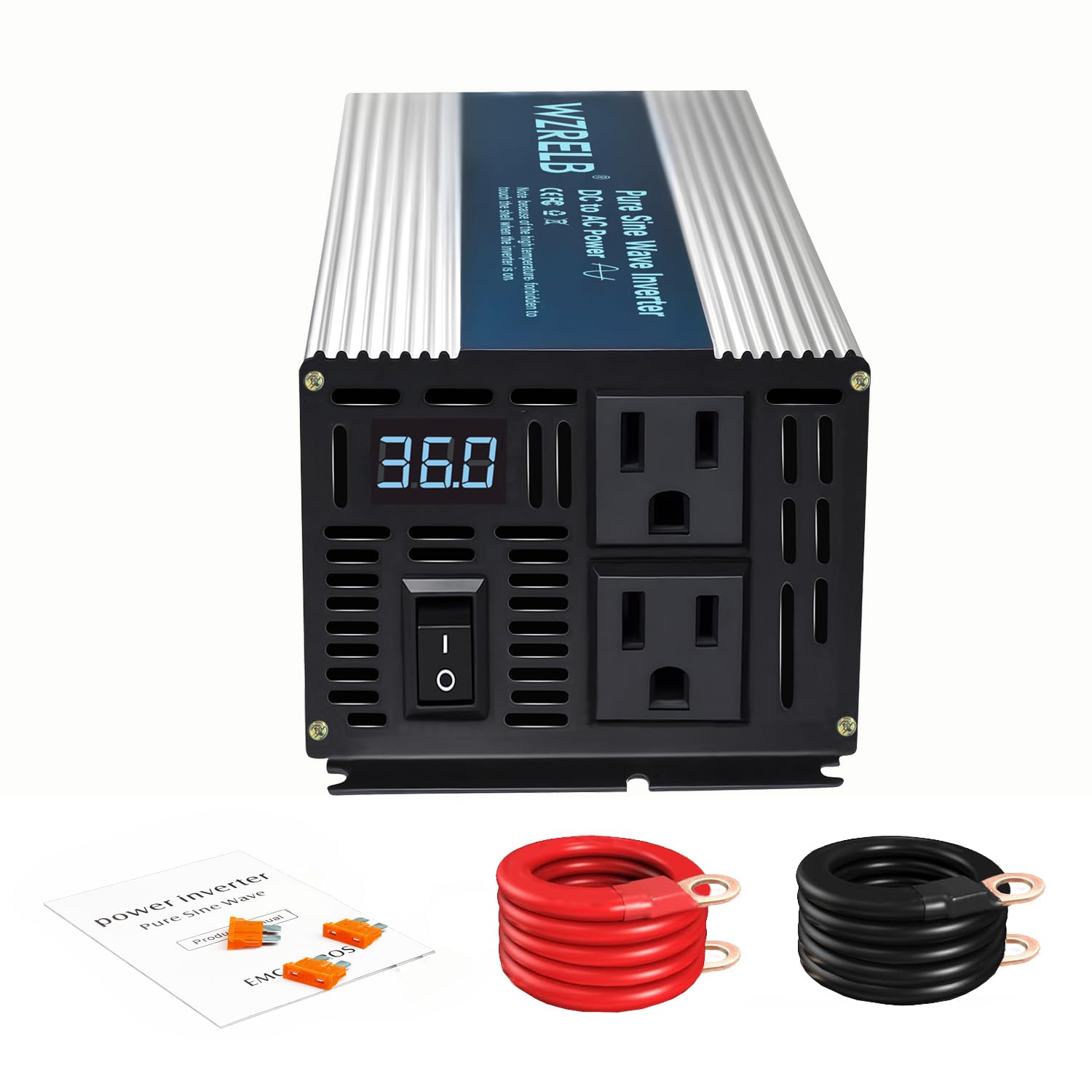
⚡ Power your off-grid lifestyle with confidence and style!
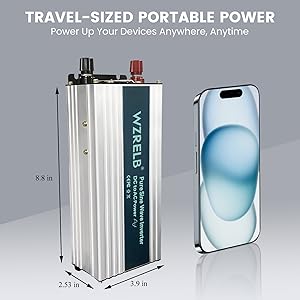
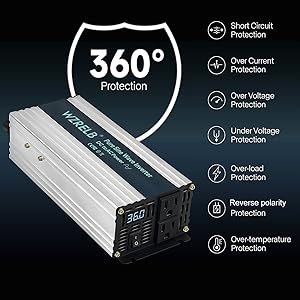
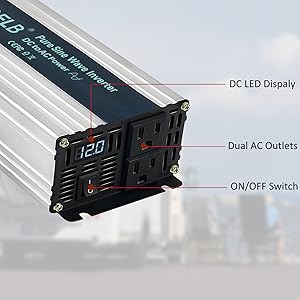
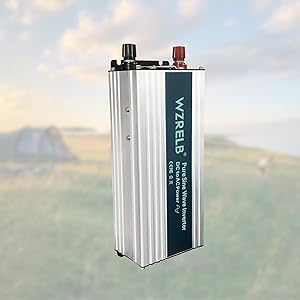
The WZRELB 1200W Pure Sine Wave Inverter converts 36V DC to stable 120V AC power with a continuous 1200W output, featuring dual AC outlets and an LED display for real-time voltage monitoring. Designed with soft start technology and an advanced cooling system, it’s optimized for sensitive electronics and off-grid applications in homes, RVs, trucks, and camping. While some users note a slightly elevated output voltage (~126V), long-term reliability and appliance protection remain strong, making it a trusted portable power solution.




| Best Sellers Rank | #114,054 in Automotive ( See Top 100 in Automotive ) #234 in Power Inverters #1,370 in Car Audio & Video Accessories |
| Brand | WZRELB |
| Color | silvery white |
| Customer Reviews | 3.8 out of 5 stars 290 Reviews |
| Model Name | SE120036 |
| Power Source | Battery Powered |
| Recommended Uses For Product | Home |
| Wattage | 1200 watts |
W**Y
This inverter does not put out as rated
I've had this inverter for 5 months now. I run a fridge and freezer off of it in my garage with 4, 250W solar panels and a large battery bank wired in series for 24V. This inverter puts out TOO high voltage. At 1st it put out 130V all the time. I wrote to the seller and he sent me instructions for lowering the voltage. I could only turn it down to 126V. AS far as being able to run 3,000W with 6,000W surge.....(UPDATE.....This is incorrect info) it will barely run a consistent 1,000W. I have a watt meter inline with the output of the inverter. As soon as any other load is put on it, the inverter shuts down and must be reset. I can't even turn on a 100w light bulb if the watt meter is displaying 1,000W. (Update.... out of ignorance, I was only using one of the 4-outlets which caused shut-down when that one outlet was over-loaded.) EDIT 7/27/2018 I have had this inverter for 18 months now. It still puts out 126V and I am not having any issues with my fridge or freezer. I was originally concerned that the high voltage might shorten the life of the compressors. However, I am now in the school of thought that it may add life to the compressors because the higher voltage helps the compressor start easier, thereby relieving some stress. Remains to be seen. I just upgraded my to 3 stars. I would have made it 4 stars but the 126V is higher than this product should produce. EDIT 6/10/2019 I've been using this inverter for over 2-years now. Still going strong but still output of 126V. My fridges are still doing just fine. In fact, I think that the higher voltage makes it easier for the fridges compressors to start upon recycling. EDIT 7/18/2022 I have finally raised my rating to 5-stars. It took me some time to realize that the 110V outlets in the inverter are EACH rated @ 15A........ The only way to get full 3000W performance is to either use several of the supplied outlets or hard wire it using the supplied connections. I've been running this inverter 24/7 for 5-years now and it is still going. I still have the same fridges and they seem to have no ill effects from the 126-130V. I have now had this inverter for 6-years and it runs 24/7 powering our refrigerators. The last few days it has periodically been shutting down for no apparent reason. All connections are tight and I am running it off of 280AH, 24V LiFeP04 (lithium) battery which is fully charged by 1500W solar array and battery is at a pretty constant 26.5V - 27.5V. Everything is functioning properly and I'm thinking that it may just be time to replace it. The inverter shuts down @ 27.1V. I am wondering if they have made any improvements since 2017 to stabilize the power output down to 120V output and shut down @ 30V, where it should be. EDIT 9/2023 I replaced this inverter with the newer model of the same inverter. This inverter NEVER did fail. It still functions as it did when new (as stated above). I find the new model to be more stable with output and it doesn't shut down at 27.1V like this one does. See the review on the newer model.
E**E
After a few minutes it quit exploding and smoking.
I ordered this a year ago. I installed it 7 months ago. It worked great until 2 weeks ago when it started billowing noxious smoke and explosions from inside. After 5 minutes it quit exploding and smoking. Reordered a different brand. I didn't bother with customer service. Problem solved.
K**A
Reliable Power
Good quality brand as far as Inverters go. Reasonably priced.
B**C
Very reliable and adequately sturdy for my needs
I have a class A motorhome and I run my whole rig off of this thing constantly, I wired in my inverter differently than most people do. I ended up making a extension wire with some thick Romex wire and ran it all the way to where my storage box with the RV hookup is located, I put a 30 amp RV plug wire directly to this inverter from there going to my batteries inside. It runs everything as if I unplugged into a 20 amp outlet, I can't run both of my air conditioning units that are on the roof on this inverter but I can run one no problem off of the batteries. Pulls a constant 950w and will get the inverter barely warm over a couple hours but it never gets hot whatsoever. I'm using two 12 volt batteries in series to get to 24 volts and they are lithium iron phosphate. Could not be more pleased with my purchase and so far over 600 hours on the inverter and counting. Definitely upgrade the included wires if you can. Overall very pleased with the inverter and would definitely buy again!
G**E
Still working fine since 2021
I Ordered this unit Sept 2021 and it has been working continuously running my large house. The unit will run my washing machine, big screen TV, side by side refrig. and more all at the same time. I have been off grid in HI. over thirty yrs now and was tired of spending high $ for inverters and decided if this unit would last even one yr it would be worth it. The unit is not quite as efficient as a low frequency inverter but that is not an issue for me as I have lots of panels and battery storage. I am giving 4 stars because it will not start my Miller welder (only because of Capacitor high start in rush current load), so I use my 4kw low frequency inverter located in the shop for that.
S**S
Solid unit that works great.
Great price and done just what I needed. For a full wave unit it's going to be hard to find a better unit for the price.
R**.
Not a Bad Inverter, But Know What You Are Buying
UPDATED: Bought this inverter as a means to provide emergency power to my house through a mechanically interlocked main breaker. The generator connection is a 30A twist lock, so I had to wire the inverter with a breaker and means of connecting to the twist lock. It has a hard-wired set of connections to accomplish this. The inverter is sturdily built, although it’s clearly not a Victron or similar. The format I purchased is the longer, narrower one, 24v split-phase 7,000 W. As mentioned, it has a set of hard-wired connections for outputting 30A of 240v power (2 hots, a neutral, and a ground). It also has a hard-wire terminal for 240v power similar to the European standard, but I didn’t have a need for this and didn’t do anything with it. You can read the specs to get the features and safeties included. However, I doubt seriously that this inverter will supply 7kW continuously, even in cold weather. That’s ok for me (not ideal, but OK) because it was the only one of similar capacity with dimensions that would work for me. I needed to mount it inside a NEMA outdoor panel, 24x24, and this thing barely fits with a tiny bit of room to wire it. However, since installing it I have performed a few tests to see how far I could push it. While I did not start sufficient loads to get to 7 kW, I was at about 6.2 kW and voltage had sagged to 115v per leg, 230v total. The inverter claims surge power of 14,000 W, but seems difficult to believe. I didn’t push it any harder during this first test, and I was going off of the unit’s own display for the voltages and currents. I have not had a chance to use it for more than a few minutes, so don’t know the long-term reliability of this “reliable inverter,” but I’d say it’s OK for the price. My next test involved charging my car with a level 2 charger that uses about 5.8 kW. I turned off all other loads. Of course, this load needs to run for a while, so I thought it would be a good test of the inverter at a high continuous load. Right off, it's clear that this inverter generates a LOT of heat, although that may be because if the large load. Based on amps in and amps out (as measured with my amp meter), I did get the claimed 90% efficiency, although just barely. This means that 580W are coming off of the inverter. Even at 75°F ambient, the temperature on the display read 62°C before it was stable. My installation is in a hot climate, so doing this load at 90°F or above was simply untenable. Yes, you can do it, but only for a few minutes until the temperature climbs so high that the unit shuts down and starts beeping until it cools and you turn it off and back on again. Yes, I understand that even Victron inverters derate based on temperature, and that the given rating is largely aspirational except at low ambient temperatures, but WZRELB's literature doesn't give a clue as to what the derate might be at various temperatures, which seems like a gaping hole in their literature. How can you size an inverter for what you need to do when you need to do it when you don't know what it's capable of AT YOUR OPERATING CONDITIONS? Please WZRELB, publish this information. Another thing, and maybe it's just my unit, but at the 5.8 kW load, the unit had a persistent electrical buzz regardless of the ambient temperature. This is not promising from an inverter that claims a continuous duty of 7 kW. Heat management could be far better in this unit. Taking the cover off reveals that only a tiny portion of the fan inlets are positioned to draw air through the heat sink. The rest draws air through the empty space in the cabinet, which makes some sense, but very little considering that the heat sink is so massive and has surface area to give up heat to passing air. They really need to improve the fans on this unit. A round fan with, say, 1/4 of its inlet area positioned over the heat sink (if that) will move far less than 1/4 of its air volume through the heat sink. Some sort of preferential ducting in the unit, or some other way to actually make the heat sink's surface area effective would be really nice. Overall, I wish it were better. However, it did fit within the space I have, with the only other similar option costing about 3X as much (Victron Quattro) and possibly requiring an autotransformer to split the phases. It also starts and runs even the largest 240 V loads in my home, including a 6.0 cuft dryer and a 5 TR air conditioner (not simultaneously and clearly not for very long if the weather is warm), along with the regular stuff (full-sized refrigerator, lights, tvs, etc.). Run time is, of course, limited by my battery storage, but I can get by when the power goes out and, even if I need to run the a/c or the water heater for a bit, I can. I may try the Victron at some point, but for now, this will fit the bill and is economical.
O**Q
High voltage on neutral, reverse polarity between hot and neutral
Just received this item and there are a few issues right from the start. This is sold as brand "WZRELB" then the box is generically branded as "EMC" then you open the box and the inverter unit is branded "YueQing Reliable Electric". Once unpacked, trying to follow the manual is a bit strange, pages are arbitrarily inverted in the "connection" section of the book. Then, it tells you to connect the negative cable to the battery, then negative to inverter. There is then a picture where you are supposed to connect the positive cable to a "spark proof" terminal, which does not exist on this inverter. Presumably, there is a large resistor to pre-charge the capacitors connected to this "spark proof" terminal because it says to connect for 3-5 seconds or more before moving cable and connecting to the actual positive terminal of the inverter. Since that mythical terminal was not present, I pre-charged the capacitors the old fashioned way with a 5 ohm, 50 watt resistor between the positive cable and the positive terminal on the inverter. Powered unit on, it shows 120VAC, but the DC power meter was kind of floppy and pushed back into the case, looks like the hot glue they used dislodged in transit (who uses hot glue or similar as a mounting fastener?) it also was off by over -0.5 volts from what the battery is reporting. I used 4AWG cables, versus the 10mm^2 cables that were included and too thin looking for supporting 800 watts. Next, I used a multimeter to test AC output voltage. Neutral to Hot shows 120VAC, good so far. Neutral to ground shows 48-60VAC, not so good... Hot to ground show 1.3VAC....Even worse, implying hot and ground are likely bonded) I came to the conclusion that the polarity is reversed on the AC, bypassing the convention that neutral is on the longer of the 2 blades which can cause a hot chassis situation on non-grounded equipment. The polarized plug is there for a reason to ensure that no voltage is present on exposed surfaces. One would expect that neutral and ground would be bonded in this unit or at least have a minimal voltage difference between the two. The fact that neutral to ground shows up to 1/2 the output voltage means there is something very wrong with the assembly. The manual then confirms that the black (hot wire) can be connected to the ground! I tested a few small resistive loads, and I got inconsistent output pulling only 272 watts, well shy of the 800 watts this claims it can power. I have a 304Ah battery powering this inverter through oversized 4AWG cables less than 18" (roughly 0.45m) in length. Then to add insult to injury, the manual states you should oversize the inverter by 5-10 times for inductive loads, and the inverter should be run at no more than 80% of its rated output to prolong the lifespan of the product, then later it is recommended to use less than 70% of the stated continuous current. The manual further warns just about every thing you can plug in may exceed the surge rating of any of their inverters. I did not bother to hook up an oscilloscope to this unit as it serves no useful purpose given all the stipulations in the manual. Can't run a tiny fan, can't run a 180W (That is 180 watts, not 1800w) heat gun, the only thing that worked was an incandescent light bulb, LED flickered horribly. This is going back as it is configured in a very dangerous way. If manufacturer corrects AC polarization issue, this might be a little safer for some unknown purpose.
Trustpilot
3 days ago
1 week ago