Some deliveries may take a little longer than usual due to regional shipping conditions.

DOWNLOAD THE APP


Customer Services
Copyright © 2025 Desertcart Holdings Limited
DOWNLOAD THE APP

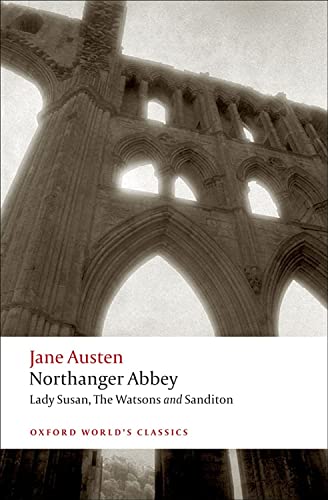
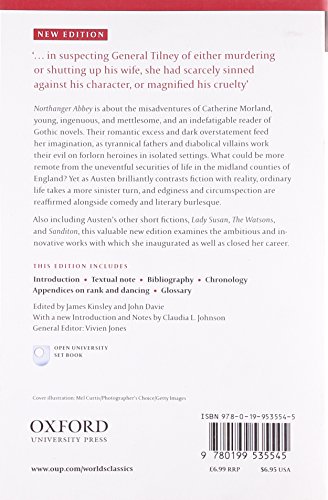


Buy Northanger Abbey, Lady Susan, The Watsons, Sanditon (Oxford World’s Classics) New by Austen, Jane, Davie, John, Kinsley, James, Johnson, Claudia L. (ISBN: 9780199535545) from desertcart's Book Store. Everyday low prices and free delivery on eligible orders. Review: Austen goes gothic - Or does she? Well, I found 'Northanger Abbey' to be a strange but fascinating novel, because in fact it's not so much Austen herself who 'goes gothic', but Catherine Morland, the young and innocent heroine of the book. She's an avid reader of gothic novels, Ann Radcliffe being her favorite author, which has so to speak skewed her vision of the real world: surely every chest must contain a skeleton, and why should doors in dark passageways be locked but to hide some awful family secret? When Catherine travels to Bath with her parents' friends Mr and Mrs Allen, she meets the charming Henry Tilney and his sister Eleanor and is enchanted by both of them. Before long she is invited for a stay at Northanger Abbey, the Tilney residence, where she meets Henry's father, General Tilney, who despite his impeccable manners, turns out to be a rather daunting figure. And how did his wife come to die? Catherine is determined to find out... As I said, this is a fascinating book, in which Austen explores the contrast between fiction (tyrannical fathers murdering their wives) and the real world (the settled, uneventful life of a gentry family), and there is definitely much more to this story than at first meets the eye (much of which, I must confess, I would have missed but for the excellent introduction). And apart from that, it is of course written in the typical, delightful Austen-style, with engaging characters and lots of wit, irony and humour (at times even 'laugh-out-loud'). This edition also contains 3 shorter pieces of which I read only 'Lady Susan', a delightful epistolary novel about an a-moral, scheming woman. 'The Watsons' and 'Sanditon' I did not read because they are unfinished and were - in Austen's view - not ready for publication. I'm sure both are a real gold mine for Austen-scholars as evidence of 'Austen at work', but personally I preferred to read only what Austen herself felt ready to be published (and I'm not an Austen-scholar either, just an enthusiastic amateur). All in all, I cannot recommend this book warmly enough, just as every other of Austen's novels! Review: Degree reading - Perfect


| Best Sellers Rank | 631,373 in Books ( See Top 100 in Books ) 2,215 in English Language Study for Young Adults |
| Customer reviews | 4.7 4.7 out of 5 stars (168) |
| Dimensions | 19.3 x 1.42 x 13.16 cm |
| Edition | New |
| ISBN-10 | 019953554X |
| ISBN-13 | 978-0199535545 |
| Item weight | 1.05 kg |
| Language | English |
| Print length | 432 pages |
| Publication date | 1 Jan. 2008 |
| Publisher | OUP Oxford |
D**R
Austen goes gothic
Or does she? Well, I found 'Northanger Abbey' to be a strange but fascinating novel, because in fact it's not so much Austen herself who 'goes gothic', but Catherine Morland, the young and innocent heroine of the book. She's an avid reader of gothic novels, Ann Radcliffe being her favorite author, which has so to speak skewed her vision of the real world: surely every chest must contain a skeleton, and why should doors in dark passageways be locked but to hide some awful family secret? When Catherine travels to Bath with her parents' friends Mr and Mrs Allen, she meets the charming Henry Tilney and his sister Eleanor and is enchanted by both of them. Before long she is invited for a stay at Northanger Abbey, the Tilney residence, where she meets Henry's father, General Tilney, who despite his impeccable manners, turns out to be a rather daunting figure. And how did his wife come to die? Catherine is determined to find out... As I said, this is a fascinating book, in which Austen explores the contrast between fiction (tyrannical fathers murdering their wives) and the real world (the settled, uneventful life of a gentry family), and there is definitely much more to this story than at first meets the eye (much of which, I must confess, I would have missed but for the excellent introduction). And apart from that, it is of course written in the typical, delightful Austen-style, with engaging characters and lots of wit, irony and humour (at times even 'laugh-out-loud'). This edition also contains 3 shorter pieces of which I read only 'Lady Susan', a delightful epistolary novel about an a-moral, scheming woman. 'The Watsons' and 'Sanditon' I did not read because they are unfinished and were - in Austen's view - not ready for publication. I'm sure both are a real gold mine for Austen-scholars as evidence of 'Austen at work', but personally I preferred to read only what Austen herself felt ready to be published (and I'm not an Austen-scholar either, just an enthusiastic amateur). All in all, I cannot recommend this book warmly enough, just as every other of Austen's novels!
E**E
Degree reading
Perfect
C**!
This is perhaps Jane Austen's finest work, it's really funny in places
This is perhaps Jane Austen's finest work, it's really funny in places! I especially like this edition as not only does it look great you get some of Jane's shorter, unfinished, novels as well!
C**L
Four Stars
Great Book!
C**E
Good.
I've given it so high a rating because it arrived on time, in fact early, and despite warnings, showed no sign of the previous usage and only a few natural signs of wear, which were of no consequence.
M**C
Northanger Abbey Oxford World's Classics
Superb, and perhaps my favourite Jane Austen along with Sense and Sensibility. But I also got great pleasure reading the Introduction and Notes by Claudia L. Johnson!
P**Y
GOOD CONDITION
WOULD BUY AGAIN
A**A
The quality of the book is perfect, but the envelope was open
The quality of the book is perfect, but the envelope was open, I do not know why. It arrived really quickly.
M**A
De todas las novelas de Jane Austen me parece la más divertida y que fluye. Creo que si Jane Austen hubiera sido contemporánea y no hubiera sido escritora, podría haber sido una terapeuta de parejas estupenda. Henry Tilney y Catherine Morland no hubieran sido sus clientes-pacientes sino sus amigos. Esta pareja desde el primer momento que se conocen, se buscan y quieren estar juntos y de forma natural superan sus limitaciones personales y las narrativas familiares, culturales y sociales para estar juntos. Además su relación es como un guante, se llevan genial y al ver la película de la novela, los personajes son así, hablan suavemente. Esta edición de Oxford Classics viene también con "Sanditon", "The Watsons" y "Lady Susan".
E**.
📖 Un roman clé de la littérature et de l’émancipation féminine Parmi les œuvres de Jane Austen, Northanger Abbey occupe une place singulière. Écrit à la fin du XVIIIe siècle et publié à titre posthume en 1817, ce roman incarne le talent unique d’Austen pour mêler ironie sociale, satire du roman gothique et réflexion sur la condition féminine. À une époque où les femmes étaient encore largement limitées par les conventions sociales, Austen et sa sœur Cassandra ont su tracer leur propre chemin, défiant les attentes imposées aux femmes de leur temps. À travers Northanger Abbey, Jane Austen critique subtilement ces contraintes tout en offrant une héroïne à la fois naïve, curieuse et pleine d’esprit. Son regard sur le monde et son évolution résonnent encore aujourd’hui. 📚 Un roman toujours étudié à l’université L’impact de Northanger Abbey dépasse largement son époque. Il est encore étudié aujourd’hui dans les cursus de littérature anglaise, y compris dans ma licence de LLCER Anglais, où il permet d’explorer : Les enjeux de l’éducation et de l’émancipation des femmes au XIXe siècle. La critique du roman gothique, notamment des œuvres d’Ann Radcliffe. Le style unique d’Austen, entre ironie mordante et finesse psychologique. 🎭 Un roman à découvrir absolument Sans révéler l’intrigue, Northanger Abbey suit les aventures de Catherine Morland, une jeune femme passionnée de romans gothiques, qui découvre peu à peu les subtilités de la société et les pièges des illusions romanesques. À travers ses expériences et ses rencontres, elle apprend à distinguer fantasme et réalité, dans une œuvre aussi drôle que critique. L’édition Oxford World’s Classics 📌 Une introduction détaillée pour mieux comprendre le contexte historique et littéraire. 📌 Des notes explicatives précieuses pour enrichir la lecture. 📌 Un texte fidèle à la version originale, dans une édition de qualité.
W**Y
I have been a Jane Austen fan for years, admiring her subtle, clever humor and sharp observations. I had never read any of the tales contained in this volume -- in fact, I had never heard of three of them -- but I found myself delighted by The Watsons and Sanditon, wishing that Jane Austen had lived to complete these two lively stories. I found Northanger Abbey rather tame; in fact, as I finished reading it, I realized that my flat response was based on the fact that the story's main conflicts were not based on romantic tension, but on the inability of the heroine to understand some of the ancillary characters' true motivations. Because there was little doubt of the hero's interest in her, there was little suspense surrounding the eventual "happily ever after" that Austen always provides. The big surprise in this small anthology was the complex, fascinating epistolary novel Lady Susan. The title character is a self-serving, self-righteous, manipulative and very attractive widow with a teenage daughter. The plot unfolds through the letters written by Lady Susan and those in her orbit, and I found myself almost gasping at Austen's ability to create a character so believably evil in motivation and action. Most of her villains are either somewhat foolish and bumbling incompetents or nasty, petty characters that help drive the plot, but Lady Susan is central, purposeful and actually vicious - she knows what she's about, and she doesn't hesitate to do whatever it takes to achieve her ends. It was a pleasant surprise to find myself genuinely concerned about the young men under Lady Susan's seductive influence, as well as the well-being of her hapless daughter, and to realize that I couldn't guess at how the resolution would be achieved. When Austen steps out of the letter-writing mode to wrap up the story, I found myself slightly disappointed, but she apologizes handsomely for depriving the British postal service of the revenue that her characters' letters had been generating. Amusing, tongue-in-cheek, and probably much less awkward than having each of the various letter-writers send each other congratulatory "All's well that ends well" notes at the conclusion of the story. I highly recommend this book, not just for the novelty of reading some lesser-known Austen gems, but also because of the helpful historical and literary notes provided in this Oxford edition.
T**T
I've read all of JA's novels numerous times and of all of her books Northanger Abbey was my least favorite. I must admit that reading Lucy Worsely's biography of JA changed all that by casting a bright light on the life and times of the author. When read in this context, my old bugbear became a new favorite and I really began to enjoy the novels. The best part of this edition was the inclusion of Lady Susan.... What a revelation! Here one meets the real Ms Austen : observant, brutally outspoken and realistically caustic. Not a hint of sugar-coated romance in sight
W**E
To read
Trustpilot
2 weeks ago
3 days ago