Desert Online General Trading LLC
Dubai, United Arab Emirates
Desert Online General Trading LLC
Dubai, United Arab Emirates
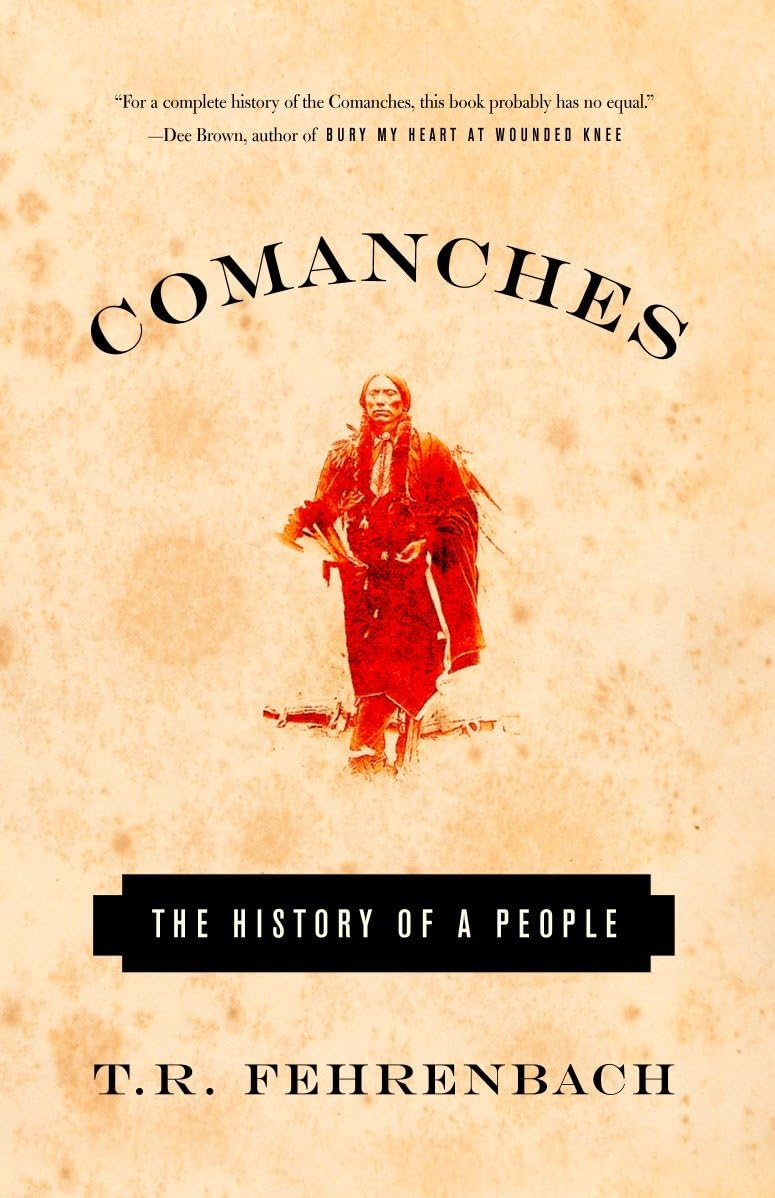
Full description not available
R**N
An enjoyable read for history buffs with an open mind
If you have a PhD in history and are looking for an exhaustive, cross-referenced academic work, look elsewhere. If you're politically correct and offended by warfare, greed, western civilization or any other defining aspect of humanity, look elsewhere.However, if you're one of those who enjoy studying history with an open mind and with no axe to grind, this is a well-written account of an aspect of the American experience that is rarely heard today, other than in echoes from the names on Southwest maps.The book starts with a description of the Amerindians in general, not just the Comanche but all the various people that emigrated at one time or another from the Asian continent across the land bridge of the Bering Straight. These people weren't any different from any other humans alive at the time, and lived in much the same way. Although I'm no academic historian, in my opinion the author makes a better argument than Jared Diamond in "Guns, Germs and Steel" that what really defeated the Amerindians wasn't guns, germs, or steel, but simply time. By the time the Mayans built their pyramids, the ones in Egypt had been abandoned for thousands of years. The Amerindians had yet to create their Bablyon, Greece, or Rome, and their cultures still clung to the magical, superstitious world view that the white tribes of Europe had when they too were overwhelmed by the advance of civilization and the scientific concept of cause and effect. The difference was that no newspapers existed thousands of years ago to chronicle those events. The author argues that Amerindian culture was doomed whether it was the Europeans or the Chinese that landed first, and regardless of whether they brought guns or gifts. It was both an inevitable and poignant loss of an earlier human cultural existence, one buried deep in the human race but left behind in the same way a growing child wistfully leaves behind their younger years.And, in essence, the above is the major thread of this book. For good or ill, civilization had destroyed the tribes of Europe and Asia and created a new cultural force, one that was now pushing across the world. The history of the Southwest Indian conflicts was the history of the clash of these two cultures, the old and the new, with the Amerindian culture never truly able to comprehend the forces pushing against it and the settlers never truly understanding the depth of the resistance. The result was decades of misunderstanding on both sides, integrated with the racism and greed on both sides that remain with the human race today. This book provides gripping accounts of those conflicts in this context, with the Comanches fighting the white settlers with the same motivations for which they fought the Apaches or the Dakota, not just to protect territory, but even more so to provide for their people and prove their personal magic. The settlers, meanwhile, through racism and greed failed to provide any mechanism by which the Comanches could adapt to the weight of the civilization bearing down upon them. Even during the final years of conflict, more Indians were killed by the rifle fire of other Indians than by that from the white settlers. Although they were on their way, time had not yet given the Indians their Rome, and they were culturally unprepared to fight it when it arrived. This book is an excellent, detailed chronicle of that tragic battle as it played out for the Comanches.
K**R
Great history of a lost people
I find this book to be a great history lesson, not only of the Comanche people but of Texas, Colorado, New Mexico, and the different tribes that lived in these areas.I have to wholeheartedly suggest this book to anyone that have an interest in the historical history of the great tribes and their undoing by a nation and people that were hell bent on eliminating the American Indian and their way of life.This was and will always be a sad truth about America.
S**Y
Not exactly the "noble" savages
I'm drawn to Feherenbach's books because of their readability. Years ago I picked up his long one volume history of teh Korean war and were fascinated with it. He was very prescient about Viet-nam in just a few paragraphs at the end. Comanche, was a different story. I'd always loved the John Ford movie, "The Searchers". Recently, Ford and John Wayne, the lead, have been accused of racism for the movie. Never taking anything for granted, I felt it my time to learn about the Comanche. What the author gave me was a full bodied no holds barred all the warts showing view of a people who terrorized not only the Spanish, Mexicans, Texicans but every other American Indian tribe that encountered them. A wild violent people with a world view quite at odds with the rest of the world. Admirable for their "virtues" nonetheless, a people you would not want to meet on the road. Their clannishness kept them safe from the diseases that decimated other tribes. What can one say about a people who even drove the mighty Apache off teh plains and into the mountains. A real eye opener which explains why the average cavalry trooper was advised to keep that one last bullet for himself. Well researched, well written and a joy to read.
K**E
Thought-provoking and highly readable account of a clash of civilizations
Fehrenback presents a broad historical and cultural view of the origins, rise, and fall of the Comanche. The book is chock-full of fascinating insights and provocative conclusions about how and why the People lived, loved, fought, and ultimately lost. The dominant impression is of a nation that could not be other than who they were - could not adapt even when it must have been clear that America would engulf them. His account is sympathetic, but unvarnished - no nonsense about the Comanche being peace-loving idealists living in concert with nature until the White Man forced them to fight. He portrays them as savage and implacable foes, but also possessing a sense of honor and nobility if you understood their world view.
Trustpilot
1 week ago
1 month ago