
DOWNLOAD THE APP


Customer Services
Copyright © 2025 Desertcart Holdings Limited
DOWNLOAD THE APP
🔥 Taste the raw truth behind culinary fame!
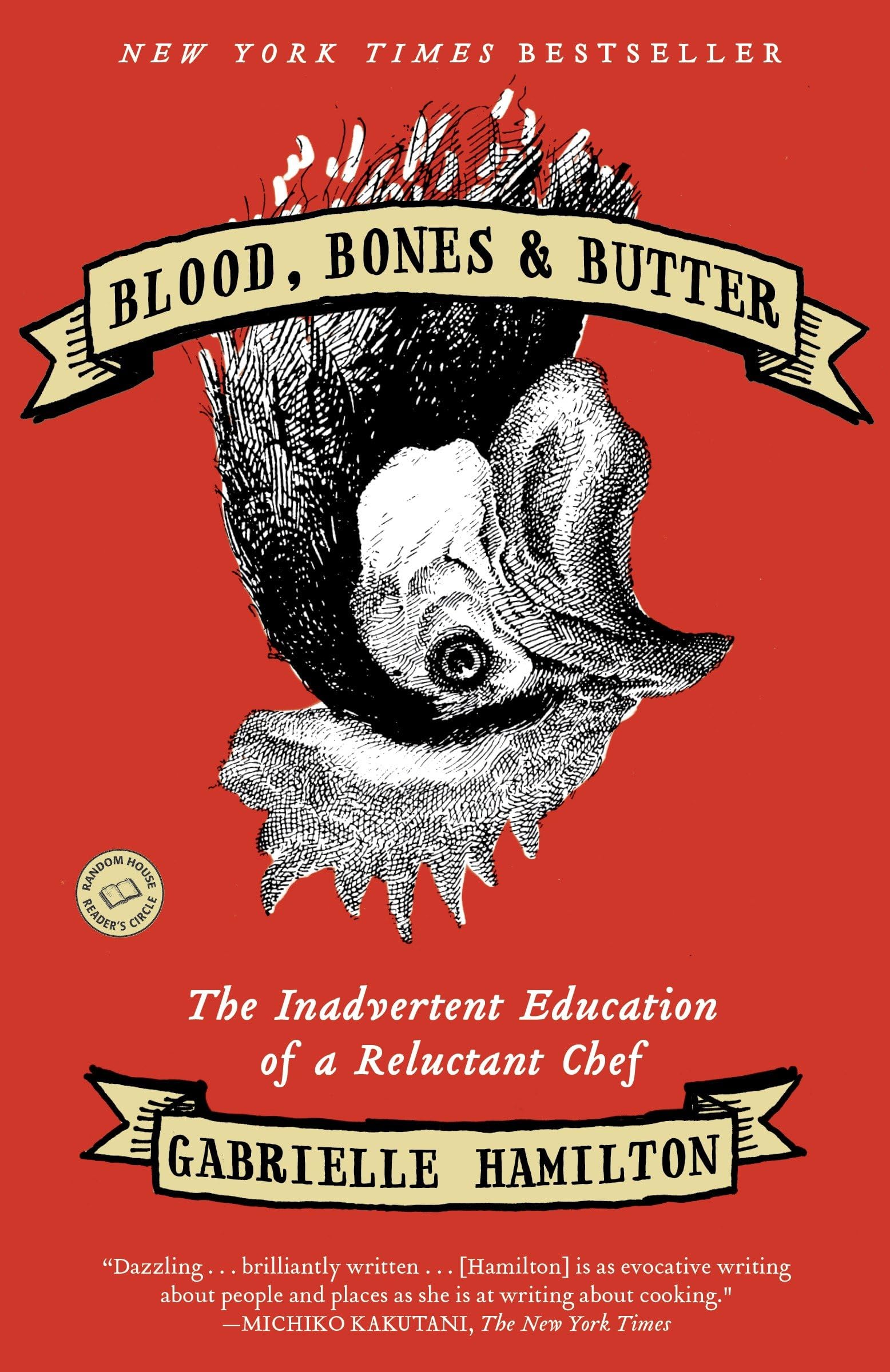
Blood, Bones & Butter is Gabrielle Hamilton’s bestselling memoir (#75 Culinary Biographies) that chronicles her tough, unvarnished journey from a turbulent childhood to becoming a celebrated New York chef. Praised for its vivid, stream-of-consciousness prose and gritty honesty, this book offers an insider’s look at the demanding world of fine dining, making it a must-read for serious food lovers and memoir enthusiasts alike.


| Best Sellers Rank | #129,514 in Books ( See Top 100 in Books ) #75 in Culinary Biographies & Memoirs #418 in Women's Biographies #1,180 in Memoirs (Books) |
| Customer Reviews | 4.3 out of 5 stars 2,518 Reviews |
Z**I
The best foodie memoir?
This is a gritty story, so gritty you sometimes feel as if you're biting on gravel. Gabrielle's style often veers towards stream-of-consciousness, and as she herself admits in her epilogue, she did jump around in time. Maybe this book should not get 5 stars from me, but I found it riveting reading. Not always easy; she sometimes writes with so much suppressed anger, and then her style is so "tight" that I sometimes had to reread a paragraph to get her gist. From, at first, a superficially happy childhood, to a rudderless, loveless and seemingly parent-less teenage, with drugs, cigarettes and often no money, this woman by pure bloody-mindedness and tenacity fights her way up through menial jobs to be the chef of "Prune", and she still is one of New York's best chefs. Take note that she really is a very hard worker, who doesn't mind cleaning up the most yucky stuff -- she cannot stand disorganization and mess. Hats off to her for that. Yet the memoir is in many ways too self-centred. She carries within her issues and old angers which the reader picks up on as the story goes on. Her husband Michele seemed to me to be a very nice man, actually, to put up for so long with this impatient woman who (she never admits this) finds it hard to love unconditionally. The (seeming) total lack of communication between her and Michele made me want to shake her and say, "For God's sake, so he's not a talker: YOU talk then!" It seems her way of expressing fury towards him -- often not well understood by the reader -- is to sulk for weeks. And yet somewhere she confesses that although she screams, swears like a sailor, and throws things when angry at Michele, he has never uttered a harsh word towards her. An easy-going woman she is not! Her one true love, apart from her children (who could well have been created by immaculate conception), is cooking. She's brilliant at that, and to keep a N Y restaurant going on her own takes true grit -- there is no other word for it. Like another reviewer I also did not understand her dislike, almost hatred, of her mother. She says they're too similar, but that does not ring true, really. And in the end we still do not know much this mother who abandoned most of her children when she left her husband. I'd recommend this book to any intelligent foodie -- just know it's not always a light or easy read, but it should keep you spellbound.
S**S
Like the book but not the author
This memoir of the making of a chef is for the most part beautifully written. So many descriptions are lovely especially in the first part, "Blood", where the author recounts her young years. Her memories of her mother are especially tender - "I remember the smell of the sulphur every morning as she lit a match to warm the tip of her black wax pencil." Or, "I sat in that woman's aproned lap every single night of my young life, so close to the sounds and smells of her that I still know her body as if it were my own." The portrayals of her father's lamb roasts are classic. Once the family disintegrates and Ms. Hamilton is more or less abandoned by both parents, she, and the book, lose her special freshness of observation and story-telling and a bitter, angry tone dominates. In the next part, "Bones", as she comes into her own slowly as a chef, and as other reviewers have noted, Ms. Hamilton trashes nearly everyone and everything she comes into contact with - fellow students in a writing class, other female chefs, catering companies, people she works for and with, suppliers etc. While clever and often funny in her criticisms, the premise that she is the only one who knows how to do things right, no matter what the issue, grates. Yes, successful chefs must be demanding of themselves and egotistical [as in most fields] but she continually exudes a superiority complex coupled with a martyrdom problem [how many times did she say she had to nurse her infants and cook and clean and get no sleep and be on her feet all day and...]. Most off-putting of all is her unrelenting bitterness and dreadful relationship with those supposedly closest to her: her father drifts out of the book completely in the early pages, she visits her mother once in 20 years and is incapable, as others have noted, of compassion or forgiveness and most appallingly shows no sadness at the death of a brother. Does she have friends? It seems so but even she notes that her moods are so volatile especially when her "blood sugar" is down that everyone is more than a little afraid of her. Her marriage is depressing as it seems to be one of convenience so her Italian husband can get a green card; does she love him? We never know. She writes a little of the worshipful adoration she holds for her two sons - shouldn't those feelings help her to mature by the end of the book to develop those softer human qualities that give essence to a richer, happier life? She never truly reveals who she is or who those around her are. She never digs into her feelings to understand her behavior. The last part of the book, "Butter", is too long and repetitious as we go again and again to Italy and eat the same meals over and over. She doesn't even learn Italian so she can converse with her husband's family! - how telling when she laments near the end that, "If I don't come back...I will not be missed, and no one will write me or call me to acknowledge my absence." Ms. Hamilton has great talent as a writer, and I'm sure she's a great chef; she's succeeded in those realms. Now maybe she can work on herself and become a more tolerant, nicer person. Now THAT would be accomplishment!
A**N
Terrific book for a foodie
I am a little surprised by some of the harsh reviews of this book that criticize the author as a snob or self-obsessed. The cover does say that this book is a memoir; it is Gabrielle Hamilton's story to tell. I found this book warm and engaging and the writing beautiful. At times I was a little confused as to the timeline of events but overall was pleased with the pacing of the book. Considering the nature of her career, which is intrisically tied into a lifelong love and relationship with food, I did not expect a normal "biographical" account of her life. I think she touched upon the major players in her life which influenced not just her cooking but her own enjoyment of food. Even reading the Prune menu (online) is a treat after reading this book. Immediately after I finished this book I longed to breeze into Prune for a cocktail and try the bone marrow with parsley salad. Maybe roast chicken and butter poached fingerling potatoes. Dishes that the author lovingly wove into her book. I am more interested in hearing how she was moved by a dish as a young girl than a 3 page written description on how she cleaned, chopped, sauteed and plated a dish. And Anthony Bourdan already wrote a book on the inner workings of a NYC restaurant. Maybe because I can relate with my own childhood memories of food that I found it delightful to read her description of her mother preparing her dandeloin greens as a young girl. I had to smile looking at her menu - 30 years later she is serving them on her menu. A nod to a loving memory of her mother despite the tension that existed in their relationship as an adult. Oh, I do hope that I can get a reservation at Prune the next time I am in NY!
D**C
Great Read, maybe she should do a follow up
So happy I read this book. Though I disagree with Hamilton on a variety of things, her attitude really speaks to me. This no-bullshit way of looking at life, trying to find dignity and respect in the world and give the world dignity and respect, I get it. Beyond that, certain scenes really stuck with me, including 1) Her childhood in New Hope and Lambertville. I grew up in Princeton but went to High School up 518 from there, so I knew the area aggressively well and she just has it nailed down in her descriptions. 2) Her time as an MFA. I "hate" MFAs though I aspire to be one. I just find that the writing that happens in these microcosms is so removed from reality....and it appears so did Hamilton 3) Her discussion of service, how to treat people, how to get through things in different service scenarios. It is nice to read someone actually put into words, what so many people have a hard time putting into action. The book does talk a lot about cooking and her career, and how Prune came to be, but it was really nice to just read about her take on life with food, not food with life. Her marriage, and the latter third of the book, I never understood. Maybe when she was writing this she was still going through the emotions of her divorce thus everything related to Michele took on very heavy coloring (whether in a positive tone or negative one). I wouldn't try to replicate most of it, just the kids and Alda, but since Prune just closed last year during the pandemic, I'd love a new memoir for the last ten years...
A**S
Poetically beautiful, but devolves into triteness.
While by no means a terrible read, I put Blood, Bones & Butter down with a sense of relief. Perhaps Anthony Bourdain's review gracing the front cover ("Simply the best memoir by a chef ever. Ever.") should not have been a significant factor in getting me to read this book. Most comprehensive? Perhaps. But best? I shudder to think at the reasons why other chefs' biographies fall short of attaining this status. Complaints aside, it is admirable that Hamilton stays on topic throughout the entire book. Blood, Bones & Butter isn't so much a memoir as it is an extensive autobiography, starting with Hamilton's earliest memories and ending at present day. She does not get sidetracked (unlike Anthony Bourdain) by dedicating entire chapters to food and everything that goes along with it. The passion for her bread of life is there, but it infuses her life story, rather than strives for its own sections. This passion is the beauty of the read. There is not a single page that does not relate Hamilton's culinary tastes to her life in general. Food is by far the most important thing in her existence, which should not be taken as a sad statement. Meals become holy in this book, something to be worshiped. Home-cooked food is the mainstay of her childhood, representing the one constant in her life. She's poetic about her subject, even when most would shy away from her disgusting culinary findings, such as near-rotting meat in France: "Pheasants...hung for a few days until their necks finally gave out, and you could see, physically, a kind of perfect ripeness to the meat when it became tender enough to pleasurably chew, as if the earliest stage of rot itself was a cooking technique." Unfortunately, the poetry, while very moving, might actually detract from some of the more interesting aspects of Hamilton's life. For example, her mother's decision to leave her husband and take all of her children with her is an abrupt transition in Hamilton's life, even though her parents' relationship had been on the rocks for a long time. Her mother quickly becomes demonized and despicable in Hamilton's eyes, but not with the justification one would expect. Hamilton herself struggles with identifying concrete reasons for hating her mother for most of her life, so much that she severs all ties with her for decades. Don't get me wrong: I'm not hoping to de-emphasize the impact any divorce can have. I'm just saying, compare this to what you'd expect in most memoirs discussing childhood turmoil, and it is not nearly as moving. Perhaps this is due to Hamilton's hyper-awareness about what she eats. Seemingly every meal, even minor ones, throughout her entire life is described in explicit, delectable detail. She is a master at food writing, managing to tease one's taste buds, without crossing over into "food porn." I don't fault her for these descriptions at all--they are a mainstay of this memoir--but the lack of detail concerning other major life decisions eventually creates a sense of dullness throughout the read (for example, the first time she tries cocaine is quickly brushed over, whereas family meals are discussed for nearly entire chapters). Food is Hamilton's saving grace for many domestic problems in her life, which is why it takes precedence over the troubles themselves. While I was perfectly satisfied with this for the Blood and Bones sections of the book (the book is divided into the three nouns of its title, respectively), Butter grated on me. Not only did it irritate me, it outright bored me and I kept checking my page count, hoping to finish soon so I could move on to something else. The boring bits begin with Hamilton's marriage to her Italian immigrant husband, Michele. The situations of the marriage itself are thoroughly entertaining, and the bizarre nature of the relationship give one pause for thought (the two lived separately for most of their years together). This is all part of what makes Blood, Bones, and Butter entertaining; however, the multiple chapters dedicated to descriptions of the couple's yearly visits to Michele's family in Rome, ripe with the continuous long dedications to homemade food and descriptions of their marital spats, become so trite that the last fourth of the book blends together to form one boring chunk that could be summarized in half the amount of space. What starts out as a memoir that delivers everything it promises, ends as a horrible flop. This is a shame considering I really loved reading the larger portion of this book. It's unfortunate that it left such a bad taste in my mouth, because I hate recommending books solely on sections, but that's exactly what I'm about to do. If this is the first book you want to read about a chef's life, I'd steer clear of it until you get some other reads under your belt. However, if you enjoy these types of books, by all means read this. I'll go so far as to saying you need to read this. Just be prepared for the latter portion of the book.
M**O
If you Think you Love Food and Restaurants
Gabrielle's story is a colorful, delicious, and emotional delight. As a chef, restaurant manager, card carrying foodie and now food purveyor I have spent the past 30 plus years living, loving, cooking, fighting and eating my way on a similar path. Up until now, Anthony Bourdain's Kitchen Confidential has been my favorite book illustrating the crazy life of one in the food biz...but now Gabrielle tops my list. Perhaps it is her at once lyrical style of writing or maybe it is the manic, emotional, sensual...slightly psychotic outbursts that I could relate to and thoroughly found relatable and most of all honest. Nowadays so many prospective young chefs have a romantic/celebrity notion of what it means to be a chef, but not Chef Hamilton. The life of a chef is all consuming, gritty, nasty, artistic, and passionate. In one minute you can be on "the line" finishing the perfect dish you've envisioned in your skull for the past 2 weeks and sending it out to the dining room...the next minute you are on your knees scrubbing the grime off the stove and finally you might finish your night at 2am racking your brain looking over the schedule trying for the life of you to cover the grill on the next day's lunch shift. Why do we do it? Because we must. We love everything about food and the execution of it. We do it because it is our passion. We do it for the immediate gratification of it when our guests receive the experience they were hoping for in our dining room. Family life and personal life may suffer for our craft, but it goes with the territory of those of us committed to it. If you love food, if you think you love the restaurant experience, read this wonderful book.
D**Z
Such a bitch 🤣
It’s a good book. Pretty boring last half tho. Why 16 words? Gah. It will pass the time for you, and you will feel many emotions.
A**R
UN-PUT-DOWN-ABLE!
Walk Don't Run to read this book. Wonderful tale, rivetingly told. She's as gifted a writer as she is a chef and restauranteur. I read a lot of books in a year. Many are good. This one's great. I wouldn't bother reviewing it if it weren't. Sure, Gabs can whine and she can be her own worst enemy, and it wouldn't be easy to have her for a daughter, friend, spouse, or boss. She's brilliant, multi-talented, judgmental, unforgiving, and eats herself up from the inside. I know some people like that, up close and personal. What she isn't is a snob, a phony, or a slough-off. My favorite part was her take on creative-writing grad school and its oh-so-precious participants. What a crock it all is, she makes clear. But she was smart enough to go ahead and take her degree, so not only did she not throw away the time and money already spent, she came away with the credential. And it's probably helped, in this credential-crazy world. What creative-writing grad school more importantly did for her was make her appreciate the work she'd been doing, cooking. And dishwashing. And went on to do more of. Oh, and scrubbing out nasty refrigerators. I read this on my Android phone.
Trustpilot
5 days ago
2 months ago