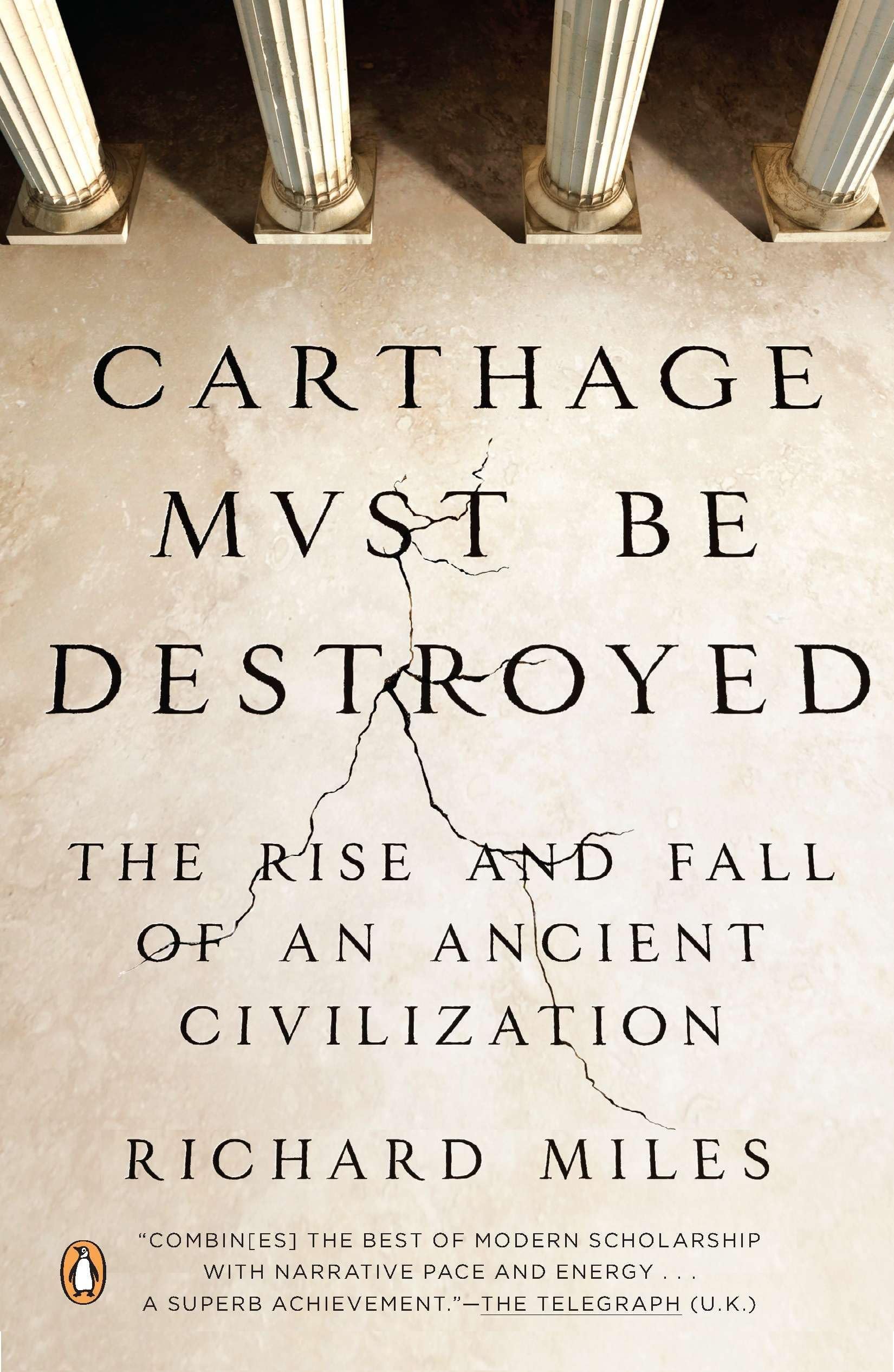

Carthage Must Be Destroyed: The Rise and Fall of an Ancient Civilization [Miles, Richard] on desertcart.com. *FREE* shipping on qualifying offers. Carthage Must Be Destroyed: The Rise and Fall of an Ancient Civilization Review: A Most Helpful, A Most Needful Book - The author has done us a valuable service in uniting the disciplines of Archaeology and Classical Studies to either validate ancient assertions, such as the Carthaginian practice of "tophet," or human/child sacrifice; or, invalidate long held biases perpetuated by Greek and Latin authors which argue for a polarized mediterranean world in which the Carthaginians represent the dark forces of barbarity and all that is alien to Western Civilization, while the Greeks and Romans represent the vanguard of all that is civil and good, with little cultural cross pollination occurring between them. Miles does a good job, mostly with the assistance of archeology to show that contrary to the above, the ancient mediterranean was a potpourri of the syncretism of Carthaginian, Etruscan, Roman, Greek, and Egyptian influences...in art, architecture and religion. The clash between Carthage and Rome was the outcome of the inevitable clash of regional hegemonies whose interests clashed as each sought to extend its influence further, and consequently into the orbit of the "other's" influence. Overall, Miles provides us with a highly readable volume of scholarly value, and which belongs to the growing genre of the interdisciplinary partnership of history, literary criticism and archeology. One of the standout themes is the syncretism and competition with regard to the legacy of Heracles, not only between rival peoples, such as the Romans and Carthaginians, but even between rival generals of the same party, such as was the case with the dictators Fabius Maximus and Minucius Felix. How the highlights of this god's journey from Spain, through Italy onward to Greece with Geryon's herd are exploited by Greeks, Romans and Carthaginians to stake their territorial claims in Spain, Sicily, Sardinia and North Africa is a recurring theme, and does much to forward and validate the author's worldview/thesis of syncretism. So interesting is this Hereclean theme alone, that it merits an entire work on its own right (perhaps Richard Miles will take on this "Hereclean" task?). Lastly, after the extensive background that Miles provides to the conflict itself, once the book reaches the Second Punic War, the reader is treated to what reads like a great story/narrative, while never loosing its scholarly tenor. The chapter, "Desolation of Carthage," in which the fateful meeting between the Roman consul and Carthaginian emissaries takes place several miles away from Carthage, during which the emissaries are told that they must agree to the destruction/oblivion of their city and their way of life as seafaring merchants, and to their relocation inland as simple agrarians left me empathizing with those Carthaginians, and at the same time, loathing Rome, whose calculus behind the destruction of the city was the manifestation of nothing more than greed and lust for empire (as the Carthaginians comprised no real threat then). It also reinforced my own skeptical approach to any postmodern view towards the subject of today's arena of international affairs, which would have us think that we have entered an age of unlimited cooperation and potential goodwill among the nations and defining elements of the power structure of the world. The same brutal end that the Carthaginians met awaits any of us who dismiss what lust for power and empire is still capable of doing. Review: The History of Carthage - When looking at world history, Carthage is perhaps best known as the enemy of Rome during the 200s and 100s BCE. In Carthage Must Be Destroyed, the entire history of the Carthage, not just how it relates to Rome, is looked at. Carthage started out as a trading colony of the Phoenicians. As time moved on, Carthage became more independent and expanded its territory. This would come into conflict with the also expanding Rome. Through three large scale wars, the Punic Wars as they are called, Rome beat Carthage each time. In the First Punic War, Rome took possession of Sicily. In the aftermath, Carthage found itself with serious internal problems. A war was fought against mercenaries Carthage had hired to fight in war against Rome. During this period, Rome annexed Sardinia and Corsica, formerly Carthaginian possessions. The Second Punic War would be the most famous for the actions of Hannibal such as his trek through the Alps. The war would be another loss for Carthage seeing all of its Spanish territories lost to Rome. In the end, Carthage was left with only North African territory. Despite a growing economy, Rome would wipe Carthage off the map in the Third Punic War. Aside from the relations with Rome, the religious history and mythology of Carthage is also extensively looked at such as how parallels existed between them and the Greeks. My only problem with the book is that this is one of the drier histories I have read. Despite the massive conflict and war, the prose of the book is not all that exciting, just very factual. Sometimes, the author tends to meander from one subject to another when he would have been better off just separating these into different sections. All in all, this was a generally enjoyable and informative look at the history of Carthage. I would recommend this to those interested in world history, ancient history, or Roman history.

| Best Sellers Rank | #94,877 in Books ( See Top 100 in Books ) #7 in North Africa History #32 in Archaeology (Books) #53 in Ancient Roman History (Books) |
| Customer Reviews | 4.4 4.4 out of 5 stars (636) |
| Dimensions | 5.45 x 1.25 x 8.4 inches |
| ISBN-10 | 0143121294 |
| ISBN-13 | 978-0143121299 |
| Item Weight | 1 pounds |
| Language | English |
| Print length | 560 pages |
| Publication date | June 26, 2012 |
| Publisher | Penguin Books |
H**D
A Most Helpful, A Most Needful Book
The author has done us a valuable service in uniting the disciplines of Archaeology and Classical Studies to either validate ancient assertions, such as the Carthaginian practice of "tophet," or human/child sacrifice; or, invalidate long held biases perpetuated by Greek and Latin authors which argue for a polarized mediterranean world in which the Carthaginians represent the dark forces of barbarity and all that is alien to Western Civilization, while the Greeks and Romans represent the vanguard of all that is civil and good, with little cultural cross pollination occurring between them. Miles does a good job, mostly with the assistance of archeology to show that contrary to the above, the ancient mediterranean was a potpourri of the syncretism of Carthaginian, Etruscan, Roman, Greek, and Egyptian influences...in art, architecture and religion. The clash between Carthage and Rome was the outcome of the inevitable clash of regional hegemonies whose interests clashed as each sought to extend its influence further, and consequently into the orbit of the "other's" influence. Overall, Miles provides us with a highly readable volume of scholarly value, and which belongs to the growing genre of the interdisciplinary partnership of history, literary criticism and archeology. One of the standout themes is the syncretism and competition with regard to the legacy of Heracles, not only between rival peoples, such as the Romans and Carthaginians, but even between rival generals of the same party, such as was the case with the dictators Fabius Maximus and Minucius Felix. How the highlights of this god's journey from Spain, through Italy onward to Greece with Geryon's herd are exploited by Greeks, Romans and Carthaginians to stake their territorial claims in Spain, Sicily, Sardinia and North Africa is a recurring theme, and does much to forward and validate the author's worldview/thesis of syncretism. So interesting is this Hereclean theme alone, that it merits an entire work on its own right (perhaps Richard Miles will take on this "Hereclean" task?). Lastly, after the extensive background that Miles provides to the conflict itself, once the book reaches the Second Punic War, the reader is treated to what reads like a great story/narrative, while never loosing its scholarly tenor. The chapter, "Desolation of Carthage," in which the fateful meeting between the Roman consul and Carthaginian emissaries takes place several miles away from Carthage, during which the emissaries are told that they must agree to the destruction/oblivion of their city and their way of life as seafaring merchants, and to their relocation inland as simple agrarians left me empathizing with those Carthaginians, and at the same time, loathing Rome, whose calculus behind the destruction of the city was the manifestation of nothing more than greed and lust for empire (as the Carthaginians comprised no real threat then). It also reinforced my own skeptical approach to any postmodern view towards the subject of today's arena of international affairs, which would have us think that we have entered an age of unlimited cooperation and potential goodwill among the nations and defining elements of the power structure of the world. The same brutal end that the Carthaginians met awaits any of us who dismiss what lust for power and empire is still capable of doing.
F**K
The History of Carthage
When looking at world history, Carthage is perhaps best known as the enemy of Rome during the 200s and 100s BCE. In Carthage Must Be Destroyed, the entire history of the Carthage, not just how it relates to Rome, is looked at. Carthage started out as a trading colony of the Phoenicians. As time moved on, Carthage became more independent and expanded its territory. This would come into conflict with the also expanding Rome. Through three large scale wars, the Punic Wars as they are called, Rome beat Carthage each time. In the First Punic War, Rome took possession of Sicily. In the aftermath, Carthage found itself with serious internal problems. A war was fought against mercenaries Carthage had hired to fight in war against Rome. During this period, Rome annexed Sardinia and Corsica, formerly Carthaginian possessions. The Second Punic War would be the most famous for the actions of Hannibal such as his trek through the Alps. The war would be another loss for Carthage seeing all of its Spanish territories lost to Rome. In the end, Carthage was left with only North African territory. Despite a growing economy, Rome would wipe Carthage off the map in the Third Punic War. Aside from the relations with Rome, the religious history and mythology of Carthage is also extensively looked at such as how parallels existed between them and the Greeks. My only problem with the book is that this is one of the drier histories I have read. Despite the massive conflict and war, the prose of the book is not all that exciting, just very factual. Sometimes, the author tends to meander from one subject to another when he would have been better off just separating these into different sections. All in all, this was a generally enjoyable and informative look at the history of Carthage. I would recommend this to those interested in world history, ancient history, or Roman history.
A**.
This was a brilliant book on a topic that did not spring immediately to my mind when I was looking for a good history read. I have an MA in modern history, so I have a reasonably strong grounding in the classical period, but certainly not comprehensive knowledge. This work was incredibly informative, yet did not require plunging in to Wikipedia to gain background. Despite rather obnoxiously dropping my own academic background, I do so only to assure any prospective reader that the research is incredibly rigourous. However, this is combined with an infinitely readable and compelling narrative. All too often obscure historical topics results in a thematic-based book that is torture to read, even for someone very used to academically-dense works. Whether you are an advanced reader of history, or are looking for a fascinating true-story, I think this book is a real triumph.
G**E
The second half of the title is a little deceiving. Although Miles does in fact give an overview of the history of Carthage from its Phoenician origins to its final destruction by Rome, the book spends much more time examining the Punic wars (about half the total number of pages) than it does the history which preceded them. The Phoenicians did not leave much of a written record and so most of what we have about them has been written by the winners and is therefore extremely biased. As other reviewers have mentioned, Miles does an excellent job of dissecting the extremely biased primary sources on the Punic wars to try and give us as balanced a picture as possible. His coverage of the Punic Wars is detailed and insightful. Of particular interest is the way in which Miles makes use of both the ancient sources themselves and his extensive knowledge of both Roman and Phoenician culture to probe both the motives behind the the actions of those involved in the wars and the ways in which they justified those actions both to themselves and the outside world. He traces the way both Romans and Carthaginians attempted to appropriate the myths surrounding Hercules to win the ideological war which underpinned the physical one. His exploration of these motivations and justifications is fascinating and is in fact one of the highlights of the book Overall this is an extremely well-researched and well-written book. It is also an extremely approachable and enjoyable read for the non-expert.
I**H
Fascinating book, both well researched and well written. Sadly the author has been let down by his publisher in that the selection of monochrome illustrations in the centre of the book are so very cheap and nasty that it is impossible to "read" some of them at all. Even a photocopier would have given clearer reproductions. Even the layout is sub-standard - with the top of each page only just within the edge of the book. This book certainly deserves better!
J**Z
Habe das Buch in 10 Tagen im Strandurlaub gelesen. Hochinteressant, da die Schulbildung ja immer nur von Rom lebt. Der zweite Punische Krieg und Hannibals 15 Jahre in Italien wird sehr kurz abgehandelt, darüber ist ja alles hinreichend bekannt. Dafür wird auf die Zeit der Anfänge Karthagos von der Gründung bis 200vC ausführlich eingegangen. Miles schreibt so, daß selbst trockene Materie lesbar bleibt. Nur schade, dass es noch keine deutsche Ausgabe gibt, wobei die englische für mich kein Problem darstellte.
H**K
Lecture très intéressante. On en apprends beaucoup sur la légendaire cité-état phénicienne, de ses débuts à sa rivalité avec Syracuse jusqu'à sa chute finale aux mains de Rome. Vous verrez défiler sur les pages des noms tels Scipion l'africain, Caton l'ancien ou encore Hannibal Barca.
Trustpilot
3 weeks ago
2 months ago