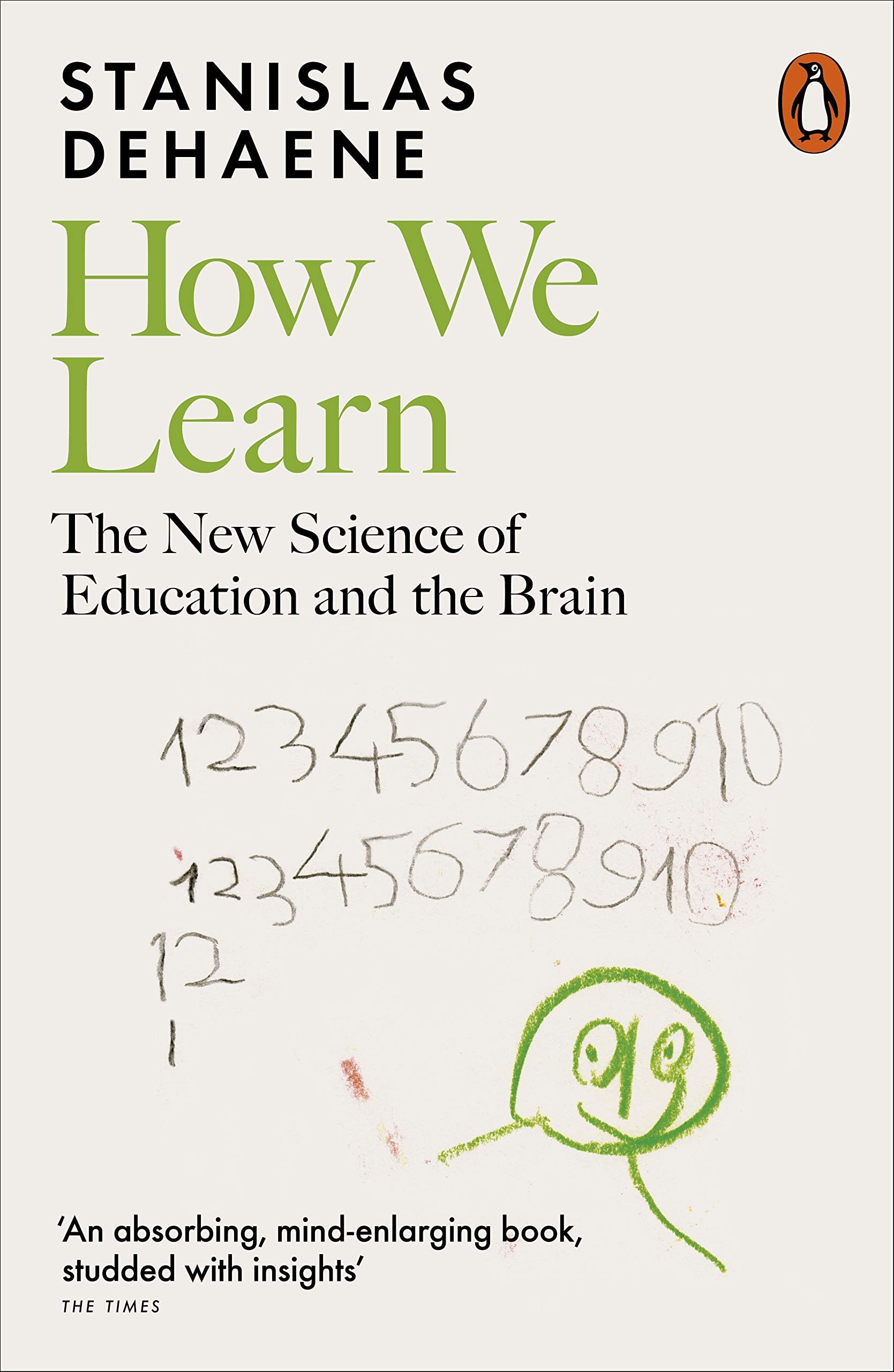
How We Learn: The New Science of Education and the Brain
Product ID: 282585968
Desertcart purchases this item on your behalf and handles shipping, customs, and support to South Africa.
Buy How We Learn: The New Science of Education and the Brain by Dehaene, Stanislas online on desertcart.ae at best prices. ✓ Fast and free shipping ✓ free returns ✓ cash on delivery available on eligible purchase. Review: Great book - Really interesting and insightful Review: Found myself getting bored of this book very quickly. Just basic info that has been known for decades.
| Best Sellers Rank | #23,920 in Books ( See Top 100 in Books ) #43 in Neuropsychology #100 in Neurology #142 in Computer Science |
| Customer reviews | 4.7 4.7 out of 5 stars (539) |
| Dimensions | 12.8 x 2 x 19.8 cm |
| Edition | 1st |
| ISBN-10 | 0141989300 |
| ISBN-13 | 978-0141989303 |
| Item weight | 282 g |
| Language | English |
| Print length | 352 pages |
| Publication date | 28 January 2021 |
| Publisher | Penguin |
K**E
Great book
Really interesting and insightful
M**K
Found myself getting bored of this book very quickly. Just basic info that has been known for decades.
A**X
So I kind of bought this book to enhance my own learning capabilities and I believe the book wasn’t really made to fulfill this need. Even though I found some helpful tips and information I felt like the book was directed to teachers more than learners. Something also made it quite hard to finish, I normally read a book with the same amount of pages in about a month (depends how much of a page turner it is) but this one took about 3 months…. I would say that if you are a teacher interested in how students can revive better teaching and guidance this book might be for you. If you are a student like me go for another book or information online. I must also say that I agree with other reviews that it wasn’t a lot of new information. Especially if you have read books like Nudge, Behave, Why we sleep, dopamine nation etc
C**N
“Just as education is based on biology, the field of education must be grounded in a systematic and rigorous research ecosystem that brings together teachers, patients, and researchers, in a ceaseless search for more effective, evidence-based learning strategies” (245) (from How We Learn). How We Learn is Stanislas Dehaene’s fourth book that I have read, and it does not disappoint. Dehaene effortlessly and compassionately moves between the abstract and the useful, carefully and methodically guiding the reader through a veritable mountain range of information from fields as different as neuroscience and education. And The Wall Street Journal got it right for this book as well when it declared (of Reading In The Brain) that Dehaene “never oversimplifies; he takes the time to tell the whole story; and he tells it in a literate way.” All in all this is an incredible book, whether you’re interested in neuroscience, education, how brain plasticity and literacy are related, AI or even the brains of babies. There’s really something in it for everyone, whether you’re looking to apply your knowledge to study (or help someone else study) more effectively, or improve your own understanding of how the brain works. Dehaene is on the cutting edge, and he’s incredibly compassionate without ever being tendentious or moralistic. Below is a more detailed breakdown. How We Learn is divided into three parts. Part One answers the question “What is Learning?” In the first chapter he discusses seven definitions of learning. One of the most interesting definitions (which isn’t even included among the first seven) is “Learning is inferring the grammar of a domain” in which he submits: “Characteristic of the human species is a relentless search for abstract rules, high-level conclusions that are extracted from a specific situation and subsequently tested on new observations” (35). In Chapter 2 Dehaene wrestles for 20 pages with “Why our brain learns better than current machines,” continuing the discussion of learning all the while. Dehaene emphatically disagrees with the belief that “machines are about to overtake us” (27). A handful of the things he argues humans still do much better includes: Learning Abstract concepts; Data-efficient learning; Social learning; One-trial Learning; and, Systematicity and the language of thought. in Part 2 Dehaene delves into “How Our Brain Learns.” This is the most scientifically granular section and, for many more technical readers, may be the most interesting. The neuroscience underpinning the four chapters in Part 2 is where Dehaene really shows off how dynamic a mind he has. Essentially, human thought is itself a kind of symbolic language. Furthermore, the literacy of thought starts almost as soon as a baby starts to develop as a fetus. By the time a baby is born, it is an incredibly well-developed instrument ready for its second (rather than first) phase of life, for which it has been preparing for three seasons. Dehaene’s thoughts and work on infants alone in this book is well worth ten times its price. Part Three, more of the applied education section, starts with the “Four Pillars of Learning”: Attention (Ch 7, about 30 pages), Active Engagement (Ch 8, about 20 pages), Error Feedback (Ch 9, about 20 pages), Consolidation (Ch 10, about 15 pages). Each of these chapters is a combinatory mine of research, experimental data and studies, as well as practical advice for learners and teachers, reminiscent of Brown, Roediger and McDaniel’s excellent book Make It Stick. The following are some kernels of very useful information from Chapters 7-10: “The intellectual quotient [IQ] is just a behavioral ability, and as such, it is far from being unchangeable by education. Like any of our abilities, IQ rests on specific brain circuits whose synaptic weights can be changed by training” (167). “A passive organism does not learn” (178). “To learn, our brain must first form a hypothetical mental model [algorithm] of the outside world, which it then projects onto its environment and puts to a test by comparing its predictions to what it receives from the senses. This algorithm implies an active, engaged, and attentive posture. Motivation is essential: we learn well only if we have a clear goal and we fully commit to reaching it” (178). “While it is crucial for students to be motivated, active, and engaged, this does not mean they should be left to their own devices” (184). “Pure discovery learning, the idea that children can teach themselves, is one of the many educational myths that have been debunked but still remain curiously popular. […] Two other major misconceptions are linked to it: the myth of the digital native [and] the myth of learning styles” 185). “Zero error, zero learning,” but… “We do not need an actual error in order to learn—all we need is an internal sign that travels in the brain” (204) “It would be wrong, therefore, to believe that what matters most for learning is to make a lot of mistakes […] What matters is receiving explicit feedback that reduces the learner’s uncertainty. […] The theory of error backpropogation predicts: every unexpected event leads to corresponding adjustment of the internal model of the world" (205). “This is the golden rule: it is always better to spread out the training periods rather than cram them into a single run. […] Decades of psychological research show that if you have a fixed amount of time to learn something, spacing out the lessons is a much more effective strategy than grouping them” (218). “Sleep and leaning are strongly linked” (228). “Computer scientists have already designed several learning algorithms that mimic the sleep/wake cycle” (231). “From an educational perspective there is little doubt that improving the length and quality of sleep can be an effective intervention for all children, especially those with learning difficulties” (235). Part Three ends with the Dehaene’s “Conclusion: Reconciling Education with Neuroscience.” He conveniently provides a bullet point summary as well as “Thirteen Take-Home Messages to Optimize Children’s Potential.” Here they are, without their supporting paragraphs. Do not underestimate children. Take advantage of the brain’s sensitivity periods. Enrich the environment. Rescind the idea that all children are different. Pat attention to attention. Keep children active, curious, engaged, and autonomous. Make every school day enjoyable. Encourage efforts. Help students deepen their thinking. Set clear learning objectives. Accept and correct mistakes. Practice regularly. Let students sleep. Dehaene ends with his insistence that “schools should devote more time to parents training,” and that “scientists must engage with teachers and schools in order to consolidate the growing field of educational science” (244).
M**E
Learn how scientifically proven methods can help one become a better educator.
J**N
Se centra en los aspectos importantes, introduciendo los casos clínicos cuando clarifican. Alejado de las respuestas "fáciles" y cuasi demagógicas de algunas propuestas didácticas que "afirman basarse" en la neurociencia. Debe ser leído
Trustpilot
1 month ago
2 weeks ago