
DOWNLOAD THE APP


Customer Services
Copyright © 2025 Desertcart Holdings Limited
DOWNLOAD THE APP
Full description not available
B**U
Very informative
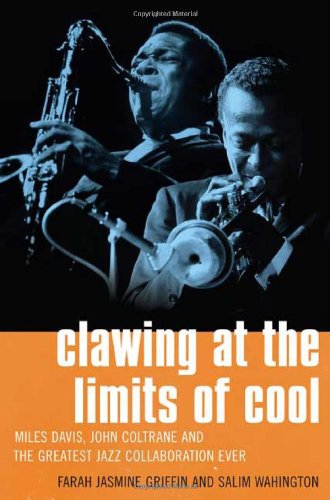
I don't have a strong background in the history of jazz, but this book seems to be a good one for studying the history and influence of two jazz greats, Davis and Train. I particularly like the second half of the book in which the authors devote extended interpretations and the cultural history of albums and single compositions, such as Milestones, Blue Train, Kind of Blue, A Love Supreme, Giant Steps, `Round About Midnight. The first half of the book delves more into the personal background of the two musicians.Washing and Griffin's book is by no means a definitive study. It simply sheds light on the relationship between Davis and Coltrane. It ends with the emergence of Miles Davis and the jazz fusion era. But it provides an overview of the history of the two great giants, describing how so different they were--Davis, the cool and more confident jazz band leader, and Coltrane, the more spiritual, sometimes timid, gentler of the two. Of course, Coltrane by 1961 formed his own group, and that time he was jazz figure breaking new territory. I had not known about there differences until reading this book.This book focuses a little more Davis than it does on Coltrane, which makes me want to definitely read a full biography of Coltrane, because he seems such a complex figure, that there's much more to him than what they book conveys.Finally, I would add, that in this era of digital technology, I really hope that jazz books like this do more to link readers to particular compositions that will be discussed in this book. It would be great if the authors had a website in which they list all the titles of compositions that will be discussed, and perhaps allow readers to listen to those songs on their website. I have several Davis and Coltrane albums, but I still needed to go on YouTube to find many of compositions that the authors write about. This book will be very accessible to those who have a strong background in jazz music, but it will be somewhat challenging to those of us who are just beginning to study the jazz, beyond just listening to it.Clawing at the Limits of Cool will be among several books on the history of jazz that I will be reading in the coming months.
B**T
Worthy addition to Miles & Trane scholarship
A worthwhile addition to the corpus of book-length writings about Miles and Trane, exploring the relationship (musical and otherwise) between those two towering figures from an African-American socio-political as well as musical perspective. One of the authors is a tenor saxophonist who came to my attention for his work as a sideman on a few albums, which is one reason I bought this book; the other is a Columbia University English professor who has written about Billie Holiday, May Lou Williams, and others. This book is in the tradition of C.O. Simpkins' "Coltrane: A Biography," Frank Kofsky's "Black Nationalism and the Revolution in Music," and Amiri Baraka's classic "Blues People" and "Black Music." In addition to explaining the political context and motivations of Miles Davis and John Coltrane's music, this book is a celebration of their genius and artistic legacy.For those reviewers who say that the political stuff is a distraction and "pushes an agenda," let me just offer this: I'm a white guy from Philly who studied flute as a high school kid (I won't say how long ago). My teacher was a professional classical flute player but was into all kinds of music. One day I asked him if I could borrow some jazz flute records (OK, this dates me) in order to learn about jazz flute playing. He picked out some Hubert Laws and Herbie Mann albums but then told me if I wanted to hear some truly great jazz, I should check *this* out: it was Coltrane's "My Favorite Things."The title track of that album blew the mind of this 15-year-old fan of the Beatles, prog-rock, and classical music. I spent the next several years -- through college and grad school as a DJ on the student radio stations and jazz columnist for one of the school newspapers -- getting deeper and deeper into jazz, with Trane as my lodestar. I read all the books about the music I could find and became especially interested in the cultural and political aspects of it - which helped me to understand how this guy (and many others) could create music like that. I always liked Miles's music, but he didn't rate as high as Trane for me personally until later in life when I could better appreciate Miles's "less is more" approach.I say this in order to suggest that if you dig Trane and Miles enough to really want to understand where they came from, it's inevitable that you get into the areas that these two authors explore in this book; it's not a "distraction" any more than it's a "distraction" to learn about 18th-century Lutheran church practices if you're studying J.S. Bach.I devoured this book and listened to Miles & Trane while doing so. In addition to adding to the biographical knowledge of the two musicians (especially Trane, through his surviving family members), it sheds new light on some of the tracks they recorded and musicians in the various bands. I stopped short of five stars because I it could have benefited from a round of editing: some of the text was repetitive and I found a handful of factual errors. But that didn't overshadow the enjoyment I had reading this book.
D**R
wow
really a good read informative and educational
W**R
am I getting what was advertised?
Got what was described about the book - good, fast service.
T**O
Yeah!
Great book
R**L
Five Stars
Sorry, only have looked at it briefly so far
P**N
A scholarly and Impassioned look at MIles and Coltrane
Farah Jasmine Griffin and Salim Washington have looked at Miles Davis and John Coltrane and their musical reelationship. This is done not only with intelligence, good judgment, and scholarship, but with compassion, even love. Every sentence is warm and penetrating. The book achieves its main purpose by drawing the reader directly to the music itself: I listened to the records all over again (repeatedly) with new enlightenment and feeling.Rev. Peter F. O'Brien, S.J.Executive DirectorThe Mary Lou Williams Foundation, Inc.
S**L
JAM PACKD
A very impressive and different POV of a a very important jazz collaboration between two giants of jazz. A very interesting perspective from two black writers.
P**R
The book of modal jazz
The book is well written and well researched. It is a must for all fans of Miles Davis and modern jazz in general.
D**R
Received in excellent condition,not read it yet.
I can't make a comment about the book yet as I haven't read it.However as far as ordering it and getting in next to no time and in exemplary condition I was more than satisfied.
Trustpilot
2 weeks ago
5 days ago