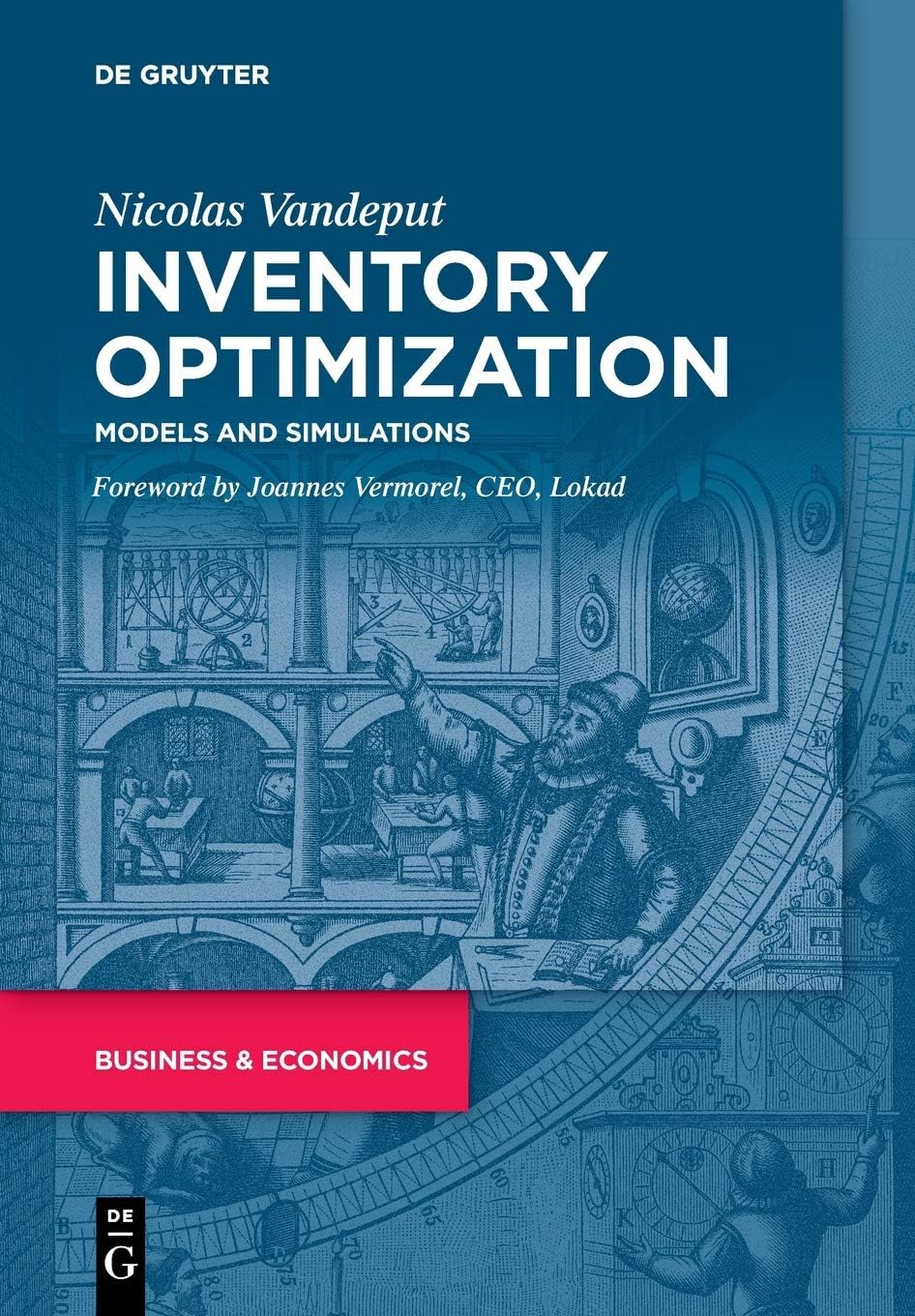
Inventory Optimization: Models and Simulations
Product ID: 207179850
Buy anything from 5,000+ international stores. One checkout price. No surprise fees. Join 2M+ shoppers on Desertcart.
Desertcart purchases this item on your behalf and handles shipping, customs, and support to South Africa.
desertcart.com: Inventory Optimization: Models and Simulations: 9783110673913: Vandeput, Nicolas: Books Review: Best book on Inventory Management ever written, not hyperbole. - If you are a reasonably well-learnèd inventory manager who understands basic statistics, Excel, and Python you will adore this book. I use this book as my go-to field manual when designing inventory optimization at work. The two best books on SCM that I have ever found are this book and Vandeput's other book on Data Science for Supply Chain Forecasting. Your IQ does need to be somewhat high to get anything out of this book (if you failed statistics don't bother), but if you have the background and you're passionate about technical things you will eat this up. I highly recommend this if you're an advanced practitioner attempting to do stochastic inventory control for your firm. I highly recommend this for anyone who is in any sort of masters program in SCM too — I would say it's equivalent to roughly 8 semester hours of credits in academia. A final word: if you're into this stuff, please do yourself a favor and get on Linux. WSL on Windows + VSCode editor running WSL remote is where most people should start (if you're a business type locked into Excel). From there you can deploy your stuff on with Docker to cloud for automated compute. Mac probably works too, just stay away from native Windows for the Python ecosystem tools, that's why Microsoft put Linux into Windows so you could have the best of both worlds for prototyping things rapidly. Review: Democratizing Inventory Theory Learning - Nicolas's Inventory Optimization: Models and Simulations is a game changer. I made it a goal this past year (2020) to study mathematical Inventory Optimization. Several academic books, papers, and software vendor blogs later, I received my copy of this book. Nicolas has a way of explaining mathematical concepts in a digestible way. He also goes beyond models that require such strict assumptions that they are quite unrealistic. Supply Chains are complex, you can't assume a perfect world when modeling. This book is the best I have found so far to go through more complex modeling while also trying not to scare the reader away. I recommend this book to all who are interested in improving their inventory planning - you will come away a better planner.
| Best Sellers Rank | #235,104 in Books ( See Top 100 in Books ) #11 in Business Operations Research (Books) #24 in Industrial Management & Leadership #86 in Production & Operations |
| Customer Reviews | 4.6 4.6 out of 5 stars (131) |
| Dimensions | 6.7 x 0.9 x 9.4 inches |
| Edition | 1st |
| ISBN-10 | 3110673916 |
| ISBN-13 | 978-3110673913 |
| Item Weight | 2.31 pounds |
| Language | English |
| Print length | 318 pages |
| Publication date | August 24, 2020 |
| Publisher | De Gruyter |
L**E
Best book on Inventory Management ever written, not hyperbole.
If you are a reasonably well-learnèd inventory manager who understands basic statistics, Excel, and Python you will adore this book. I use this book as my go-to field manual when designing inventory optimization at work. The two best books on SCM that I have ever found are this book and Vandeput's other book on Data Science for Supply Chain Forecasting. Your IQ does need to be somewhat high to get anything out of this book (if you failed statistics don't bother), but if you have the background and you're passionate about technical things you will eat this up. I highly recommend this if you're an advanced practitioner attempting to do stochastic inventory control for your firm. I highly recommend this for anyone who is in any sort of masters program in SCM too — I would say it's equivalent to roughly 8 semester hours of credits in academia. A final word: if you're into this stuff, please do yourself a favor and get on Linux. WSL on Windows + VSCode editor running WSL remote is where most people should start (if you're a business type locked into Excel). From there you can deploy your stuff on with Docker to cloud for automated compute. Mac probably works too, just stay away from native Windows for the Python ecosystem tools, that's why Microsoft put Linux into Windows so you could have the best of both worlds for prototyping things rapidly.
M**L
Democratizing Inventory Theory Learning
Nicolas's Inventory Optimization: Models and Simulations is a game changer. I made it a goal this past year (2020) to study mathematical Inventory Optimization. Several academic books, papers, and software vendor blogs later, I received my copy of this book. Nicolas has a way of explaining mathematical concepts in a digestible way. He also goes beyond models that require such strict assumptions that they are quite unrealistic. Supply Chains are complex, you can't assume a perfect world when modeling. This book is the best I have found so far to go through more complex modeling while also trying not to scare the reader away. I recommend this book to all who are interested in improving their inventory planning - you will come away a better planner.
P**A
Good introduction to inventory management!
Good introduction to inventory management!
K**N
Eye-opening book for all supply chain practitioners responsible for inventory policies
This is my favorite book of the three books Nicolas published thus far as of Nov 2023. I read it after finishing his other book on "Data science for supply chain forecasting", which really sparked my interest to dive deeper into these topics. Nicolas showcases how to use mathematical models to capture supply chain complexities. With each chapter, the models become more powerful and more capable to capture reality. Finally, simulations are presented as pinnacle of optimization. I had some background in Python so it was really a breeze to implement the suggested code snippets and use them as baseline to develop my own models and simulations. It was a great inspiration. Even if you are not a Python expert, you can use ChatGPT for troubleshooting and coding support! This book can help you to bring your inventory management policies to the next level, leaving outdated approaches such as ABC/XYZ + economical order quantity methods far behind and deploying modern continuous optimization through simulation. For instance, I modeled the total cost of ownership for our company: From purchase order placement through consumption of parts/delivery, factoring in dynamic transaction cost, inventory holding cost and backorder cost as function of order quantity and service level / fill rate. Using probability mass functions for demand and supply lead times based on historical and forecasted data, simulations enabled me to find optimum sets of order parameters and safety stock to operate in the proximity of the total cost minimum - fantastic! Once you grasp the concepts you realize the power this book allows you to harness.
C**A
Great Book, very practical and comprehensive.
Nicolas in his book has a way of explaining mathematical concepts in a digestible way. We all know that Supply Chains are complex and it is not a exact science. This book shows differents inventory policies and the way to optimize them. It include too simulations and Phyton codes. Definitely an excellent book showing "what" and "how to" optimize inventory.
M**O
Good book for beginners
Inventory optimization is not my background. I enjoyed reading the book and learn the fundamentals, in a step-by-step manner. Pros: - A lot of examples - Easy to decipher (advanced) topics - When and why each approach in Inventory Optimization should be used.
L**S
Thoroughly impressed A+++
I continue to be impressed by Nicolas Vandeput’s books. They give you so much more than what you would find in a hypothetical academia textbook. They allow you to pivot in and out of detail and “how to” and “why” and if you didn’t understand it, here’s the “plug and play” version so you can learn by doing. It’s like getting the notes from your favourite lecturer, that show how the engine really works.
R**A
Excelente libro como muy buena base e incluso códigos para diseñar una politica de inventarios robusta. Muy recomendable para todo quien este en las areas de Planeacion de la Cadena de Suministro.
F**F
Great combination of theory behind models, meaning of various consepts and assistance to easily implement the models in excel and/or python.
D**O
The content is very good but reading is very difficult in the Kindle version
K**R
Day to day applicability of the inventory policies formulas are well explained.. completed the deterministic supply chain part..about to start the stochastic version ( 2 parts of the book)
N**M
Great book based on an extensive scientific work, very well documented and with a lot code snippets. Most importantly, the book provides the best practices proven with scientific and simulation work from the author and not just the classical formulas that have been demonstrated as not optimal due to assumptions and hypothesis that are rarely confirmed in the reality. I recommend this to all data practitioners working on inventory optimization.
Trustpilot
2 months ago
1 month ago