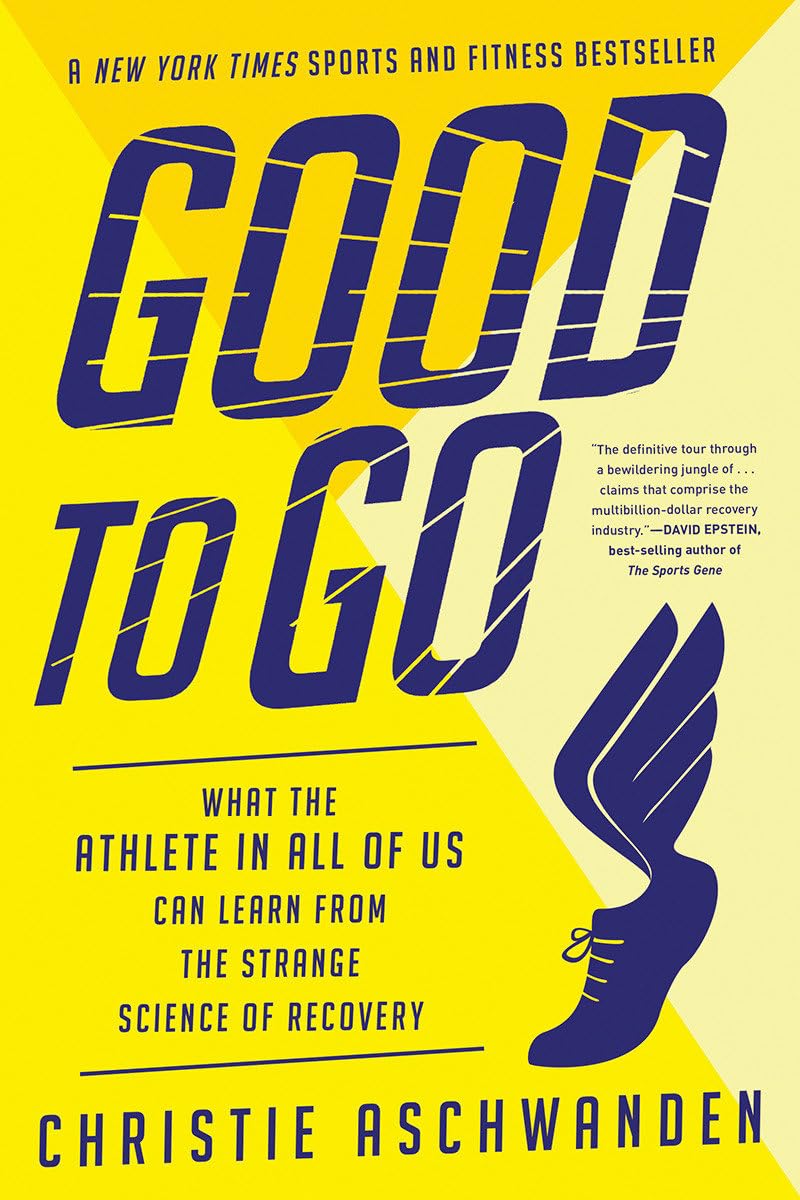
Good to Go: What the Athlete in All of Us Can Learn from the Strange Science of Recovery [Aschwanden, Christie] on desertcart.com. *FREE* shipping on qualifying offers. Good to Go: What the Athlete in All of Us Can Learn from the Strange Science of Recovery Review: Funny, broad overview of science, pseudoscience, and marketing of recovery aids for athletes. - Athletes know in order to gain fitness, and improve performance, adequate recovery must take place between training sessions. And as the author points out, athletes are always looking for a new way to hasten recovery. The author seems to have the perfect mix of experience to write on this topic -- she has a degree in biology, has worked as a science journalist for many years, and is a long-time serious athlete. In a highly readable and witty manner, she first generally discusses the limitations on scientific studies (using as an example her own participation in a study if beer is a good recovery fluid) . This discussion is a very well done example of issues in studies she later discusses. She describe a bewildering variety of recovery modalities, devices and regimens (icing, salt baths, NSAIDS, stretching, recovery drinks, foam rolling, massage, meditation, sleep, protein supplements, etc, etc. etc.). She describes each of them, sometimes tries them herself for the first time ( e. g. sensory deprivation" floating salt bath), talks to coaches and athletes, discusses scientific studies which have evaluated the issue, and talks to leading experts in the field to get their opinion on the status of scientific knowledge. The text of the book is refreshingly almost free of scientific jargon, but her work is well-supported with almost 200 end notes of studies and her sources. I have to disagree with the one-star reviewer who seems to think that the book's only lesson is to be sure to get adequate sleep. The author's point is that sleep is of paramount importance (well documented scientifically), especially when compared to the various unproven, aggressively marketed fads. Yes, she does debunk, or at least "throw shade" on some recovery devices or rituals, but to me that is the most valuable service the book provides. Who doesn't want to stop wasting time and money on something that is unlikely to work? I think the author precisely reports the great uncertainty on many of these recovery issues. A lot is not known, and perhaps will never be known. Her honest reporting of the many uncertainties is a feature, not a bug. It provides a great education on what you should look at when considering recovery issues, and a very enlightening discussion of how marketing influences people's choices. Finally, she also discusses the psychological aspect of these issues, noting that some things seem to work for some people and not others. She discusses how and perhaps why people will not change their habits even in face of clear evidence that it does not work. In sum, this is a very valuable resource for any serious athlete. I have coached an adult marathon training program for many years now (and have run more than 50 marathons and ultras) and this is also a good resource for coaches, if nothing else, to recommend to your athletes. Review: Interesting read - I am by nature a skeptic and I am constantly rolling my eyes at all the crazy stuff athletes think work. I liked this book because it really goes into the science process to highlight what we know and don't know.


| Best Sellers Rank | #215,743 in Books ( See Top 100 in Books ) #21 in Sports Health & Safety (Books) #139 in Sports Training (Books) #181 in Exercise Injuries & Rehabilitation |
| Customer Reviews | 4.4 4.4 out of 5 stars (650) |
| Dimensions | 5.5 x 0.8 x 8.3 inches |
| ISBN-10 | 0393357716 |
| ISBN-13 | 978-0393357714 |
| Item Weight | 9 ounces |
| Language | English |
| Print length | 320 pages |
| Publication date | February 18, 2020 |
| Publisher | W. W. Norton & Company |
J**Y
Funny, broad overview of science, pseudoscience, and marketing of recovery aids for athletes.
Athletes know in order to gain fitness, and improve performance, adequate recovery must take place between training sessions. And as the author points out, athletes are always looking for a new way to hasten recovery. The author seems to have the perfect mix of experience to write on this topic -- she has a degree in biology, has worked as a science journalist for many years, and is a long-time serious athlete. In a highly readable and witty manner, she first generally discusses the limitations on scientific studies (using as an example her own participation in a study if beer is a good recovery fluid) . This discussion is a very well done example of issues in studies she later discusses. She describe a bewildering variety of recovery modalities, devices and regimens (icing, salt baths, NSAIDS, stretching, recovery drinks, foam rolling, massage, meditation, sleep, protein supplements, etc, etc. etc.). She describes each of them, sometimes tries them herself for the first time ( e. g. sensory deprivation" floating salt bath), talks to coaches and athletes, discusses scientific studies which have evaluated the issue, and talks to leading experts in the field to get their opinion on the status of scientific knowledge. The text of the book is refreshingly almost free of scientific jargon, but her work is well-supported with almost 200 end notes of studies and her sources. I have to disagree with the one-star reviewer who seems to think that the book's only lesson is to be sure to get adequate sleep. The author's point is that sleep is of paramount importance (well documented scientifically), especially when compared to the various unproven, aggressively marketed fads. Yes, she does debunk, or at least "throw shade" on some recovery devices or rituals, but to me that is the most valuable service the book provides. Who doesn't want to stop wasting time and money on something that is unlikely to work? I think the author precisely reports the great uncertainty on many of these recovery issues. A lot is not known, and perhaps will never be known. Her honest reporting of the many uncertainties is a feature, not a bug. It provides a great education on what you should look at when considering recovery issues, and a very enlightening discussion of how marketing influences people's choices. Finally, she also discusses the psychological aspect of these issues, noting that some things seem to work for some people and not others. She discusses how and perhaps why people will not change their habits even in face of clear evidence that it does not work. In sum, this is a very valuable resource for any serious athlete. I have coached an adult marathon training program for many years now (and have run more than 50 marathons and ultras) and this is also a good resource for coaches, if nothing else, to recommend to your athletes.
A**R
Interesting read
I am by nature a skeptic and I am constantly rolling my eyes at all the crazy stuff athletes think work. I liked this book because it really goes into the science process to highlight what we know and don't know.
B**R
Fun and Informative
Easy read, interesting insights, she makes the reading experience fun yet insightful.
A**R
A worthwhile read for athletes
A thorough review of recovery methods, quite objective. The final answer is as satisfying as tour go to recovery method - it works, but you wish it worked just a bit better.
T**I
Does anything actually work, or just sleep and water?
This book is dense, which is not a bad thing. I just think it could have been two books, or maybe fewer interviews in some chapters. I also think if I'd taken less time to read it, I'd have better tracked why she repeated some folks' input in different chapters. Aschwanden-a cyclist and runner who is a former competitive skier- was on a quest to explore the varied tools at athletes' disposal and which worked better, and/or how perceived "working" differed from science or blood work. She explored everything from Gatorade to NormaTec boots and talked to everyone from weekend warriors to former marathoner Ryan Hall. As a runner who swears by her epsom soaks and credits NormaTec sessions for better than expected marathon-recovery, I was curious to see what her research found. I also enjoyed how she explained the role in marketing in making us think we need things that science might not indicate. At the same time, she was clear to indicate that "studies" weren't always scientifically valid in their conclusions. Appreciated the mix of international coaches and scientists she spoke with. A good read.
E**T
Beneficial information
More or less reinforced what I suspected.
K**S
great present for any older athlete or health-minded exerciser
Bought this as a present for my husband. He has been working out, staying in shape, for decades but as time goes on, it can get tougher to heal when he "overdoes" on the working out or stretching. He is always interested in taking a scientific approach and also in keeping up with new health trends that seem sound. He is really enjoying reading this book. He finds her debunking of various sport recovery myths interesting and sound, and also likes the writing style, finds it an easy read. Youth can try anything, heal fast. But as you get older, you want to put your effort into methods that will actually work, both for staying in shape and for recovering from injuries, nagging issues, overuse. This book provides enlightenment.
K**N
fascinating dive into a surprisingly complex topic
You'd think it would be simple enough to judge a recovery modality -- does it work or doesn't it? Aha! It's not so simple, as this book explains (and makes interesting). The author has a strong grasp of the intricacies of sports science trials, which are tricky to design and to draw firm conclusions from -- her opening chapter, which describes her self-designed study of whether beer can aid recovery, provides a great example. My favorite parts of the book delved into the supplement industry's excesses and also the psychology of believing that something works, and how that alone can be helpful. And as another person who isn't naturally inclined to meditate, I am newly fascinated by float tanks as "forced meditation" and plan to float at my earliest possible convenience. Funny, informative, and entertaining to read; I am recommending this to all my sporty friends.
L**E
I loved this book: brilliantly written and science journalism at its best. I had thought I was up-to-date on sports science, but this book changed my approach to training and recovery. The author – a scientist and former elite athlete – investigates the evidence behind many of the common methods of sports recovery. Who knew this subject could be a page-turner? The author writes with honesty, humour and an engaging style. It starts with her own lab experiment to find out if beer can make you run faster and the sense of fun continues through the book. The book covers a wide range of recovery methods. Commons methods like compression clothing are covered as you'd expect, with a clear summary of how marketing claims stack up against the scientific evidence. So are more expensive methods like cryotherapy and it's interesting to know what's available to Olympic athletes. I thought I'd kept pace with sports science, but this book showed how much I'd missed and which things do more harm than good. In addition, this book gives the clearest explanation I’ve seen about how your state of mind can effect real biological changes. I've only one criticism: the book challenges the benefit of icing, because icing reduces inflammation and an inflammatory response is needed for recovery. Yet inflammation is long-recognised in sports medicine and widely studied. Sports physicians know this and know when to advise the use of ice. However, this is a minor criticism of an overall well-researched book. If you want to find out which recovery methods are snake oil, this is the book to read. You’ll finish the book with fewer recovery methods to use, but knowing these actually work. Perhaps more importantly, you’ll feel more relaxed about the whole subject of recovery – and raise a glass to thank the author. Cheers! An enjoyable read for weekend warriors and serious athletes alike. Highly recommended.
A**I
Fantastic book for anyone keen to improve their sport, highly recommend it for the wonderful inputs. Give it a go
T**K
this is a good book that doesn't sell snake oil. TL;DR sleep is the #1 healer, and everything else is at least half placebo — but in sports, placebos work, so recover however makes you feel best
E**E
Excelente recurso para todos aquellos que practican deporte, ya sea de manera profesional, amateur o recreativa
K**L
Excellent book I like my science to be researched & referenced, but not so dry you loose the gist of the subject or its conclusions & not so simplified the end result tells you little to nothing. Entertainingly written but sufficiently rigorous whilst still acknowledging that personal preference counts for something, this is avery good book. You may have to give up ice baths though...oh dear.
Trustpilot
1 month ago
4 days ago