We remain fully operational. Our teams are working around the clock to ensure your deliveries continue safely.

DOWNLOAD THE APP


Customer Services
Copyright © 2025 Desertcart Holdings Limited
DOWNLOAD THE APP

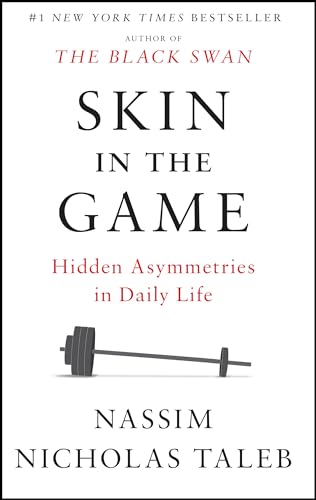


Skin in the Game: Hidden Asymmetries in Daily Life (Incerto) [Taleb, Nassim Nicholas] on desertcart.com. *FREE* shipping on qualifying offers. Skin in the Game: Hidden Asymmetries in Daily Life (Incerto) Review: For a different viewpoint - well worth reading - This is the fourth book by Nassim Taleb that I've read. Even when I don't agree with him, I find his views to be a useful antidote to sloppy thinking, which is much of what passes for public discourse now. Taleb calls out public intellectuals, Paul Krugman for one, and challenges their intellectual credibility. He does this with much of academia as well. He calls out Bob Rubin, former Treasury Secretary, for what I believe is fundamentally an integrity issue. I point this out because if you, as a prospective reader, might find this troubling, then brace yourself. On another front, he invokes a wide range of scholarship involving not only classical Greek and Roman sources, but also sources from the mid-East both Christian and Islamic. He's from Lebanon so his exposure to this culture arises from personal experience. I find the breadth of his source material to be unusual and worthy of careful consideration. What do I take as the basic idea of the book? One has to be at risk of personal loss to understand and responsibly respond to the world's challenges. Telling others what they should do when you are not exposed to the consequences is fundamentally corrupt. Ethics runs throughout the book. What are some of the topics? Why the most intolerant minorities can impose their will on the majority. How to legally own another person. Why some legal systems seek to impose equality of uncertainty in commercial transactions,. How to ethically disagree with another. How today's merchandising of virtue compares to simony in the Middle Ages. Religion, belief and the necessity for skin in the game - for, as Taleb puts it, the gods don't like cheap signaling. These are only some of the topics that the book delves into. I think you can agree that the topics listed above, and many others in the book, are not light reading. If, like me, you find these topics worthwhile for consideration, I encourage you to read the book. I think that it will repay your time. Review: Nassim Taleb is the author who has influenced my thinking ... - Nassim Taleb is the author who has influenced my thinking more than any other that I have read. His approach, grounded in statistical rigor, is contrarian but also intuitive. I first encountered his work when I read the Black Swan in 2006 while working a summer in Geneva. I remember being struck by the truth in his descriptions of how Wall Street forecasting is done and how misleading and often incorrect it is. Reading The Black Swan led me to read Fooled By Randomness, the Bed of Procrustes, and Antifragile. Each one further reinforcing and refining his ideas. Not only are the books insightful, they are also entertaining and I relished each opportunity to read his work. Following him on twitter is one of my guilty pleasures. His latest book, Skin in The Game, is more of a work of moral philosophy than one of probability and statistics. In my opinion, its most valuable aspect is that it provides a framework though which to judge the arguments, assertions, and most importantly the actions of others. That framework is skin in the game. To have skin in the game is to have a stake in the outcome of any given circumstance (upside and downside). This framework only ascribes value to the opinions of people who have skin in the game and makes judgements based on other people’s actions and not their words. In the end the determination of right and wrong is left up to the passage of time, with survival being the highest badge of success. This has applications not just in investing but also in politics, religion, medicine, and may other arenas. My only gripe about the book is that there is no update on the life and times of Nero Tulip. One of Taleb’s most interesting characters and a mainstay in all of his other books.


| Best Sellers Rank | #21,538 in Books ( See Top 100 in Books ) #11 in Political Economy #17 in Economic Conditions (Books) #39 in Philosophy of Ethics & Morality |
| Book 5 of 5 | Incerto |
| Customer Reviews | 4.4 4.4 out of 5 stars (6,970) |
| Dimensions | 5.2 x 0.7 x 8 inches |
| Edition | Reprint |
| ISBN-10 | 0425284646 |
| ISBN-13 | 978-0425284643 |
| Item Weight | 2.31 pounds |
| Language | English |
| Print length | 304 pages |
| Publication date | January 7, 2020 |
| Publisher | Random House Trade Paperbacks |
F**G
For a different viewpoint - well worth reading
This is the fourth book by Nassim Taleb that I've read. Even when I don't agree with him, I find his views to be a useful antidote to sloppy thinking, which is much of what passes for public discourse now. Taleb calls out public intellectuals, Paul Krugman for one, and challenges their intellectual credibility. He does this with much of academia as well. He calls out Bob Rubin, former Treasury Secretary, for what I believe is fundamentally an integrity issue. I point this out because if you, as a prospective reader, might find this troubling, then brace yourself. On another front, he invokes a wide range of scholarship involving not only classical Greek and Roman sources, but also sources from the mid-East both Christian and Islamic. He's from Lebanon so his exposure to this culture arises from personal experience. I find the breadth of his source material to be unusual and worthy of careful consideration. What do I take as the basic idea of the book? One has to be at risk of personal loss to understand and responsibly respond to the world's challenges. Telling others what they should do when you are not exposed to the consequences is fundamentally corrupt. Ethics runs throughout the book. What are some of the topics? Why the most intolerant minorities can impose their will on the majority. How to legally own another person. Why some legal systems seek to impose equality of uncertainty in commercial transactions,. How to ethically disagree with another. How today's merchandising of virtue compares to simony in the Middle Ages. Religion, belief and the necessity for skin in the game - for, as Taleb puts it, the gods don't like cheap signaling. These are only some of the topics that the book delves into. I think you can agree that the topics listed above, and many others in the book, are not light reading. If, like me, you find these topics worthwhile for consideration, I encourage you to read the book. I think that it will repay your time.
F**R
Nassim Taleb is the author who has influenced my thinking ...
Nassim Taleb is the author who has influenced my thinking more than any other that I have read. His approach, grounded in statistical rigor, is contrarian but also intuitive. I first encountered his work when I read the Black Swan in 2006 while working a summer in Geneva. I remember being struck by the truth in his descriptions of how Wall Street forecasting is done and how misleading and often incorrect it is. Reading The Black Swan led me to read Fooled By Randomness, the Bed of Procrustes, and Antifragile. Each one further reinforcing and refining his ideas. Not only are the books insightful, they are also entertaining and I relished each opportunity to read his work. Following him on twitter is one of my guilty pleasures. His latest book, Skin in The Game, is more of a work of moral philosophy than one of probability and statistics. In my opinion, its most valuable aspect is that it provides a framework though which to judge the arguments, assertions, and most importantly the actions of others. That framework is skin in the game. To have skin in the game is to have a stake in the outcome of any given circumstance (upside and downside). This framework only ascribes value to the opinions of people who have skin in the game and makes judgements based on other people’s actions and not their words. In the end the determination of right and wrong is left up to the passage of time, with survival being the highest badge of success. This has applications not just in investing but also in politics, religion, medicine, and may other arenas. My only gripe about the book is that there is no update on the life and times of Nero Tulip. One of Taleb’s most interesting characters and a mainstay in all of his other books.
A**W
Long-winded but insightful
It's not the easiest book to read, partially because its diction is pretty abstract, partially because the examples it provides make you stop to think long enough that you lose focus on the book
S**S
Risk/Reward Ratios in the Real World
Skin in the Game is about the dynamics of the behaviors of people when their actions have downside risk along with the potential reward. Too many executives and politicians have all the upside reward from compensation and none of the risks of ruin that their actions can cause, this is a big problem in our modern world that Mr. Taleb addresses in great detail. The book is overall about four things: 1. The difference between knowledge and reality. Having information is not the same thing as having experience executing successful long term methods in reality. 2. Symmetry in life through fairness and justice. People being held responsible for their actions and good behaviors being rewarded in magnitude of the value produced. 3. Full disclosure and information sharing in transactions. 4. Using reason and logic in complex systems and in the real world in the long term. Mr. Taleb explains and sets forward his case that skin in the game is necessary for fairness, commercial efficiency, risk management, and to understand how the world really works. Academia is not the real world, pain and results are the best educators in the majority of careers, businesses, and life. The point of this book is that in the real world it is hard to disentangle ethics on one hand from knowledge and competence on the other. Theories, college papers, and books fall short from experiential knowledge, contact with the real world is only done through skin in the game, you have to leave the classroom, boardroom, or legislature. Historically with few exceptions, societies were run by risk takers not risk transferors. Skin in game was more of a filter than a deterrence. It keeps human hubris in check and direct consequences of behaviors removed bad actors from participation eventually and permanently. Skin in the game removes the fragile and keeps the robust and the survival of the nonfragile lengthens with time creating a stronger world that benefits the majority. I enjoyed reading this book and N.N Taleb's insights into how the world really works though the magnitude of rewards and the risk of ruin.
Z**A
Perfect
H**A
Si on va voir mieux que ce qu'on nous offrent les médias traditionnels
E**.
I have never read Taleb's books before and I didnt finish this book. As far as I read, this book is full of ego, biased, down talking and hatred buried deep inside the cranks. I was deceived to buy this book by the 5 star givers. No one seems to make an unbiased review because of the credentials of the authors; I wonder what they would have said about the book if author's name was not on the book.
V**C
🔷 Approccio unico alla comprensione dei rischi: "Skin in the Game" di Nassim Taleb esplora come le persone, spesso inconsapevolmente, siano coinvolte in situazioni in cui i rischi e le ricompense non sono equamente distribuiti. 🔷 Concetti intriganti: Taleb sfida le convenzioni economiche e sociali, proponendo una visione audace della vita e dei suoi equilibri, dove le asimmetrie nascoste spesso determinano il nostro comportamento e le nostre decisioni. 🔷 Profondità filosofica: L'autore non si limita a parlare di economia e finanza, ma si avventura in filosofia e psicologia, esplorando come le asimmetrie influiscono sulle scelte quotidiane e sulle strutture sociali. 🔷 Stile di scrittura coinvolgente: Con uno stile diretto e provocatorio, Taleb non teme di mettere in discussione le convenzioni e di portare alla luce verità scomode. 🔷 Stimolante e provocatorio: Un libro che invita alla riflessione su come le asimmetrie invisibili modellano la nostra vita e il nostro mondo, facendoci guardare alla realtà con occhi diversi. 📚💡 Un libro stimolante per chiunque voglia esplorare le dinamiche nascoste che influenzano la nostra esistenza quotidiana, mettendo in luce la complessità e le sfide che affrontiamo nel mondo moderno!
S**I
A deep and clear vision about our day to day reality. A call to take ownership of our own decisions and a tool to identify those not be trusted. 100% recommendation
Trustpilot
2 months ago
3 weeks ago