Some deliveries may take a little longer than usual due to regional shipping conditions.

DOWNLOAD THE APP


Customer Services
Copyright © 2025 Desertcart Holdings Limited
DOWNLOAD THE APP
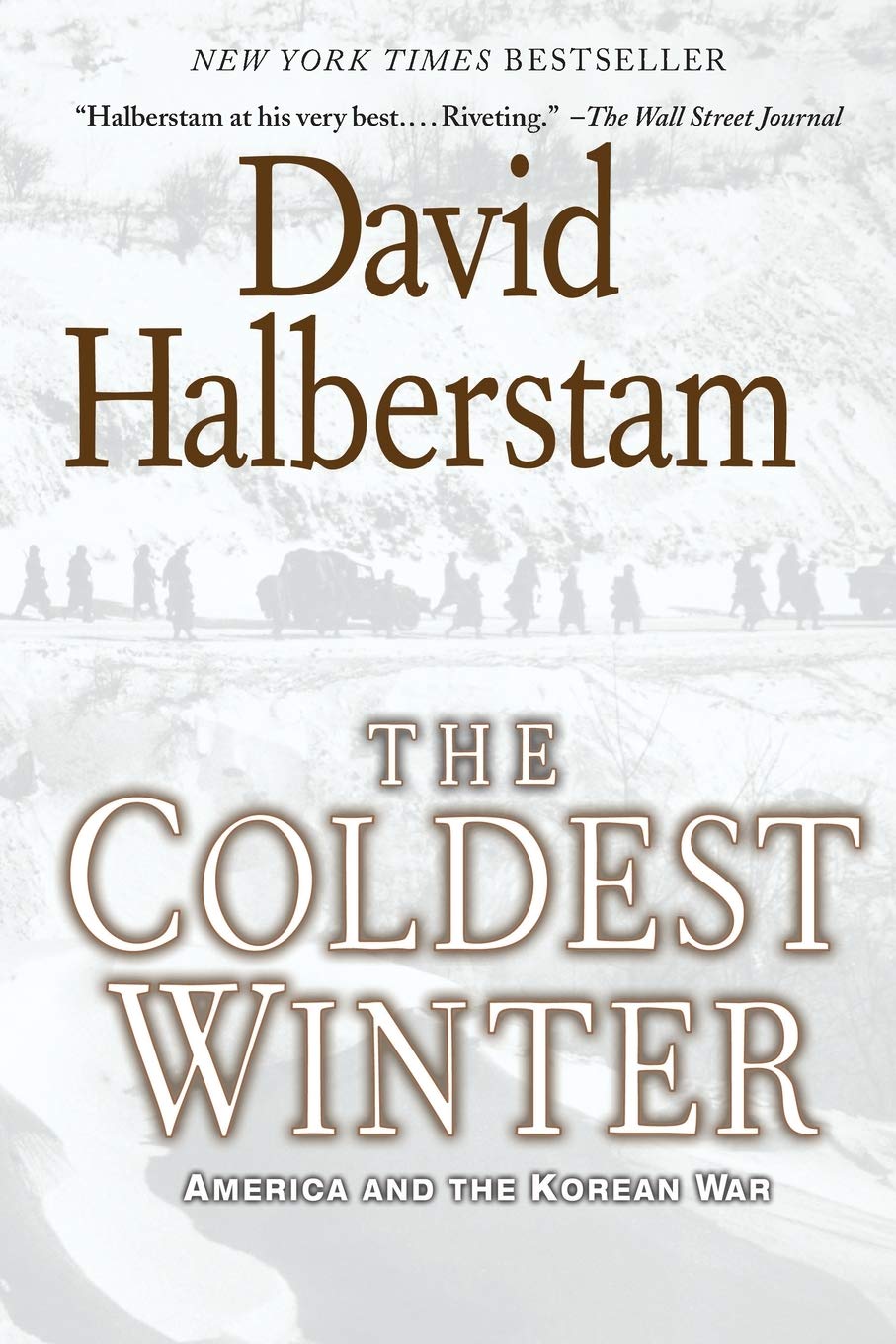
The Coldest Winter: America and the Korean War [Halberstam, David] on desertcart.com. *FREE* shipping on qualifying offers. The Coldest Winter: America and the Korean War Review: A brilliant merger of the political battles that overlapped the real war - No question in my mind that Halberstam was a great writer. I could not put this down. Yes, we know what happened but do we really? The actions of the war and the homefront are so well assembled. Halberstam has a view and he spills his guts to support it. In Korea he sees MacArthur as deeply flawed, exercising horrific judgment based on vanity and ego and surrounding himself with sycophants that told him only what he wanted to hear. He caused much unnecessary suffering and challenged the power of the Commander in Chief. While MacArthur is central to the history of the Korean War, Halberstam pulls back from the battles to give a fuller picture of the political winds blowing in China, Russia and United States that lead to misunderstandings (America not mentioning the Korea peninsula as under is "shield" was a major blunder) at almost every instance. The US had a skewed view of China presented by a 100 years of missionaries that was contradictory to Mao's growing success in fighting the Nationalists and therefore could not be "true". Halberstam helps explain how the defeat of the Nationalists triggered some sense in Americans that the US had lost to Mao. He does a great job refuting that but showing how the Republicans and Joseph McCarthy used this issue to show the Democrats as weak on Communism and trigger the Redbaiting that destroyed so many careers and reputations. Thus the Korean War took on added significance as it was seen as repulsing the Communists (as was Vietnam) rather than a nationalist uprising or civil war. Since the US had said Korea was not under their protection Mao saw an opportunity and he equally could not back down once he was committed to action. And of course could Stalin have it any better? The US tied up in Korea fighting a very large Chinese army? Halberstam's view is that while communism is the form of government that many countries took after WWII it was NOT a global movement but a series of nationalist battles for freedom from the Colonial era. While not the only one with this theory he does a wonderful job making his arguments. I could go on an on about how much can be gained by reading the book. Great history points and a very sincere effort to say "hey, there is actually some black and white here and I going to try to explain it". The battle scenes are excellent and I do wish he had spent some time on the Chosin Resevoir Breakout as it appears to be one of the most heroic battles in American military history. I very much appreciated how he studied the battles, interviewed relentlessly and paints a very human picture of soldiers under the greatest of physical stress acting with intelligence, bravery, loyalty and heroism. Clearly Band of Brothers. Last but not least - Korea itself. What a remarkable country. To have been so systematically torn apart by the Japanese and other invaders for so long to the point where there really was nothing; no indigenous structures for government, education, health, infrastructure. Just nothing. And yet today it's a world leader in many industries and a prosperous interesting place. That came about through the hard hard work of the people. Americans can claim some credit but for the most part the success of South Korea is another story that needs to be told. Review: Korea - A Chilling Tale - A small Asian nation, divided into a communist north and a non-communist south, commences a civil war with the communists attacking the south. The US decides to send ground combat formations to protect the south and the government they installed. The war is unpopular in the US and goes badly. It costs the President a chance at a second term. This is not Vietnam, this is Korea. The Korean War is a very bitter memory for Americans. Even though a non-communist South Korea was preserved it was a very unpopular war in America, shortened Truman’s presidential aspirations, ended McArthur’s career, and set America on the endless task of eternal military protection for that nation. I had always thought that Korea marked McArthur’s career peak with the Inchon landing and that the Chinese invasion had been a complete surprise. In other words, McArthur did not see that China was prepared to invade until it happened and his demand to use nuclear weapons was what got him fired. Now I know that I was half right and the half I got wrong was the most important part. McArthur knew. He ignorantly, arrogantly, underestimated the resolve of the PRC. He wasted American lives because of this dereliction. Their blood is on his hands. And he was responsible for much more than American forces. His egregious performance also endangered international UN forces. A truly despicable performance. David Halberstam has produced a very revealing account of how that happened. He begins with a description of the world as it existed at the end of World War II and clearly describes the events that culminated with the North Korean invasion on 25 June, 1950. His writing, as always, is first rate and he tells a very engaging and informative tale. I could not stop reading. The Communist victory in China was the pivotal event affecting the First Indochina War, already underway by 1950; the Korean War; and the subsequent Second Indochina War. I had always wondered why the US didn’t take away any lessons from her involvement in the Korean War. It was not a happy outcome even though a non-communist government was preserved. The war was very unpopular at home and ended with an armistice, not a peace agreement. America’s involvement was plagued by mismanagement and dereliction. The whole affair was overshowed by partisan political concerns. President Johnson, on a White House tape of a phone conversation, said on 27 May, 1964, “…the more I think of it [Vietnam], I don’t know what in the hell…it looks like to me we are getting into another Korea. I don’t see what we can ever hope to get out of there with. I don’t think it is worth fighting for and I don’t think we can get out!” Another Korea! That is why I got this book. I needed to know more about that conflict. I had no idea anyone in the Johnson administration was even thinking about Korea before the decision to put boots on the ground in Vietnam. US involvement in Korea established a permanent burden for the US military and Johnson was right: Vietnam would either become another Korea, with permanent US military involvement, or we could limit US involvement to advice and support. Growing up during the 60s I had always thought of Korea as a victory, or at worst a draw. As I delved into the history of the Vietnam War it became obvious that there were similarities and differences but this book makes it clear that Korea should have provided an overarching cautionary tale for Kennedy and Johnson, especially Johnson, with respect to Vietnam. David Halberstam tells the complete story. From Chang’s loss of the Chinese Civil War, and how Truman was successfully blamed for that outcome, to how the United States then became the guarantor of the Republic of China’s security on Taiwan. How the China Firsters, who convinced the American public that Truman and the Democratic Party really lost China to the Communists, looked on a war in Korea as a catalyst to reignite the war between Communist and Nationalist Chinese. This is a long story of denigrating and underestimating the resolve and ability of North Korea and the PRC while overestimating the abilities of the Nationalist on Taiwan who had just lost a long war. I guess Korea had to be fought but the progression of the war after Inchon did not need to follow the course it took. A better, more engaged, less egomaniacal commander was necessary but partisan political concerns prevented that. The difficulty of fighting a war on the Asian mainland and the obvious necessity to maintain a constant US military force to preserve the peace should have been paramount concerns for any subsequent presidents considering the same action. David Halberstam's book is a valuable source to understand what happened in Korea and how America eventually lost her way in Vietnam.
| Best Sellers Rank | #79,342 in Books ( See Top 100 in Books ) #2 in Korean War History (Books) #134 in American Military History #387 in United States History (Books) |
| Customer Reviews | 4.6 4.6 out of 5 stars (1,895) |
| Dimensions | 6.15 x 1.75 x 9.15 inches |
| Edition | Reprint |
| Grade level | 8 and up |
| ISBN-10 | 0786888628 |
| ISBN-13 | 978-0786888627 |
| Item Weight | 1.9 pounds |
| Language | English |
| Print length | 736 pages |
| Publication date | September 1, 2008 |
| Publisher | Grand Central Publishing |
| Reading age | 13 years and up |
D**S
A brilliant merger of the political battles that overlapped the real war
No question in my mind that Halberstam was a great writer. I could not put this down. Yes, we know what happened but do we really? The actions of the war and the homefront are so well assembled. Halberstam has a view and he spills his guts to support it. In Korea he sees MacArthur as deeply flawed, exercising horrific judgment based on vanity and ego and surrounding himself with sycophants that told him only what he wanted to hear. He caused much unnecessary suffering and challenged the power of the Commander in Chief. While MacArthur is central to the history of the Korean War, Halberstam pulls back from the battles to give a fuller picture of the political winds blowing in China, Russia and United States that lead to misunderstandings (America not mentioning the Korea peninsula as under is "shield" was a major blunder) at almost every instance. The US had a skewed view of China presented by a 100 years of missionaries that was contradictory to Mao's growing success in fighting the Nationalists and therefore could not be "true". Halberstam helps explain how the defeat of the Nationalists triggered some sense in Americans that the US had lost to Mao. He does a great job refuting that but showing how the Republicans and Joseph McCarthy used this issue to show the Democrats as weak on Communism and trigger the Redbaiting that destroyed so many careers and reputations. Thus the Korean War took on added significance as it was seen as repulsing the Communists (as was Vietnam) rather than a nationalist uprising or civil war. Since the US had said Korea was not under their protection Mao saw an opportunity and he equally could not back down once he was committed to action. And of course could Stalin have it any better? The US tied up in Korea fighting a very large Chinese army? Halberstam's view is that while communism is the form of government that many countries took after WWII it was NOT a global movement but a series of nationalist battles for freedom from the Colonial era. While not the only one with this theory he does a wonderful job making his arguments. I could go on an on about how much can be gained by reading the book. Great history points and a very sincere effort to say "hey, there is actually some black and white here and I going to try to explain it". The battle scenes are excellent and I do wish he had spent some time on the Chosin Resevoir Breakout as it appears to be one of the most heroic battles in American military history. I very much appreciated how he studied the battles, interviewed relentlessly and paints a very human picture of soldiers under the greatest of physical stress acting with intelligence, bravery, loyalty and heroism. Clearly Band of Brothers. Last but not least - Korea itself. What a remarkable country. To have been so systematically torn apart by the Japanese and other invaders for so long to the point where there really was nothing; no indigenous structures for government, education, health, infrastructure. Just nothing. And yet today it's a world leader in many industries and a prosperous interesting place. That came about through the hard hard work of the people. Americans can claim some credit but for the most part the success of South Korea is another story that needs to be told.
M**R
Korea - A Chilling Tale
A small Asian nation, divided into a communist north and a non-communist south, commences a civil war with the communists attacking the south. The US decides to send ground combat formations to protect the south and the government they installed. The war is unpopular in the US and goes badly. It costs the President a chance at a second term. This is not Vietnam, this is Korea. The Korean War is a very bitter memory for Americans. Even though a non-communist South Korea was preserved it was a very unpopular war in America, shortened Truman’s presidential aspirations, ended McArthur’s career, and set America on the endless task of eternal military protection for that nation. I had always thought that Korea marked McArthur’s career peak with the Inchon landing and that the Chinese invasion had been a complete surprise. In other words, McArthur did not see that China was prepared to invade until it happened and his demand to use nuclear weapons was what got him fired. Now I know that I was half right and the half I got wrong was the most important part. McArthur knew. He ignorantly, arrogantly, underestimated the resolve of the PRC. He wasted American lives because of this dereliction. Their blood is on his hands. And he was responsible for much more than American forces. His egregious performance also endangered international UN forces. A truly despicable performance. David Halberstam has produced a very revealing account of how that happened. He begins with a description of the world as it existed at the end of World War II and clearly describes the events that culminated with the North Korean invasion on 25 June, 1950. His writing, as always, is first rate and he tells a very engaging and informative tale. I could not stop reading. The Communist victory in China was the pivotal event affecting the First Indochina War, already underway by 1950; the Korean War; and the subsequent Second Indochina War. I had always wondered why the US didn’t take away any lessons from her involvement in the Korean War. It was not a happy outcome even though a non-communist government was preserved. The war was very unpopular at home and ended with an armistice, not a peace agreement. America’s involvement was plagued by mismanagement and dereliction. The whole affair was overshowed by partisan political concerns. President Johnson, on a White House tape of a phone conversation, said on 27 May, 1964, “…the more I think of it [Vietnam], I don’t know what in the hell…it looks like to me we are getting into another Korea. I don’t see what we can ever hope to get out of there with. I don’t think it is worth fighting for and I don’t think we can get out!” Another Korea! That is why I got this book. I needed to know more about that conflict. I had no idea anyone in the Johnson administration was even thinking about Korea before the decision to put boots on the ground in Vietnam. US involvement in Korea established a permanent burden for the US military and Johnson was right: Vietnam would either become another Korea, with permanent US military involvement, or we could limit US involvement to advice and support. Growing up during the 60s I had always thought of Korea as a victory, or at worst a draw. As I delved into the history of the Vietnam War it became obvious that there were similarities and differences but this book makes it clear that Korea should have provided an overarching cautionary tale for Kennedy and Johnson, especially Johnson, with respect to Vietnam. David Halberstam tells the complete story. From Chang’s loss of the Chinese Civil War, and how Truman was successfully blamed for that outcome, to how the United States then became the guarantor of the Republic of China’s security on Taiwan. How the China Firsters, who convinced the American public that Truman and the Democratic Party really lost China to the Communists, looked on a war in Korea as a catalyst to reignite the war between Communist and Nationalist Chinese. This is a long story of denigrating and underestimating the resolve and ability of North Korea and the PRC while overestimating the abilities of the Nationalist on Taiwan who had just lost a long war. I guess Korea had to be fought but the progression of the war after Inchon did not need to follow the course it took. A better, more engaged, less egomaniacal commander was necessary but partisan political concerns prevented that. The difficulty of fighting a war on the Asian mainland and the obvious necessity to maintain a constant US military force to preserve the peace should have been paramount concerns for any subsequent presidents considering the same action. David Halberstam's book is a valuable source to understand what happened in Korea and how America eventually lost her way in Vietnam.
L**R
A Detailed and Highly Readable Account of the Korean War
I have to say that this is an amazingly informative book on the Korean War. I started this book knowing very little about the war, the people involved, the generals or anything else about it. I knew that the Chinese were involved in it somehow and that Douglas MacArthur had been relieved of duty over it. This book help put all of this in the proper context and in a order. The author has a very engaging writing style that reads like a narrative account but at the same time goes into great detail. He does an excellent job of explaining the different roles of the countries in the war as well as what their motivations were. I found the information on the relationship between North Korea, the Soviet Union and China to be especially interesting. Halberstam says at the beginning of his book that Korea is seen as a forgotten and unwanted war stuck between WWII and Vietnam we tend to overlook it and it has been relegated to a foot note in history. But it should not be because in many ways it shows the transition between the decisive victory of WWII and the new type of warfare that would characterize the Cold War. War without a firm conclusion or even a satisfying end. War in which hundreds of thousands of people die just to maintain the status quo and wars in which the military might of the United States is not necessarily enough to win the day. The Korean War was the first of these types of wars an the this book does a great job of putting it in it appropriate context and explaining what happens from the perspectives of the highest level cabinet meeting down to the private in a front line infantry division. This book is a must read for anyone interested in Cold War or military history. I cannot recommend it enough.
M**Y
Check-out the rough cut pages of my copy. Not sure how this happened. Looks cool but it's clearly an issue in the manufacturing process. This is a review of the copy itself, not the content or author.
M**Y
I like the writing of David Halberstam. At its best it is magisterial in its sweep and the 'helicopter' approach of recording and recounting events at both the highest and lowest levels of action makes it for me the ideal sort of reading material. I did not know a lot about the Korean War but Halberstam has in this work placed on the record for all time the sacrifices that were made by the men on the front line and the arrogant stupidity of some of the Senior Command involved in the decision making process which ended up causing the needless deaths of so many men. This book should be mandatory reading for all OCS entrants in the US military and beyond.
R**1
Es handelt sich nicht um ein rein militärgeschichtliches Werk. Vielmehr widmet der Autor den politischen Hintergründen, der zeitgeschichtlichen Situation und den Persönlichkeiten der Hauptakteure breiten Raum, so z.B. der Stimmung in den USA in den Jahren nach dem 2. Weltkrieg - radikale Kürzung des Wehretats und drastische Verringerung der Truppenstärke sowie Unschlüssigkeit hinsichtlich der künftigen Rolle der USA in der Weltpolitik, Beginn des Kalten Krieges, kommunistische Machtübernahme in der Volksrepublik China, erste koloniale Befreiungskriege, um nur einige Schlagworte zu nennen. Selbstredend wird auch der Kriegsverlauf ausführlich dargestellt, wobei es dem Autor auch hier gelingt, Hintergründe sichtbar zu machen. Beispielsweise werden die Gründe für die amerikanischen Niederlagen zu Beginn des Krieges anschaulich herausgearbeitet. Die Darlegungen des Autors sind ungemein kenntnisreich und akribisch recherchiert. Er versteht sich darauf, komplexe Vorgänge und Szenarien für den Leser nachvollziehbar zu machen. Das Werk vermittelt profunde Einblicke in eine Epoche, deren Folgewirkungen bis in unsere Gegenwart spürbar bleiben.
W**N
Door de publiciteit rond de herdenking van het einde van de Korea oorlog 70 jaar geleden, die vreselijk was en waarin 4700 Nederlandse vrijwilligers meevochten en 122 omkwamen, leek het goed om te weten wat er toen gebeurde en wat deze mensen hebben meegemaakt. En ik heb het aan veel mensen gevraagd, maar niemand weet dat hier 4 miljoen mensen sneuvelden. Ik kwam op dit boek door een goede recensie van Jan Blokker indertijd. Het boek is overwegend zeer pakkend, maar af en toe wel erg uitvoerig. Het is echter gemakkelijk stukjes over te slaan zonder de draad kwijt te raken en het is ook minder dik dan het lijkt door vele blz. noten aan het eind. Ik hoop dat meer mensen dit zullen lezen, want dit mag niet nog meer in de vergetelheid raken.
A**H
A book that covers multiple dimensions that surrounded the Korean War. Very informative about the many leaders who shaped this chapter of history in their own way.
Trustpilot
2 months ago
2 weeks ago