Some deliveries may take a little longer than usual due to regional shipping conditions.

DOWNLOAD THE APP


Customer Services
Copyright © 2025 Desertcart Holdings Limited
DOWNLOAD THE APP


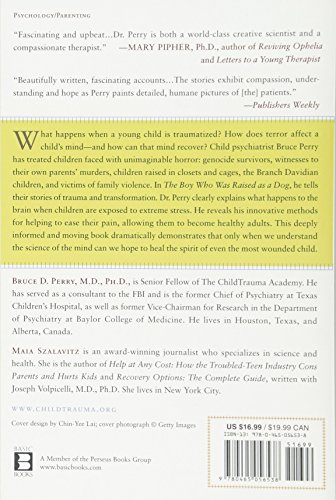


The Boy Who Was Raised as a Dog: And Other Stories from a Child Psychiatrist's Notebook - What Traumatized Children Can Teach Us About Loss, Love, and Healing [Perry, Bruce D, Szalavitz, Maia] on desertcart.com. *FREE* shipping on qualifying offers. The Boy Who Was Raised as a Dog: And Other Stories from a Child Psychiatrist's Notebook - What Traumatized Children Can Teach Us About Loss, Love, and Healing Review: Required Reading For Everyone - Dr. Perry is not just a psychiatrist who spends his time listening to and diagnosing clients. He is a maverick, willing to break the rules whenever needed and play detective rather than assert his expertise. By taking this approach to his young clients and studying not just their symptoms, but the treatment they were given from birth, he follows the brain as it develops. What he learns is of value to everyone. We were all children once. As he talks us through each of the cases covered in this book, we get a strong sense of his love for and understanding of the traumatized children. He approaches them slowly and with the utmost respect for their personhood. Like Alice Miller, he is acutely aware of the ways in which we seek to control or diminish small lives and the horrific consequences that sometimes result. But his quest is not just to address the psychological, it is to probe the way the brain itself forms and what can be done when its components lag or turn off. You will find every kind of child in this book, those who murder, those lacking normal social responses and those unable to thrive physically. In each case Dr. Perry reaches back into their past to uncover how the brain was encouraged to or discouraged from developing in corresponding ways. What is different about Perry's work is how he uses with this information. You won't find the perfect drug to control a child mentioned here. You will find some excellent stories about how touch therapy can renew and enhance neural pathways or how dance and movement can help a child regain natural psychological and physical cycles. In every case he fully explains what he did and why and gives full credit to those who taught him along the way. I am not talking about other doctors here, but people such as a foster mother and the children themselves. Even if you have no children and never plan to work with them, this book is worth reading. If you are an adult who has always felt out of sync with the world, you may find an explanation here.I found quite a few ah-ha moments and a great deal of personal food for thought. If you are an adherent of mind/body medicine, much of what he says will appeal to you as well. Review: Inspiring stories, well-written and applicable - "The Boy Who Was Raised as a Dog" is an excellent book full of real-life examples of children who have experienced severe trauma and successful therapies administered to them. As an educator, I have found myself reflecting on the many "problem" children I've encountered in school settings, and wondering how many of them had been exposed to trauma at young ages, or even currently. I truly enjoyed reading about each case presented in this book, and the way each of these children overcame their painful pasts and experiences with the help of Dr. Perry. As I've observed students and their family lives over the years as a teacher, I've come to agree more and more on the importance of stability, love and quality time spent in the family for children. I've often theorized that the lack of quality time spent with parents have diminished children's linguistic abilities, but after reading this book, I've come to realize that the damages are far more extensive. Dr. Perry's concluding chapter outlines the needs for children to be cared for in healthy environments, as early as in their infancy. He contends for the need for community, extended families, cooperation and empathy in our lives in order for our brains to develop healthily. It is a good commentary on our familial and societal issues, and we cannot argue that many of the issues we face today stem from broken relationships in the smallest units. The stories in the book are well-narrated, and Dr. Perry's writing style is easy to read and interesting. If you are interested in reading a book about neglected and abused children and how to help them, this book is an excellent choice.
| Best Sellers Rank | #495,841 in Books ( See Top 100 in Books ) #12 in Post-Traumatic Stress #15 in Popular Child Psychology #38 in Popular Psychology Pathologies |
| Customer Reviews | 4.8 4.8 out of 5 stars (9,111) |
| Dimensions | 5.25 x 0.75 x 8 inches |
| Edition | Reprint |
| ISBN-10 | 0465056539 |
| ISBN-13 | 978-0465056538 |
| Item Weight | 8.6 ounces |
| Language | English |
| Print length | 288 pages |
| Publication date | December 25, 2007 |
| Publisher | Basic Books |
B**4
Required Reading For Everyone
Dr. Perry is not just a psychiatrist who spends his time listening to and diagnosing clients. He is a maverick, willing to break the rules whenever needed and play detective rather than assert his expertise. By taking this approach to his young clients and studying not just their symptoms, but the treatment they were given from birth, he follows the brain as it develops. What he learns is of value to everyone. We were all children once. As he talks us through each of the cases covered in this book, we get a strong sense of his love for and understanding of the traumatized children. He approaches them slowly and with the utmost respect for their personhood. Like Alice Miller, he is acutely aware of the ways in which we seek to control or diminish small lives and the horrific consequences that sometimes result. But his quest is not just to address the psychological, it is to probe the way the brain itself forms and what can be done when its components lag or turn off. You will find every kind of child in this book, those who murder, those lacking normal social responses and those unable to thrive physically. In each case Dr. Perry reaches back into their past to uncover how the brain was encouraged to or discouraged from developing in corresponding ways. What is different about Perry's work is how he uses with this information. You won't find the perfect drug to control a child mentioned here. You will find some excellent stories about how touch therapy can renew and enhance neural pathways or how dance and movement can help a child regain natural psychological and physical cycles. In every case he fully explains what he did and why and gives full credit to those who taught him along the way. I am not talking about other doctors here, but people such as a foster mother and the children themselves. Even if you have no children and never plan to work with them, this book is worth reading. If you are an adult who has always felt out of sync with the world, you may find an explanation here.I found quite a few ah-ha moments and a great deal of personal food for thought. If you are an adherent of mind/body medicine, much of what he says will appeal to you as well.
G**5
Inspiring stories, well-written and applicable
"The Boy Who Was Raised as a Dog" is an excellent book full of real-life examples of children who have experienced severe trauma and successful therapies administered to them. As an educator, I have found myself reflecting on the many "problem" children I've encountered in school settings, and wondering how many of them had been exposed to trauma at young ages, or even currently. I truly enjoyed reading about each case presented in this book, and the way each of these children overcame their painful pasts and experiences with the help of Dr. Perry. As I've observed students and their family lives over the years as a teacher, I've come to agree more and more on the importance of stability, love and quality time spent in the family for children. I've often theorized that the lack of quality time spent with parents have diminished children's linguistic abilities, but after reading this book, I've come to realize that the damages are far more extensive. Dr. Perry's concluding chapter outlines the needs for children to be cared for in healthy environments, as early as in their infancy. He contends for the need for community, extended families, cooperation and empathy in our lives in order for our brains to develop healthily. It is a good commentary on our familial and societal issues, and we cannot argue that many of the issues we face today stem from broken relationships in the smallest units. The stories in the book are well-narrated, and Dr. Perry's writing style is easy to read and interesting. If you are interested in reading a book about neglected and abused children and how to help them, this book is an excellent choice.
A**R
a must read for childhood trauma survivors
There was so much i have noticed about myself but I don’t understand or know where it was coming from. I see now how my brain has been shaped by my abusive parents and I can move forward. It’s so important to also know that these things cannot be undone but managed and retrained, just not undone. I have a lot more understanding about myself and I can focus on my healing in a different, more realistic way now.
M**Y
Highly recommended!
Perry combines neuroscience and a belief in the resiliency of severely traumatized individuals to show that healing can happen in the most dire of circumstances. I recommend this book for mental health professionals, psychology students, or the lay person with an interest in psychology. Each case study is presented in a clear and interesting manner, which keeps the reader engaged. For the mental health professional, Perry's book offers a model of relating to traumatized individuals using a biosocialpsychological model that truly integrates biological understanding with attachment theory. The author provides hope to the clinician working with severely traumatized patients that changes can happen biologically through the brain's neuronal plasticity combined with consistency, therapeutic love, and human connection. Perry helps the clinician believe that even the most traumatized individuals can heal, which is helpful for the sense of hopeless that clinicians can often feel in working with this population. Perry provides a fantastic display of clinical work, compassion, and science written in an easy to digest manner. I highly recommend this book and find myself re-reading various stories that will stay with me forever. Michelle Zody, M.A. Clinical Psychology doctoral student
A**L
Wonderful resource
A wonderful resource for those who work with or have children who have experienced trauma in their lives. The chapters are long, but are full of ways to both recognize trauma and how to help the child who has survived it. Wish i would’ve found this earlier! It gives me hope for those suffering. I gave it a 4 star only because of the loooong chapters.
W**S
Pungentes relatos de alguém que dedicou sua vida a tratar de crianças tramatizadas.Necessário a todos os profissionais que militem na área
T**T
Dr. Bruce Perry's "The Boy Who Was Raised as a Dog" is one of the most profound books I've encountered on childhood trauma. As someone who's always been interested in understanding human psychology, this book was both devastating and illuminating. Perry's approach of using individual case studies makes complex neurological concepts accessible while never diminishing the humanity of his subjects. The titular story about a child who was literally kept in a cage is haunting, but what makes this book exceptional is how Perry explains the neurobiological impacts of trauma with remarkable clarity. His explanation of how trauma affects brain development and how timing of traumatic experiences impacts different brain regions has completely changed how I understand human behavior. What separates this book from others in the field is its ultimately hopeful message. Perry doesn't just catalog horror stories - he demonstrates how understanding the brain's response to trauma can inform treatment approaches that actually work. His neurosequential model, focusing on addressing lower brain regulation before attempting higher cognitive therapies, makes incredible sense once you understand the science behind it. The book strikes a perfect balance between scientific explanation and compassionate storytelling. Some sections were so emotionally difficult I had to take breaks, but Perry's genuine care for his patients always shines through. His humility in acknowledging his own early mistakes in treatment approaches adds credibility to his work. For anyone working with children, or simply trying to understand human behavior (including their own), this book is essential reading. The insights about how our brains develop in response to our environments have applications far beyond clinical settings. This isn't just a book about extreme trauma - it's about understanding what all humans need to thrive.
A**R
Nice stuff to read .
G**N
Ho comprato questo libro dopo aver letto “The body keeps the score” e devo dire che segue molto quella linea di pensiero. Mi è piaciuto molto, rispettoso dei pazienti citati senza mettere in evidenza dettagli degli abusi.
N**T
Must read for any person working with kids (& for parents). It is definitely a book that dives in deep. So insightful. Thank you Maia and Bruce for writing this and making this knowledge available.
Trustpilot
2 weeks ago
5 days ago