
DOWNLOAD THE APP


Customer Services
Copyright © 2025 Desertcart Holdings Limited
DOWNLOAD THE APP
Full description not available
J**N
When Tennis was a Prize Fight
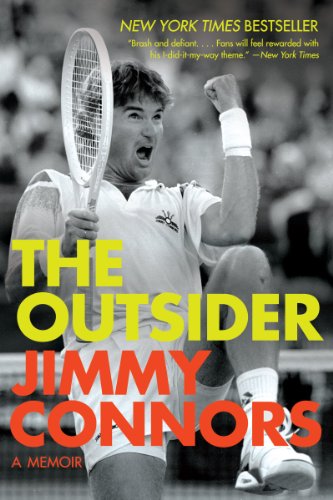
When Tennis was a Prize FightAs a teenager of the 1970s, I was not simply a Jimmy Connors fan. Connors was not just my favorite tennis player. I wanted to play like him, look like him, behave like him, and win like him. While possessing the same small, lanky build was not by choice, other things were: the same floppy hair, the same two-handed backhand, the Wilson "T" series steel racquet; and the same attitude, manufactured on my part during my high school matches.There was nothing I loved more - nothing - than watching Jimmy Connors play tennis. And with each match my emotions ran the gamut: exhilarated when he hit a crosscourt backhand winner, flabbergasted with yet another flat forehand too low and into the net, outraged when the umpire refused to overturn a bad line call, and demoralized when Connors lost.The affinity with Connors lasted well into my adult life. In Virginia Beach, Virginia, where I lived for several years in my 20s and 30s, there is a street named after Mr. Connors, and I got a true sense of satisfaction as I drove past it on my way to work in the morning.So, when a colleague and fellow tennis enthusiast suggested I write a review of The Outsider, Connors's long-awaited autobiography (Harper Collins, 2013, 401 pages), I immediately thought it to be something I would enjoy doing.The Outsider isn't the typical story of a famous person, celebrity or athlete, one who was among the several greatest players in the history of his sport, who dragged tennis from the country clubs to the playgrounds. It is more akin to the pedestrian life a regular person, who, like many, has fantasized about writing his own life for others to see, to tell the world what made him tick, what made him angry, and what frustrated him. Connors writes less about his tennis and more about his life, his family, his friends, and there are even two pages devoted to the various dogs he owned. He obviously wants to tell us not so much how he played, but how he lived. The overarching narrative is that of a blue collar boy in a white collar world, who felt like an outsider in whatever circumstance he found himself.There are the expected inclusions, such as how his mother (Gloria) and his grandmother (Two Mom) formed his game and his approach to life. He of course writes of his love for wife Patti and his two children, as well as his almost career-long devotion to his Wilson T-2000 racquet.But he also writes - at length - of things we did not expect, such as his early life, how when he was only eight a physical attack on his mother by two thugs framed his competitive spirit and his will to go into combat on the court. He tells of his gambling addiction, his failures as a husband, and his triumphs as a father. That pugilist-like nature existed not only on the court, but off as well, as we read of Connors successfully fending off two physical attacks on Patti.There are accounts of things we did not know jet-setting tennis players were faced with, like doing laundry, keeping up with tennis shoes, and booking flights. Don't they have "people" to handle those things for them? Evidently, Connors did not. Who knew they actually are handed a live check after winning a tournament, and that - at least in Connors's day - they had to scramble so hard to earn significant sums of money.Quite disappointing is the lack of match commentary, far less than in the typical story of a star tennis player. The tennis tournaments are commonly portrayed as just something he is doing while on a trip to New York, or London, or Paris, to visit friends and to party. The entire 1974 "grass slam" season - still the most successful single season by a male player since Rod Laver's (second) grand slam of 1969 - is covered in just a few pages. Connors includes practically nothing about the epic five-set Wimbledon final loss to Bjorn Borg in 1977.Connors tells us nothing at all of "the tiebreaker" in the U. S. Open final versus Borg at Forest Hills in 1976 or of "the point" against Dutchman Paul Haarhuis at Flushing Meadow in 1991. We miss the point-by-point detail of the days when tennis was more like a prize fight and the players like boxers in the ring, circling each other, trying to get under each other's skin in the heat of the contest.He writes about his friends, those personal and those in tennis: Ilie Nastase, Vitas Gerulaitis, and others. Connors writes in detail about partying on the town with Nastase or playing backgammon with journeyman lesser known players after his matches had concluded. He seems more excited to write about his life on the 35-and-over Champions Tour late in his career than about his two Wimbledon victories in 1974 and 1982.Connors's thankfulness for his mother's formative role in his life is evident throughout, including spending half his time with her in the final weeks before she died. Somewhat balancing out the needless profanity and oft-repeated obscenities throughout the book - regrettably, this is not one for the kids, folks - is a quite heartfelt comment about his mother's devotion to her personal Bible, and how she had left notes to him in it which he found after her death.The book reads frankly and seems to be more so dictated than written, leaves out much of the tennis, but it nonetheless is a thrill to read, giving the reader many previously unknown insights into Connors the man. This is his story, and we must let him tell it as he desires.-Joel D VaughanColorado Springs, ColoMay 27, 2013
T**R
The sportsmanly soul search of tennis' no. 1 iconoclast attraction
Of all the sports autobios, who would have thought that the most poignant, down to earth and conversational would be written by one of tennis' black hats from the good old days of the 70s? A time when there were so many top flight players that competition parity required a series of main event challenge matches to fill in the gaps between major tournaments. To understand the scope of that era was to admit that the decade gave us the best of everything, from sports to pop culture. Enter Jimmy C, self described outsider (but in reality an All American kid from the heartland with the right chip on his shoulder necessary for greatness), and you got a career memoir that out gut checks all of the new age poseurs, pretenders and phoneys.Cast as tennis' original bad boy, what he was really up against was the red tape monopoly of open tennis and pro tour politics based on Grand Slams and global satellite events that limited a star player's right to earn a living as an exhibition free lancer. So all these years after he was unfairly painted by the media as anti-establishment, what he really was was a maverick headliner who was trying to turn tennis into showtime entertainment and not just so many ranking points on an ATP computer. All this mind you in the middle of the racket sport's golden age when it was free of boring robotic players, one dimensional power games and it had standard sized equipment less forgiving and more demanding of rare talent and bold character.What you take away from this is the crucial importance of supportive parentage and quality family in the quest for achievement in life. And Connors' saga with his mom who nurtured, guided and managed his career, benefited from that more than any athlete other than Tiger Woods. So much so that this book is as much a story about family as it is a window into the makings of an ageless, transgenerational champion. Any ego displayed is a product of a proud, healthy upbringing and most of it details the journey and struggle of his accomplishments and not just the fame and fortune. This much is true when he seems to focus a lot more on maintaining his late longevity than dwelling on the early stages of his rocket to tennis stardom.At home as the people's blue collar tennis icon, Jimmy was self made more from hard work than luck. And you get the feeling that there was much more to him than tennis when a romance blossomed with champion beauty Chris Evert at a young age. If the pairing was never meant to be, she came across as a control freak and he was no pushover. In the midst of a tennis rock star life style, JC never fell prey to the excesses of fame except when he had an affair and gambling became an issue. But then it was only a pastime replacement for the action he left behind when his fleeting ranking and failing health would no longer hold up. More than just stats or records, his career end game was his swan song and he hit his peak when father time said no mas.Jimmy willed his slight physique to the top of the tennis world through mental toughness. You won't find a winner in open history who put his body through more punishment and got more out of it. With wrist and hip injuries, 8 slams and 109 total tournament wins to his credit, his legacy is well earned. The personal life he reveals behind the scenes after he was spent and the spotlight was gone is proof that his success story never lost a sense of priorities. In this sincere book who he is as a cocky tennis personality is not emblematic of his humble humanity in private moments. Ultimately, this book gives him away as an individualist who flourished in a lonely individual sport. The courage to be himself in order to compete at the highest level is what he was all about. And you gotta like, love or respect that.
C**F
The Inner Connors
Tennis autobiographies are intriguing to me, and this one ticks a lot of boxes. Jimmy Connors took on many opponents and often the crowd to reach his goals. Eventually the New York crowds at the US Open accepted him as one of their own, and he had a grand slam home. He won 5 US Opens, 2 Wimbledon's and an Australian Open. He won a record 109 professional tournaments in all. In his book he gives insights into his important matches, opponents, friends and foes. He does not hold much back with his opinions and perhaps gains many of his readers respect with the detailing of his sheer determination to be number 1. The tireless work of his mother with help from her parents cannot be understated and isn't. He almost blows his relationship with his beautiful wife Patti, but realises he cannot live without her. It was great to see they worked things out and provided Jimmy with two children and a loving family life that lights up the latter part of the book. Jimmy Connors was part of a golden generation of tennis characters including Borg, McCenroe, Gerulaitis and partner in comedy crime Nastase. All play their part in a great read.
A**J
Compelling
Compelling autobiography. I liked the style of the writing. Connors personality came across very loud and clear throughout.However, his memory of his record against Borg at the US Open was a little inaccurate, given that the Swede beat him in their final encounter there in the semi finals in 1981 in straight sets; 6-2 7-5 6-4. But of course, Jimmy has already conveniently erased that loss from his memory bank.
P**L
It's irritating, but why should he care?
This is an OK book if you're a tennis fan of a certain age. I read it mostly because I had a crush on the peerless Chris Evert and wanted to hear about Connors' relationship with her, but Connors doesn't really do "insight" on the human level.Connors is comfortable in his own skin, and he can be admired for that as well as for his brilliant tennis career. But don't expect to learn much from him, as it seems like he has nothing to give other than to himself.For insight, warmth and a thoroughly good read, buy Agassi's book instead. Or as well, so that you have the two extremes of tennis autobiographies to compare and contrast.
T**7
No Holds Barred
This is one of the best sports biographies I have ever read. Jimmy Connors tells his story, warts and all, in a candid account of his career. He pulls no punches in his opinion of the many and varied characters he has encountered, and is especially critical of himself in his darker moments. He brings back vivid memories for those of us lucky enough to have seen him play in his pomp, and whether you loved or loathed him as a player, you can't help but warm to him after reading this book.This is no anodyne, sugar-coated tale; it's brash, earthy, vulgar in parts, and ultimately uplifting - just as you would expect from Jimmy Connors.
E**L
Get's better. He does play the victim through out the ...
Starts off very poorly but get's going. Sloppy cartoon writing and nearly stopped reading after the first chapter . Get's better. He does play the victim through out the whole book and this makes his version of events less than credible.. His wife can not have been that pleased that the first 50 or 60 pages are all about Chris Evert. Inclusive of a very unnecessary and unbalanced version of a major issue in their relationship. Clearly, he is still very hung up about her. Have to say at the end, I thought there was in fact a human side to this boorish tennis player. If only because he likes dogs. Everything else in his life seemed marred by prize money or the terms and conditions. Agassi gets a sharp reply to the accusations made against Connors in his Autobiography. Chris Evert has still yet to write her memoirs. So it's her turn next. I hope Jimmy is sitting comfortably....
Trustpilot
3 weeks ago
2 days ago