

Desert Online General Trading LLC
Warehouse # 7, 4th Street, Umm Ramool, Dubai, 30183, Dubai
Desert Online General Trading LLC
Warehouse # 7, 4th Street, Umm Ramool, Dubai, 30183, Dubai
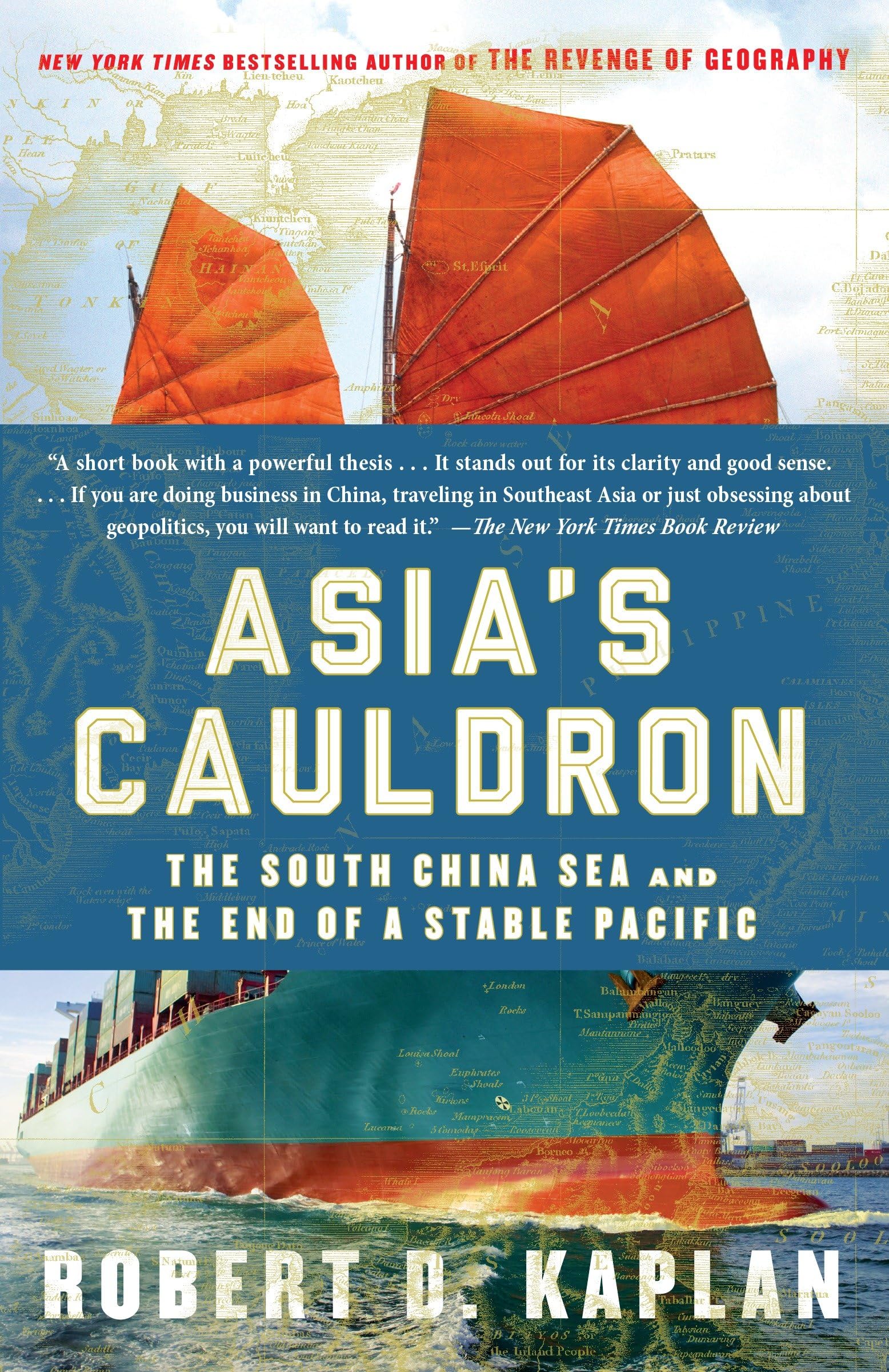
Asia's Cauldron: The South China Sea and the End of a Stable Pacific
A**E
China's Claim to the South China Sea, and It's Obstacles to that Goal, Especially the U.S.
It's ironic that I write this review on the day that the U.S. and the Philippines agrees to a new military alliance, where the U.S. sends rotating troops and navy ships to perform maneuvers and reconnaissance. The U.S. now has similar treaties with Australia and Singapore. I've also been reading recent articles on why the U.S. is making military commitments, to counter China, with Obama stating that "China isn't the focus."This book explains what this situation is all about, the situation of each country on the South China Sea, and why China is so hostile to all this. Note that China is building up their military, not their army, but their navy, and to a slightly lesser degree, their air force.The American press pictures China as the hostile power here, but when you look at it, China feels they have a rightful claim to the South China Sea, just as the U.S. has a claim on the Caribbean and the Gulf of Mexico, and Europe having a claim on the Mediterranean, except that the U.S. does not violate the territorial waters off of other countries in the Gulf or the Caribbean.With China now being a major economic power, and they do do business with India, Africa, and the Middle East,the South China Sea provides major passage between the Pacific and Indian Oceans, and, like the United States, China intends to become a two ocean country. This sea also has a lot of valuable natural resources, starting with oil and natural gas, not to mention rich fishing grounds, and China is going to want all that wealth. With a population of 1.3 billion people, they are going to need it.Another little known fact is that China does not go by the Law of the Sea treaty, with a claim 200 miles of the continental shelf off its coast only, with all other international borders respected. China want all of the sea. The U.S., from their point of view, has no right to it because they are a country 7000 miles away, with no claim whatsoever. China, having a history of being colonized, and humiliated by other world powers, in coming into its own, and what they claim, they will have. That's the way they see it. Are they really the villains?Other countries around the sea do see China as a threat, and China's claims are intruding on their own territories on the sea, with Chinese coast guard vessels driving off fishing boats and other vessels, laying claim to small islands other countries also claim (the Spratleys, the Parcels, etc.).Because of this, these countries, Japan, Taiwan, the Philippines, Vietnam (yes, Vietnam), Indonesia, Malaysia, Singapore, and Australia are all drawing up treaties with the U.S., allowing them to either establish naval bases or at least allow our navy ships to dock at their ports. Many of these countries and also establishing posts of their own in the sea to counteract China.This is where the situations stands today.Robert Kaplan has visited these countries, studied their cultures, and history, and gives a clear understanding of why these countries, and China, have the points of view that they do. In order to stabilize that part of the world, the U.S. Navy, and Air Force, has to be there to protect these countries and allow freedom for their ships, merchant and military, to sail where needed. China needs the freedom to sail on the South China Sea, through the Straits of Malacca, to the Indian Ocean and beyond to Asia, Africa, and the Middle East.What is especially interesting is the question on Taiwan. China may want it back, and they are very stubborn about this, but Taiwan's coast is almost impossible for ships to land in invade, and the Taiwanese themselves are armed to the teeth.Vietnam, in spite of our war with them (they call it the American War), has invited the U.S. Navy back to Cam Rahn Bay for ships to dock. They have a sense of superiority because they won the war against us, but that is fading into history.Malaysia is an interesting case because, although Muslim, that also have a Chinese and Indian population, and they all get along quite well.All these countries and cultures are described in great detail, and gives us a point of view that Americans do not have.One reason why this book is accurate because after I have finished reading it, I read in the newspapers how U.S. Air Force reconnaissance planes constantly flies over the South China Sea to spy on the Chinese and test their reaction. It is only a matter of time before the Chinese navy and air forces catches up with us.Also given are scenarios of China should their economy begin to fail. How likely that is remains to be seen.When you read the newspapers about the present situation in the South China Sea, I strongly recommend that you pick up this book for a clear point of view, and how China and Southeast Asia sees it.
P**.
Deeply Enriching Lessons About China, Vietnam, Malaysia, Singapore, the Philippines and Taiwan
I bought this book reluctantly since I don't like to read more than one book by an author and I've read Robert Kaplan's earlier book entitled "Monsoon: The Indian Ocean and the Future of American Power," which is very insightful and instructive. Mr. Kaplan tops himself.This little compact book is actually excellent, just like each iteration of Apple's iPhone and Samsung's Galaxy S smartphone. I'm glad I bought and read this informative book.I've traveled to some of the countries (and have close friends who were born in the countries) that are featured in this book. Mr. Kaplan delivered yet again, succinctly capturing the essence and historical and contemporary nuances of the countries he featured in this book. He solidly portrayals each of the nations that are located within the sphere of the South China Sea.The biggest takeaway from this book is that the geopolitical struggles that have been occurring in the South China Sea have significant ramifications for every nation on planet Earth and Earth itself (e.g., climate and sea level changes). These struggles will likely continue long into the distance future and the constant multitude of wakes generated in the South China Sea can and will have existential relevance not only to the "physical speck of a city-state" known as Singapore but also to large and small nations in every other continent in the world, especially as the world now (the Summer of 2014) watches Iraq disintegrate further into the abyss.While the world now watches helplessly as the US "liberated" Iraq descends further into a hellish nightmare and the Islamic State of Iraq and the Levant and similar savage militant groups continue to run amok, the prism through which one should formulate and implement strategic relationships among and with nations that are within the sphere of the South China Sea should include the following optics Mr. Kaplan proffers:"[T]he ruler who moves society to a more advanced stage of development is not only good, but perhaps the most necessary of historical actors -- to the extent that history is determined by free-willed individuals as well as by larger geographical and economic forces. And the good autocrat, I submit, is not a contradiction in terms; rather, he stands at the center of the political questions that we face and will continue to face. The South China Sea region proves it."Mr. Kaplan explains:"The good dictator, by fostering economic growth, among other things, makes society more complex, leading to more civil society groupings, and to political divisions based on economic interest that are by definition more benign than divisions of tribe and sectarian or ethnic group. A good dictator can be defined as one who makes his own removal less fraught with risk, by preparing his people for representative government. All this is exactly what Lee [Kuan Yew of Singapore] and Mahathir [bin Mohamad of Malaysia] accomplished."While the Middle East is on the precipice of imploding and Vladimir Putin's Russia continues to make incursions into Ukraine, current and aspiring world leaders along with business executives should also keep their keen eyes on changes that are shaping up in the South China Sea, which "is a nervous world, crowded with warships and oil tankers, one of incessant war games without necessarily leading to actual combat." And this book helps sharpen those keen eyes.Those keener eyes counsel against a Paul Revere reaction to China's "rising military powers," alerting readers to critically analyze China's supposed desire to establish hegemony over the South China Sea and to question China's mantra of "while China only defends, the United States conquers." The hypothetical war games presented in the latter part of this book are fanciful but perhaps instructive for military planners and politicians.At the end of the day, as Mr. Kaplan poignantly asserts, "The South China Sea will grow in importance less because of the hydrocarbon resources it holds than because of the increased amounts of imported oil and natural gas passing through its sea lanes." Mr. Kaplan ends the book as follows: "But as much as I heard bout submarines throughout my journeys, the image of the slum encampment on stilts in the water lingers, too."The grinding poverty that pervades resource-rich nations in Africa is also prevalent among nations that surround the South China Sea. Sea piracy will remain a potently tangible treat as long as pervasive poverty exists. Therefore, the navies of both China and the United States, whose economies are becoming ever more intertwined, must work together to defend the sea lanes against piracy in the South China Sea, the defense of which would partly require genuine joint efforts to alleviate poverty throughout the region. This common interest between China and the United States is likely to predominate over maritime disputes involving "features" in three archipelagos: the Pratas, the Paracels and the Spratlys.
Trustpilot
2 months ago
1 month ago