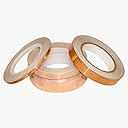
![JVCC Copper Foil Tape [Conductive Adhesive] (CFL-5CA): 1/4 in. x 36 yds. (Copper)](https://m.media-amazon.com/images/I/61xV+ckaBtL.jpg)


🛡️ Shield your tech, stay ahead of interference!
JVCC CFL-5CA Copper Foil Tape is a 1/4 inch by 36 yards premium copper tape with a conductive acrylic adhesive, engineered for superior EMI/RFI shielding. Featuring ultra-low electrical resistance (0.003 Ω/sq), high tensile strength (36 lbs/in), and heat resistance up to 311°F, it’s the go-to solution for professional-grade electronics repair, prototype design, and static charge management.
R**E
Resistance of 1/4" wide copper tape
For those of you who are electrically inclined, I did a quick back-of-the-envelope calculation for the resistance of this copper tape. The description says that it's 3.5 mils (.0035") thick, and of course it's 0.25" wide. That defines the cross-sectional area of the tape. The resistivity of copper is 16.78*10^-9 ohm-meters. Converting the inch measurements to metric and plugging into the standard formula, I get that the tape has a resistance of about 0.00075 ohms per linear inch, or 0.75 milliohms per linear inch.What this means is that for each inch of tape, you add an incremental resistance of .00075 ohms. If you roll out 10 feet of the stuff (120"), the end-to-end resistance will be 0.09 ohms. If you run 1 amp through this tape length of 120", you will see a voltage drop of about .09 volts. (Voltage drop equal current times resistance, which is called "Ohm's Law" in the business.) Bear in mind that this is just for one of the conductors. If you use this tape for a 2-wire power system, the other piece of tape will experience the same current drain, so it, too, will have a .09 volt drop across it. This results in a total voltage drop at the end of 2*.09V = .18V.You can easily calculate the resistance of other tape widths by decreasing the .00075 ohm figure by the ratio of the other tape width divided by this tape width of 0.25". For instance, 1" tape is 1.0"/0.25" = 4, so decrease the resistance by a factor of 4, resulting in .00019 ohms. Wider tape means less resistance, and therefore less voltage drop per length of the tape.
T**P
Poor conductor of electricity
The only reason I purchased product is due expected properties of conductivity. Tape was poor and messy better of and easier using soider to tab solar cells.
V**H
The adhesive does not conduct electricity
Since heating batteries can damage them, I wanted to avoid solder to create new battery packs for our phones. Instead, I attempted to use the JVCC CFL-5CA Copper Foil Tape with Conductive Adhesive (1/4 in. x 36 yds). However, the adhesive is not conductive at all. To test this, I securely wrapped the ends of my multimeter probes with a section of the tape. With the adhesive side in contact with the probe surfaces, I measured an open circuit. Given that the reason to pay a premium for this expensive tape is the promise of conductive adhesive, this warrants a rating of one star.
D**S
Like another reviewer
I purchased this tape for its electrical conductivity. Like another reviewer, I too bought this tape as an alternative to connecting solar cells without soldering. And it seems to work out just fine. The electrical current passes through the adhesive as promised. The resistance is mostly nominal, as another person said, the more contact area you have with the adhesive, the less resistance there is. The adhesive is also quite strong, once you firmly press down on the tape, it is difficult to remove from the surface you are sticking it to. At least for me, the solar cells are quite fragile, so once you apply the tape, don't try to undo it, or the tape will destroy the cell. Other people talked about it about getting cut by the tape, and sure enough first day I got cut by it, beware of the sharp corners. Can't solder to the adhesive side, repels the solder, but can definitely solder to the topside. I definitely recommend this to someone who needs to make a super flat electrical connection. Some reviews indicate this is not electrically conductive adhesive, but I suspect they did not actually apply it to a surface. If you put an ohm meter up to the adhesive only, there is no reading. But once the adhesive is firmly pressed and adhered, the electrical connection across the adhesive is there and measurable. I liked this tape, but for my application (connecting solar cells), I will highly recommend the double sided tape instead, it is much faster when both sides have the conductive adhesive.
M**A
Great for rewiring model locomotives.
I bought this tape to install DCC decoders in some very old, very small N-scale locomotives. It was a life-saver when used in conjunction with Kapton insulating tape, as opposed to having to drill out the frame to allow room for standard wires. The adhesive is fair - you really need to press it on - but in my application, it's a non-issue since it's held in place by other parts and/or the insulating tape. It's VERY easy to solder to and quite simple to trim to size. I'm already brainstorming other uses for this stuff.
Z**S
If using as a wire, please consider buying Tarn-X
I bought this product for a home project whereby lights are controlled by an Arduino. Instead of wires running from lights/sensors to arduino I instead used this copper foil for artistic purposes. The problem that I ran into was that foil tarnishes fast and placing one piece of foil over another resulted in very high resistance along the junctions. At one point I measured 20 ohms of resistance after 4 junction points.The solution was to cut the junction points where two pieces of copper overlap and replace them with fresh pieces of copper foil. I used tarn-x to remove the highly resistive tarnish to join the new copper with the old copper. Make sure you have a *lot* of overlap.Despite this, it seems that the junction points increase their resistance as time goes on. On the next project I'm going to experiment with aluminum strips since aluminum doesn't tarnish nearly as fast. It's also entirely possible that the acrylic-based adhesive is to blame.
Trustpilot
3 weeks ago
1 week ago