


Buy anything from 5,000+ international stores. One checkout price. No surprise fees. Join 2M+ shoppers on Desertcart.
Desertcart purchases this item on your behalf and handles shipping, customs, and support to South Africa.
🌶️ Grind like a pro, savor like a local — authentic Mexican flavor in every crush!
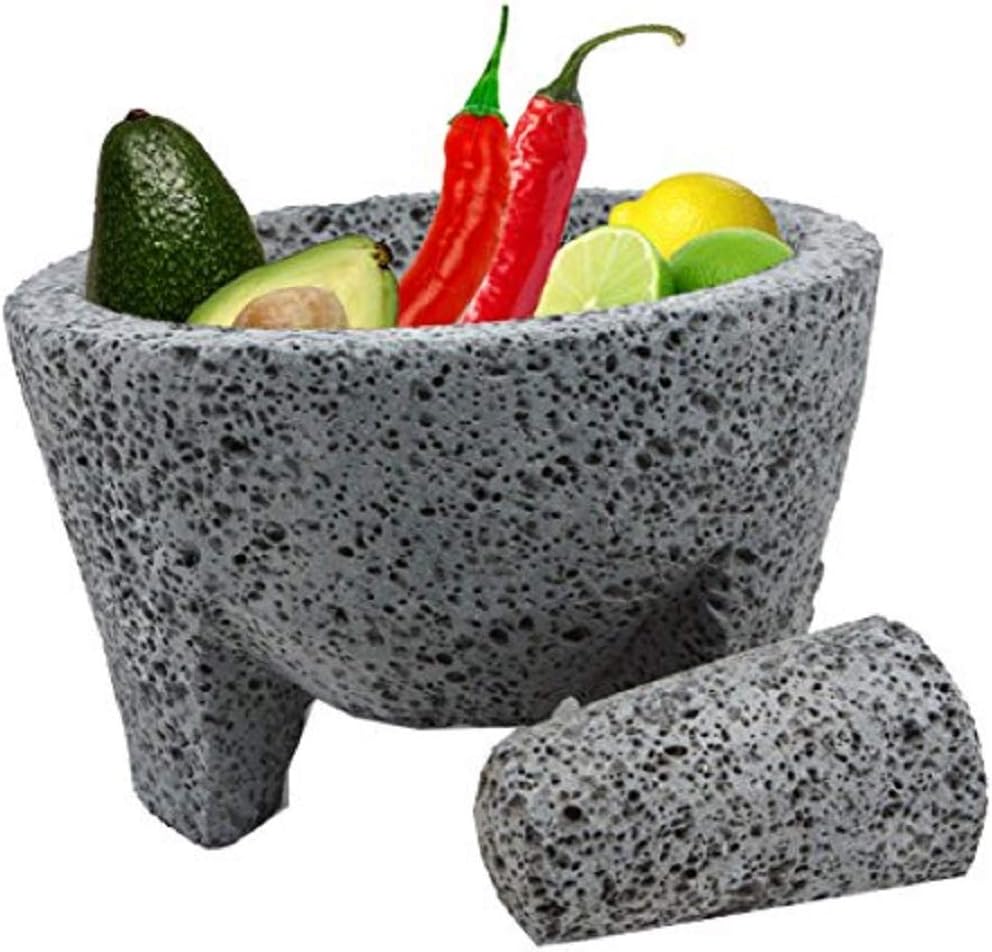
The OUTASIGHT Molcajete is an 8.5-inch diameter, 8.5-pound authentic handmade mortar and pestle crafted from porous volcanic lava stone. Designed for durability and optimal grinding, it requires initial seasoning to smooth its surface and unlock rich, traditional Mexican flavors. Perfect for making guacamole, salsas, and spice blends, this kitchen tool grows better with use, offering a lifetime of bold culinary experiences.
| ASIN | B001J3ZZ4I |
| Best Sellers Rank | #449,634 in Kitchen & Dining ( See Top 100 in Kitchen & Dining ) #459 in Mortar & Pestles |
| Brand | OUTASIGHT |
| Brand Name | OUTASIGHT |
| Color | Black |
| Customer Reviews | 4.6 out of 5 stars 1,338 Reviews |
| Finish Type | Unfinished |
| Included Components | 1 Mortar, 1 Pestle |
| Item Diameter | 8.5 Inches |
| Item Dimensions | 12.6 x 9 x 9 inches |
| Item Weight | 8.5 Pounds |
| Item dimensions L x W x H | 12.6 x 9 x 9 inches |
| Manufacturer | TheLatinProducts |
| Material | Lava Stone |
| Material Type | Lava Stone |
| Model Number | 8541981377 |
| Part Number | MOLCAJETE W/PESTLE |
| UPC | 793842067323 844819004008 |
| Unit Count | 3.00 Pounds |
G**Y
A little work up front and you'll have a wonderful kitchen tool for a lifetime
If you're interested in a molcajete you've probably read a billion articles about seasoning it. They all say different things and they all say their way is the best. The basic takeaways are: -Wash it with water to get dust and loose grit out. Doing this under a high pressure shower head works nicely. -Let it dry and then start grinding rice to powder in it to smooth the inner surface and work out additional grit. Keep grinding palm-fulls of rice until the rice dust is coming out white. -Get a small stiff brush that you only use for cleaning the molcajete. Brush out the dust with some water. In the future this is all you need to wash out the molcajete. No need to ever use soap, which might add an undesirable flavor. -There will still be a little grit but you can start making salsa in it now. The grit will find its way to the liquid at the bottom. After a couple batches, you should stop seeing grit and then you can use it for grinding spice blends and making guacamole. -Through use, the inside of the molcajete will become seasoned, growing smoother and darker than the outside. -The main thing is to just start using it. Don't grind rice in it for weeks because you keep finding a piece of grit. It will become perfect with time and use. I'm no expert, but this seems to be the real deal, volcanic rock. There are signs of hand-working the stone, which is porous and flecked with shiny bits and ceases being dusty and gritty after the initial preparation process. As for size, it's probably on the small end. A one-avocado batch of guacamole fills it up pretty well, but there's probably room for two.
K**S
An actual volcanic rock Molcajete
Okay, first and foremost, ignore ANYONE who insists that "real" molcajetes are slick, black river rock basalt. They are insane. Unless you are shipping basalt from the Pacific North West, don't expect to find this kind of basalt used in a Mexican Molcajete. A real molcajete *IS* made of basalt, but it needn't be made of river rock basalt (as is the case for the MAJORITY of ones used in Mexico). This is in fact an actual volcanic rock molcajete. It has the mottled color, the porous surface, the noticeable tool marks when it was made, and...well...if you can't tell the difference between volcanic rock and concrete, molcajetes are not for you (hahahaha). Now, it is also important to note that basalt comes in a WIDE range of colors: black (usually in rivers) to light greys, sometime with white splotches all over. If yours is not jet black, that is A-okay as long as it is still basalt...which this one is. Now, you need to cure it. What I did: I started with 120 grit sandpaper and I SANDED EVERYTHING! I sanded the feet, the sides, the inside...EVERYTHING! Do a few extra passes on the tejolote because the sides of that never grind against anything, so it doesn't smooth as well during the grinding as the rest of the bowl portion. Once it is smooth enough that it no longer hurts to move your hand across it, it is time to start grinding. Start with 4 runs of dried corn (1 cup for each run). Add small portions and grind in a smooth motion that lets your wrist slightly rotate as you come along the sides. After the corn, it is time for 4 runs of dried pinto beans. After the beans, do 4 runs of white rice. By this point, it should be smoothing up nicely, and the rice should be white. If it is not, you need to go back a stage or two. This is a lengthy process. If you stretch it out over a few day, it is fine. Otherwise, if you are like me, be prepared to accept blisters, but get it done in a day or two. Once it is smooth and no longer gritting the rice, we need a final curing. I first roasted 3 serrano chiles. Grind those into a paste. Toss in 3-4 cloves of garlic and grind them. Add some cumin, salt, pepper, and Mexican oregano. Now, here comes the real important part. When you look at a well used Molcajete, you will notice the inside is actually black. How did this happen? Oil. Oils from avocados. So, you can grind some avocado into your curing paste and/or add a little olive oil. Then stick it in a 400-450*F (depending on what oil you used) oven for a good half an hour or an hour with the tejolote in it. Then just turn off the oven and let it chill overnight inside the oven (it takes a LONG time to cool...cause it's volcanic rock). The next day, take a stiff brush and some water and clean it out. It should be nice, smooth, blackened, and seasoned. Now you're ready for guacamole! I've been using mine 2-3 times/week for the past 6 months. It works like a charm and just gets smoother and smoother. By this point, mine is well-seasoned. The bowl and tejolote are smooth and black, and have a slight spicy aroma at all times. If yours is gritty, you have more elbow work to do. It's just that simple. I know, it's 2011...people hate effort, especially in America. But, trust me. It is worth it. The guacamole is as good as you are hoping. This is a good size and makes enough salsa verde for about 3 days worth of using as a condiment with the food I eat. It's a good shape and if you sanded the feet smooth, it doesn't scratch surfaces when you set it upon them (though I still always grind with it on a pot holder).
D**N
Very Impressed! Made of real volcanic rock, once seasoned it's perfect.
This is a very nice molcajete, made with real volcanic rock, not granite like a lot of others, which is ok for getting stuff fine but the coarseness of the volcanic rock is nice for getting a coarser grind on ingredients., Took a good 4 seasoning runs with rice and salt but once seasoned it's amazing. It's pretty heavy so be careful if you have a glass induction stovetop or glass cutting board this could easily damage them. Think I'm going to get some felt or silicone pads to add to the bottom, but other than that this is a really good deal on an authentically made molcajete.
B**R
Very nice but 1st and 2nd one had to be returned
This item is great / as I was curing the outside it wouldn’t stand up / so I realized one leg looks like a piece came off - looks like this happened while machining... The second one arrive and has what appears to be a table saw gash about 6 inches long and the same depth across a curved surface - so again - this was clearly done while machining. Other than that I can’t wait to get the 3rd replacement / the items was packaged amazingly well - so the first chip didn’t happen from mailing. Note to Amazon and the manufacturer This has now been mailed and returned - and then mailed and returned and will now be mailed a 3rd time Simple attention to detail would work Also the angle cut on the legs on the second one was at a 20 degree angle from flat with the table / whereas the first one - two of the legs laid perfectly flat on the table - it was just that 3rd leg was missing 45% of the part that toughest the table so you couldn’t properly use it on that side - any pressure it would tip.. Hand made is great - but your system is greatly flawed
D**W
REAL VOLCANIC ROCK -- HEAVY!! Needs to be "cured"
I would give it 5 stars -- but it didn't come with directions for how to cure it -- I had to google it and ask a chef friend what to do. Bowl is very heavy -- after I cured it, I stuck some felt feet on it so it wouldn't scratch my table & counters -- it appears to be real volcanic rock (I chipped off a tiny bit just to check) -- it does need to be cured before you use it -- it has a genuine, natural volcanic, porous surface. To cure it, I rubbed the whole bowl down garlic & uncooked rice (using the smasher thing) then brushed it down with avocado oil before baking it in the oven for about an hour at 350 degrees. Then, I turned oven off and let it sit overnight to cool (still in the oven). The bowl & smasher thing (can't remember what it's called and don't feel like looking it up...sorry guys!) turned out black and nice looking, but it still has some "holes" in it. I guess that's normal and from what I understand from my culinary friend, I need to season again and do the process all over maybe a time or two more -- but he said product was good quality and purchase overall for the price.
M**S
It’s the real deal.
I finally got myself this molcajete. I have been wanting to get one for many years but never came across it in a store. My package arrived safe and the molcajete was not damaged in anyway. I appreciate the effort and art that goes into making this ancient cooking tool. A PERSON chips away at a piece of lava rock for 6 HOURS. Look up some history before purchasing. It’s absolutely beautiful. I love the small chisel marks underneath and the “imperfections”. I’m pretty sure the Aztecs just used them and didn’t worry about how spanking clean they were... a little dust here or there...it’s a natural product. If the thought of eating from this type of stone repulses you because of some dust, maybe you should look into a granite or other type of mortar and pestle set. I crushed up some rice with it to clean it out anyway and that was too annoying so I used garlic cloves and bits of onion instead. I think that worked better. Yup it smelled like garlic and and onions in the house for days it seemed. I did this until the paste wasn’t grey. I ground up my old chilies to help break it in. I made my first salsa verde tonight and it was quite a workout. I have a little blister on my palm now. But my salsa was amazing and ridiculously delicious. I didn’t spend hours curing it and didn’t see or taste any dust or rocks. I can’t wait to make more! It’s pretty porous. You’ll probably have a bit of hard time to clean out the holes. I just scrubbed it with hot water and a brush and got most of the debris out. There’s no way to get everything out. Just make sure to dry it. I just put in the cold oven and heat to 300•F for 10 minutes, turn it off and let the residual heat dry it the rest of the way. Yes this tool requires a learning curve and some time and energy. No, it’s not the easiest or fastest way to make salsa. If that’s what you want then just use your blender. But where’s the fun in that? Enjoy the salsa making!
S**Y
Authentic molcajete just needs to be cured properly
This is clearly an authentic handmade molcajete which appears to be from volcanic basalt - the way they’re supposed to be. There are slight imperfections with it which don’t appear to have any negative effect on its function. That just adds character to its handmade authenticity. Both the molcajete and tejolote were packaged well in bubble wrap and arrived without any issues. I studied many different recommendations for curing it, and here’s what I ultimately decided to do: 1. Wash the molcajete and tejolote thoroughly with water and then allow them to air dry. Try to wipe up as much of the the grit as possible without letting it run down the drain for the sake of your plumbing. Work on a plastic cutting board or towel to avoid scratching your sink, countertops or tables. 2. Lightly go over the molcajete and tejolote surfaces with 120-grit sandpaper just to add a smooth finish and remove some of the ridges that may be present. Wash both and scrub with a plastic-bristled brush then allow to air dry once more. I recommend having a dedicated brush just for the molcajete simply so soap doesn't inadvertently creep into your cleaning process. 3. Grind a small handful of rice (just rice for the first batch) until it’s a ground to a powder. Work up along the sides and top of bowl cure all working surfaces. 4. Discard rice, wipe off with brush, and repeat with an even mixture of rice and coarse salt. Repeat as many times as needed until rice/salt powder comes out mostly white with no grit. Many have reported that it takes 8-10 batches to remove all grit. I found that mine was clean after only 5 - I think the 'pre-cleaning' process helped to remove much of the initial grit. 5. Season with a couple of cloves of garlic, coarse salt, a few pepper corns and cumin seeds, and grind it down, covering all interior surfaces. Allow paste to sit for a few hours, then wash it out and clean with brush. One last air dry, and it’s now ready to take your salsa game to the next level! *Final note: Never use soap during the cleaning, curing, or cooking process as the soap flavor will leach into the food. Including an out-of-the-box and cured/seasoned "before/after" pictures for reference on what it should look like once it's ready to start making salsas and guacamoles.
B**N
Sturdy unit. So far so good
Received this quickly after ordering. Arrived well packaged. The mortar and pestle are very robust, and while exhibiting some rustic touches due to how they are made, it is all pretty uniform overall and sits evenly on tbe 3 legs. The top edge seems to be slightly off level, but not enough to stand out or interfere with food prep. Again, part of its handmade nature. I haven’t used it to make food yet, as I’m still in the break-in and cure stage. But already I can tell that it’s going to be a robust and useful kitchen tool, and I think the 8.5” sizes will help me handle big prep jobs with ease, while still being just fine for quick small jobs. My last mortar and pestle, which I’m replacing because I broke it, was a more traditional cup type design and was pretty small . On that one I often found myself wishing it had more volume AND more of a bowl shape. So this new molcajete is meeting all the requirements. And a side benefit is that it looks good just sitting out on the counter.
Trustpilot
3 weeks ago
2 months ago