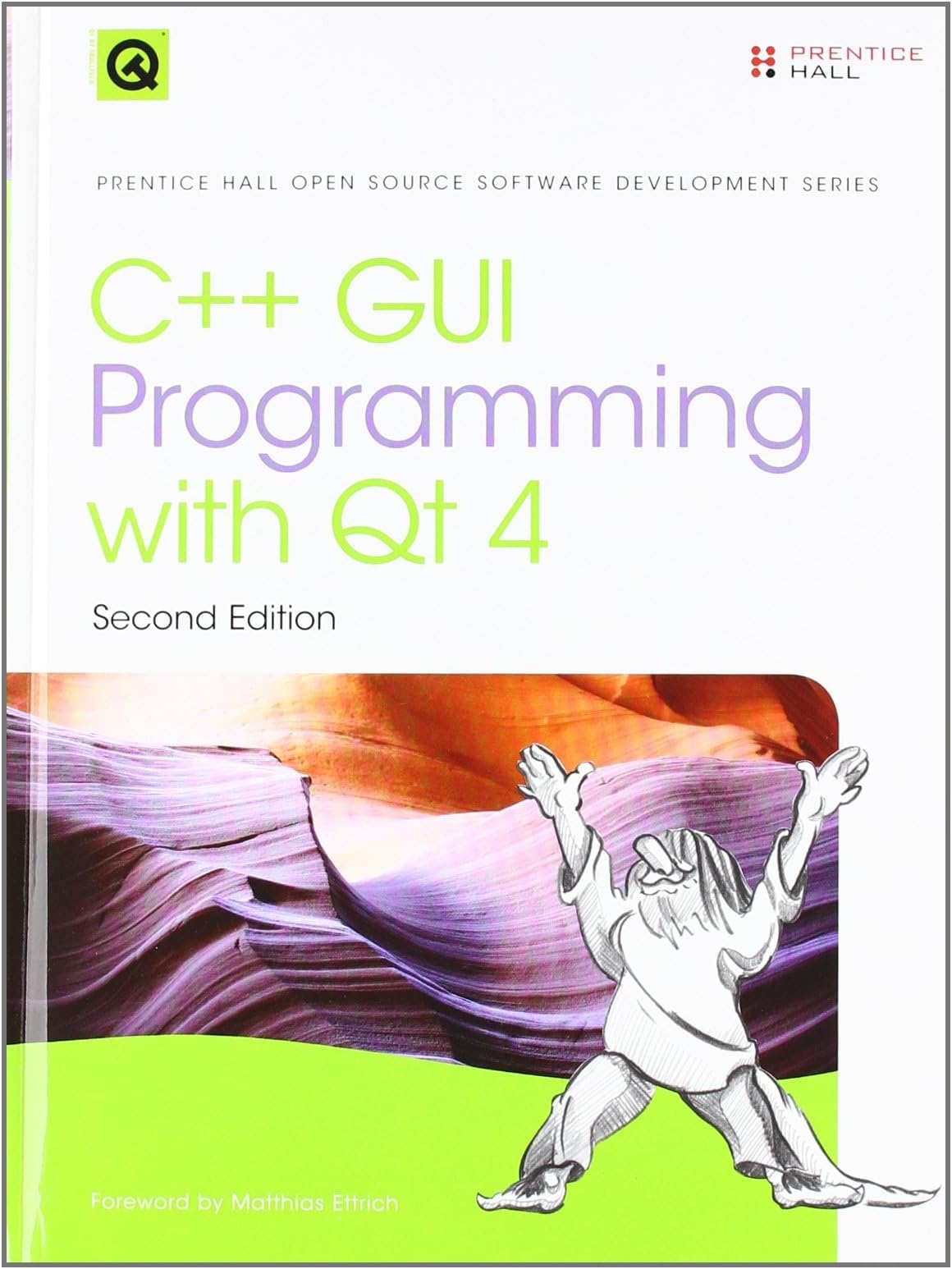
C++ GUI Programming with Qt 4 (2nd Edition) (Prentice Hall Open Source Software Development Series)
Product ID: 8497877
Buy anything from 5,000+ international stores. One checkout price. No surprise fees. Join 2M+ shoppers on Desertcart.
Desertcart purchases this item on your behalf and handles shipping, customs, and support to South Africa.
desertcart.com: C++ GUI Programming with Qt 4 (2nd Edition) (Prentice Hall Open Source Software Development Series): 9780132354165: Blanchette, Jasmin, Summerfield, Mark: Books Review: Nails it! - This book is the model that all others should emulate. I haven't read every single page of it, nor do I expected to, nor do I expect to _have_ to. Long before I could read every word or try every example, I will _understand_ Qt and will be confident and expert enough to dive into it on my own. Here's what makes this book amazing: every single example works exactly as printed. Every single example includes a description, and every single description exactly matches and illuminates what the example code is doing. Every single chapter introduces an area of Qt to a sufficient depth to get real, production code up and running (in my case, in XP, Vista64, and MacOS). Will you still need to read the on-line docs? Sure. And when you do, you'll understand them better because of the introduction the book provided. I have well over 100 programming books accumulated over a 25 year academic and professional career, and this is among the best in accomplishing what it's supposed to. If you want to learn Qt, get it. 'nuff said. Review: Great Jump Start - I've recently had a need to create some cross-platform applications and decided to look at Qt. While the Qt web site provides a great deal of information, I found this text to be a very readable way to quickly come up to speed on creating applications with Qt. Summerfield's prose moves the reader quickly from point to point with a series of short example programs and detailed breakdowns of hows and whys. I also own copies of other Summerfield books, and I've quite enjoyed the rapid learning experience they provide. The Python books (Learning Python / Programming Python / Programming in Python 3) provide more than enough detail for the experienced developer and gently take the novice forward as well. I'm looking forward to the upcoming Advanced Qt Programming book to continue to dive deeper into Qt development.
| ASIN | 0132354160 |
| Best Sellers Rank | #2,696,970 in Books ( See Top 100 in Books ) #495 in C++ Programming Language #3,255 in Software Development (Books) #4,940 in Computer Graphics & Design |
| Customer Reviews | 4.2 4.2 out of 5 stars (119) |
| Dimensions | 7 x 1.5 x 9.5 inches |
| Edition | 2nd |
| ISBN-10 | 9780132354165 |
| ISBN-13 | 978-0132354165 |
| Item Weight | 2.8 pounds |
| Language | English |
| Print length | 718 pages |
| Publication date | January 1, 2008 |
| Publisher | Prentice Hall |
D**C
Nails it!
This book is the model that all others should emulate. I haven't read every single page of it, nor do I expected to, nor do I expect to _have_ to. Long before I could read every word or try every example, I will _understand_ Qt and will be confident and expert enough to dive into it on my own. Here's what makes this book amazing: every single example works exactly as printed. Every single example includes a description, and every single description exactly matches and illuminates what the example code is doing. Every single chapter introduces an area of Qt to a sufficient depth to get real, production code up and running (in my case, in XP, Vista64, and MacOS). Will you still need to read the on-line docs? Sure. And when you do, you'll understand them better because of the introduction the book provided. I have well over 100 programming books accumulated over a 25 year academic and professional career, and this is among the best in accomplishing what it's supposed to. If you want to learn Qt, get it. 'nuff said.
T**T
Great Jump Start
I've recently had a need to create some cross-platform applications and decided to look at Qt. While the Qt web site provides a great deal of information, I found this text to be a very readable way to quickly come up to speed on creating applications with Qt. Summerfield's prose moves the reader quickly from point to point with a series of short example programs and detailed breakdowns of hows and whys. I also own copies of other Summerfield books, and I've quite enjoyed the rapid learning experience they provide. The Python books (Learning Python / Programming Python / Programming in Python 3) provide more than enough detail for the experienced developer and gently take the novice forward as well. I'm looking forward to the upcoming Advanced Qt Programming book to continue to dive deeper into Qt development.
D**Y
Simply Required Reading
While this text is now out of date in terms of the many important `minor' improvements and the IDE in the last ~2 years, it remains the very best place to start things I have found. It's advanced brother (also available here) covers few more pragmatic programming techniques, but is also a bit dated. Of course on top of all that is the announcement in 2011 by Nokia that they will be using a Windows approach for future phones which has many people questioning the Qt future itself. I presume you are reading this because you decided (in spite of that) to try Qt for a project of you own. This book is fairly dense but technically quite precise. I find myself re-reading the first ~four chapters to grasp the key terminology and I continue to find Qt more elegant than Mac or Windows who each have decades of baggage at this point. The authors know their stuff. Once you have the basics, the remaining 2/3rd cover the normal collection of programming tasks in a direct way. Qt is much more then just the GUI part. Unless your tasks are very diverse, you will likely only read what you need. The only `missing' content to my mind is a deeper review of debugging methods when things go amiss. If you are not moderately up on GUIs and the concepts of event driven programming in general, you might be overwhelmed a bit. But if you are, then you will not have your time wasted on such things. Rather, the text simply states how Qt does what it does with a bit more perspective on the design approach then the on-line documents have. That's was what I needed to fit it into my world view. It is not to my mind a restatement of the man pages as another reviewed stated, rather it is more like the style found in the 1984 classic "Inside Macintosh " manuals.
G**E
Lots of up-to-date information
This book was my first introduction to Qt, and I've been using it for about two weeks now on a project. Other reviewers have argued that it doesn't give enough of a big-picture view. It is true that the book has many pages of annotated source code. I started off thinking the verbosity was daunting, but when I actually tried to start using Qt, I quickly appreciated all the little details in this book and the very complete index (the index is over 50 pages long). The Trolltech website is a good reference for putting everything in one place, but this book is great for stepping through an example in detail. One caveat: I've used other widget sets (Gtk, Tk) before with other languages, but have no previous experience with Qt, and not much experience with C++ (so I found the "Intro to C++" chapter for Qt programmers a helpful summary).
N**N
OO problems
I realize its difficult to make examples that appeal to everybody. This book have some very good example ideas, but often lack in execution. Having spent the last few years with Java & C# it annoys me a lot that C++ programmers still continue to place a lot of initialization code into main(). In this book, eg. in chapter 5 the authors creates a custom plotter widget, that would be very useful as an example if it wasn't half made. Remember that Qt is OO and then you don't require the user to modify the class initialization in order to use the class. Every class needs to be able to stand on its own and initializations come in the constructor. Like a previous reviewer I would also like to see a Qt book that doesn't follow the exact same topic layout as the official manual, variety is always good. I'd like to end with saying that this is good book, however there is a bit too much information in some of the lengthy examples. If you manage to get through the chapters though, I'm sure you're well set up for a job as a Qt programmer.
C**N
Scritto in modalità molto chiara. Ho imparato molto veloce con questo libro.
M**R
Anders als das eher enttäuschende "... Design Patterns ..." des selben Verlages hat mich dieses Buch sofort in seinen Bann gezogen. Alle Beispiele sind leicht nachvollziehbar, die Lernkurve ist stetig. Viele Tips, warum etwas so und nicht anders funktioniert. So muß das sein! Dieses Buch erinnert mich sehr an das Niveau von "Buchheit" (Win16) und "Petzold" (Win32). Ich würde es darum als "DAS ESSENTIELLE BUCH FÜR Qt-EINSTEIGER" bezeichnen. Das einzige, was mich ärgert ist, daß ich es nicht schon vor 3 Jahren gekauft habe, als in c't immer mal wieder Qt-Projekte vorgestellt wurden. Habe viel Lebens- und Arbeitszeit vertrödelt weil ich mich nicht ernsthaft mit Qt befaßt habe. Hätte ich dieses Buch eher in die Finger bekommen, wäre das anders gelaufen!
D**A
I am working with the book and Qt4. The book is a valuable guide for people using C++ and Qt4 to develop platform-independent GUI applications. The book shows how to do this both in C++ code and also by using Qt Designer as a visual design tool. This gives the reader the grounding necessary to do more advanced work with Qt4. The earlier reviewer who wants to use Qt Designer rather than C++ code may have missed page 13 which states: "We will create our first dialog purely by writing code to show how it is done. Then we will see how to build dialogs using Qt Designer, Qt's visual design tool. Using Qt Designer is a lot faster than hand-coding and makes it easy to test different designs and to change designs later." In brief, I found the book to be an excellent source of training for learning Qt and its sophisticated use of C++.
V**H
I've gone thru the first 3 chapters as yet and I can say its a fantastic book, very clearly explained. Even subtle points are explained. Its evident that its written by those who have used Qt extensively. The only thing I'd like to point out is that it is written keeping Qt4 in mind. In my installation I had Qt5. To adapt to this, I had to make the following change, viz. add the following in the ".pro" file: QT += widgets That said, the book could have spent a few more pages on walking thru the installation. There are a few gotchas which are not so evident. Eg. I broke my head when I installed 64-bit Qt components but my MSVC was 32-bit I had forgotten; Then there are also gotchas around how to use MSVC as the main IDE (eg. the steps for running qtenv2.bat, vcvarsall.bat, etc are not documented anywhere. I had to Google up a lot and find out this info). BTW: Qt installation sucks. It is painfully slow. It seems to download and install one file/component at a time. I don't know why they didn't architect it so as to download all in one shot (which'd be much faster) and then do the installation.
N**I
Je commence à pratiquer avec Qt, je trouve ce livre bien fait. Les paragraphes sont illustrés par des exemples bien détaillés. Attention, il nécessite une connaissance minimum du langage C++ et des outils de compilation.
Trustpilot
2 weeks ago
1 week ago