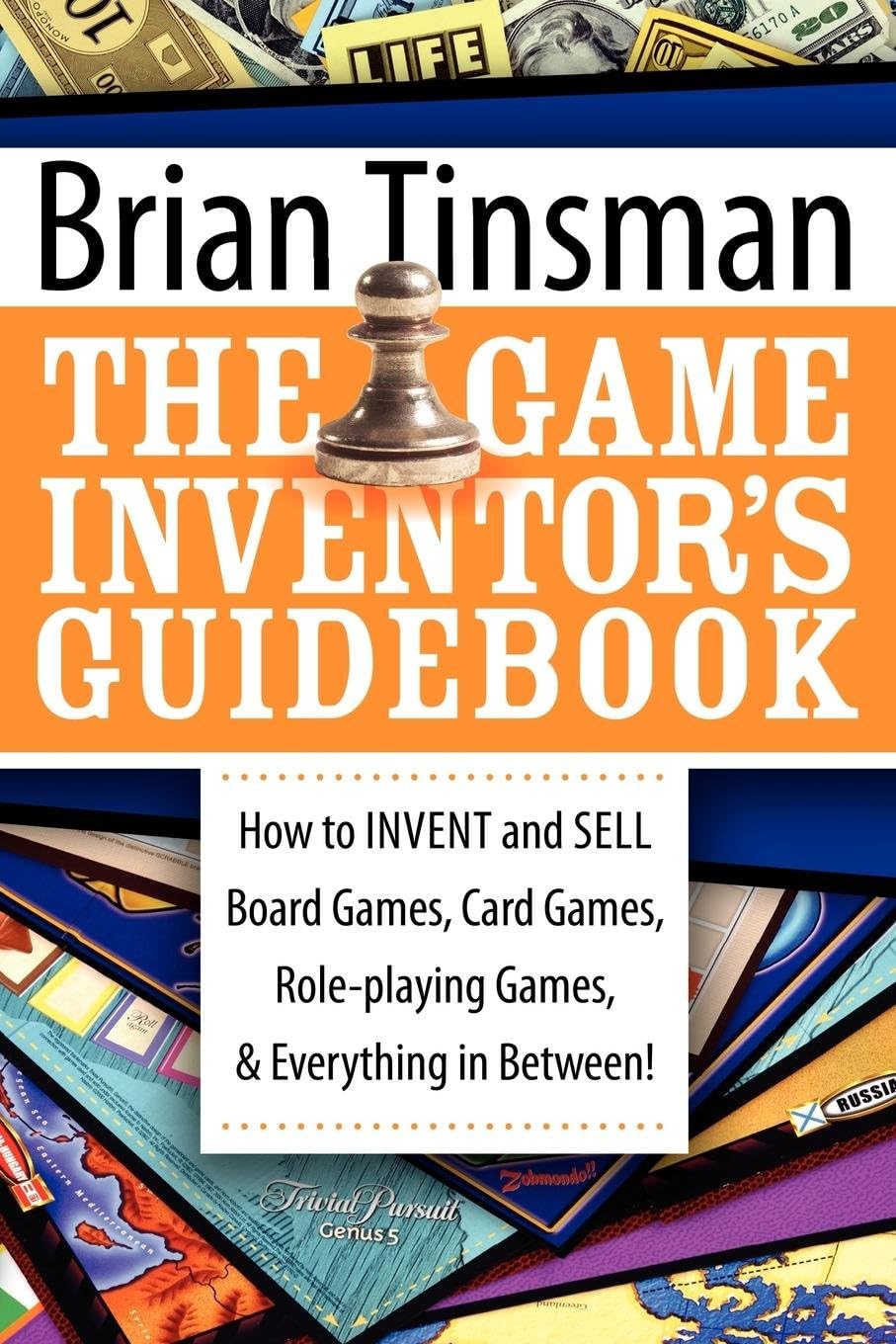
The Game Inventor's Guidebook: How to Invent and Sell Board Games, Card Games, Role-Playing Games, & Everything in Between!
Product ID: 8367312
Desertcart purchases this item on your behalf and handles shipping, customs, and support to South Africa.
The definitive guide for anyone with a game idea who wants to know how to get it published from a Game Design Manager at Wizards of the Coast, the world's largest tabletop hobby game company. Do you have an idea for a board game, card game, role-playing game or tabletop game? Have you ever wondered how to get it published? For many years Brian Tinsman reviewed new game submissions for Hasbro, the largest game company in the US. With The Game Inventor's Guidebook: How to Invent and Sell Board Games, Card Games, Role-playing Games & Everything in Between! he presents the only book that lays out step-by-step advice, guidelines and instructions for getting a new game from idea to retail shelf. Review: A veritable Treasure Trove of useful information! - I was a little hesitant on this at first,but I am so glad I grabbed this book! It has a ton of useful info from someone who is actually in the Gaming industry and has watched the birth of the TCG via Magic the Gathering,had incredible experiences with giants in the industry when they were just starting out and actually played a lot of the board games and more that you and I have enjoyed for years.If you are thinking of trying to seek out information on where and how to make your idea into reality-this truly is the book you want! It even includes contact information for each and every gaming company-small and giant- that you could possibly want,as well as a lot of firsthand real life experience- successes as well as failures- that will help in your endeavors.My son and I have had lots of great ideas for games and more,and we can't wait to throw our hat in the ring-so to speak-and see what happens.Another cool aspect of this book is it includes the histories of various game companies from your small time companies to monsters like Parker Brothers with everything in between.This book truly is a tool you can use in your very own arsenal to (hopefully) make your ideas come to life! Highly recommended! Review: Insight into the game publishing industry - I read this book on the recommendation of game designer Lewis Pulsipher. Tinsman, game design manager for new business at Wizards of the Coast, describes the book's target audience as "really just for one person...the lucky person destined to create the next category-defining blockbuster game." In fact, though, his book addresses anyone who seeks to have a game published, one way or another, with valuable advice and insight toward making a game concept into a reality. Tinsman opens with a series of anecdotes about four of the wildly successful games of our time - Trivial Pursuit, Magic: The Gathering, Dungeons and Dragons, and Pokemon. These stories of blockbuster proportions are exciting to read, inspiring to imagine, and yet a little daunting to the hopeful designer. What are the odds of coming up with the next Monopoly? Is that too crazy to consider? Perhaps, but Tinsman offers much more than just a review of the peak games of the age. He follows with chapters on the nature of the industry, the considerations that publishers have when they consider a new design, and the motivations behind designing (or as he likes to say, "inventing") games. I found especially interesting his description of the inner workings of a game company and the internal considerations that weigh on whether a game is published. Tinsman spells out four "markets" for games, and here I could quibble with his taxonomy, but really, his classification works for the purposes of his book, which come down to the different ways to approach design, publication, and marketing. He categorizes games among the following markets: - Mass market (what you'd find in a big box retailer like Target or WalMart) - Hobby games (roleplaying, miniatures, and trading card games) - American specialty games (a "catch-all" category for small print-run games like strategy games and "how to host a mystery") - European market (German boardgames, largely) - Others (unique market type games, such as sports games that might sell in sports-related retail outlets, etc) Okay, that's really five, but he spends little meaningful text on the "Other" category except as an out for the types of games that he doesn't cover otherwise. Although the average gamer might not break down games into these categories, they work for purposes of addressing the different ways that a designer would approach a publisher with a prototype and the different ways that a game would be published and marketed. Tinsman provides considerable detail on specific games and companies that he feels the reader should become familiar with. Many are familiar to the regular gamer, but a few gems emerge that are worth investigation. Self-publishing had always struck me as a last great act of desperation, but that's not so much the case with the resources available to today's self-publisher. Tinsman spends some time discussing the special considerations that have to be taken into account to try to bring a game to market yourself. The upside potential and the downside risk are both staggering. A nice aspect of Tinsman's format is that he intersperses the book with interviews of key figures in the game industry and "Insider's Views" on publishers, information that he is in a unique position to provide as a longtime member of the industry himself. He provides remarkably insightful perspective on what designers and industry figures consider in bringing a game from concept to market. These vignettes make clear that there is more than one way to skin the boardgame cat, and different people have different priorities and visions on what they hope to bring to the gaming world. With all of this background, Tinsman walks the reader step-by-step through the process of conceiving and scoping a design, developing it, all the way through getting it on contract. This final walk-through brings all the elements of the book together into a soup-to-nuts accounting of all the steps that a designer will need to follow to make a game concept into something that people can buy, take home, and play. Appendices include considerable resources - contact information for game companies, brokers, conventions, as well as sample forms for letters and agreements that the designer will find handy in conducting business with potential publishers. Brian Tinsman's Guidebook came well recommended by Lewis Pulsipher, and I am not disappointed. I hope my readers find it as valuable for gaining insight into the workings of the gaming industry as I have.
| Best Sellers Rank | #696,767 in Books ( See Top 100 in Books ) #273 in Cheese & Dairy Cooking #513 in Puzzle & Game Reference (Books) #543 in Card Games (Books) |
| Customer Reviews | 4.2 out of 5 stars 236 Reviews |
C**D
A veritable Treasure Trove of useful information!
I was a little hesitant on this at first,but I am so glad I grabbed this book! It has a ton of useful info from someone who is actually in the Gaming industry and has watched the birth of the TCG via Magic the Gathering,had incredible experiences with giants in the industry when they were just starting out and actually played a lot of the board games and more that you and I have enjoyed for years.If you are thinking of trying to seek out information on where and how to make your idea into reality-this truly is the book you want! It even includes contact information for each and every gaming company-small and giant- that you could possibly want,as well as a lot of firsthand real life experience- successes as well as failures- that will help in your endeavors.My son and I have had lots of great ideas for games and more,and we can't wait to throw our hat in the ring-so to speak-and see what happens.Another cool aspect of this book is it includes the histories of various game companies from your small time companies to monsters like Parker Brothers with everything in between.This book truly is a tool you can use in your very own arsenal to (hopefully) make your ideas come to life! Highly recommended!
P**3
Insight into the game publishing industry
I read this book on the recommendation of game designer Lewis Pulsipher. Tinsman, game design manager for new business at Wizards of the Coast, describes the book's target audience as "really just for one person...the lucky person destined to create the next category-defining blockbuster game." In fact, though, his book addresses anyone who seeks to have a game published, one way or another, with valuable advice and insight toward making a game concept into a reality. Tinsman opens with a series of anecdotes about four of the wildly successful games of our time - Trivial Pursuit, Magic: The Gathering, Dungeons and Dragons, and Pokemon. These stories of blockbuster proportions are exciting to read, inspiring to imagine, and yet a little daunting to the hopeful designer. What are the odds of coming up with the next Monopoly? Is that too crazy to consider? Perhaps, but Tinsman offers much more than just a review of the peak games of the age. He follows with chapters on the nature of the industry, the considerations that publishers have when they consider a new design, and the motivations behind designing (or as he likes to say, "inventing") games. I found especially interesting his description of the inner workings of a game company and the internal considerations that weigh on whether a game is published. Tinsman spells out four "markets" for games, and here I could quibble with his taxonomy, but really, his classification works for the purposes of his book, which come down to the different ways to approach design, publication, and marketing. He categorizes games among the following markets: - Mass market (what you'd find in a big box retailer like Target or WalMart) - Hobby games (roleplaying, miniatures, and trading card games) - American specialty games (a "catch-all" category for small print-run games like strategy games and "how to host a mystery") - European market (German boardgames, largely) - Others (unique market type games, such as sports games that might sell in sports-related retail outlets, etc) Okay, that's really five, but he spends little meaningful text on the "Other" category except as an out for the types of games that he doesn't cover otherwise. Although the average gamer might not break down games into these categories, they work for purposes of addressing the different ways that a designer would approach a publisher with a prototype and the different ways that a game would be published and marketed. Tinsman provides considerable detail on specific games and companies that he feels the reader should become familiar with. Many are familiar to the regular gamer, but a few gems emerge that are worth investigation. Self-publishing had always struck me as a last great act of desperation, but that's not so much the case with the resources available to today's self-publisher. Tinsman spends some time discussing the special considerations that have to be taken into account to try to bring a game to market yourself. The upside potential and the downside risk are both staggering. A nice aspect of Tinsman's format is that he intersperses the book with interviews of key figures in the game industry and "Insider's Views" on publishers, information that he is in a unique position to provide as a longtime member of the industry himself. He provides remarkably insightful perspective on what designers and industry figures consider in bringing a game from concept to market. These vignettes make clear that there is more than one way to skin the boardgame cat, and different people have different priorities and visions on what they hope to bring to the gaming world. With all of this background, Tinsman walks the reader step-by-step through the process of conceiving and scoping a design, developing it, all the way through getting it on contract. This final walk-through brings all the elements of the book together into a soup-to-nuts accounting of all the steps that a designer will need to follow to make a game concept into something that people can buy, take home, and play. Appendices include considerable resources - contact information for game companies, brokers, conventions, as well as sample forms for letters and agreements that the designer will find handy in conducting business with potential publishers. Brian Tinsman's Guidebook came well recommended by Lewis Pulsipher, and I am not disappointed. I hope my readers find it as valuable for gaining insight into the workings of the gaming industry as I have.
V**S
Brilliant, captivating
Brilliant, captivating, inspiring, and with tons of interesting and valuable information. I wrote a short motivational e-book, which I structured as a board game description and this book has helped me tremendously in the process. It continue to help me with my work (which is not game design). I haven't finished reading the book yet, but I definitely will. And I am sure I will re-read it too. I have already re-read several sections of it and quoted in my blog posts. I read this book bit by bit, because every page is extremely valuable and as with any great guide book, as well as for the name "guide", it should be used as guiding hand in the process of the work to be done. I highly recommend it not only for game developers, but also to writers, and especially to managers and entrepreneurs. You will get many great ideas and inspiration for adjusting successfully the game strategy for your business.
O**N
Interesting read but little else...
When I purchased this book I was expecting it to go into a good amount of detail about the design process. In short, the book primarily goes: okay, here's an example of what kind of games sell, here's how this guy sold it, now he's rich, chances are you won't be like him, now understand what makes a game good is that you make it fun, etc. etc. I feel that the book is less of a guide and more of a showcase. The author does provide plenty of resources though so that if you design a game you can contact people through what he provides but that is really about it. Otherwise the book simply goes through success stories and only touches the surface of game design and when in this stage of the book the advice is simple common sense. Then, after the short amount dedicated to design it goes into legal protection, etc. Perhaps I simply expected more than I what I was getting into. Again, this book is by no means bad, it is an enjoyable read for a person who is interested in the field but don't expect to learn too much pertaining to designing your game.
T**M
Authoritative
This excellent, highly readable guide to the practice and business of tabletop (board, card or miniature) games. Its chapters are interspersed with several enjoyable, brief interviews with successful game designers. Every practical question you might have about breaking into the industry is answered here: How to playtest; how to write a pitch; whether you need an agent; what the standard contract is; which markets you should target. If you're considering self-publishing, there's a chapter on that, too. An appendix contains lists of companies and brokers, along with their contact information. Whether you're trying to launch a family-friendly game for mass-market consumption or a geek-fest for a handful of comic shops, this fine reference will serve you well.
K**R
The book is really a "how to make successful games by asking the best game makers in the market about how they did ...
The title could actually be a little misleading. The book is really a "how to make successful games by asking the best game makers in the market about how they did it" kind of book. I gave it 5 stars anyway because there was a ton of useful anecdotes from people who really know what they are doing. Hearing from the makers of Dungeons and Dragons about the thought process they went through is highly revealing and interesting. I would recommend this to anyone who wants to learn a how to make a good game while at the same time dabbling in some game history.
A**R
An Entertaining and Educational Look Non-Computer Games
According to its subtitle, The Game Inventor's Guidebook covers: "How to Invent and Sell Board Games, Card Games, Role-player Games, and Everything in Between!" In other words, the book covers the modern, *non*-computer game industry. The book opens with short descriptions of some of the success stories of the past couple decades: * Trivial Pursuit * Magic: the Gathering * Dungeons & Dragons * The Pokemon Trading Card Game If you're not familiar with the stories behind these games, they make very interesting reading, especially for indies. With the exception of the Pokemon TCG, these are stories of dedicated individuals pursuing a dream and not giving up when things get tough. After that, the book describes how the game publishing industry works, and provides summaries of the companies and games that a would-be "game inventor" should be aware of. More useful than the birds-eye view of how the industry works are the frequent interviews with publishers and game designers. These are probably the best part of the book. Such modern "name" game designers like Reiner Knizia (Lord of the Rings, Tigris & Euphrates & many, many more), Brian Hersch (Outburst, Taboo), Mike Fitzgerald (Mystery Rummy, Wyvern), and more, discuss how they got started and how they approach game design. Equally informative were the interviews with publishers such as Mike Gray of Hasbro, Peggy Brown of Patch, Mike Osterhaus of Out of the Box, and others. Because of the costs associated with games of this nature, the book several times cautions against self-publishing your game ideas, recommending that the would-be game inventor go through a publisher. Despite this advice, the book also points out that such major successes as Trivial Pursuit, Pictionary, and even the perennial Monopoly were created and made successful by determined self-publishers before a major publishing company picked them up. The book does provide 4 chapters discussing what's involved with self-publishing games. Like most of the book, though, the chapters are at a very high level, providing more of a broadbrush overview than details. Still, the chapters cover the topic quite well. One point that the book stresses over and over is that all game design should begin by first deciding on your audience. If you don't care about the marketability of your game, then you can start where you wish and enjoy creating and playing your game. But if you want to appeal to a segment of the population bigger than "You and People Just Like You", you have to pick who you want to appeal to. Once you know who you're making the game for, you can adjust and refine to better appeal to those people. All in all, The Game Inventor's Guidebook provides an entertaining and educational look at the non-computer game industry and its current markets. If you are serious about game design, and want to learn about all aspects of game design, and not just within the computer industry, this book provides a good place to start.
J**R
Valuable Investment Indeed!
I have an idea for a game... I needed some kind of direction and an action plan with steps to help me take my game from idea to shelf. I have a few books on inventing, but the game & toy industry seems to be a little different. I was afraid I was wasting my money on this book but as soon as I started to read it I couldn't put it down. Brian did a great job at giving his readers an inside look at the game industry. IF YOU HAVE AN IDEA FOR A GAME... THIS BOOK WILL PROVE TO BE A VALUABLE INVESTMENT.
A**N
saved me spending a fortune
i invented a game, and thought, what next, how do i become a millionaire? so i bought the book, it was very honest, and crushed my dreams by factual reality and how little you'd actually make. to be honest, i bought the book hoping it would help me make a packet, however the book actually brought me down to earth and saved me a fortune. best £ i ever spent.
W**G
All about inventing board games.
Nice book with black n white pics of games.
M**N
Ottimo
Libro ottimo. Proprio quello che cercavo.
C**E
Um guia completo de por onde começar
O livro mudou muito minha concepção de como criar um jogo, existem um monte de variaveis entre sua ideia e o jogador e conhecer cada uma delas ajuda muito a projetar algo que consiga passar por todo esse trajeto sem grandes problemas.
R**N
Make It Stop!
There is something of value in this book, but it's hard to find amongst all the self promoting of Hasbro and Wizards of the Coast (WotC) as well as the numerous errors the copy editor missed. Don't get me wrong, I'm a big fan of WotC, and I've spent enough money to prove it, but this book was born and raised by WotC and Hasbro and is obnoxiously biased towards that family of companies. I don't want to bash this book either, because there's some useful stuff here, but it could have been so much more. I found the first section of the book to contain very little meat. If you're interested in games, particularly anything owned by Hasbro or WotC, you probably already know much of what's written here. If you're thinking of getting this book, don't be fooled by the title. It's not a book for Game Inventor's who want to make games. It's a book for Game Inventor's who want to know about Brian Tinsman's job and how they'll get money out of guys like him once they have already invented a game. There is some worth in that, because why make games for free, but I bought the book to learn about mechanics and the design process. There's very, very little about that. The real value in this book is the overview of how to get games published and some of the considerations you should think about when making and planning your game. This isn't a complete guide, and there sure are some holes, but it should help you get started and asking some important questions. Another thing I enjoyed was the interviews from the real heroes of the industry, award winning game designers like Dr. Reiner Knizia and Alan Moon. Unfortunately these interviews are short and many of them say the same things, so there's not a heap to learn here, which is a pity. This book will probably stay on my shelf, but I'm not sure it will be a book that I'll be referring back to often, as I toil away at some fantastic new game design. Time will tell. Would I be able to stand Brian's obnoxious writing style enough to reread any of the chapters? Certainly not the first couple of chapters, but the last few will get a re-read.
Trustpilot
2 days ago
1 month ago