


Desertcart purchases this item on your behalf and handles shipping, customs, and support to South Africa.
⏳ Unlock gourmet speed and safety in one sleek pot!
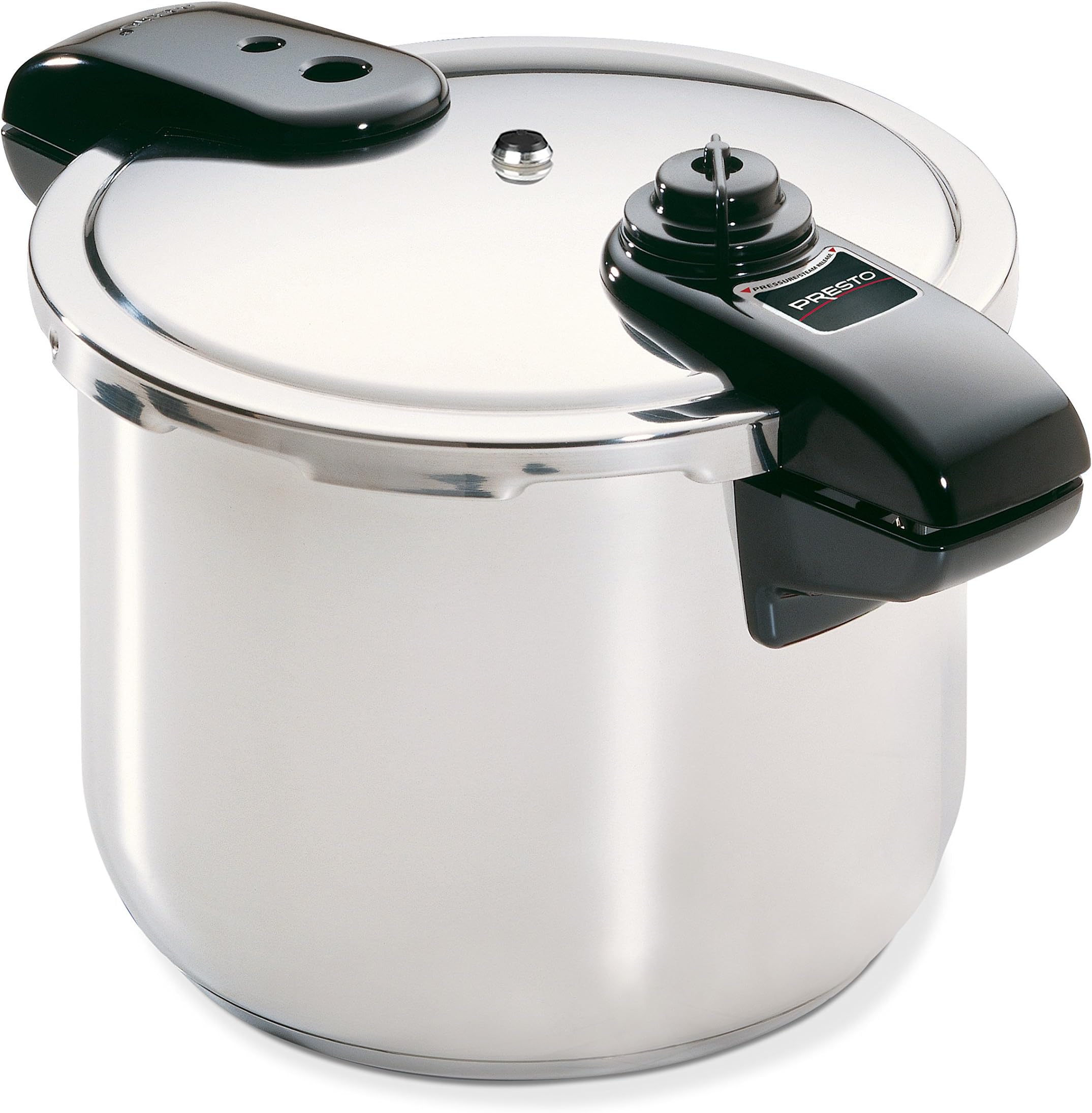
The Presto 01370 8-Quart Stainless Steel Pressure Cooker combines professional-grade tri-clad heating with advanced safety features like a locking lid and pressure indicator. It cooks food up to three times faster while preserving nutrients and flavor, making it ideal for busy professionals seeking healthy, delicious meals. Compatible with all stovetops and including a stainless steel steaming basket plus a 64-page recipe book, it’s a versatile kitchen essential backed by a 12-year warranty.


| ASIN | B0000Z6JIW |
| Best Sellers Rank | #193,941 in Kitchen & Dining ( See Top 100 in Kitchen & Dining ) #164 in Pressure Cookers |
| Brand | Presto |
| Brand Name | Presto |
| Capacity | 8 quarts |
| Color | Silver |
| Control Method | Touch |
| Controller Type | Hand Control |
| Customer Reviews | 4.6 out of 5 stars 4,423 Reviews |
| Finish Type | Stainless Steel |
| Global Trade Identification Number | 00075741013701, 00757410137016 |
| Included Components | 64-Page Instruction/Recipe Book, Stainless Steel Pressure Cooker |
| Item Dimensions D x W x H | 11"D x 17.4"W x 10.5"H |
| Item Type Name | Pressure Cooker |
| Item Weight | 8.9 pounds |
| Manufacturer | Presto |
| Material | Stainless steel |
| Model Number | 01370 |
| Number of Items | 1 |
| Operation Mode | Automatic |
| Part Number | 01370 |
| Product Dimensions | 11"D x 17.4"W x 10.5"H |
| Special Features | Locking Lid |
| UPC | 075741013701 |
| Unit Count | 1 Count |
| Warranty Description | 1 Year Limited |
| Wattage | 1000 watts |
G**E
I've Had Mine For 8 Years...What Happened?
This is an excellent pressure cooker overall. The cooker will reduce your cooking times to less than half depending on the food item that you're cooking. What I'm saying is, all food items cook times will be reduced, but more or less for particular food items. For example, something that has a tougher skin on it such as pig's feet, will normally take 2 1/2 hours or more to cook in a regular pot. If you know anything about cooking such an item, you WILL have to crack that lid, so the bubbling doesn't spill over and down onto your burner. That's why the cooking time may exceed 2 1/2 hours. However, with the pressure cooker, cooking time is around 45 minutes for very tender well-cooked pig's feet. If you're cooking a whole chicken, which I often do for my homemade chicken soup, you're looking at around 35 minutes until done. Now, these times are based on my not releasing the pressure from the pressure cooker as it has an automatic release valve. That is what you're hearing and seeing being released. All that hot steam that is built up into the pressure cooker will be released. Now, some people think that hissing sound means "this thing is about to explode, I'd better release the valve and let some pressure go!" Well, that's a personal choice, but the cooker will not explode. Again, it's just released the pressure. That's why the release valve is on there. Now, if you choose to do so and release periodically, just know that you just increased your cooking time. For beginners, they may do that because they are not sure if it is safe to have the pressure cooker constantly hissing (releasing steam) for 30 - 45 minutes or so. Believe me when I say, let the pressure cooker do its job. NEVER, open the pressure cooker while the metallic knob is still up. Release ALL the steam and you will hear the metallic knob drop down after a couple of minutes. Folk with good hearing will hear it drop from another nearby room in the house. Read the manual that comes with the pressure cooker and read all of it. Having same all that, you MUST, I repeat, you MUST make sure that enough water or broth is in the pot. Because there is MUCH pressure built-up inside the cooker, when it does begin releasing the steam (the hissing), that is your liquid in the form of vapor (steam) leaving the pot. It's not instant and all at once. But if you place the recommended amounts of liquids into the pot to cook your whole chicken, roast, chicken thighs, pig's feet, whatever, (I usually place just enough to almost cover the food item), that will be sufficient. DO NOT pass the FILL LINE that is clearly marked on the inside of the pressure cooker. Overfilling may cause spurting of hot liquids through the release valve. I NEVER go pass the fill line. Trust me, the manufacturer placed the marker there for a reason. The pressure cooker can be soo much fun to use at helping to cook delicious and relatively quick meals, but you must pay attention to the water (broth) levels and monitor the cooker after 30 minutes. The weight of the cooker is probably slightly heavier that your typical 8-quart stainless steel pot, but that's good. That's a good sign that it is built solid to withstand all of the internal pressure within the pot. I wouldn't want anything flimsy. Mine has lasted a long time. I purchased it back in December 2018 and the price was only $43.23, whereas now, it has jumped to a whopping $115.99. That is so ridiculous. So, do some research of where you can get a more reasonable price for this item. Should you purchase one though and learn how to properly use it, you will be well pleased.
T**N
Why did I wait so long to get this?
In the interest of full disclosure - I've just used this 4 times in the last 16 hours, so maybe it's a little premature to write a rave review. And should time prove me wrong, I'll quickly update this review. Before the purchase I read and reread the reviews, particularly the bad ones. However, in all my many years of buying appliances (and most recently many from Amazon) I've only had a couple of lemons. The vast majority just quietly do what they are designed to do, day in and day out. Therefore while I can't explain why several people have had explosions or said it takes a long time to reach the pressurized stage, I figure I'll get a good one and I'm willing to give it a try. No one is better than Amazon about returns of defective products. I read the instructions if it's a product I'm not familiar with, such as this pressure cooker, before my first use, and I kept the instructions near yesterday as I started, making sure I knew what to expect and how to time the cooking. First thing I made yesterday was candied sweet potatoes. That which normally takes over an hour of cooking on the stove and in the oven (I'm ignoring prep work which is essentially the same regardless of the way it's cooked) in the pressure cooker took about 2-3 minutes to reach the pressurized state and 11 minutes to cook (this was a two step recipe, so I'm counting it as two uses as I removed the cooked sweet potatoes and placed them in a bowl with the other ingredients and then put them back in the pressure cooker). Soon after that I cooked a couple of pounds of Idaho potatoes for mashed potatoes with our roast chicken dinner. Five minutes of cooking after reaching pressure, and the potatoes were done, and not waterlogged as they are when boiled. Then today I cooked a pound of dried baby lima beans. The preparation was the same as when I cook them without the pressure cooker: wash, sort, bring to a boil for 3-4 minutes. Turn off heat, cover, let sit an hour or so. Pour off water. (this step does two things: it makes cooking faster regardless of type of cooking, plus it removes the enzymes (?) that cause gas when we eat them. After this, I put them in the pressure cooker and cooked them 5 minutes. That's all. Five minutes. Would have taken 2-3 hours on the stove. All the food was terrific. Better than other cooking methods? How do you compare unless you have both dishes before you at the same time. They were all so good that I'm satisfied I'll be doing this from now on. I'm eager to try meat next. . . maybe a pork roast tomorrow. Clean up is a breeze. Instructions say it's all dishwasher safe (well, not the gasket) but I washed it by hand because it's large and I didn't want to take up so much space in the dishwasher. Also, I used my stand alone induction burner rather than the stove for the heat source, as the pressure cooker has the right mixture of metals to work on the induction burner. No heat - other than a little steam. Low electricity use. It's very easy to set up, the Presto instruction booklet has very clear information and a few recipes to get you started. So far, I couldn't be more pleased!
B**N
I'm loving it!
This is my first pressure cooker, and I couldn't be happier. This turned out the best pot roast and potatoes I've ever had, ribs so moist and tender I just plucked out the bone with some tongs, and I'm looking forward to trying many different things in this pot. First of all, the pot itself is very high quality. Better than my Calphalon Commercial pots in my opinion. It has an amazing mirror polish finish to it, which does take a bit of extra effort to keep looking new. And a nice, thick, triple-clad bottom that heats amazingly evenly and both takes and holds heat beautifully. Judging by how things brown in it and the evenness of bubbles in simmering liquids, this spreads the heat out very evenly, unlike some of my other pots and pans. And it can take a blast of high heat (of course with liquid in the pot) in order to get it up to pressure quickly. No discoloration or suspicious clinks and clangs as it heats and expands. Took a little bit for me to figure out exactly how it all worked, being I'd never used one before, but finally got it figured out and it worked exactly as designed. The instruction/recipe booklet that comes with it is very well done, compared to the usual confusing and poorly done quality of such things. Cleaning is a bit of a chore. Not particularly difficult, but I like to do a thorough job, and it's a fairly large pot to scrub out. I've found that I've had to use some Softsoap cleanser and non-scratch scouring pad to get some of the discoloration off the metal after cooking. This is just trying to keep it looking new... I'm sure I'll stop being so particular at some point and won't have to spend so much time scrubbing it. To clean, in addition to scrubbing and washing the pot inside and out, (and another reviewer said this one was light compared to her old one and she hoped it held up. It's plenty heavy for me to try to hold in one hand while rinsing with the other, etc. Not sure I'd like it if it were heavier.)... they also say to remove the plastic sealing gasket and wash that completely, which isn't tough. The over-pressure plug is easy to remove if you want to clean around that, and you can also remove the little metal post and gasket of the cover lock mechanism, though if you use the pot normally, you probably wouldn't needed to clean them very often. Water spots/stains appeared on the inside of the lid from cooking, but again, I'm sure they won't affect anything. Having never used a pressure cooker before, the first time I flipped the lever to do a quick release of the pressure, it startled me pretty good, as it instantly shoots out a jet of loud steam that would probably go 10 ft high if it didn't roll off the ceiling or range hood... and continues for around 3 minutes before settling down. Rather amazed that in all the instructions, nothing was said about being sure to avoid being over the pressure valve when you release it. I could see someone who didn't understand how it worked possibly leaning over it when they flipped the lever and if they did, they'd end up being scalded terribly on their face I'd imagine. Since it's winter and the air in the house is dry as a bone, I've actually used this as a sort of quickie humidifier. Just bring a few cups of water to pressure until steam is escaping the pressure valve, (I added some lemon juice to give a pleasant smell. Could use vanilla or whatever) and carry it to whatever room or area you want to humidify. I sat it on an upside-down cast iron pot lid, and then flipped the pressure relief lever and it blasted out a torrent of steam. Did it a few times and according to my thermometer/humidity gauge, it brought up the humidity in the room about 5% and left a nice scent. So... it's multi-purpose. ha! But the greatest thing about it is the FOOD. Just so tender and delicious. I particularly like to brown/sear meats in it in a tiny bit of oil, then add liquid and things like carrots/celery/potato and pressure cook for a bit. Leaves everything done perfectly and with a nice flavorful liquid that can easily be made into gravy. Haven't tried beans or vegetables, but meats come out amazingly flavorful and fork tender. So good. A good product and well made. Keep it clean and perhaps replace the gasket every year or so, and it should last forever.
X**2
Low fat beans
My low fat vegetarian diet is greatly enhanced by preparing dry beans. Cuban black beans, smashed pinto beans, garbanzo beans, etc. I tried using someone else's Presto 6 quart aluminum and this one is much better. This has a bigger base and it vents much less steam so that I can put our gas burner on simmer and it maintains pressure. It is much easier to clean than the aluminum one that I tried that is all pitted inside. This does not have a complicated spring and plastic valve like the European style pressure cookers. So there is no low pressure setting, only high pressure or pressure release. But the weight that sits on the vent tube doesn't "jiggle" like the aluminum cooker I tried as this weight has a metal clip and the plastic around the weight doesn't allow the weight to rock from side to side. It mainly can only move up and down. Just a little bit of steam comes out to let you know it is at full pressure. I make my beans with no oil which is against what the manual requires, but I haven't had a problem *(EDIT see MAY update below). I looked through the vent tube afterwards during clean up and it has remained clean. I have run a pipe cleaner through the vent tube like the manual recommends. I use natural release (allow pressure to come down by itself) so maybe that is why I have not had problems. I also don't fill the pot more than the half way mark. I haven't used the release where you turn the weight to the position that releases pressure. The other pressure cooker I used had quite a bit of crud built up in the vent tube. I can see how if these pots build up enough crud to plug the vent tube that it could lead to an overpressure situation where the rubber plug would blow out and make a mess. With this style of pressure cooker I recommend doing like the manual says and looking through the vent tube every time that you use the pot. If you have read about the horror stories about melting pressure cookers, I think it is that people are using too much heat. I use high heat until the interlock pops up which means there is pressure but not the full 15 psi. I use a burner that is not bigger than the thick metal base. As pressure starts building, some steam vents from the interlock but not from the main vent with the weight sitting on top. I turn the flame down to medium. (EDIT: I now use high heat until steam is released from the main vent tube. I then lower my gas flame to high simmer. If you have an electric stove top that doesn't change temperature as quickly as a gas stove you need a different technique). Once I hear some venting coming from the vent tube under the weight, then high simmer is enough to keep this pressurized with a little steam being released from the vent tube under the weight. I can listen and tell how this thing is doing. I don't have to look at a pressure gauge so I can be doing something else in the kitchen. It is not completely silent but it is much quieter than the other "jiggler" model I tried. But I don't leave this thing unattended while it is on a burner. Hope this helps. Update 1/8/14: Deducted one star because Presto cheaped out on the fasteners. I replaced the two machined screws holding the handles to the pot body with stainless steel screws I bought at a hardware store. A little rust was visible on those 2 screws. Most of the rust though was on the star shaped washer. Used a number 3 phillips head screw driver although I believe one could also use a big flat head screwdriver to remove. I also am seeing a little rust on one of the screw heads holding the handle to the lid. Those screws may be harder for me to find in stainless steel. I believe another reviewer also mentioned that they had this problem. Tried Bon Ami to clean the inside of the pot. Didn't work well. Barkeeper's Friend (powder) which I read about in another review did clean the inside and outside of the pot well. I picked it up at a large physical store but it is available as an ad-on item on Amazon though the price is higher. May 6, 2014 Update: I have two of these PC's. One of the PC's I own is difficult to open and close. I am a guy with good hand strength so it is not a big deal for me, but it could be a significant issue for someone with weaker fingers. I wet the gasket with water and that helps to get the lid on. The instruction manual says to avoid oil on the gasket. I also have a Magafesa Pracktika Plus PC. It is a little more money (at current prices) and it doesn't come with a trivet and steamer insert. It is superior to the Presto though in my opinion. It is a bit taller and narrower though. I did call Presto and complain about the rust on the screws holding the handles to the pot and they did send me replacement screws. I grew up with pressure cookers, so the sound of the Presto is reassuring to me. This Presto Professional with its modified weight valve regulator is quieter than the rocking weight (jiggle top) valve on other Presto PC's and has been said, this modified weight regulator does allow for pressure release at the valve. This Presto makes a gurgling spitting sound from under the weight for a short time (that is when I start my cooking timing) before becoming a steady steam sound as opposed the interrupted steam release sound of a jiggle top PC. If you are new to Pressure Cooker's, I would suggest you consider the spring weighted valve cookers. They are much quieter and seem less scary. Once you learn how to place the gasket (search for Laura Pazzaglia's website with her excellent review of the Magafesa Pracktika Plus with pictures), the lid on the Magafesa goes on very easily. The Magafesa does require attention just like the Presto in that the way I know it is at 15 psi is that steam is released from the valve. It is just with the Magafesa, it is just a wisp of steam when the burner is adjusted correctly which in the case of my gas stove is at Low simmer. To maintain pressure on my stove with the Presto I need High Simmer. Not a big difference, but the Magafesa is more energy efficient. On my stove, the burner I use has a tiny burner inside of a larger ring. Simmer only burns the tiny burner. It really doesn't take a lot of heat to keep the cooker at pressure once it gets up to pressure. If you have hearing problems, operate in a noisy environment, or are just more of a visual person, then consider one of the PC's from Kuhn Rikon, WMF, Fagor (Chef Line), Fissler and I am sure others that have a VISUAL pressure indicator. Consider only if you are not that price sensitive because these cookers are a lot more expensive. Those pots let you know what pressure they are at by looking the what line the pressure indicator is at. The thing that pops up on the Presto, most Fagor, and the Magafesa PC's is there to protect you, not to tell you what pressure the pot is at. Once there is minimal pressure in the pot, that indicator/ interlock comes up interacting with the lid to physically prevent the operator (you) from accidentally opening the PC while it has pressure in it and having the lid blow off a pressurized pot with the obvious potential for serious injury. Presto has been in business for a long time and that makes me more confident that spare parts will be available down the road. With the Magafesa, spare parts are only (I believe) available through the manufacturer. I considered getting a Fagor Chef PC, but Fagor's bankruptcy in Spain made me leery of the long term availability of parts. The Presto will likely be less expensive to operate in the longer term as there are only 3 rubber parts to replace (the lid gasket, the gasket on the interlock, and the overpressure plug). The Magafesa has more silicone rubber parts that likely will need to be replaced over time. The white silicone rubber lid gasket of the Presto is much firmer than the grey silicone rubber of the Magafesa lid. I bet that the Presto gasket will last longer, but it also may be why the lid goes on so much easier over the more pliable Magafesa gasket. The white silicone lid gasket of the Presto has scattered little notches on the outside edge. They must be there to cause the gasket to buckle in an overpressure situation where the overpressure plug failed to come out. The Magafesa pot has a cutout in the side of the lid which will allow the gasket to bulge out there to depressurize the pot in case the other two safeties were to fail to depressurize the pot. All that said, I still use both my Presto Professional PC's and find them to be wonderful. But I must say that if you are new to pressure cooking, I would recommend the Magafesa Pracktika especially if the price differential isn't too great. The Presto is great too, and like all PC's, once you learn it you will be great with it. For example, I tried soaking black eyed peas to see what would happen (normally I don't soak them). At about 8 minutes of high pressure, the usual steam sound release from the pressure cooker changed and became much louder. Since I know what my PC normally sounds like, I immediately took it off heat and since I could still hear steam escape as it was off the burner, I allowed it to finish cooking (Natural pressure release). If it had become quiet, I would have done a cold water release to quickly depressurize. I know my PC and I know high simmer on my stove is enough to keep it pressurized. If it were ever to become quiet while cooking at high simmer, I wouldn't turn up the heat hoping to pressurize. I would assume that the vent pipe was completely clogged and do a cold water release. I would not assume that the pressure had dropped. I would assume that the pot could go into over pressure and trigger blowing the overpressure plug (a mess at best as many of the bad reviews attest, burn injury at worst). When I opened the pot, some of the black eyed pea skins had partially blocked the vent tube. Presto warns me to always use some oil to avoid this type of scenario, but I avoid that since I am trying to eat as low in fat as possible. So this was not a fault of the pot. I am operating the pot not according to the instructions, and still there was enough warning for me since I was there with the pot to get it into a safe condition. I use my pots to make beans. I/we eat a lot of beans and rice. I have lost more than 25 pounds, my cholesterol is down and so is my blood pressure all with just diet (low fat, no animal protein, no dairy, whole grains). A shout out to Dr. McDougall and his "Starch Solution" book Update May 8, 2015 Was getting leaks at lid gasket. Prior I had a leak that went away as soon as I tightened the screws that hold the handles onto the lid. Advice, remember to check the tightness of the screws that hold the handle onto the lid. You can also tighten and adjust the handles on the pot to give you more space to push down on the lid when closing. If the PC does not behave normally, I will take the pot off heat, then wet and readjust the lid gasket and it has always worked. Decided to replace lid gasket, interlock seal and overpressure plug and has been working great. I scanned the reviews. The main problem areas I read about when they occur are people have trouble closing the pressure cooker or the exploding pressure cooker reviews. The complaints about the pressure cooker being difficult to close are true. I wet the gasket before putting it in the lid. I then press down on the lid before twisting it on without the weight on. Then I put the weight on the lid. (Correction) The manual mentions that you can use cooking oil on the gasket and underside of lugs. So my advice is if you have trouble with this pressure cooker, shop for one with the longer handles so you have more leverage closing the lid. As far as the exploding pressure cookers, my guess is that this is mainly operator error. What people generally mean by "exploding" is the overpressure plug blows out. It is a rubber cork in the top with some metal inside the rubber. I am sure it is a traumatic event that creates a truly terrible mess. It must be an awful experience. I am writing this in the hope that it may assist you in avoiding this outcome. The vent tube on the lid must be checked before using every time. EVERY TIME. I look through the vent tube to make sure it is perfectly clean. I use pipe cleaners that I got from a cigar store to clean crud from the vent tube the few times this has been necessary. The pressure cooker requires monitoring. I use the cooker every week. I know about how long it takes to get up to pressure. If it doesn't pressurize like normal, I take it off the heat, depressurize the pot, open the lid and check everything. If you leave it on high heat with the pot leaking at the lid gasket, interlock, lid handle, or overpressure plug, it will scorch your food. If the pot stops venting normally, then some of the food may have plugged up the vent tube. It the vent gets plugged and the heat is left on, the overpressure plug will blow out spewing hot food contents. This has never happened to me but I am aware it could happen so I am cautious. Once the pot gets up to pressure, it requires very little heat to stay at pressure. On my gas range, I turn it down to simmer on the very smallest burner once the steam starts being released from the vent tube. Second update on May 14, 2016 As a matter of habit, I hand tighten the 4 lid screws before every use along with the safety inspection of the vent hole and cleaning with a pipe cleaner at the vent hole when it does not look spotless to me. This has eliminated the loss of pressure there so I have had no further incidents of no pressurization. I know to order new rubber parts for my cooker when I have an incident of no pressurization that is not easily explained which has not happened to me in a while with my newish rubber parts. If you have no pressurization, remember that after safely opening the PC, just remove the sealing gasket and flip it over. That keeps me going until I get new rubber parts. I also check the tightness of the screws that hold the plastic handles onto the pot.
J**C
It's a Whole New World!
I've been using my 8-quart pressure cooker for about two years now. I waited to post a review until I had some experience with it. Hands down, this is the BEST addition to my kitchen in 39 years of cooking. Not only does it cook food faster, it cooks it better. Foods are more flavorful, roasts are more tender. You can even cook them from frozen. It's not the best way, but in a pinch, it will do. I have been using it for making bone broth, and it is amazing. When I'm done cooking it (in one hour, not twelve), the bones crumble. You could feed them to a dog. And the broths are amazingly flavorful. Here are a few things I've learned: 1. If your pot stops steaming, or the steam slows way down, turn off the heat, vent off and investigate. So far paying attention to this has saved me from burning several dishes because I did not add in enough liquid for the amount of time I needed to cook, and once unnecessarily, but still worth investigating. This CAN mean that the vents are blocked, and pressure is building. Even though there is a safety valve, using it is still dangerous, and always a cleaning disaster. This has never happened to me, but it's happened to others which you can read about in the unsatisfied customer reviews. 2. If you are cooking something for a long time, use the basket. This will raise your food just a wee bit off the bottom of the pan, and prevent burning and sticking. 3. When removing the lid, tip it away from you, and make sure your face isn't over the pot. 4. When using a ceramic-top stove, bring it to temp on high, but then reduce the temperature to the lowest temp that will continue the pot steaming steadily. On my stove that means starting it at ten, but turning it down to between 5 and 6. This will help preserve the liquid in your pot and prevent burning, particularly if you are making a soup or cooking dry beans or pasta (in soup). I've been cooking for 39 years, since I was a small child. Growing up, we never had a pressure cooker, and I had some vague notion that they were dangerous. And it's true. Respect your pressure cooker. Pay attention to it if it stops talking. Don't try to open it until the little metal valve drops. Always check the holes in the lid before use to make sure they are clear. Replace your gasket and plug if they look worn, and every couple of years whether they need it or not. Other complaints I've seen are that it is very difficult to open and close. That is true. Especially when I was first using it. I was also challenged by lining it up just correctly. There is an arrow on the lid that is probably supposed to direct me to line it up with something, but I have no idea what. I've looked all over the outside, and I can't find anything. I've developed the knack, and the learning curve was longer than I care to admit. There were also a couple of times where I could not get it to close. I just had to completely take off the lid and start over. I think it had something to do with the lock valve and after a couple of tries, it just went on like it always does. Putting on the lid has also gotten easier with age, and I have no idea if it's because it was just "tighter" when it was new, and has eased, or if I've just figured it out. Put a little oil on the gasket once it a while. It helps. That's about it. If you're hesitant, I'd encourage you to give it a go. Not only is cooking faster and easier, it's also tastier!
H**D
Best Bang for the Buck!
After researching available pressure cookers on the market, I went with this one. Features I was looking for: 1. 8 Qt. Capacity. Perhaps the 6 qt. would have fit our needs 80% of the time, but for the other 20%, when a big stew or batch of stock was necessary, this pot gives us the flexibility in one pot. 2. Stainless Steel. Easy to clean. Additionally, this PC has the tri-ply base, so it efficiently handles heat, and allows you to saute or brown ingredients prior to putting them under pressure. 3. Reputable Manufacturer and Worry-free spare parts. Presto fit the bill perfectly. They've been around forever, and parts are readily available from a variety of sources. I had a 6 qt aluminum prior to this pressure cooker. The aluminum cooker was a basic model with the rocking top. It did what it was supposed to do and did it well. However, I found myself wanting a larger capacity cooker with the above features. This Presto doesn't have the fancy bells and whistles of some of the other manufacturers, but it is safe and it performs just as well. A pressure cooker either holds its pressure or it doesn't-- I wasn't convinced I needed to pay 2-4 times as much for a unit that didn't perform noticeably better or give me any real additional benefits. The pressure regulator on this unit doesn't rock-- it simply begins to emit a wisp of steam when it comes to pressure. The lever controls 2 things-- pressure or venting. When you slide the lever to "vent", the steam exhausts straight upwards. It's not dangerous to your hands, but can also exhaust part of your liquid-- this is a drawback in my opinion. However, it's only a slight drawback for me because I prefer to depressurize the unit by running the cooker under cold water to minimize steam escaping into my kitchen. The handles are a bit different than those found on other cookers. This has 2 small handles versus a long handle and a shorter "helper handle." I wasn't sure if I'd like the handles, but I find I'm always handling the cooker with 2 hands anyway and don't mind not having a long handle. Here's an interesting thing I noticed as I compare my old aluminum with this Presto-- it takes significantly less energy to keep the Presto at pressure than the aluminum. When the aluminum unit came to pressure, I'd turn down the burner to about 4 or 5 to keep it at pressure. On this Presto, I can go all the way down to "1/Lo" and it keeps chugging right along. Some of my favorite things to make with this include: 1. Stocks. Chicken, Beef or Veal-- these stocks come out perfect in 45-50 minutes versus the 4 hours I used to spend developing all the flavors. Thick and rich-- can't beat it. 2. Soups. Use some of the stock you've either made fresh or have frozen from before. Brown your meat, saute your mirpoix, add your fresh or frozen veggies and any other liquids, and then "lock and load" for appropriate time. Yummy! 3. Risotto. Follow Miss Vickie's instructions on her website. OMG!! Cook like Top Chef! 4. BBQ. Use this for a quick braise, then finish it off on the grill. Fall-off-the-bone tender! 5. Beans. Any time, any where. I used to not do as much with beans since to cook them on the stovetop, you'd use just as much energy and time to cook the whole bag as half a bag--so..... I'd cook the whole bag. Then I'd have leftovers that would go bad. Not anymore. Now I cook the exact amount I need because the time/energy used in the PC is negligible. I like to give the beans a full soak and then cook for just a few minutes. 6. Anything else that usually involves "T-I-M-E" because with a pressure cooker, time is no longer a 4-letter word for a busy person! This is a good quality piece of cookware that should last you a lifetime.
A**R
Great value for a good quality pot- has one very realiable 15psi setting it fully achieves unlike other pots.
Well made. The one issue I would point to is that it only has one PSI setting-> 15psi or what is otherwise called "High Pressure". Most recipes call for the :standard" or high pressure. It used to be all only had one pressure but some of the new ones have 2 or 3. The most vital one is 15psi. It is also very important that the pressure cooker actually achieves the 15psi and I am quite confident the Presto 8 quart model does. Many pressure cookers don't and hence force you to extend the cooking time. I made some delicious "Chicken Cacciatore"-- flavors were out of this world- cooked to PERFECTION in just 8 minutes of high pressure. Just bring the pot to full pressure- a little metal bar pops up flush with the top of the pan lid(showing a silver disk through a round hole) and that tells you, you have reached full pressure- cooking time starts at this point and 8 minutes later, in this case you just turn off the heat and wait for the bar to fall- it makes a metallic clicking sound. Then you are ready to eat. Some recipes call for rapid release which on this pan just requires a turn of the dial to the right and you are able to open the pan. The pan comes with the dial detached-- just push it down on the stem with minimal effort- it will not go flush- notice you can turn it about 90 degrees to the left or right- one position allows for pressure to build while the other allows for quick release allowing you to open the pan when it is in pressure mode(always turn the burner off and move the pan to a cool burner if you are suing an electric stove). With gas ranges you can leave the pan on the same burner as the gas cools very quickly. You should also buy a stainless steel bowl with a handle that fits in the pressure cooker to cook rice in- just set the bowl in the included tray which sets upon an included rack- keeps rice from sticking to the bottom although I had very little trouble with that. Also the bottom is nice and thick the food cooked to perfection and clean up was very easy. Once the pot comes to pressure there is nearly no steam lost. The pot is extremely quiet compared to many other pressure cookers.
N**R
BUY QUALITY LIVE WITH QUALITY EXCELLENT
This is WONDERFUL simple easy to understand easy to get parts not that expensive buy quality live with quality love the simple yet easy to understand pressure safety measures my mom used pressure cookers all my kid life , they fell out of favor because of slow cookers and prepared meals at the store this DRAMATICALLY cuts down cooking time. we've done chicken roll ups , enchiladas, pork roast with cherry dejon cause (WOW WOW WOW). I debated aluminum vs stainless, get stainless lifetime durable not that much heavier, we got the 8 quart for the flexibility in cooking stuff. and the quick release valve IS THE BOMB SIMPLE push left to pressure push right to quick release ---that means you don't have to put in the sink with cold water when the recipe calls for QUICK RELEASE this valve is GENIUS leave it to presto to make my mom's pressure cooker so easy and safe to use another great idea---they have a pop up indicator to tell if under pressure--wait for the thing to fall down and bingo its safe to remove the lid. Clean up is typical stainless steel. Handles make it easy to use as a serving dish ---i hate to clean dishes why not combine things. goes to the table easy. WE ARE SO IMPRESSED WITH THIS my wife thanks me each time we have used it. I know you can buy cheaper, more complex but remember this is a well established company easy to get parts. and because its stove top based like you mom or grandmother they can give you insights and make it a re-bonding event. Most of the recipes i've reviewed calls for 15psi----those fancy electric models are very nice but they cook at lower pressure SOOOOOO you have to adjust cooking times---hey wasn't one of the reasons you go pressure cooker is to cut down on the cooking time----well be aware check out the recipe books BEFORE you invest in that non-15psi unit I called up my mom told her about my family going back to pressure cookers and at 87 she had tons of recipes and how to's bonding is wonderful she loved the attention. Can't go wrong with this unit and its size. I suggest you get another , say its 4 qt cousin for doing multiple dishes at the same time as we did. we also bought from amazon pressure perfect (no pictures but GREAT BOOK), AND Great food fast by bob warden---we go those BEFORE we got the pressure cookers to plan and understand. You will enjoy this for generations---try the pork roast with the cherry dejon sauce by bob warden- amazing
A**S
Me encanta
Me encanta ya tengo mas de medio año usandola, he hecho caldos de res, he puesto frijoles, me hice un flan y quedo excelente. Eso si como es acero inoxidable, es importante disolver la sal en el agua hirviendo para evitar que se manche y se corroe. Leean su instructivo ya que dependiendo de lo que vayas a cocinar cambia el tiempo y el maximo de agua que debes poner. La recomiendo
D**E
Qualité
Très bon produit. Très bonne qualité. Je vous le recommande.
A**K
First rate pot and pressure set
This product as a stand alone item is excellent and I would recommend any person getting into preserving to make the plunge and buy this
J**H
So far so good.
I have my mother's Presto pressure cooker from the 70's which I still use but needed something bigger. I love the size of this and it works perfectly. I read that some people were having trouble opening and closing the lid but I haven't had any problems and wonder if they have the rubber seal mounted improperly ( which would be hard if not impossible to do). There is a slight resistance when closing it and a little more when opening it after use but even my elderly father had no problem with it. I've used it about 20 or so times and have had no problems. I love pressure cooking because it's so quick and it makes meats so tender (even the lousy tough cuts). If you are one of the people who are afraid of pressure cookers "exploding" you don't have to worry, this pot has safety features which will not allow that to happen and it also has a safety pin which will not allow it to be opened under pressure. Bon appetit.
H**B
very good pressure cooker.
Trustpilot
1 month ago
1 week ago