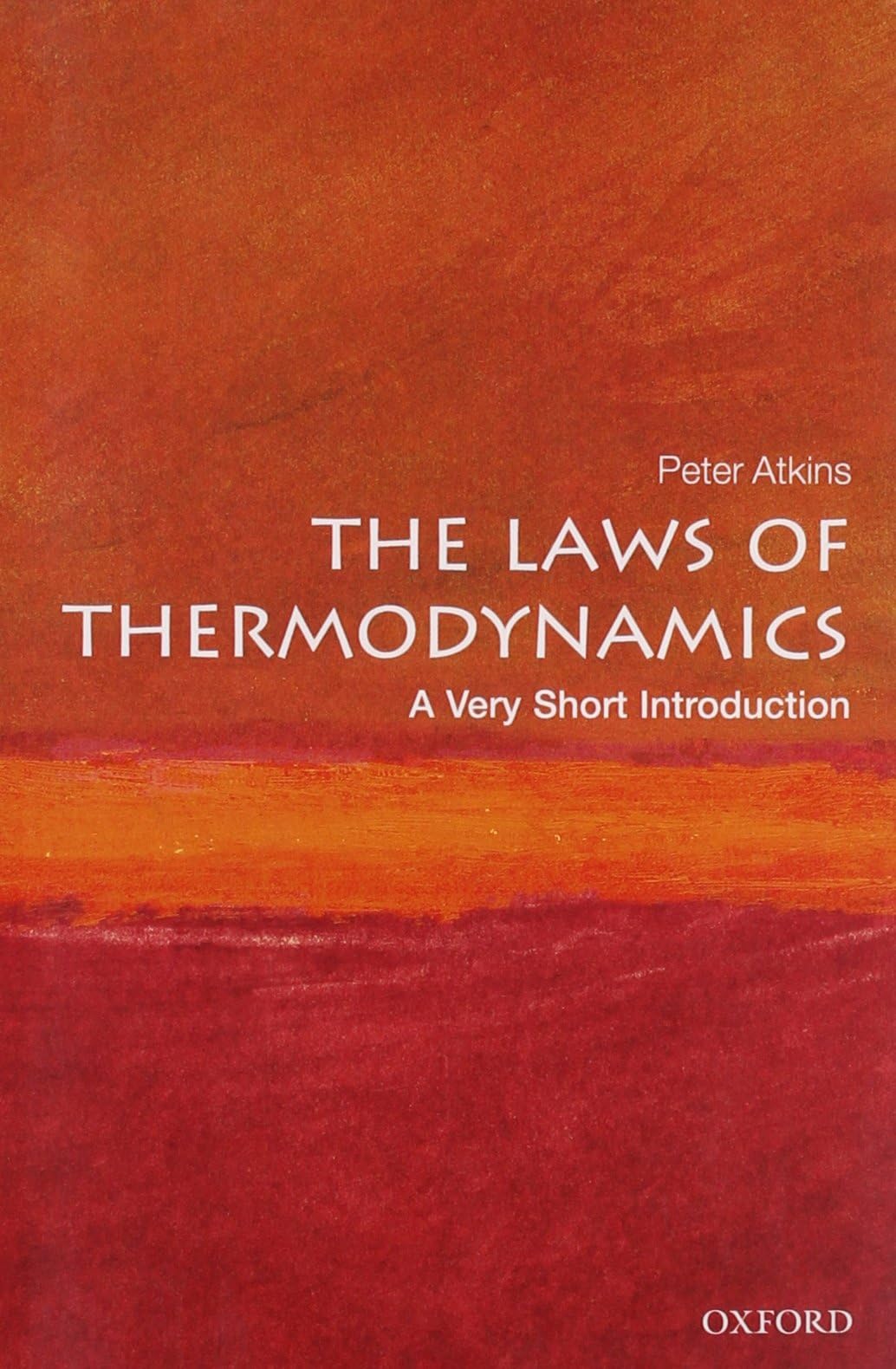
The Laws of Thermodynamics: A Very Short Introduction
Product ID: 7036536
Desertcart purchases this item on your behalf and handles shipping, customs, and support to South Africa.
The laws of thermodynamics drive everything that happens in the universe. From the sudden expansion of a cloud of gas to the cooling of hot metal--everything is moved or restrained by four simple laws. Written by Peter Atkins, one of the world's leading authorities on thermodynamics, this powerful and compact introduction explains what these four laws are and how they work, using accessible language and virtually no mathematics. Guiding the reader a step at a time, Atkins begins with Zeroth (so named because the first two laws were well established before scientists realized that a third law, relating to temperature, should precede them--hence the jocular name zeroth), and proceeds through the First, Second, and Third Laws, offering a clear account of concepts such as the availability of work and the conservation of energy. Atkins ranges from the fascinating theory of entropy (revealing how its unstoppable rise constitutes the engine of the universe), through the concept of free energy, and to the brink, and then beyond the brink, of absolute zero. About the Series: Combining authority with wit, accessibility, and style, Very Short Introductions offer an introduction to some of life's most interesting topics. Written by experts for the newcomer, they demonstrate the finest contemporary thinking about the central problems and issues in hundreds of key topics, from philosophy to Freud, quantum theory to Islam. Review: Very engaging and exceptionally well-written: An excellent introduction to or concise review of key concepts - I'm a big fan of the "A Very Short Introduction" series, wanted to review some basic physics (a longstanding interest), and this seemed like a nice concise review of the basics. I was not only pleased but delighted with the book. With respect to content, it provides a good overview at an introductory level (more precisely, at an ambitious high school or introductory college level). There are excellent chapters on each of the four laws of thermodynamics: the zeroth law that addresses the concept of temperature (the funny numbering is a historical artifact in that it was not named until the 20th century); the first law (on conservation of energy); the second law (on entropy, one of the most important laws in all of science); and the third law (which holds that nothing can be cooled or cool to absolute zero). There is also a fine chapter on energy and work. What distinguishes this little book from others, however, has more to do with style than content. I was not familiar with the author, Peter Atkins, until downloading this recently; after reading it, I immediately downloaded three of his other books mainly because I enjoy his writing so much. (One of the other books is Galileo's Finger: The Ten Great Ideas of Science, which has suberb chapters on evolution, DNA, energy, entropy, atoms, quantum physics, cosmology, and other things.) He is a gifted educator who explains complex concepts in clear, plain language with an emphasis on basic principles and minimal math (which can either be studied or ignored at the reader's discretion). Moreover, he is able to make the material come alive by drawing on the history of physics, describing how various laws and principles came to be discovered, and by explaining their practical significance. For instance, he explains how the second law governs everyday experiences such as cars and refrigerators, and, more importantly, that it has more far-reaching implications, one of which is that it is impossible to build a perpetual motion machine. In short, the book provides an excellent conceptual framework for what is usually considered a difficult subject, simplifying the material by presenting it in bite size pieces. In conclusion: (1) For dabblers like me, this is a superb introduction and summary; (2) For students who want an introduction to the basic concepts, this is for you -- no one should take an introductory physics course that includes thermodynamics without reading this. Review: Effective Book - The Laws of Thermodynamics: A Very Short Introduction by Peter W. Atkins "The Laws of Thermodynamics" is a very solid and practical book that covers the core concepts of thermodynamics. Accomplished author of many science books and Professor of Chemistry at the University of Oxford, does the wonderful A Very Short Introduction series justice by providing readers with an accessible account of the four laws of thermodynamics. This well-written 144 page-book is composed of the following five chapters: 1. The zeroth law: The concept of temperature, 2. The first law: The conservation of energy, 3. The second law: The increase in entropy, 4. Free energy: The availability of work and 5. The third law: The unattainability of zero. Positives: 1. A professionally written book. Good science writing. 2. The book is sound and concise. 3. Does a great job of summarizing the properties of energy and its transformation from one form to another. 4. Though intended for the masses this book does not short change the reader. 5. Goes over every one of the four laws of thermodynamics in adequate detail. 6. Effective use of charts and illustrations. 7. The difference between dynamics and thermodynamics. 8. Terms are well defined: temperature, gas, work, heat, enthalpy, entropy, etc... 9. Name dropping...the scientific greats. 10. Entropy and disorder. 11. The importance of Gibbs energy in chemistry and in the field of bioenergetics. 12. The process of sublimation. 13. Absolute zero...cool. 14. The Boltzmann distribution. 15. The process of adiabatic demagnetization. 16. A further reading section. Negatives: 1. This is not as basic as the introductory series implies. Make no bones about it, thermodynamics is complex and even at its most basic it can be difficult. 2. You must grasp the terms early on to progress effectively through the book. 3. More quantitative than expected. 4. No links to further reading material. In summary, this is a very good science book. The "A Very Short Introduction" series is a really good one intended for those who want to gain a basic understanding of a given topic in a concise manner. Professor Atkins succeeds in providing the reader the core concepts of thermodynamics. Thermodynamics is a complex topic so even at its basic it will test the resolve of some to get through it. It's good concise science writing on a challenging topic. If you are looking to get a basic understanding of the laws of thermodynamics, this is a good book to start. I recommend it. Further suggestions: " Galileo's Finger: The Ten Great Ideas of Science " by the same author, " Thermodynamics For Dummies " by Mike Pauken, " Science Matters: Achieving Scientific Literacy " by Robert M. Hazen, " Why Does E=mc2? (And Why Should We Care?) " by Brian Cox, " Entropy Demystified: The Second Law Reduced to Plain Common Sense " by Arieh Ben-Naim, and " For the Love of Physics: From the End of the Rainbow to the Edge of Time - A Journey Through the Wonders of Physics " by Walter Lewin.

| Best Sellers Rank | #234,506 in Books ( See Top 100 in Books ) #19 in Thermodynamics (Books) #61 in Mechanics #194 in Physics (Books) |
| Customer Reviews | 4.3 out of 5 stars 464 Reviews |
M**1
Very engaging and exceptionally well-written: An excellent introduction to or concise review of key concepts
I'm a big fan of the "A Very Short Introduction" series, wanted to review some basic physics (a longstanding interest), and this seemed like a nice concise review of the basics. I was not only pleased but delighted with the book. With respect to content, it provides a good overview at an introductory level (more precisely, at an ambitious high school or introductory college level). There are excellent chapters on each of the four laws of thermodynamics: the zeroth law that addresses the concept of temperature (the funny numbering is a historical artifact in that it was not named until the 20th century); the first law (on conservation of energy); the second law (on entropy, one of the most important laws in all of science); and the third law (which holds that nothing can be cooled or cool to absolute zero). There is also a fine chapter on energy and work. What distinguishes this little book from others, however, has more to do with style than content. I was not familiar with the author, Peter Atkins, until downloading this recently; after reading it, I immediately downloaded three of his other books mainly because I enjoy his writing so much. (One of the other books is Galileo's Finger: The Ten Great Ideas of Science, which has suberb chapters on evolution, DNA, energy, entropy, atoms, quantum physics, cosmology, and other things.) He is a gifted educator who explains complex concepts in clear, plain language with an emphasis on basic principles and minimal math (which can either be studied or ignored at the reader's discretion). Moreover, he is able to make the material come alive by drawing on the history of physics, describing how various laws and principles came to be discovered, and by explaining their practical significance. For instance, he explains how the second law governs everyday experiences such as cars and refrigerators, and, more importantly, that it has more far-reaching implications, one of which is that it is impossible to build a perpetual motion machine. In short, the book provides an excellent conceptual framework for what is usually considered a difficult subject, simplifying the material by presenting it in bite size pieces. In conclusion: (1) For dabblers like me, this is a superb introduction and summary; (2) For students who want an introduction to the basic concepts, this is for you -- no one should take an introductory physics course that includes thermodynamics without reading this.
B**K
Effective Book
The Laws of Thermodynamics: A Very Short Introduction by Peter W. Atkins "The Laws of Thermodynamics" is a very solid and practical book that covers the core concepts of thermodynamics. Accomplished author of many science books and Professor of Chemistry at the University of Oxford, does the wonderful A Very Short Introduction series justice by providing readers with an accessible account of the four laws of thermodynamics. This well-written 144 page-book is composed of the following five chapters: 1. The zeroth law: The concept of temperature, 2. The first law: The conservation of energy, 3. The second law: The increase in entropy, 4. Free energy: The availability of work and 5. The third law: The unattainability of zero. Positives: 1. A professionally written book. Good science writing. 2. The book is sound and concise. 3. Does a great job of summarizing the properties of energy and its transformation from one form to another. 4. Though intended for the masses this book does not short change the reader. 5. Goes over every one of the four laws of thermodynamics in adequate detail. 6. Effective use of charts and illustrations. 7. The difference between dynamics and thermodynamics. 8. Terms are well defined: temperature, gas, work, heat, enthalpy, entropy, etc... 9. Name dropping...the scientific greats. 10. Entropy and disorder. 11. The importance of Gibbs energy in chemistry and in the field of bioenergetics. 12. The process of sublimation. 13. Absolute zero...cool. 14. The Boltzmann distribution. 15. The process of adiabatic demagnetization. 16. A further reading section. Negatives: 1. This is not as basic as the introductory series implies. Make no bones about it, thermodynamics is complex and even at its most basic it can be difficult. 2. You must grasp the terms early on to progress effectively through the book. 3. More quantitative than expected. 4. No links to further reading material. In summary, this is a very good science book. The "A Very Short Introduction" series is a really good one intended for those who want to gain a basic understanding of a given topic in a concise manner. Professor Atkins succeeds in providing the reader the core concepts of thermodynamics. Thermodynamics is a complex topic so even at its basic it will test the resolve of some to get through it. It's good concise science writing on a challenging topic. If you are looking to get a basic understanding of the laws of thermodynamics, this is a good book to start. I recommend it. Further suggestions: " Galileo's Finger: The Ten Great Ideas of Science " by the same author, " Thermodynamics For Dummies " by Mike Pauken, " Science Matters: Achieving Scientific Literacy " by Robert M. Hazen, " Why Does E=mc2? (And Why Should We Care?) " by Brian Cox, " Entropy Demystified: The Second Law Reduced to Plain Common Sense " by Arieh Ben-Naim, and " For the Love of Physics: From the End of the Rainbow to the Edge of Time - A Journey Through the Wonders of Physics " by Walter Lewin.
A**N
The laws of thermodynamics are fundamental knowledge made accessible.
Peter Atkins’ “The Laws of Thermodynamics: A Very Short Introduction”, (Oxford University Press, 2010) is yet another in a series of thumbnail sketches that give readers, students, and even potential scholars fundamental information about subjects many will know little or nothing about, but which will contribute immeasurably to the fund of knowledge and information that they may already have – things that may have heard about, may know something about, but not in any great detail, and which just might connect with the knowledge they may already have, reinforcing and adding both depth and precision to what they already know and use in their daily lives. So it is with this slim little book that arrived in this morning’s mail. Unwrapped and in hand by noon, and read cover to cover by 3:00 p.m., 94 pages of good solid information tucked inside its colorful covers, and including no fewer than 22 charts, graphs, and illustrations making clear the author’s central points. This is a book that I anticipate referring to again and again. And, I was delighted with the conversational way in which Atkins makes his points, making comparisons and figures of speech that are readily understood. Several times I caught myself murmuring ‘Oh yeah. So that’s the way it works;’ or,’ that’s what it means’. Beginning with the concept of temperature (the Zeroth Law) Atkins takes us into the realm of temperature equilibrium, pressure, heat transfer, modes of measurement, molecules and their response to energy states. Then, in Chapter 2, Adkins introduces us to the First Law, the conservation of energy, and how it works: path independence, what is meant by ‘work’, and he transfer as a mode of transferring energy from one set of molecules to another, and what happens then. He then tells us what happens during a process known as enthalpy as a process in which energy transfers within the system, and why energy can neither be created nor destroyed because time cannot be reversed. In Chapter 3, Atkins discusses what is meant by ‘entropy’, and how entropy affects a system’s internal energy. This leads into a discussion of heat engines and their relative efficiency; why an engine that uses heat to create motive power needs also to have a ‘cold sink’ to dissipate accumulated heat because it is the differential in heat gradient that makes the engine work as intended in a cyclic process. I further learned that entropy is a measure of the ‘quality’ of stored energy. Basically, action seems to be saying that as energy is transferred from its initial repository for potential use the release and flow of energy permeates the entire system and its surroundings; some of that energy performs useful work while the remainder dissipates into the system’s outer reaches and beyond as either heat energy or light, as with the furnace, or a celestial object, like the sun. Entropy is also described as a measure of disorder as substances representing stored energy (i.e., petroleum or coal) are consumed through the process of oxidation and decomposition into simpler, entered substances for which their energy potential have been depleted or removed (coal ash or carbon dioxide and water vapor). In popular parlance entropy has been described as a measure of disorder, or is the tendency of complex objects or substances to degrade or decompose into their constituent parts. That appears to be an extrapolation of the basic concept; but specific to thermodynamics, not necessarily accurate. Atkins then describes how refrigeration and heat pumps operate, and extrapolates from steam engines to chemical and biological changes in food items that essentially replicate the same effects. In Chapter 4, Atkins describes the cost of converting stored energy into ‘work’ or life-sustaining energy – the so-called Gibbs energy that are accomplished through biologic processes alone. He then go on to describe the mechanics of freezing under conditions of physical changes along the temperature gradient running from a gas or vapor through a liquid form into a solid. Chapter 5 speaks to the unattainability of absolute zero temperature and superconductivity. Atkins notes of the composition of matter and the nature of the electromagnetic spectrum combined to make attainment of 0° temperature on an absolute scale and impossibility. He states: “simply put, the entropy of all perfectly crystalline substances at zero temperature is zero”. Whether non-cyclic processes can eventually reach her approximate -273° Kelvin may be theoretically possible; but the process by which that would necessarily occur is subject to a power law, and with the logarithmic curve expanding into infinity. In effect, that would be like attempting to exceed the speed of light; and the fundamental nature of the universe will not allow that. So, there we have it. Peter Atkins concise, neat little book is an absolute gem. I heartily recommend it.
S**N
Perhaps best for those who already understand the subject
Having worked my way through most of this very short introduction to thermodynamics (I confess to having given up about halfway through its discussion of the Second Law) I conclude that thermodynamics does not lend itself to a very short introduction. The book clearly tries to give a simple, popularized explanation; those without much of a background in science, mathematics, or engineering, though, may quickly find it somewhat mystifying. There are a few principles that I think it managed to teach even me. But to get much more out of it apparently requires suitable prerequisites. I cannot blame the author for his book's inability to reduce a complex scientific subject to the level of a mere lawyer. Your mileage may vary. But be prepared for a fair amount of mathematics, often accompanied by the suggestion -- common in works of science but not, I would have thought, entirely appropriate for a "very short introduction" -- that, based on the equations you're presented, coming up with various other equations and understanding their import is a trifling thing that requires no explanation.
I**N
top intro
This is an excellent introduction to the topic. As one other reviewer says (more or less), the laws of thermodynamics are going to hang in there right to the end, in the pantheon of our undertsandings of nature. They are so important, and as Sir Arthur Eddington said so long ago, the second law the most important in all of science. So they are well worth knowing about, for lay readers and thinkers even. I love to read a writer who comes across as obviously loving his subject. Peter Atkins does just this. He is so good to read, to learn from, so crystal clear, so logical, so plain in his uncluttered expression, so helpful. No wonder so many university students around the world have benefited from this man, as their lecturer, their teacher. Most of all I loved the explanation of entropy increase as increasing disorder, particles expanding into shelf-like areas of a box-like space. In this simple diagram and accompanying notes (pp.52-3) he gives the best metaphor for microstates and diversity I have seen. I presume he realises that his statement of the second law as the entropy of the universe increasing in the course of spontaneous change (p.49), when coupled with his defintion of spontaneous change as being when the entropy of the universe increases (p.51), together imply that the second law (as he states it) can be re-stated as: the entropy of the universe increases in the course of changes in which the entropy of the universe increases. I've given the book 5 stars because I can't find a way to award 4.5 and it's worth more than 4. My detracting quibbles, so minor, are i) shared with an earlier reviewer, that we couldn't get more on implication topics like information theory and diversity; and ii) that particularly for entropy and the second law, there wasn't just a smidgen more mathematical background. But I already know the responses to these: you've only got so much space in a very short intro, and you have to keep to topic. Secondly, if you want maths, he gives references at the end to his chemistry textbooks and other volumes. So while I quibble, I understand the reasoning. A top read. Hugely informative.
P**E
A dynamic introduction
Peter Atkins promises at the outset that this will not be a light read, and it isn't, at least not if you want to really take it all in and much of it is new to you. Gibbs energy and Helmholtz energy are discussed, as are negative (below absolute zero) temperatures. For a very short introduction to the subject, it goes into considerable depth. You would need no more than an average grasp of High School math and science to follow the arguments completely, and not even that if you are just seeking a flavor of what the subject is about and are willing to settle for less than a thorough understanding. Atkins writes very well, with clarity, elegance and an infectious enthusiasm. There is certainly no lack of the latter - he describes these laws as 'a mighty handful' that drives the Universe, and claims that 'no other scientific law has contributed more to the liberation of the human spirit than the second law of Thermodynamics'. I'm not sure about that, but I do now appreciate the fundamental importance of these laws and how they are crucial to understanding how Nature works. [PeterReeve]
B**S
An Excellent Introductory Resource
As an individual that tends more to the side of the "soft" sciences, the important theorems that are foundational to the "hard" sciences can be extremely difficult to grasp or intimidating to even attempt to try to learn at the least, a freshman level of understanding of these laws. Needless to say, it is always good to at least try. Peter Atkins and his Very Short Introduction proved to be an excellent resource to help me to develop at the minimum, a clearer and foundational understanding of the Laws of Thermodynamics. The best thing about this book is that Peter Atkins was asked to write it. He does quite an amazing job as far as taking the esoteric and making it as understandable and the least intimidating that it can possibly be. He writes clearly and speaks about the concepts behind the laws in a way that translates the material into common real life scenarios. Another great thing about the book is that he always makes sure to remind the reader of the subjects previously discussed as he moves on to the next topic. In other words, when starting a new subject or sub part of an overall subject, he reminds us of what was previously talked about and gives a very quick recap of the basics of that material. There is one drawback though. This drawback probably has more to do with the reader than anything Dr. Atkins has done though. It is in the last two chapters that things begin to get more technical than the first part of the book. This may require some extra reading and backtracking through the book to make sure that you understand everything clearly enough to get out of the book and its descriptions everything that Dr. Atkins is trying to teach. This means then, that for the beginner, this part is slightly more difficult than the earlier parts. It is not anything that Dr. Atkins does, it is just that the material gets a little heavier. Another plus of the book is that Atkins provides his reader with an excellent little text that will provide you with the basics and a little more. The further reading section at the end of the book will also give the person wanting to know more the capability to find other books that Dr. Atkins has given his seal of approval to. This was truly a well thought out, clear, and actually approachable book considering the topic and my own background. This should be a great book for a person wanting to know about the Laws of Thermodynamics or a person especially looking for a quick refresher on things that they learned previously. It should also prove especially helpful to a student of chemistry, physics or biology to use as a quick resource.
M**Y
As good as it gets (for a short book)
I've ordered many books in thermodynamics to see how the subject is taught and to get a deep understanding. This book is one of the best introductory science books I have ever held in my hands. Peter Atkins is a master at finding lucid analogies (this shows up when he describes enthalpy and free energy). I do not agree with the reviewer who criticises the book for not discussing some advanced applications like biology. This is a very short introduction for goodness sake! However the reviewer who complained thathe didnt always understand the English does get my sympathy. The style is pithy, and it is perhaps because I have already read quite a few other books that I havent been put off by this. I also recommend his books on chemistry which are also very well written. For example If you feel you never quite understood some of the abstract concepts of thermodynamics, then this one is for you (if you like a terse book), or you could get the more leisurely introduction by John Fenn Engines, Energy, And Entropy: A Thermodynamics Primer . The latter is more geared to the discussion of engines. Do not think you will be ready to sit exams on thermodynamics by just reading this book though, it's just meant to get you over some conceptual hurdles or to complement your other readings.
D**A
Almost perfect short introduction
Overall this is a very good introduction to the subject. It also provides some insights in the kinetic theory and statistical mechanics when discussing the microscopic properties of matter. The discussion is most phenomenological - as it should be - the phenomena leading to the laws. The first chapter defines thermal equilibrium and gives us the Zeroth Law. Although it does not mention technical terms such as equivalence class, it is clear from the discussion that this the motivation for introducing the concept of temperature. In the second chapter the author introduces the First Law by following Joule's works. It also defines - precisely - the very important concept of reversibility. One of my few concerns with this book is that it does not state the First Law mathematically. It should be convenient in order to fix some notations such as whether the work term in the First Law is the work done by the system or the work done by the neighborhood. From the discussion in this chapter, in must imply work done by the system. Chapter three works great with the Second Law - in the form, Clausius, Kelvin and the increasing entropy - and introduces another important concept, the spontaneity. It discusses both the macroscopic world of thermal engines and the microscopic world of molecules. Author's analogy between Clausius definition of entropy and a sneezing in a busy street or a quite lab is superb. Although Carnot's Theorem is contained in this chapter, I think it deserved slightly more words on it. Since the author shows the equivalence between Clausius and Kelvin statements, it would be worth to show how theses statements imply Carnot's Theorem. The proof is quite similar. The fourth chapter - on free energies - is slightly opaque. I suppose someone who had not taken a formal course on thermodynamics is perhaps not prepared to appreciate this topic in its full. In the discussion about Helmholtz Potential, there are a lack of care with signs as well as it is considering the work done by the neighborhood, dA = dW, in opposing to what seems to be adopted in chapter 2. The fifth and last chapter explain us the Third Law, both macroscopicaly and microscopicaly, discusses how beta would be a natural - and better - temperature scale and the meaning of negative temperature. It is my favorite chapter on the book. In the Conclusion the author gives some references on the subject. Even technical ones.I suppose Fermi's and Callen's books shouldn't be forgotten.
F**Z
Komprimierte Uni-Vorlesung
War zur Auffrischung der Uni-Vorlesung vor 40 Jahren gedacht. Erfüllt seinen Zweck. Nicht nebenbei lesbar, aber nicht übermäßig viel schwieriges Material, verständlich geschrieben.
A**A
Lectura densa
Si piensas entrar al mundo de la termodinámica, este libro es una excelente opción. Sin embargo, debes estar seguro de entrañar en las leyes de la termodinámica, ya que a pesar que el autor trata de redactar de manera simple y nada técnica, es una lectura de mucha reflexión sobre lo que se lee. Es de mucha ayuda buscar videos en internet a la vez que se lee el libro.
M**E
A concise summary that still manages to be thought-provoking
At last, a book that has been able to explain to me the purpose of the definitions of enthalpy, Gibbs free energy, and the workings of Kelvin's Carnot-efficiency thermometer. Moreover, there appears to be an intriguing connection between the way that the demagnetised and magnetised curves of entropy against temperature necessarily converging at T=0, to adhere to the third law of thermodynamics, and the way that the electric current against voltage curves necessarily change quadrants exactly at the origin, to adhere to the first law of thermodynamics
J**E
Dry but quite manageable.
Well written and concise, the author does quite well at presenting the subject in a progressive way. With the aid of very few drawings and even fewer analogies he still managed to keep me riveted.
Trustpilot
5 days ago
1 month ago