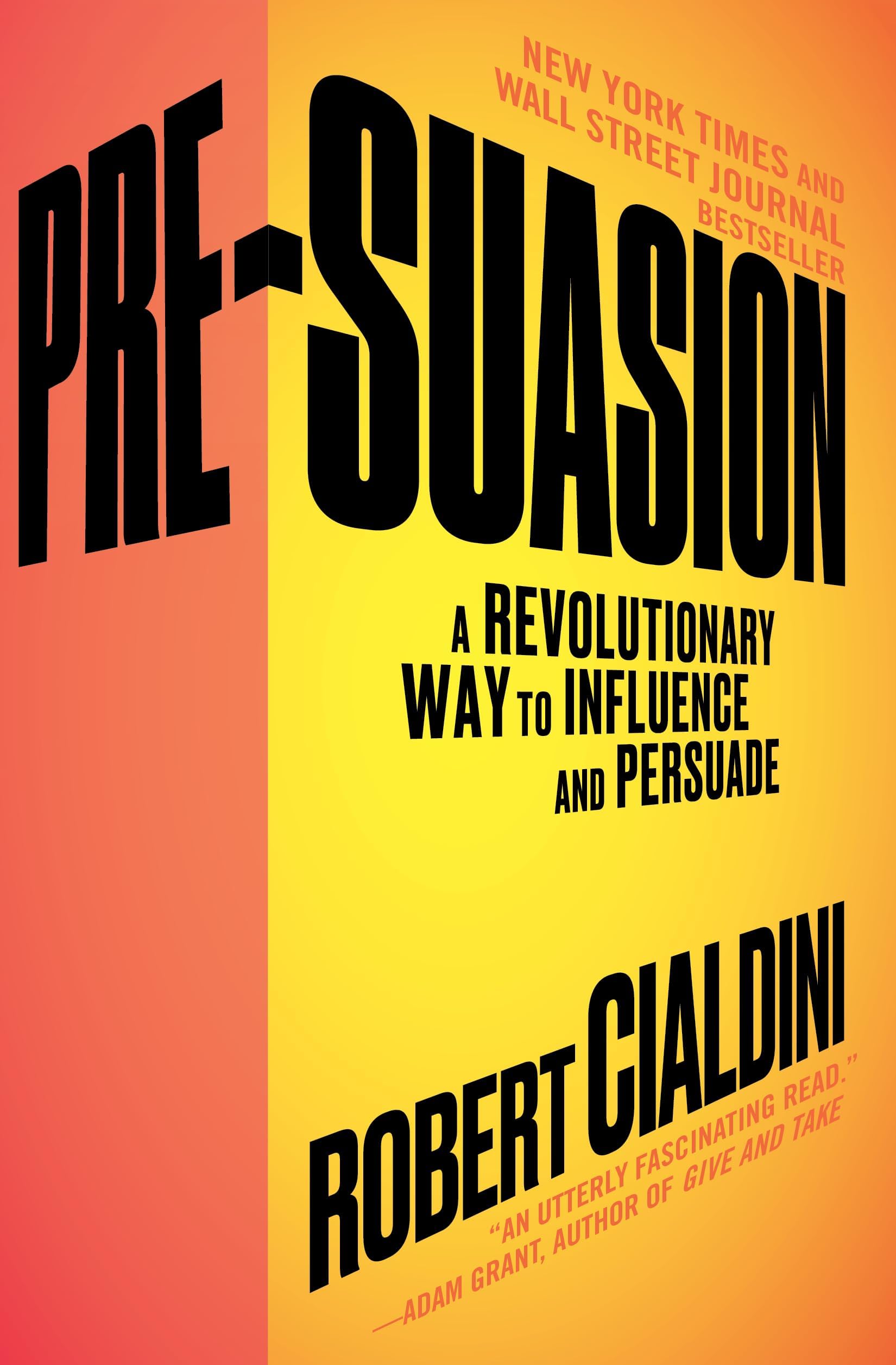
Pre-Suasion: A Revolutionary Way to Influence and Persuade
Product ID: 66638571
Desertcart purchases this item on your behalf and handles shipping, customs, and support to South Africa.
The acclaimed New York Times and Wall Street Journal bestseller from Robert Cialdini—“the foremost expert on effective persuasion” ( Harvard Business Review )—explains how it’s not necessarily the message itself that changes minds, but the key moment before you deliver that message. What separates effective communicators from truly successful persuaders? With the same rigorous scientific research and accessibility that made his Influence an iconic bestseller, Robert Cialdini explains how to prepare people to be receptive to a message before they experience it. Optimal persuasion is achieved only through optimal pre -suasion. In other words, to change “minds” a pre-suader must also change “states of mind.” Named a “Best Business Books of 2016” by the Financial Times , and “compelling” by The Wall Street Journal , Cialdini’s Pre-Suasion draws on his extensive experience as the most cited social psychologist of our time and explains the techniques a person should implement to become a master persuader. Altering a listener’s attitudes, beliefs, or experiences isn’t necessary, says Cialdini—all that’s required is for a communicator to redirect the audience’s focus of attention before a relevant action. From studies on advertising imagery to treating opiate addiction, from the annual letters of Berkshire Hathaway to the annals of history, Cialdini outlines the specific techniques you can use on online marketing campaigns and even effective wartime propaganda. He illustrates how the artful diversion of attention leads to successful pre-suasion and gets your targeted audience primed and ready to say, “Yes.” His book is “an essential tool for anyone serious about science based business strategies…and is destined to be an instant classic. It belongs on the shelf of anyone in business, from the CEO to the newest salesperson” ( Forbes ). Review: Most interesting book I have read this year - Robert Cialdini’s 1984 book Influence: The Psychology of Persuasion has sold over three million copies and has been translated into thirty languages. The book brought science to the art of persuasion, and set out the famed Six Principles of Influence: social proof, reciprocation, authority, liking, scarcity and consistency. There is a good 10 minute summary of the work here. [...] Someone recently recommended that I read his new book Pre-suasion. This book is about research into “Priming”. This is the idea that our decisions are substantially influenced by seemingly trivial items. For example, a company was introducing a new soft drink and had representatives stationed in a mall. Their job was to stop shoppers, explain the features of the new soft drink and attempt to gain the shoppers email address in exchange for the promise of a sample. The success rate was less than 33%. But when a Pre-Suasion question, “Are you adventurous?” was asked prior to launching into the discussion about the new soft drink, the results were astounding. First 97% of the people responded that there were in fact adventurous. They all had a better than average sense of humour as well . But what was really amazing was that once people had affirmed they were adventurous, the success rate shot up to 75%. A key message of the book is that we like those who are like us, be it liking the same sports or sharing a nationality. This is also a key message of the Humm-Wadsworth. [...] If two individuals share a dominant Humm Component, it is highly likely they will get along with each other. A wonderful example of this “liking” effect were the Lithuanian Jews who had escaped to Shanghai and Japan during WWII after gaining Japanese travel visas. The Japanese, post Pearl Harbour, had become allies of the Nazis who in turn demanded these Jews be killed. The Japanese asked the Jews why they were so hated by the Nazis. The answer by Rabbi Kalisch was telling, “It is because we are Asians, just like you.” Understanding the social power of saying the right thing at the right time saved a large group of Jews from death. Another interesting application discussed in the book is when to use “I think” or “I feel.” Normals and Engineers are logical in their decision making and “I think” is the best approach. By contrast the other five Humm components are emotional in their decision making and “I feel” is the best approach. This is a great example of Practical Emotional Intelligence in action. I found Pre-suasion to be a lively and engaging book. It’s a tour through social psychology. Note the actual book is 233 pages long but the references and end notes are about 150 pages. Review: Another gem from Cialdini - This book is a worthy continuation of the previous book (“Influence”). And although Cialdini does repeat several ideas here, it is - I think - with a view to a reader who either did not read the previous book at all and deserves some general introduction to persuasion techniques, or one that has read it but has already forgotten some key ideas. Otherwise it is an excellent addition to his first book, completing the picture from two perspectives: the one of psychological priming, and the one of ethics. I highly recommend reading both books for full understanding of how social psychology of influence works.
| Best Sellers Rank | #15,794 in Books ( See Top 100 in Books ) #7 in Marketing & Consumer Behavior #10 in Business Negotiating (Books) #14 in Rhetoric (Books) |
| Customer Reviews | 4.5 out of 5 stars 3,555 Reviews |
E**T
Most interesting book I have read this year
Robert Cialdini’s 1984 book Influence: The Psychology of Persuasion has sold over three million copies and has been translated into thirty languages. The book brought science to the art of persuasion, and set out the famed Six Principles of Influence: social proof, reciprocation, authority, liking, scarcity and consistency. There is a good 10 minute summary of the work here. [...] Someone recently recommended that I read his new book Pre-suasion. This book is about research into “Priming”. This is the idea that our decisions are substantially influenced by seemingly trivial items. For example, a company was introducing a new soft drink and had representatives stationed in a mall. Their job was to stop shoppers, explain the features of the new soft drink and attempt to gain the shoppers email address in exchange for the promise of a sample. The success rate was less than 33%. But when a Pre-Suasion question, “Are you adventurous?” was asked prior to launching into the discussion about the new soft drink, the results were astounding. First 97% of the people responded that there were in fact adventurous. They all had a better than average sense of humour as well . But what was really amazing was that once people had affirmed they were adventurous, the success rate shot up to 75%. A key message of the book is that we like those who are like us, be it liking the same sports or sharing a nationality. This is also a key message of the Humm-Wadsworth. [...] If two individuals share a dominant Humm Component, it is highly likely they will get along with each other. A wonderful example of this “liking” effect were the Lithuanian Jews who had escaped to Shanghai and Japan during WWII after gaining Japanese travel visas. The Japanese, post Pearl Harbour, had become allies of the Nazis who in turn demanded these Jews be killed. The Japanese asked the Jews why they were so hated by the Nazis. The answer by Rabbi Kalisch was telling, “It is because we are Asians, just like you.” Understanding the social power of saying the right thing at the right time saved a large group of Jews from death. Another interesting application discussed in the book is when to use “I think” or “I feel.” Normals and Engineers are logical in their decision making and “I think” is the best approach. By contrast the other five Humm components are emotional in their decision making and “I feel” is the best approach. This is a great example of Practical Emotional Intelligence in action. I found Pre-suasion to be a lively and engaging book. It’s a tour through social psychology. Note the actual book is 233 pages long but the references and end notes are about 150 pages.
A**S
Another gem from Cialdini
This book is a worthy continuation of the previous book (“Influence”). And although Cialdini does repeat several ideas here, it is - I think - with a view to a reader who either did not read the previous book at all and deserves some general introduction to persuasion techniques, or one that has read it but has already forgotten some key ideas. Otherwise it is an excellent addition to his first book, completing the picture from two perspectives: the one of psychological priming, and the one of ethics. I highly recommend reading both books for full understanding of how social psychology of influence works.
I**N
This book’s significance lies in its science-based evidence of not just what best to say to persuade
Author Cialdini was the Professor of Psychology and Marketing at Arizona State University and a visiting professor of marketing, business and psychology at Stanford University. He rose to fame because of his first book, ‘Influence’, in which he identified six psychological principles that were being routinely used in businesses that dealt with influencing people. ‘Influence’ was bolstered by valuable evidence from scientific and social psychological research into successful persuasion. This book’s significance lies in its science-based evidence of not just what best to say to persuade, but when best to say it. The focus of this book is what effective communicators do before delivering a message, to get that message through. The legitimate merits of your message are never enough to get it accepted, any more than the finest seeds can grow in stony soil. Pre-suasion is the psychological framework in which your message is placed to carry even greater weight. Consider this example as an introduction to the line of thinking. Clearly, the tactic of mentioning an admittedly unrealistic price tag for a job won’t win you the business; many other factors are involved, but it almost always eliminates challenges to the price. Research shows that the amount of money people are prepared to spend on dinner went up when the restaurant was named Studio 97, as opposed to Studio 17. After drawing a set of long lines on a sheet of paper, college students estimated the length of the Mississippi River as much greater than those who had just drawn a set of short lines. People buying wine were more likely to purchase a German vintage if, before their choice, they’d heard a German song playing on the shop’s sound system. An extraordinarily successful home fire-alarm salesman always conducted his sales in people’s homes. A key to his success was an odd technique he always used to establish an aura of trust with the family. “Trust is one of those qualities that leads to compliance with requests, provided that it has been planted before the request is made,” Cialdini explains. In each sales situation he would apologize that he had forgotten something in his car, then get up, fetch it and enter the house again. His rationale: “Who do you let walk in and out of your house on their own? Only somebody you trust, right? I want to be associated with trust in those families’ minds.” He simply arranged to be treated as one of these trusted individuals. Many people believe that the approach needs to be different in their profession, ignoring what is the same. The process of persuasion is governed by psychological laws, which means that similar procedures can produce similar results over a wide range of situations, Cialdini explains. There are specific identifiable moments, when an individual is particularly receptive to a communicator’s message. If you were asked if you were stubborn, you automatically begin searching your memory for times when you’d acted stubbornly, and you would almost certainly identify an instance. If on the other hand, you were labelled quite flexible, someone who is prepared to change her mind after getting new information, you would find instances of this, too. The reason for deciding if a description of oneself is true or false, involves looking for confirmation of the idea rather than for contradiction. This is because it is easier to register the presence of something than its absence. When researchers asked people “Do you consider yourself a helpful person?” nearly everyone answered yes. “In that privileged moment—after subjects had confirmed privately and affirmed publicly their helpful natures—the researchers requested help with their survey. 77.3% volunteered,” Cialdini reports. Without the question, only 29% agreed to help with the survey. What people give attention to is, obviously, of immediate importance to them. However, it is also considered, even unduly, to be an important issue. This is because of the human tendency to assign undue levels of importance to an idea as soon as one’s attention is turned to it. Two weeks before the anniversary of 9/11, about 30% of respondents had named 9/11 as an especially important event. As the anniversary drew closer, and the media treatment intensified, 65% of survey respondents started identifying 9/11 as an especially important event. People believe that if the media (or the public,) has paid attention to an idea or event or pop-group, it must be important enough to warrant the consideration. In not too dissimilar a way, attentional-focus leads to the appearance of causality. Economists, Cialdini believes, are prone to this bias because the monetary aspects of a situation dominate their attention and analysis. Economist Felix Oberholzer-Gee approached people waiting in line at several different locations, and offered them money to let him in front of them. 50% of everyone offered $1 let him in, as did 65% of those offered $3, and 76%, when offered $10. This is not surprising except that almost no one took the money! To explain this, Oberholzer-Gee ignored the economic factors in favour of the moral obligation most people feel to help those in need. The need was deemed stronger by what the line-jumper was prepared to pay. Elements such as money that attract our attention, don’t just appear more important, they also appear more causal, Cialdini explains. In the same vein, when observers asked to judge who had more influence in a discussion, based on tone, content, and direction, the results were the same: whoever’s face was more visible, was judged to be more influential. We see the cause in what attracts our attention. With the array of powerful insights Cialdini has gathered, the question must be asked about the ethical use of pre-Pre-Suasive techniques. Chapter 13 addresses this concern cogently. Undoubtedly the unethical will use this knowledge unethically, until they get caught. However, with this information made known to consumers, those who behave unethically will be identified. Onerous penalties for that behaviour, will be inflicted by now more-aware customers – avoiding doing business with the unethical. That said, the real value of this book to a wide range of people in business, lies in the understanding that it doesn’t take much to enhance the effectiveness of communication. Sun Tzu wrote, “Every battle is won before it is fought.” That is the value of pre-planning, and the value of understanding the insights of Pre-Suasion. Read this book, you will be pleased you did. It works to prevent falling prey to the unethical, and as a guide to how you can become more persuasive – ethically. Readability Light ---+- Serious Insights High +---- Low Practical High -+--- Low *Ian Mann of Gateways consults internationally on leadership and strategy and is the author of Strategy that Works.
J**N
This is not an optional read if you're in business or want to be in business
Disclosure - I have only read a little over the first 100 pages. The problem is I'm afraid to finish this book. Not for lack of trying. I've read these 100 pages over and over again. They are incredible. Beyond incredible. Intellectually stimulating yet also practical. Useful. Profitable. I've already made significant changes to my business and seen the impact on my bottom line. It's also made me a better person by practicing and using these principles on myself. And to think I almost didn't read this book in the first place. Why? Years ago I read Robert Cialdini's book Influence Influence: The Psychology of Persuasion, Revised Edition and unlike all other books about persuasion out at the time, Cialdini's was backed by actual research, not anecdotal. Simply put, it was the best book on persuasion that I have ever read. I read that book 9 years ago and I still use something I learned from that book in my business every day. For some dumb reason I was hesitant to read Pre-suasion at first because I didn't want to taint my experience with Cialdini as an author, having written one of my all time favorite books. Then I watched a podcast that Joe Polish did with Cialdini and realize I was foolish for dragging my feet so I bought Pre-suasion. I had heard from several people already before that how good the book was, but you know how some people are - quick to dish out the hyperbole. In retrospect everyone who told me how good the book was undersold it. It's not just good. It's not even great. It, to me, is the evolution of Influence. I haven't even read the whole thing yet and I think it might already be my new favorite book on persuasion. I can only imagine the untold number of success stories that are come from this book. To think, a retired professor was able to write something so impactful to business that it surpassed all these books that actual successful businessmen and marketers put out. Hey, I'll take it. This is not an optional read if you're in business or want to be in business. If you go into any category, niche or field and you run up against a competitor who has read and practices presuasion and you don't... I can't understate how much of a disadvantage you'll be at. Pre-suasion? Simply incredible.
D**R
The Master speaks: the deep techniques and principles for stacking the deck of life in your favor
In his now-classic "Influence", Robert Cialdini tagged along with vacuum salesmen, car dealers and other persuasion professionals to come up with the six psychological principles that were "deployed routinely in long-prospering influence businesses" -- reciprocation, liking, social proof, authority, scarcity, and consistency. Those principles are still solid gold. Prof Cialdini once again gets his hands dirty to uncover an even deeper level of influence: how to make compliance almost a foregone conclusion through what happens *before* the pitch -- or "pre-suasion, the process of arranging for recipients to be receptive to a message before they encounter it." Some of its principles: • Privileged moments: timing is huge. Get people at the right time, and compliance goes way up. • Channeled attention: things that you pay attention to automatically become more important. Channel attention to get results. • Primacy of associations: change the associations around a concept -> change the behavior. • Persuasive geographies: location predisposes to behavior, e.g. you're going to run more often if you live close to a park. The book is full of fascinating anecdotes illustrating the persuasive strategies that make you think at once "Holy cow that's like voodoo" and "Geez I'm glad I know about this so I don't fall for it" and "Y'know, I just may have to use that one someday." Jim, the top home alarm salesman would "forget" something from his car at the same point in every sales presentation, then get the homeowner's house keys "to let himself out." Now they implicitly trusted him *'cause he's got their house keys*. Cult recruiters ask people "Are you unhappy?" to get them to focus on their dissatisfactions. You put fluffy clouds on a furniture website's background, and people paid more; you put pennies, and people paid less. At a certain point, you have to ask yourself: can influence be this subtle? Are we all such chumps to fall for the key trick or the cloud trick? The answer is that nothing in this book is speculative or theoretical, no matter how zany it sounds. These are scientifically-verified findings based on observing what works. Bob Cialdini doth not mess around. The tools in this book are potent, and like a hammer, you can use them to build or to destroy. Marketers and advertisers are obviously going to have a field day with this book to manipulate us further. But you can also expand your awareness of these techniques to become more savvy about how you wish to be influenced -- or even better, to influence *yourself* towards greater happiness and well-being. Channel your attention towards gratitude and the blessings in your life. Arrange your environment such that you favor a healthier diet. Live close to a park, trail, gym, health food store and dear friends. "Presuasion", an instant classic about how the world works, can be your secret weapon to stack the deck of life in your favor. -- Ali Binazir, M.D., M.Phil., Happiness Engineer & author of The Tao of Dating: The Smart Woman's Guide to Being Absolutely Irresistible , the highest-rating dating book on Amazon for 4+ years
C**N
I hope my competitors do not read it.
Superb! This book is a treasure. I hope my competitors do not read it.
V**S
Cialdini is brilliant. I have read most of what he has ...
Cialdini is brilliant. I have read most of what he has ever written. I SO wanted to read this book. I could not get past the 2nd chapter. I read a LOT. I have tons of books. This one will never be on the "have read" list. There is a big difference between great information, and great information formatted in a way that makes it easily digestible. I do not want to have to strain to read a book. I had to strain to read this one. I am disappointed. I hope someone takes the research that is in this book and puts it into a user friendly book that one can enjoy.
M**A
Buy the Hardcover
The paperback version is so cheap and thin, it’s practically tissue paper. Not worth worrying you’ll rip it each time you turn the page imo.
D**E
It is also an excellent book teaching us that what we say directly before ...
This is the sequel to the book Influence. It is also an excellent book teaching us that what we say directly before the message we want to deliver can directly influence how others will react to our message. It also has a section on how false confessions are provoked by some police interrogations. He also advises on how to best deal with a police interrogation so that you can be cooperative but not put yourself in a compromised position. For instance, he gives information that if you are being videotaped, it is wise to make sure the interviewer and the interviewed person have the same view on the tape such as from the side. If the video is directly on the person's face but not on the interviewer, someone looking at the video at a later date would tend to not get an impartial view of the interview. He gives an example of seeing a couple having a discussion where he was on one side of a restaurant where he could watch the couple interact while watching the male's face. Seeing only the male's face while listening to the discussion he felt the male was dominating the conversation. A short time later he realised that on the other side of the couple was another psychologist he knew who was watching the same couple but seeing only the female's face. The other psychologist had the opposite interpretation of the conversation thinking that the female in a submissive type of way controlled the result and was more dominant. Very interesting! Hans Boehnke
B**O
Power of influence
Great work! Amazing for nowadays' scenario.
U**F
A worth reading classic
The earliest in your life you read this book, the most benefit it will provide you. Read it and notice how these tricks influence your life in a conscious or unconscious way.
A**S
The go to book on Ethical Pre-suasion
Our April Data Book Club session on Robert Cialdini’s latest book Pre-suasion was both insightful and actionable . Moving beyond mere data, we explored how the "psychology of notice" drives high-stakes decision-making. We found the insights on Pre-Suasion particularly striking; learning how to frame a context before even making an "ask" is a superpower for any leader. Whether you're in Data, AI, or management, this is essential reading for navigating organizational change ethically. Highly recommended for anyone looking to communicate with more clarity and confidence!
N**A
Wonderful lecture
I would say this book was on my wishlist for a very Long Time and finally i got it
Trustpilot
2 days ago
1 week ago