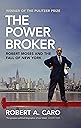
The Power Broker: Robert Moses and the Fall of New York
Product ID: 66459786
The Power Broker by Robert A. Caro is 'simply one of the best non-fiction books in English of the last forty years' (Dominic Sandbrook, Sunday Times ): a riveting and timeless account of power, politics and the city of New York by ‘the greatest political biographer of our times’ ( Sunday Times ); chosen by Time magazine as one of the 100 Best Non-Fiction Books of All Time and by the Modern Library as one of the 100 Greatest Books of the Twentieth Century; Winner of the Pulitzer Prize; a Sunday Times Bestseller; 'An outright masterpiece' ( Evening Standard ) The Power Broker tells the story of Robert Moses, the single most powerful man in New York for almost half a century and the greatest builder America (and probably the world) has ever known. Without ever once being elected to office, he created for himself a position of supreme and untouchable authority, allowing him to utterly reshape the city of New York, turning it into the city we know today, while at the same time blighting the lives of millions and remaining accountable to no one. First published in 1974, this monumental classic is now widely acknowledged to be one of the greatest books of its kind. Review: Absorbing, multi-layered portrait of a brilliant monster. - Long an admirer of Robert A Caro’s biographies of LBJ, I confess I had ignored The Power Broker because at first glance a book about a man who built bridges, roads, parks and civic buildings sounded bland compared to the complex personality of Lyndon Johnson. I was wrong and this book fully deserves its reputation as one of the best biographies ever written. Robert Moses was a peculiar man, initially fascinated by, of all things, the British Civil Service and how it remained incorruptible. He doesn’t appear to have been formally trained in anything but he quickly mastered the tedious aspects of statutes and how they are drafted, power structures and where true control and authority lie. He learned a great deal from Gov Al Smith, to whom he was devoted, but unlike Smith, Moses was not a benign man. Throughout his career his personal power was protected by foresight, and the killer clause. He was never elected to anything (and his one attempt to run for office almost destroyed him by exposing his raw and ruthless personality). He was Park Commissioner because that role gave him the kind of inviolate authority that politicians could only envy. It also meant that the public thought he fought on the side of the angels because everyone likes parks. In his early days he was an idealist, and armed with a letter of passage by the Governor, he tirelessly explored the virgin hinterland of New York, jealously guarded by the Robber Baron families who wanted to exclude the riff-raff from the wilderness and the seaside. He planned Parkways that would enable middle-class Americans to drive to the countryside previously barred to them by the privileged. He built vast and luxurious venues where previously there had been just sand, with building materials and leisure facilities second to none. He understood structural engineering and drove his loyal (and often terrified) staff to produce blueprints and plans and costings in record time. And although he was most active during the Depression years, money never seemed to be a problem. The myriad financial deals and bond issues can become dense at times but they were directly related to the freedom given him by the structure of an ‘Authority’, compared to a municipality, city or state administration. He had no personal interest in money, and coming from a wealthy family had refused a salary. He was ‘money honest’ but as his taste for power grew he became corruptible, fascinated by power for its own sake. The idealist of the early chapters soon turns into something of a monster with huge prejudices against lower class people, blacks and ethnics. When he built his Expressways and Parkways he deliberately made the bridges crossing them too low to permit buses because he just wasn’t interested in people who didn’t drive a car. Ironically, he never learned to drive a car himself and was chauffered everywhere in a luxurious limo that served as his mobile office. As his engineering megalomania grew he evicted thousands of tenants and bulldozed their houses and tenements to make way for another road. The cruelty with which this was done was later exposed and led to his downfall. He drove his engineers and structural crews very hard and the New York bridges he built are his monuments along with the UN Building and the Lincoln Centre. Only very late did it dawn on people that Moses’ roads didn’t reduce congestion at all; they did the opposite, feeding traffic into huge jams and making commuting a nightmare. Cars didn’t just fill roads, they needed to be parked in the City and at the airport. Moses despised trains and buses so mass transit was never part of his plans, as anyone lining up for a cab at JFK can testify. Yet this fascinating man continues to confound the reader. Physically driven, he worked long days then relaxed by diving into the sea and swimming for miles. The atmosphere in his offices was lively and chatty and invigorating and he instilled loyalty as well as affection (and terror). He always defended his subordinants fiercely and was contemptuous of complaints, petitions or legal challenges. He cultivated the press who loved him to the point of dereliction of duty as far as the common good was concerned. For a long time most of the press were in awe of him and he could do no wrong, and the little people he had pushed around had to wait a long time for justice. But he was a mean SOB too, unforgiving and vengeful. Chapter 26 is a fascinating description of his relationship with his older brother, who he destroyed, and his mother, and only a psychiatrist could unravel the darkness there. (Chapter 35 also gives fascinating insights into Moses). But Caro’s skill as a biographer makes us feel sorry for Moses when his downfall finally arrives, at the hands of some maverick reporters and Nelson Rockefeller. At the same time the realisation dawns that his life’s work as a builder of roads and bridges caused far more problems than it resolved, and ultimately his career was devalued. Power was so important to him that to be excluded from it was agony, and he became a ghost haunting a landscape he had built. Review: One of life's force's of nature. - I have never written a review for anything in my life but I will make an exception for Caro's epic. I have just finished it. It is brilliant. I must confess that as of three years ago, I had never heard of Robert Moses. This is a difficult confession to make for a person who views themselves as knowing more than most about history. The confession is all the more difficult when Caro lists, as he does in the preface, Moses' list of achievements: builder of the Triborough Bridge, the Brooklyn-Battery Tunnel, the Veranzano Narrows Bridge, Jones Beach and their stunning Bathhouses, the United Nations building and the chicanery involved in bringing that prestigious organisation to New York, the Throgs Neck, Bronx-Whitestone bridges, the Long Island Expressways and the complete opening up, to the poor of New York City, of the land and beaches of Long Island. Then there were the playgrounds, more than 250 of them, which Moses constructed in New York City alone. Who was this man? He was a Jew at a time when being Jewish meant being excluded (he was excluded from his university's fraternity solely on this basis) and being on the periphery of social acceptance by the aristocracy. He was extremely intelligent and a possessor of his mother's (and grandmother before her) fierce self-righteousness and self-belief. He alone knew what was right and he would make sure that what he thought was right for the city, what he was sure was right for the city, would be done come hell or high-water, over the heads of objecting home-owners (whom he derided as 'crackpots') or uneasy politicians (whom he advised to take up a new profession if their conscience worried them). But Caro isnt really interested in where Moses came from or even the character of the man, although he does not shy away from discussing either. He is interested in the sole concept of power. Who has it? Where does it come from? How does one get it? How does one lose it? Whats possible without it? What can be achieved with it? Moses, a Jew in an Irish-dominated city had no power. He came from a wealthy family but to realise his dreams, the dreams of taking the virgin lands of Long Island from the Robber Barons who lived there and hand them back to the poor people of New York, the poor who had no playgrounds worthy of that name to take their children to, and transform those pristine lands into beaches and parkland, the likes of which neither America nor the western world had ever seen before, would require power. And not just any sort of power, legislative power. And this is how a man with a great knowledge of local government but with no electoral power to realise his dreams, came to power. Moses offered to support Al Smith, New York's first Irish-American Governor, a man who famously declared that he had never read a book in his life, and give him parklands. In return for huge parks and the consequent massive public approval, Smith was reelected Governor twice. As a payback Smith agreed to Moses' wish to become Parks Commissioner. With power at last Moses built on a vast scale. Caro details Moses enormous capacity for hardwork. Quite frankly, Moses was a force of nature. He worked 15-16 hour days, seven days a week, was chauffeured to and from work in a car specially adapted with a table and chairs to use as a mobile office. He created the Long Island Expressways. This is hard to visualise but up to this point (c. 1926) Long Island was vast wilderness owned by the wealthy. Moses created laws effectively allowing him to compulsorily purchase their land and convert it, over their delirious objections, for the betterment of society's poorest. Caro rightly gives Moses credit for this. But there was the other side of Moses. As he got older he craved more power. Being put in charge of Parks in New York City under Mayor La Guardia allowed Moses to bring his magic to the City. And he did so. Beloved of the media (especially the New York Times whose owner was a devout conservationist) Moses ensured that he had an ally in the press whom he call upon if any politician refused to do what he wanted. And that became the nature of the man. Moses' connections amongst the City's architects, builders, engineers, lawyers, bankers and Wall Street financiers, all men who realised that Moses was a man, the only man, who could cut through red tape and 'get things done' gradually meant that nobody, no local politician, not even the Mayor or Governor, at the risk of being rounded on by the media and adoring public who saw Moses as a model public servant, felt that they were strong enough to oppose him. Moses crushed all of these men. Caro details in a poignant chapter how Moses' own brother, Paul, could not find a job in the City, because he had a disagreement with his famous sibling. Caro interviewed Paul Moses on a few occasions and mentions in the book that he died, in the top apartment in a downtown building, in virtual poverty. Robert Moses could have helped his brother. He chose not to. Moses throughout the 1950's and 1960's revealed a man whose gloss began to wear off for the public. Caro expertly pulls together all the various strings to the drama in East Tremont,a vibrant neighbourhood in North Brooklyn, a neighbourhood which was demolished when Moses ran the Cross-Bronx Expressway right through it. Why didnt the local politicans object? Because if they did, they'd have every engineer and union-man in the construction industry roaring at them down the phone. They'd be denounced as 'standing in the way of progress', of 'denying men a chance to work'. One politician wearily told Caro that this experience, of being denounced, of being screamed at and publicly vilified by organisations who needed work, was impossible to imagine, all the more so when one knew that Moses was behind the scenes orchestrating it. Moses was eventually removed from all power in 1968. Caro points out that it needed a man every bit as much a bully as Moses to do it, every bit the force of nature he was, and every bit as powerful. Nelson Rockefeller was Governor and he had heard all the stories about Moses. He had gotten used to the stories that Moses, throughout his 50 years in power, had routinely offered to resign if he didnt get his way. Every Mayor and Governor had always backed down when this threat was made. Rockefeller was different. Caro shows that Rockefeller didnt have to back down, didnt need to, because he himself had access to the sort of money that Moses would use to lord over lesser public officials. Rockefeller had huge power. Rockefeller took Moses's threat to resign and allowed him to do it. Too late, Moses realised his mistake. Through chicanery of a different type, through lies-lies that Moses had often barefacedly told himself to others down through the years- Rockefeller eased Moses out of power and once out, kept him out. This last part of Caro's book (a book which another reviewer, despite its size, rightly alluded to as a 'page-turner') paints a sad picture of this once mighty man. Able at one point to defy President Roosevelt himself, by 1972, out of power, this man who had once held 12 city and state jobs at once, a man who in his twenties Frances Perkins had described admiringly as 'burning up with ideas, just burning up with them', was confined to his home in Long Island, lashing out at the inequities that had befallen a man of 82 years of age, of the lies that had been told him to ease him out of power, of being forced to live out his life in relative obscurity while lesser able men, incompetent politicians eager to score political points, denounced him and all that he had achieved as 'all that was once wrong with this city'. Caro expertly paints a picture of not only a frustrated old man at the end of his life in public life, but of a sad man, just a man really, all alone, with no one to visit him, alone with his thoughts and pictures of the things he built. Robert Moses was a force of nature. Caro's magnificent book shows, if nothing else, how, despite all the nay-sayers and doom-mongerers, anything, absolutely anything, is possible. Robert Moses was proof of this.
| Best Sellers Rank | 558,911 in Books ( See Top 100 in Books ) 1 in Urban & Rural Planning 8 in United States Historical Biographies 58 in Political Biographies |
| Customer Reviews | 4.7 out of 5 stars 3,016 Reviews |
M**M
Absorbing, multi-layered portrait of a brilliant monster.
Long an admirer of Robert A Caro’s biographies of LBJ, I confess I had ignored The Power Broker because at first glance a book about a man who built bridges, roads, parks and civic buildings sounded bland compared to the complex personality of Lyndon Johnson. I was wrong and this book fully deserves its reputation as one of the best biographies ever written. Robert Moses was a peculiar man, initially fascinated by, of all things, the British Civil Service and how it remained incorruptible. He doesn’t appear to have been formally trained in anything but he quickly mastered the tedious aspects of statutes and how they are drafted, power structures and where true control and authority lie. He learned a great deal from Gov Al Smith, to whom he was devoted, but unlike Smith, Moses was not a benign man. Throughout his career his personal power was protected by foresight, and the killer clause. He was never elected to anything (and his one attempt to run for office almost destroyed him by exposing his raw and ruthless personality). He was Park Commissioner because that role gave him the kind of inviolate authority that politicians could only envy. It also meant that the public thought he fought on the side of the angels because everyone likes parks. In his early days he was an idealist, and armed with a letter of passage by the Governor, he tirelessly explored the virgin hinterland of New York, jealously guarded by the Robber Baron families who wanted to exclude the riff-raff from the wilderness and the seaside. He planned Parkways that would enable middle-class Americans to drive to the countryside previously barred to them by the privileged. He built vast and luxurious venues where previously there had been just sand, with building materials and leisure facilities second to none. He understood structural engineering and drove his loyal (and often terrified) staff to produce blueprints and plans and costings in record time. And although he was most active during the Depression years, money never seemed to be a problem. The myriad financial deals and bond issues can become dense at times but they were directly related to the freedom given him by the structure of an ‘Authority’, compared to a municipality, city or state administration. He had no personal interest in money, and coming from a wealthy family had refused a salary. He was ‘money honest’ but as his taste for power grew he became corruptible, fascinated by power for its own sake. The idealist of the early chapters soon turns into something of a monster with huge prejudices against lower class people, blacks and ethnics. When he built his Expressways and Parkways he deliberately made the bridges crossing them too low to permit buses because he just wasn’t interested in people who didn’t drive a car. Ironically, he never learned to drive a car himself and was chauffered everywhere in a luxurious limo that served as his mobile office. As his engineering megalomania grew he evicted thousands of tenants and bulldozed their houses and tenements to make way for another road. The cruelty with which this was done was later exposed and led to his downfall. He drove his engineers and structural crews very hard and the New York bridges he built are his monuments along with the UN Building and the Lincoln Centre. Only very late did it dawn on people that Moses’ roads didn’t reduce congestion at all; they did the opposite, feeding traffic into huge jams and making commuting a nightmare. Cars didn’t just fill roads, they needed to be parked in the City and at the airport. Moses despised trains and buses so mass transit was never part of his plans, as anyone lining up for a cab at JFK can testify. Yet this fascinating man continues to confound the reader. Physically driven, he worked long days then relaxed by diving into the sea and swimming for miles. The atmosphere in his offices was lively and chatty and invigorating and he instilled loyalty as well as affection (and terror). He always defended his subordinants fiercely and was contemptuous of complaints, petitions or legal challenges. He cultivated the press who loved him to the point of dereliction of duty as far as the common good was concerned. For a long time most of the press were in awe of him and he could do no wrong, and the little people he had pushed around had to wait a long time for justice. But he was a mean SOB too, unforgiving and vengeful. Chapter 26 is a fascinating description of his relationship with his older brother, who he destroyed, and his mother, and only a psychiatrist could unravel the darkness there. (Chapter 35 also gives fascinating insights into Moses). But Caro’s skill as a biographer makes us feel sorry for Moses when his downfall finally arrives, at the hands of some maverick reporters and Nelson Rockefeller. At the same time the realisation dawns that his life’s work as a builder of roads and bridges caused far more problems than it resolved, and ultimately his career was devalued. Power was so important to him that to be excluded from it was agony, and he became a ghost haunting a landscape he had built.
P**N
One of life's force's of nature.
I have never written a review for anything in my life but I will make an exception for Caro's epic. I have just finished it. It is brilliant. I must confess that as of three years ago, I had never heard of Robert Moses. This is a difficult confession to make for a person who views themselves as knowing more than most about history. The confession is all the more difficult when Caro lists, as he does in the preface, Moses' list of achievements: builder of the Triborough Bridge, the Brooklyn-Battery Tunnel, the Veranzano Narrows Bridge, Jones Beach and their stunning Bathhouses, the United Nations building and the chicanery involved in bringing that prestigious organisation to New York, the Throgs Neck, Bronx-Whitestone bridges, the Long Island Expressways and the complete opening up, to the poor of New York City, of the land and beaches of Long Island. Then there were the playgrounds, more than 250 of them, which Moses constructed in New York City alone. Who was this man? He was a Jew at a time when being Jewish meant being excluded (he was excluded from his university's fraternity solely on this basis) and being on the periphery of social acceptance by the aristocracy. He was extremely intelligent and a possessor of his mother's (and grandmother before her) fierce self-righteousness and self-belief. He alone knew what was right and he would make sure that what he thought was right for the city, what he was sure was right for the city, would be done come hell or high-water, over the heads of objecting home-owners (whom he derided as 'crackpots') or uneasy politicians (whom he advised to take up a new profession if their conscience worried them). But Caro isnt really interested in where Moses came from or even the character of the man, although he does not shy away from discussing either. He is interested in the sole concept of power. Who has it? Where does it come from? How does one get it? How does one lose it? Whats possible without it? What can be achieved with it? Moses, a Jew in an Irish-dominated city had no power. He came from a wealthy family but to realise his dreams, the dreams of taking the virgin lands of Long Island from the Robber Barons who lived there and hand them back to the poor people of New York, the poor who had no playgrounds worthy of that name to take their children to, and transform those pristine lands into beaches and parkland, the likes of which neither America nor the western world had ever seen before, would require power. And not just any sort of power, legislative power. And this is how a man with a great knowledge of local government but with no electoral power to realise his dreams, came to power. Moses offered to support Al Smith, New York's first Irish-American Governor, a man who famously declared that he had never read a book in his life, and give him parklands. In return for huge parks and the consequent massive public approval, Smith was reelected Governor twice. As a payback Smith agreed to Moses' wish to become Parks Commissioner. With power at last Moses built on a vast scale. Caro details Moses enormous capacity for hardwork. Quite frankly, Moses was a force of nature. He worked 15-16 hour days, seven days a week, was chauffeured to and from work in a car specially adapted with a table and chairs to use as a mobile office. He created the Long Island Expressways. This is hard to visualise but up to this point (c. 1926) Long Island was vast wilderness owned by the wealthy. Moses created laws effectively allowing him to compulsorily purchase their land and convert it, over their delirious objections, for the betterment of society's poorest. Caro rightly gives Moses credit for this. But there was the other side of Moses. As he got older he craved more power. Being put in charge of Parks in New York City under Mayor La Guardia allowed Moses to bring his magic to the City. And he did so. Beloved of the media (especially the New York Times whose owner was a devout conservationist) Moses ensured that he had an ally in the press whom he call upon if any politician refused to do what he wanted. And that became the nature of the man. Moses' connections amongst the City's architects, builders, engineers, lawyers, bankers and Wall Street financiers, all men who realised that Moses was a man, the only man, who could cut through red tape and 'get things done' gradually meant that nobody, no local politician, not even the Mayor or Governor, at the risk of being rounded on by the media and adoring public who saw Moses as a model public servant, felt that they were strong enough to oppose him. Moses crushed all of these men. Caro details in a poignant chapter how Moses' own brother, Paul, could not find a job in the City, because he had a disagreement with his famous sibling. Caro interviewed Paul Moses on a few occasions and mentions in the book that he died, in the top apartment in a downtown building, in virtual poverty. Robert Moses could have helped his brother. He chose not to. Moses throughout the 1950's and 1960's revealed a man whose gloss began to wear off for the public. Caro expertly pulls together all the various strings to the drama in East Tremont,a vibrant neighbourhood in North Brooklyn, a neighbourhood which was demolished when Moses ran the Cross-Bronx Expressway right through it. Why didnt the local politicans object? Because if they did, they'd have every engineer and union-man in the construction industry roaring at them down the phone. They'd be denounced as 'standing in the way of progress', of 'denying men a chance to work'. One politician wearily told Caro that this experience, of being denounced, of being screamed at and publicly vilified by organisations who needed work, was impossible to imagine, all the more so when one knew that Moses was behind the scenes orchestrating it. Moses was eventually removed from all power in 1968. Caro points out that it needed a man every bit as much a bully as Moses to do it, every bit the force of nature he was, and every bit as powerful. Nelson Rockefeller was Governor and he had heard all the stories about Moses. He had gotten used to the stories that Moses, throughout his 50 years in power, had routinely offered to resign if he didnt get his way. Every Mayor and Governor had always backed down when this threat was made. Rockefeller was different. Caro shows that Rockefeller didnt have to back down, didnt need to, because he himself had access to the sort of money that Moses would use to lord over lesser public officials. Rockefeller had huge power. Rockefeller took Moses's threat to resign and allowed him to do it. Too late, Moses realised his mistake. Through chicanery of a different type, through lies-lies that Moses had often barefacedly told himself to others down through the years- Rockefeller eased Moses out of power and once out, kept him out. This last part of Caro's book (a book which another reviewer, despite its size, rightly alluded to as a 'page-turner') paints a sad picture of this once mighty man. Able at one point to defy President Roosevelt himself, by 1972, out of power, this man who had once held 12 city and state jobs at once, a man who in his twenties Frances Perkins had described admiringly as 'burning up with ideas, just burning up with them', was confined to his home in Long Island, lashing out at the inequities that had befallen a man of 82 years of age, of the lies that had been told him to ease him out of power, of being forced to live out his life in relative obscurity while lesser able men, incompetent politicians eager to score political points, denounced him and all that he had achieved as 'all that was once wrong with this city'. Caro expertly paints a picture of not only a frustrated old man at the end of his life in public life, but of a sad man, just a man really, all alone, with no one to visit him, alone with his thoughts and pictures of the things he built. Robert Moses was a force of nature. Caro's magnificent book shows, if nothing else, how, despite all the nay-sayers and doom-mongerers, anything, absolutely anything, is possible. Robert Moses was proof of this.
B**N
The complete book about political power
It is the best book I have read and I read a lot. Despite its 1100 pages I didn't lose interest at any time. It's incredibly well-written, it's engaging, it's informative about New York history, about urban planning and, most of all, about politics. Working in politics and government myself, this book has been more than just a great read. It shows how politics really works, how policy is made and implemented and how it's incredibly difficult to pull all the strings together and bring about change (good or bad). It shows, in Robert Moses' life story, how an effective politicians needs to control the bureacracy to ensure compliance, how media support is key to pressure competing politicians and ensure protection from hostile ones higher up in the food chain, how a politician needs to gather support from relevant interest groups, how a politician needs to control a stable source of funding in order to have money to pay for the implementation of ideas, how a politician needs to know how to use all the legislative tricks at hand to control the language of the legislative process and really make laws work the way you want. And a lot more.
A**H
Robert Caro – Master Biographer
If you know anyone, still, with delusions about 'people seeking to do good in government', or ‘planners with vision who know best’, recommend this book as a timeless (it was published in 1974) primer. At the very least its length will keep them off the streets and out of your ear a few weeks. And its bulk will prove invaluable when you’re looking for objects to throw at the next person who urges ‘infrastructure’ as a cure-all. For through painstaking yet thrilling inquiry into the nature and usurpation of public power, Caro reveals Robert Moses, the ‘Master Builder’ of New York, as a despot of the first water, beneath even Lyndon Johnson (Caro’s subsequent life’s work) on this slimy pole of politics-in-practice. And Caro shows that Moses found 'public service' the ideal, unaccountable medium in which to build monuments to himself and to destroy the lives of millions in his power-path. (Far-sighted? Indeed - he made the bridges on his ‘Parkways’ onto Long Island too low for the buses that would have allowed the car-less hoi polloi to stain his middle class playgrounds.) So comprehensive a study in evil is this – Caro dives down every rat run of the power sewer of half a century of New York politics - that ‘Power Broker’ may be one of the more uncomfortable reads of your life. How can any New Yorker, knowing anything about the history of their built environment, still think government has any answers? If only someone like Ian Nairn had been allowed to lampoon Moses’ concrete chimeras! Why is it that 'The Left' has such a soft spot for Big Builders – eg. (National) Socialists Mussolini and Hitler, Communists Stalin and Ceausescu? (These, arguably, as close to Moses’ worldview as his hero Baron Haussmann.) Perhaps it’s because, just as “public works had been the main ingredient in the rich swill of graft on which Tammany (the kernel of Democratic Party corruption in New York in Moses’ day) battened”, so they are still the trough of choice for the snouts of the ‘public spirited’. As America anoints a Builder as its 45th president, how timely still Caro’s warning: “democracy had not solved the problem of building large-scale urban public works, so Moses solved it by ignoring democracy”?
C**R
Best biography I’ve read on someone I’d never heard of
Anyone familiar with Caro’s work from his LBJ biographies will be aware how detailed and brilliant his writing is. This is no exception. I confess to never having heard of Moses before buying this book and knowing very very little about the politics and culture of 20th century New York, and was sceptical I would find it that interesting. I was wrong. Don’t hesitate in getting this book if you think it’s not something that would interest you, the writing alone and in depth character assessment of everyone involved are a master piece.
R**A
A superb biography of a poor man
This is the Citizen Kane of biographies. Mr Caro's book has been highly praised, and deservedly so, and regularly included in the "best of" books, namely in the worthy 100 best non-fiction books of the XXth Century, made by Time.com. At over 1000 pages is a mamoth of a book, oceanic in every sense. At the same time it is very keen on details, letting us know, for instance, some of the brands the Moses family used in home appliances a the change of the century. It is a crash course also on American politics. And overall it is delivered with a very good prose, sober yet bright, faultless and elegant. And then, why not five stars? I do believe the matter of the book (Robert Moses himself) let down the writer from half of the book onwards. The ascent to glory is superbly told and rivals any novel of business sucess or any movie on the matter. Yet the second half, the way down of Mr Moses, is so petty that the reader feels that the subject of the book is becoming thinner and thinner by the page. And in the end, in the last years of Mr Moses nothing happens - literally. Also, half way through the book, a reader cannot help but noticing what a poor man Robert Moses was - after the brilliant years at University and the ascent to glory and power in New York City, Mr Moses is revealed in his maturity as a undercover racist, misogynist and adulterer man. And also someone with deep troubles to relate with other people - his running for public posts are shameful and, ultimately, how he treated his own brother is simple nasty. Furthermore, the man who handled budgets of billion of dollars ended up begging for a menial job and almost living of charity. The after taste is sad and hollow, and after roughly 700 pages the reader is expecting a conclusion at par with the first half. But we're left only thus: expecting. And the feeling is: is that all?
S**Y
Power tends to corrupt
This is a brilliant elucidation and proof of Acton's famous aphorism that power tends to corrupt and absolute power corrupts absolutely. It is more perfect in this respect than his monumental and equally fine tomes on Lyndon Johnson who at least had principles and who having got to the top he intended to put into practice before being derailed by Vietnam. He was a truly tragic figure for which admiration and disgust vie in the mind of the reader There is no redeeming feature in Caro's depiction of Moses who was a truly vile man through and through and who desired power solely for power's sake. His character for all his ability is comprehensively demolished by this great work. Unfortunately the infrastructure he built and which destroyed so much of value in New York even if it could be demolished would not restore what has been lost. Perhaps most culpable in this tale is not the way that mayors caved into this demonic ego but the way the vaunted press lapped up everything Moses said and almost never challenged it. Where are America's investigative journalists? Largely comatose. But here I have my one quibble. There is no mention at all of the journalist Jane Jacobs, nor of her influential book,The Death and Life of American Cities, and nor of her considerable role in toppling Moses from his pedestal. This is an odd omission, and we know that she read Caro's hatchet job with relish, commenting that even though she knew Moses was an awful man this book was a shocking revelation. She had opposed his policies but not exposed his vile personality in all its vividness. It took Caro - one man delving deep into documents and sources, -to pull all the threads together to weave a shroud for a vampire. Moses was a monster, a racist, a bully a self-centred egotist, only interested in himself, indifferent to those he demeaned or whose lives he destroyed. It reminds me at least of another who has recently attained great power. Men such as Moses are the American nightmare.
S**G
NON BONO PUBLICO SED SIBI
I started reading this book as an imported paperback years ago but didn't finish it. Last year I read a glowing review on Twitter by Michael Crick, bought the new UK hardback and retreated from my family over Christmas to re-read it to the end. It is a great book. It is a beautifully written slow motion lifetime-long descent from idealism to megalomania; it is a forensic unpicking of the progressive privatising of the American public sphere; and it is as much a biography of the concrete, steel and earth that make up New York as it is of Robert Moses. Unfortunately it is also very long, with the feeling that all the information Caro collected was going to be used. It has lots of detail on public figures who were probably household names in Brooklyn and Queens, but mean little to British readers. It would be sacrilege, but this book could have been edited down to a book of less than half the length without, for British readers, making it any less powerful, but much more digestible.
T**.
Un must
Da leggere per capire New York.
L**A
One of the best histories ever written
Magnificent book. One of the best I’ve ever read.
R**D
One of the best books I have read in a long time.
Easily one of the best non-fiction books I have ever read. Simple put, this is a fantastic book. Despite its length it never gets the least bit boring or tedious it is so well written. Along with understanding the life of Robert Moses, after reading it you will learn a huge amount about the history of New York City. Reading this book is an education.
F**O
Lectura necesaria
Excelente libro, y calidad de portada y hojas. Muy recomendable.
G**S
It's missing the first 8 pages (possible more)
I'm going to return the book because it's missing the first pages.
Trustpilot
3 weeks ago
4 days ago