
Buy anything from 5,000+ international stores. One checkout price. No surprise fees. Join 2M+ shoppers on Desertcart.
Desertcart purchases this item on your behalf and handles shipping, customs, and support to South Africa.
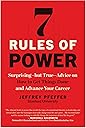
If you want to "change lives, change organizations, change the world," the Stanford business school’s motto, you need power. Is power the last dirty secret or the secret to success? Both. While power carries some negative connotations, power is a tool that can be used for good or evil. Don’t blame the tool for how some people used it. If fully understood and harnessed effectively, power skills and understanding become the keys to increasing salaries, job satisfaction, career advancement, organizational change, and, happiness. In 7 Rules of Power , Jeffrey Pfeffer, professor of organizational behavior at the Stanford University Graduate School of Business, provides the insights that have made both his online and on-campus classes incredibly popular—with life-changing results often achieved in 8 or 10 weeks. Rooted firmly in social science research, Pfeffer’s 7 rules provide a manual for increasing your ability to get things done, including increasing the positive effects of your job performance. The 7 rules are: 1) Get out of your own way. 2) Break the rules. 3) Show up in powerful fashion. 4) Create a powerful brand. 5) Network relentlessly. 6) Use your power. 7) Understand that once you have acquired power, what you did to get it will be forgiven, forgotten, or both. With 7 Rules of Power , you’ll learn, through both numerous examples as well as research evidence, how to accomplish change in your organization, your life, the lives of others, and the world. Review: Fantastic, practical, career advancement manual! - The 7 Rules of Power is a must-read book for everyone wanting to improve their career. Buy it. Read it. Implement its teachings. More power to you. Most leadership books and courses tell you how to lead in a parallel universe where things are how they ought to be – nice, and all that. Unfortunately, I don’t live there. This book tells of the cold hard reality of our actual corporate environments and how to get stuff done. In the main, this book does three things: (1) It tells you what is going on, (2) provides scientific evidence as to the causal mechanisms at work, and (3) derives practical actions that you can take to advance your career. And yes, I mean practical. Not the kind of practical that demands an unrealistic dramatic change of lifestyle but rather totally realistic small transformations that you can make without blowing up your life. The main angle taken is career advancement. Leadership of your team and the team’s success follow as a byline. First, power is morally neutral even though the word may leave a bitter taste at first hearing. Letting this go and realizing that you need to seek power to get your positive and wholesome goal accomplished is the first step. Second, most significant accomplishments were step changes and so changed the game in some way. Therefore, following all established conventions is unlikely to accomplish it. Break some of the rules. Third, fake it till you make it. Once you make it, all the faking is forgotten and so pretend to be powerful already and power will find you. Fourth, there can be no power without communicating that power in a coherent consistent way, which you may call a brand. Fifth, communication requires an audience and this is best obtained and nurtured personally. Networking in a structured way is the best way to do that. Sixth, power is a renewable energy that grows through use. So use it. Seventh, the manner in which you acquired power no longer matters once you have that power. When I first heard about these seven concepts from Jeffrey over dinner one night, I immediately realized the value of this framework. Weeks later when the book was in print, I had the book in my hand and read it right away. It is different from most other such books in two important ways. It does not try to conjure a counterfactual world but deals with the imperfect reality we have with a lot of scientific evidence that proves that the world does in fact act like that, and then it gives realistic advice. So, as a scientist, I figured let’s do an experiment. While I will not tell the story at this time as the details are still unfolding, it is very clear that the rules and the advice are working very well. From my personal experience therefore, I recommend not only reading this book, but doing what it says. Review: Incisive. - Incisive.
| Best Sellers Rank | #6,241 in Books ( See Top 100 in Books ) #3 in Job Hunting (Books) #26 in Motivational Management & Leadership #48 in Business Motivation & Self-Improvement (Books) |
| Customer Reviews | 4.6 out of 5 stars 412 Reviews |
P**T
Fantastic, practical, career advancement manual!
The 7 Rules of Power is a must-read book for everyone wanting to improve their career. Buy it. Read it. Implement its teachings. More power to you. Most leadership books and courses tell you how to lead in a parallel universe where things are how they ought to be – nice, and all that. Unfortunately, I don’t live there. This book tells of the cold hard reality of our actual corporate environments and how to get stuff done. In the main, this book does three things: (1) It tells you what is going on, (2) provides scientific evidence as to the causal mechanisms at work, and (3) derives practical actions that you can take to advance your career. And yes, I mean practical. Not the kind of practical that demands an unrealistic dramatic change of lifestyle but rather totally realistic small transformations that you can make without blowing up your life. The main angle taken is career advancement. Leadership of your team and the team’s success follow as a byline. First, power is morally neutral even though the word may leave a bitter taste at first hearing. Letting this go and realizing that you need to seek power to get your positive and wholesome goal accomplished is the first step. Second, most significant accomplishments were step changes and so changed the game in some way. Therefore, following all established conventions is unlikely to accomplish it. Break some of the rules. Third, fake it till you make it. Once you make it, all the faking is forgotten and so pretend to be powerful already and power will find you. Fourth, there can be no power without communicating that power in a coherent consistent way, which you may call a brand. Fifth, communication requires an audience and this is best obtained and nurtured personally. Networking in a structured way is the best way to do that. Sixth, power is a renewable energy that grows through use. So use it. Seventh, the manner in which you acquired power no longer matters once you have that power. When I first heard about these seven concepts from Jeffrey over dinner one night, I immediately realized the value of this framework. Weeks later when the book was in print, I had the book in my hand and read it right away. It is different from most other such books in two important ways. It does not try to conjure a counterfactual world but deals with the imperfect reality we have with a lot of scientific evidence that proves that the world does in fact act like that, and then it gives realistic advice. So, as a scientist, I figured let’s do an experiment. While I will not tell the story at this time as the details are still unfolding, it is very clear that the rules and the advice are working very well. From my personal experience therefore, I recommend not only reading this book, but doing what it says.
В**Я
Incisive.
Incisive.
S**N
Feedback
Well written, provocative. Yet to be tested (and replicated) in non-western contexts
R**Z
Suspend your belief that morality is directly related to leadership!
"Leadership is not a moral pursuit". It is above all about the pragmatics of making things happen whether they be moral, immoral, or amoral. I struggled for a long time with my inner sense of justice, relating leadership to morality. One does not necessarily go hand in hand with the other. Only until I accepted this fact, could I open my mind to understanding why some of the worst people on the planet obtain positions of leadership and clout. Professor Jeffrey Pfeffer teaches his class on power at Stanford University and the seats in his class are rarely, if ever, empty. He brings the principles that he teaches from the classroom to the pages of this book! These 7 rules are practical and laid out in a manner that operates regardless of moral aptitude. Since morality is subjective, it would be wise to approach this book by suspending your handle on morality and look at each rule objectively. The examples that Pfeffer provides help you understand that the way you use these rules are up to you, however you decide to use them. Liken unto Robert Greene's '48 Laws of Power', Jeffrey Pfeffer's concise rules will have you seeking opportunities to harness and grow your own power.
6**R
Get it. Easy to read in sections.
Not your average book about power. I have read many, and was always turned off by the masculine tone, focus and references. This one reads like it was written by a Stanford professor. Oh wait, it was. But I appreciate the female nod, references and intellectual content.
A**N
Straight talk about what really matters at work for career advancement
I wish I would have understood and known about Jeffrey Pfeffer's work 15 years ago when I started my career.
A**A
A must-read for anyone interested in the subject of Power.
In 7 Rules of Power, Jefferey Pfeffer has again eased our understanding of the enigma of power with practical, actionable, and contemporaneous examples. Power, the dirty little secret, doesn’t have to be shun by its negative connotations—but understood by its rules. It is commendable that Pfeffer was able to focus on the essence of power, despite the moral and ethical dimensions that we all wrestle with, and was still able to distill these 7 rules of power so eloquently. It isn’t always a comfortable read, but it’s an honest one. If you want to send a rocket to the moon, you need to know the rules and laws of physics. Fighting them for whatever reason will not work. As Pfeffer is well known to emphasize, if you want more power used for good purposes and applications—get more good people to have power. Power is like other useful tools in life. The individual’s character is what defines its use. Get it and use it for good. Get the book. Read it. And read it again a few more times, especially as you go through your life journey and your career. It will make more sense.
J**F
Watched the MasterClass then Read the Book
Finally, a book that talks about the gritty, sometimes unpleasant aspects of acquiring and maintaining power. I shared some of his insights with a nephew and said power can be used for good. He asked, “But that rarely happens.” In response, I shared what Pfeffer said/wrote: for power to be used for good, good people need to attain power. I especially liked some of the parting wisdom - that applying this information can be hard because it goes against some of the values and principles (or ideals) we’ve been raised on. These aren’t lessons that will be easily implemented, so the next step is to find a way to actively implement them.
I**E
Estudo e análise extremamente interessante
Gostei muito ! Creio que abre nossos olhos e perspectiva com relação a negócios e relacionamentos Confirma muitas coisas que ocorrem no dia a dia e a esperança que temos de um mundo justo e correto ofuscam essa realidade… Pfeffer menciona tudo isso em seu livro… um estudo e análise que podem nos ajudar a entender melhor o jogo e como participar mantendo a nossa integridade ou como ele menciona… usando o poder para o bem
A**A
Nice
Nice book
R**A
Como entender o poder
A busca pelo poder está presente em todas as organizações. Trabalho com projetos ligados ao setor público onde o tema de poder é mais presente. Sempre quis entender melhor como isso funciona dado que as pessoas tendem a ligar uma percepção negativa ao poder. O livro vai nas entranhas do que é o poder.
Trustpilot
2 weeks ago
2 weeks ago