

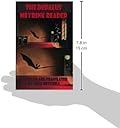
The Dedalus Meyrink Reader (Dedalus European Classics)
Product ID: 63791554
Desertcart purchases this item on your behalf and handles shipping, customs, and support to South Africa.
Gustav Meyrink is one of the most important and interesting authors of early 20th-century German Literature. To establish his reputation in the English-speaking world Dedalus has translated his five novels plus a collection of his short stories and published the first ever English-language biography of Meyrink. Now is the time to produce an overview of Meyrink in a single volume. The Dedalus Meyrink Reader has excerpts from all the translated books and a whole section of hitherto untranslated material, including the stories from the collection Flederma¤use and autobiographical articles. This volume is perfect companion for both the Meyrink scholar and the first-time Meyrink reader, containing as it does the whole gamut of Meyrink's writing from his love of the bizarre, the grotesque and the macabre to the spine-chilling occult tales and his quest to know what is on the Other Side of the Mirror. Novelist, satirist, translator of Charles Dickens, dandy, man-about-time, fencer, rower, banker and mystic seer, there are many, sometimes contradictory aspects to Gustav Meyrink, who must also be the only novelist to have challenged a whole army regiment to a duel. He has left behind a unique body of work, which can be sampled and enjoyed in The Dedalus Meyrink Reader.
| Dimensions | 12.7 x 2.74 x 19.69 cm |
| Edition | Ist |
| Isbn 10 | 1903517850 |
| Isbn 13 | 978-1903517857 |
| Item Weight | 340 g |
| Language | English |
| Print Length | 320 pages |
| Publication Date | 30 Oct. 2010 |
| Publisher | Dedalus Ltd |
User
A good introduction to Meyrink.
Meyrink is a writer who is overlooked by English-speaking readers, who tend to read his fellow Prague resident: Kafka instead.That is a shame because Meyrink is an extraordinary writer and I suspect readers of horror, psychological suspense and historical fiction will all find something of interest in his works. This reader which includes an extract of his best known novel, the psychological suspense The Golem, extracts from his other novels, short stories and essays
User
BE WARNED - Incomplete Novels, fragments and Sample Chapters only - not very useful, just a taste certainly not the whole cake
Well I am somewhat disappointed - I purchased this book in good faith hoping to read Gustave Meyrinks Novels. But the Novels are incomplete they only have a sample Chapter or so and are far from complete - SO BE WARNED.As far as the literature - im not sure as I haven't read any yet, and I am not sure I will, as I don't see much point in a fragment of a novel.Very Misleading - so be WARNED.
User
EXTRAORDINARY AND UTTERLY FASCINATING
I am immensely grateful to find anything whatsoever of Gustav Meyrink that I have not previously read - although re-reading him is always a delight - This precious collection is riveting and loses nothing of its extraordinary qualities in translation.I heartily recommend this book.Gustav Meyrink's books have been my constant companions ever since my late teens when I read everything available in French. Indeed, my own fascination with esoteric matters was fanned by reading him.
User
A Meyrink Sampler
This may well serve as the best introduction to Gustav Meyrink for an English speaking audience. Long esteemed in German & Spanish speaking countries, Meyrink is known for his macabre fiction in the tradition of Poe and Ambrose Bierce as well as for his biting social satire. This volume provides excerpts of his major novels including his best known, 'The Golem' and my personal favorite 'The Green Face.' What makes this compilation even more noteworthy is the inclusion of some of his esoteric writings. Many devotees look to Meyrink as an authority on esoteric knowledge and insight, he was a practitioner of yoga, a student of Taoism, and the Theosophical traditions. Included in this collection is an excerpt of his most esoteric novel, the Taoist inspired 'The White Dominican' a deceptively simple work whose hidden riches only become apparent with careful reading and re-reading. Highly recommended to those new to Meyrink and those long familiar with his work.
User
Fascinating If You Share the Author’s Interest in the Occult, Can Be Obscure If You Don’t
This book came out in 2010 and collected 22 works by Meyrink. They comprised 13 stories, excerpts from 6 novels, and 3 autobiographical tales. In addition, there were excerpts from a biography of Meyrink published by the translator, Mike Mitchell.Meyrink, a near-contemporary of Kafka, seems little read today in English. His first story was published in 1901, around the time his career as a banker in Prague was coming to an end. His early tales have been described as mainly satirical, like those of Karl Kraus in Vienna. His early work included a number of anti-war stories published in the midst of World War I.Meyrink had long had an interest in Eastern mysticism, and by the time the war broke out his fiction had begun to shift to occult subjects. His first and best-known novel, The Golem, was published in serial form in 1913-14 and in book form in 1915. (His version of the golem tale set in Prague differed from that of Yiddish-language writers such as I. L. Peretz or Yehudah Rosenberg, in that it focused not on the moral aspects of the legend, such as the golem’s punishment of evil-doers, but on the narrator’s possession by the golem.) Meyrink continued publishing stories and novels on occult subjects into the 1920s, dying in Munich in 1932. Besides his five finished novels he left behind an incomplete novel, The Alchemist’s House (a.k.a. At the Sign of the Green Peacock) and several shorter pieces that came out after his death. All of the novels were excerpted in this anthology.It was good to have so many of Meyrink’s works together in one collection, in whole or in part. But if you don’t share his interest in the occult, the works can be frustrating reads. In nearly half the pieces in the collection, his approach was to have a male narrator speak at length about his spiritual journey, to the point where he felt he’d glimpsed the reality beyond the shadows of the present world. This happened again and again. Women were virtually absent from the selections. Meyrink has been compared to Poe, and there was some similarity in their reliance on obsessive narrators, but even Poe managed to introduce a few female characters, in “Berenice,” “Ligeia,” “The Fall of the House of Usher,” and “The Oval Portrait.” And Poe wrote a wider variety of tales: detective and SF in addition to supernatural and psychological horror.The clearest of Meyrink’s stories were enjoyed for their images and atmosphere. These included a tale set in Prague, in which a narrator left his body (“Dr. Cinderella’s Plants”). A tale in which a seemingly immortal spiritual mentor imparted his understanding of time (“J.H. Obereit’s Visit to the Time-Leeches”). A tale in which a watch was used as a metaphor for the narrator’s spiritual journey, and his search for the repairman was guided by his shadow (“The Clockmaker”). A tale set in Tibet, in which the blind frenzy of maddened insects battling each other on a map alluded to the insanity of the Great War (“Cricket Magic”). In The Golem, the narrator felt possessed by another being as he traversed a network of tunnels and a spiral staircase. And in the excerpt from Meyrink’s fifth and last finished novel, The Angel of the West Window (1927) --- set in Prague in the late 1500s --- narrator John Dee recounted a powerful seance. Any of these selections would have made a strong addition to a collection of fantastic tales such as Alberto Manguel’s Black Water.Too many of the other works contained fascinating images and atmosphere here and there, but often they felt obscured by page after page of discussion of the forces guiding human beings. The most extensive and exhausting of such works was “The Transformation of the Blood,” an autobiographical tale that comprised about a fifth of the entire book and was included presumably because of the light it shed on the author’s outlook and intentions. Like his contemporary Aleister Crowley, Meyrink was seeker of enlightenment, but Meyrink seems to have avoided the use of psychedelic drugs or sexual rites in pursuit of the Godhead.Among Meyrink’s other works in the collection, “The City with the Secret Heartbeat,” a short description of Prague, was an appreciation that conveyed the beauty and mystery of that city. “The Pilot” was Meyrink’s account, fictional or factual, of a key moment in his early life, when suicide was averted because he felt an invisible pilot had boarded the ship of his life and turned the helm. The excerpt from Mitchell’s biography --- Vivo, published in 2008 --- discussed Meyrink’s family background and problems in Prague that influenced his later career and gave insight into his character.In one of his works, Meyrink wrote, “For almost thirty years now I have looked on life as a kind of conditioning to which some invisible being . . . is subjecting me.” Enjoyment of this author’s writing might depend partly on how far the reader is willing to go along with him in this belief.Meyrink’s five completed novels, all translated by Mitchell, are likewise available from Dedalus. Also published by Dedalus is The Opal and Other Stories (1994), a translation of 31 stories by Meyrink, mostly from early in his career.
User
Five Stars
htsrysr
Trustpilot
2 weeks ago
2 months ago
1 month ago
3 days ago