Desertcart purchases this item on your behalf and handles shipping, customs, and support to South Africa.
🚀 Unlock lightning-fast, secure Wi-Fi 6 power — because buffering is so last decade!
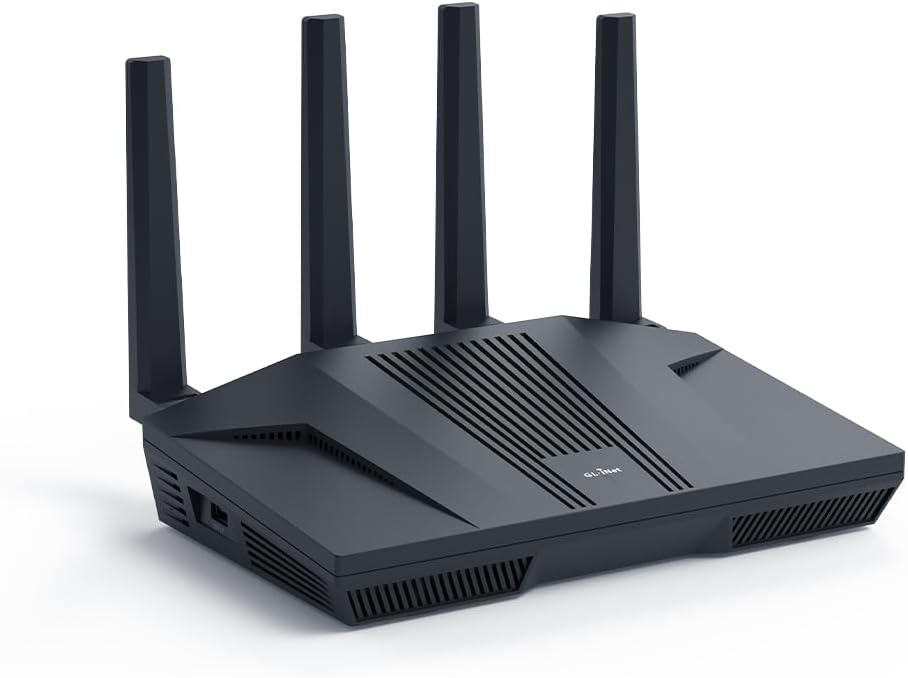
The GL.iNet GL-MT6000 Flint 2 is a cutting-edge Wi-Fi 6 dual 2.5G VPN router delivering up to 6 Gbps speeds with 8-stream technology. It supports ultra-fast WireGuard and OpenVPN connections up to 900 Mbps, integrates AdGuard Home for ad-blocking, and handles over 100 devices simultaneously. Designed for gamers and professionals, it offers stable, low-latency connectivity with advanced security protocols and easy setup, backed by a 2-year warranty.


| ASIN | B0CP7S3117 |
| Antenna Location | Gaming |
| Antenna Type | Retractable |
| Best Sellers Rank | 4,150 in Computers & Accessories ( See Top 100 in Computers & Accessories ) 39 in Routers |
| Box Contents | Ethernet Cable, GL-MT6000 router with 2-years warranty, Power Adapter (EU+UK Plugs), User Manual |
| Brand | GL.iNet |
| Brand Name | GL.iNet |
| Colour | Black |
| Compatible Devices | Computers, Mobile Devices |
| Compatible devices | Computers, Mobile Devices |
| Connectivity Protocol | Wi-Fi |
| Connectivity Technology | Wi-Fi |
| Control Method | App |
| Controller Type | App Control |
| Country of Origin | China |
| Coverage | Long Range |
| Customer Reviews | 4.4 out of 5 stars 2,893 Reviews |
| Data Transfer Rate | 6000 Megabits Per Second |
| Frequency | 5 GHz |
| Frequency Band Class | Dual-Band |
| Frequency band class | Dual-Band |
| Has Internet Connectivity | Yes |
| Has Security Updates | Yes |
| Is Electric | Yes |
| Is Modem Compatible | No |
| Item Weight | 761 Grams |
| LAN Port Bandwidth | 2.5 Gbps |
| Manufacturer | GL.iNet |
| Manufacturer Part Number | GL-MT6000 |
| Maximum Upstream Data Transfer Rate | 6000 Megabits Per Second |
| Model Name | GL-MT6000 |
| Model Number | GL-MT6000 |
| Model name | GL-MT6000 |
| Number of Ports | 6 |
| Operating System | Linux |
| Other Special Features of the Product | 8 Stream Wi-Fi 6 |
| Product Warranty | 2 years |
| RAM Memory Installed | 1 GB |
| Router Firewall Security Level | Basic |
| Router Network Type | hybrid |
| Security Protocol | WPA3 |
| Special feature | 8 Stream Wi-Fi 6 |
| Unit Count | 1.0 count |
| Voltage | 5 Volts |
| Wi-Fi Generation | WiFi 6 |
| Wireless Compability | 802.11ac, 802.11ax, 802.11b, 802.11g, 802.11n |
| Wireless communication standard | 802.11ac, 802.11ax, 802.11b, 802.11g, 802.11n |
S**D
Best in class
Another amazing GL.iNet product. It is safe to say this is the direct bigger brother of the GL-AXT1800, the Slate AX Wi-Fi 6 Travel Router i own in terms of the basic features, but it can do a whole lot more. FYI is uses the same GUI webpage for administration, so anyone with previous experience will have no issues. For starters the WiFi signal is nice and strong and more importantly stable thoughtout the day. Throughput is consistant and i have not noticed any real data drops. Whilst i cannot completely describe in details what i use the router for, I will say that the support for OpenVPN and WireGuard is the same reliable form as the travel router. As technical information only, if you were attempting to place yourself in a different country using vpn to obfuscate site and app country locks, this router will lock all traffic to the VPN tunnel only and not allow DNS leak, which is where most routers fail. This router runs in many modes, however its party trick (as with the GL-AXT1800) is acting as a repeater but using the Ethernet LAN uplink port (also you can used WiFi as either a primary or a secondary source (Backup to LAN)). This is where this router stands out as best of class in features as well as price point for devices in this class. If you are slightly interested in Tech and were looking for a router that has more features that you can shake a stick at this is the one to buy.
F**Y
🌟🌟🌟🌟🌟 Absolutely Unmatched – Hidden Features That Make This a Dream!!!!
If I could give this 10 stars, I would. This isn't just a router — it's a full network control centre hiding in plain sight - even for me that knows next to nothing about networks. I bought the GL.iNet Flint 2 expecting decent Wi-Fi and a few nice extras, but this thing has completely changed how I run my home network. --> Here's what nobody is talking about in the reviews: 1. Drop-In Gateway Mode (The “Secret Weapon”) This feature lets you add the Flint to your existing network without replacing your old router — and still get full control over everything. This should be one the front of the box as it is mind blowing!! That means: - No weird setup clashes - No “double NAT” problems (where you have two routers trying to be the boss) - No IP conflicts - No headaches I was able to move all my smart home gear over to the Flint (like cameras, sensors, smart plugs, etc.) without touching my old PlusNet router settings. It just worked — like magic. I still do not have nay idea how they did this! 2. Built-in NAS (Network Attached Storage) I plugged in a USB solid-state drive (SSD), and within 30 seconds, I had a shared network folder for my whole house. No extra software. No technical setup. It's like having a mini file server built right into the router. The only thing it will not do is file sync between devices, but hey, bung a 1Tb USB3 SSD onto this and you have a discount network storage system, you cant have it all. 3. Tailscale, AdGuard, and VPNs – Built In!!! These just work, and using the Drop-In Gateway Mode, this all just happens behind the existing router. It is mind blowing, this all just works with the existing IPS provided router sitting there with no idea all this is going on! - Tailscale: Secure, encrypted connection to your home network from anywhere in the world. Works across phones, tablets, laptops, even while on 4G or public Wi-Fi. No port forwarding needed. ---> One note on this: You can't set Tailscale as an exit node in Drop-In Gateway Mode, which is a bit annoying. Suppose it just is not able to configure enough settings to run this way when it is not in main control? But...it works a dream as an exit node once it is the main router. That means any device with Tailscale can connect to, and use your home network securely from anywhere in the world, which is amazing! - AdGuard Home: Blocks ads, trackers, and malware at the network level. All devices benefit automatically — no need to install ad blockers on each one. - WireGuard & OpenVPN: These are VPN (Virtual Private Network) options that protect your traffic and can let you appear as if you're browsing from home when away. Great for remote working, bypassing restrictions, or accessing local devices securely. 4. Full OpenWRT Access for Advanced Users If you know what OpenWRT is (a Linux-based open-source router OS), then you already know why this is amazing. You can: - SSH into the router - Install custom packages (like fail2ban, iperf, etc.) - Tweak firewall rules - Monitor logs in real time It’s like having your own little Linux server at the heart of your network. This router should be called “The FlintForge” — it’s a network Swiss Army knife disguised as a consumer router. This is the first product I’ve bought in years that exceeded every expectation. I’ve already ordered another for a family member, and I’m not done yet. If you're even slightly technical — or just want more privacy, more speed, and total control — this is the best 100 odd quid you’ll ever spend.
C**R
Powerful, flexible, vanilla openwrt capable
This is a fantastic router. I get excellent coverage and it has all the features I need. I just followed instructions from a video on youtube called "Tutorial & notes! on standard Openwrt 25.12 to setup a router securely with mesh capability" and now that it is on vanilla openwrt, I have a strong, stable, fast router which the update support for it will outlive what gl.inet would support with their firmware, since openwrt is the main OG. You can even put the vanilla firmware on older routers that have long since gone out of their support period and get some new, secure life out of them. Things I like about this, it's pretty easy to work with on the regular firmware it comes with. The power is great, it has lots of ports. And if you install vanilla Openwrt you get way more control and flexibility in how you use your router. Even though there is a Flint 2 and a Flint 3 and a Flint 3e and soon a Flint 4... this Flint 2 is a powerhouse. It's built for punch and rock-steady stability. You and your home need this in your lives.
G**E
Why I Replaced My Asus Router with the Flint 2
After using an Asus RT-AC86U for several years, I started running into limitations. While it was generally stable, it lacked native support for WireGuard VPN, and relied on Merlin firmware, which eventually dropped support for this model. I was also seeing frequent Sonos speaker dropouts and occasional issues with Tado smart heating connectivity. Around the same time, I had started using a GL.iNet Beryl AX (MT3000) while abroad and was impressed by its intuitive web interface and the ease of setting up VPN tunnelling. That experience led me to replace my Asus with the GL.iNet Flint 2, which offered similar software but with far more power and flexibility for a main router. VPN Server – Secure Tunnel to Remote Router One of my main goals was to build a WireGuard VPN tunnel between the Flint 2 and the Beryl AX, located abroad. This setup has worked extremely well: The Flint 2 acts as a WireGuard server, and the Beryl connects as a client. I have full access to my UK network from abroad without relying on cloud services or complex port forwarding. The connection is persistent and stable, with no need for manual reconnection. Low-Latency Streaming Locally, the Flint 2 also performs well under low-latency use cases. I stream games from a Windows laptop (first floor, wifi) to an Nvidia Shield TV (ground floor, wifi) using Sunshine and Apollo. Even across floors and mixed connections, I consistently see 1–2 ms latency, and gameplay is smooth and responsive. Smart Home – Sonos and Tado Now Stable Since switching to the Flint 2, I’ve had no more issues with my Sonos system or Tado smart heating. Devices connect and stay connected reliably, even across restarts. I haven’t needed to troubleshoot dropouts or re-pair devices since the switch. Additional Notes I’ve configured scheduled reboots at 5:00 AM daily, which helps keep memory usage stable (typically under 70%). Firmware updates have been reliable so far. The user interface is the same as the Beryl AX, which was one of the reasons I chose the Flint 2, as there is no need to learn a different UI just because I upgraded to a more powerful router. Advanced settings are available via LuCI if needed, but for most cases, the main interface is more than sufficient. Overall, the Flint 2 has cleanly replaced my older Asus setup while solving several recurring issues. It offers stable WireGuard performance, supports my smart home devices without problems, and handles low-latency LAN streaming better than I expected. The fact that I could stay within the same GL.iNet ecosystem as my Beryl AX made the transition seamless. If you're already using a GL.iNet travel router and want the same experience in a more capable home setup, the Flint 2 is a solid option.
B**P
Great Router-Has all the Bells & Whistles, but Advanced Features Are Outside of the Basic Interface
Had this for 4 weeks, but have had issues with anything more complicated than an out of the box setup. There are 3 types of users in my opinion: 1) Simple: Users that just want everything to work out the box, with no grief and easy setup and no complicated requirements. 2) Simple +: As above but like more an more people today may have WiFi cameras and 'Smart' devices and who need a little more, like being able to create an IoT network to isolate all these devices away from their main network for security reasons. Also, especially as many cameras need resetting if the SSID or password ever changes, often losing all their settings, to say nothing of manually having to get to the camera and reset them manually (a la up the ladder type of thing). 3) Power User: Those that may have more complex networking requirements who really want to take advantage of the Flint 2's advanced features. The issue is that although this is a very well-spec'd piece of hardware, a solidly built router with a 2.0 GHz processor and oodles of memory, the software side of things is lacking. Ok for the simple user - GL have designed a simple interface accessed via App or browser that can set up the default main and Guest WiFi easily and get you connected in a few simple steps. But anything more than this will require you to launch the advanced Luci interface. This is where problems can happen as not everything implemented here are reflected in the GL GUI. It's because GL have provided their interface to keep it simple and the version of OpenWRT provided means that some later commands don't work and changes made don't show in the main GL GUI, which causes confusion. I.e. Trying to create an IoT network is not possible in the GL GUI with the current firmware without going into Luci or using a terminal to enter commands or scripts. This not for the feint hearted and is the subject of much debate on Forums, as GL are marketing this as a consumer router, but providing advanced features. Fair play to them, but the software development is seriously lacking at present. I've still not been able to create my IoT networks yet because of incompatibilities with the various OpenWRT versions and the lack of support. Having said that, they are planning to provide native IoT support int he interface with Version 4.9x of the firmware later this year. As for features, the included Adguard is brilliant for blocking Ads and other tracking behaviour from your devices, especially if you have a smart TV, Roku and anything else that likes to 'Dial home to ....' - it just works brilliantly and allows custom filters and rules to be setup at will, unlike the TP-Link routers that put anything like this behind a paywall! This router has great capabilities and loads of fallback features allowing tethering and connection of internet backup devices, and loads of plugins available given it built to run OpenWRT. So as long as you understand that anything more advanced than basic operation may need a huge learning curve. GL.inet do need to get the software side of things more stable and comprehensive to allow simple IOT creation on the fly without being a rocket engineer.
A**R
So far the best router I've ever owned
I stopped using and relying on ISP provided routers and popular consumer routers like netgear and asus a few years back after going through years of issues and struggles. I switched to a more hobbyist setup of Tomato firmware and openwrt and then ASUSMerlin, where you install community software on consumer hardware. This was immediately better and I relied on this for a few years but found the hardware aging and slow, and the community software either getting abandoned or very slow to get updates to fix bugs. I ended up switching to a more complex but much more reliable combination of Unifi and Mikrotik which served me will until this year, however I again needed a hardware refresh to allow me Wifi6 and also had been struggling with VPN customizations often breaking on the mikrotik for the past year, where I ended up introducing more hardware - a GL.INet low end router for the ease of configuration especially in terms of VPN. I was about to buy a new Wifi Unifi access point to replace my current one and figured I'd look around at what else was around. Then I discovered the GL.iNet Flint 2 for the same price as the Unifi access point. Seeing it does Wifi6, plus the software capabilities I already depend on for things like VPN, AND 2.5G ethernet ports, it seemed like an upgrade for all 3 separate pieces of hardware I was relying on. SO I bought it. Indeed I have now disconnected my Unifi access point, my gigabit Mikrotik router and my existing GL.iNET router. The Flint 2 is doing all 3 things at a fraction of the price (accumulatively). My wifi speeds went from 88mbps to 400 Mbps (and that's whilst using Wireguard VPN in both cases), my configuration is much simpler, and my "network cabinet" has just reduced a 3rd in size. Outstanding. My network speeds (specifically from one ethernet device reading and writing to another ethernet device - my NAS) went from 1.19 MB/s read and 0.73 MB/s write to 3.52 MB/s read and 3.78 MB/s write. (Cat6 ethernet cables and gigabit intermediary switch in both cases). Incredible. I'll continue to use this for a while to see how it goes, but so far it's looking promising. I did have 3 smarthome devices that failed to continue with the SSID changed to be the same as the old access point, but resetting all 3 devices fixed them without issue, and they seem fine now so was probably just them being weird, and all my other devices transitioned without issue. My next plan is to further reduce the network hardware I'm relying on, and getting rid of another router I use for a non-vpn network - as I've been testing out the VPN policies provided by the Flint 2, and it makes it easy to force a device to use VPN or not based on mac address/ip/vlan and so far that's been working great. If that works out, I'll be replacing 5 network devices with a single GL.iNet Flint 2. Insane. I wish this device existed years ago, it'd have saved me a lot of headache, time and sunk cost. Edit: six months later I have realised that the WiFi has gotten much worse and prevents me from gaming or game streaming entirely despite speed tests showing around 260/250 I constantly get dropped frames and disconnects, whereas it wasn't an issue before. Using ethernet I gave no issues though. I'm not sure why, I haven't had the chance to play much since buying the flint 2 but I'm fairly sure there was no issue originally with the flint 2. I'm now wondering if I need to buy a unifi access point again.
C**W
Secure, Powerful, and Worth the Effort
This router has truly proved to be an efficient, powerful, and remarkably flexible piece of kit. I initially planned to use the Flint 2 simply as a VPN front-end for my existing Google Nest WiFi mesh system, allowing the Google hardware to handle the Wi-Fi. However, once I started the setup, I quickly realized the Flint 2 was capable enough to stand on its own, and I opted to remove the entire Google mesh network and use the Flint 2 exclusively. The performance has been exceptional. Performance & Features VPN Excellence: The WireGuard client performance with my Surfshark subscription is stellar. The ability to run full-speed VPN and configure Domain-based Split Tunneling (to exclude services like Netflix, Disney+, BBC iPlayer, ITVX, and Channel 4) directly on the router is a game-changer for UK streaming. AdGuard Home: The integrated AdGuard Home feature provides network-wide ad and tracker blocking, creating a cleaner, faster browsing experience across all devices. Network Segmentation: I appreciate the ability to use a Guest Network for low-trust IoT devices (switches, smart plugs) for superior security, keeping my high-value devices segregated on the main network. The Learning Curve (Why it's not 'Plug and Play') To be transparent, this is not a product for beginners. It is a powerful piece of hardware that requires an understanding of network principles to unlock its potential. As the manufacturer states, it's not a plug-and-expect-everything-to-work device. It has taken a couple of days of focused tweaking to get every setting perfectly optimized (especially integrating the VPN, AdGuard, and resolving connectivity issues on devices like Google Nest Hubs due to advanced Wi-Fi features). The Gemini Advantage: This is where modern AI assistance (specifically Google Gemini) made setting things up a breeze. By feeding the logs from both the Flint 2 and AdGuard directly into Gemini, I received simple, step-by-step instructions and troubleshooting advice to resolve tricky blocking and Wi-Fi compatibility issues. As someone with a technical background, Gemini made the configuration process highly efficient and straightforward. Conclusion: I absolutely do not regret buying this. It has replaced a complex mesh network with a single, highly capable device. The flexibility and raw performance are outstanding, and I am confident that my home network is now fast, highly secure, and optimized for both privacy and streaming performance. If you have some technical knowledge and want the absolute best control over your home network, the Flint 2 is the clear choice.
A**R
Dead on Arrival..
Dead on arrival. Either the adaptor or the router was faulty, tried many sockets but a brand new piece didn't work. Returned and refund initiated. Turns out other people have faced this issue too, super disappointed, saved up for 4 months to buy this only to get a product that's faulty.
R**S
A Privacy oriented router That Actually Works . Great Choice for VPN Users
I've tried my fair share of routers, but the Flint 2 (GL-MT6000) has actually outdone my expectations, considering that I value privacy, speed, and control of the network most. Setup: The configuration is simple and easy to use. The web user interface (available through both GL.iNet and LuCI) is suitable for beginners and power users. I set it up with ProtonVPN directly on the router itself, so no VPN client software is required on every device now—a huge convenience. Performance: Performance is impressively high on the 2.4GHz and 5GHz Wi-Fi bands. Even when the VPN is running continually through the router, the speed loss is only minimal. The streaming, browsing, and video calling are uninterrupted and smooth. In addition, I have DNS filtering done through AdGuard Home, and the Flint 2 takes it all in stride with no noticeable slowdowns. Security & Privacy: • Full VPN tunneling to protect all devices that are connected • DNS-over-HTTPS (DoH) for encrypted DNS queries • A customizable kill switch that prevents data leaks if the VPN connection drops • The ability to skip the VPN on a certain device or app Network Management: I like the convenience of having independent SSIDs, deciding whether to give both bands the same or different names, and the ability to isolate devices when necessary. Also nice is the feature of labeling some devices such as my work laptop or guest device to a non-VPN Telus connection for selective access. Extras: GL.iNet updates the firmware for performance and security on a regular basis, and the community support is good. The device is also quiet and does not use a fan, ideal for home use. Final Thoughts: If you want a robust, privacy-orientated router that is capable of running an entire VPN client, ad- and tracker-blocking, and sustaining maximum speed, Flint 2 is a winner. The best for those that must have end control of the network but will not compromise speed in the least. Highly recommended!
C**N
El rey del OpenWrt y las VPN (Potencia bruta sin restricciones)
Buscaba un router que no me limitara con firmwares cerrados y este GL.iNet GL-MT6000 (Flint 2) es, sencillamente, una bestia. Si te gusta tener el control total de tu red, no hay nada mejor por este precio. Lo que lo hace especial: • Rendimiento VPN: Es capaz de mover WireGuard a velocidades increíbles (casi 900 Mbps según mis pruebas). Ideal si trabajas con privacidad o quieres ver contenido de otros países sin tirones. • OpenWrt de serie: Viene con una interfaz muy limpia y fácil de usar, pero si entras en el panel avanzado de LuCI, tienes todas las opciones del mundo. Es un paraíso para los que nos gusta "trastear". • Hardware potente: Con sus puertos de 2.5G y el procesador que lleva, gestiona decenas de dispositivos sin inmutarse. El alcance del WiFi 6 es sólido y estable en toda la casa. Comparativa rápida: A diferencia de marcas más tradicionales donde el software es rígido, aquí la libertad es total. Es un router pensado para durar años y adaptarse a lo que necesites (AdGuard Home, túneles VPN, etc.). Conclusión: Si solo quieres enchufar y olvidar, quizás te sobre router. Pero si valoras la privacidad, la velocidad en VPN y un hardware de primera con software abierto, el Flint 2 es imbatible. 100% recomendado.
T**A
La scelta obbligata per chi vuole il massimo dalla propria connessione
Il router arriva in un'elegante confezione in cartoncino blu che protegge una solida scatola interna in cartone nero. All'interno troviamo il router, l'alimentatore, una serie di adattatori per prese europee e inglesi (avvitabili direttamente sull'alimentatore), un cavo Ethernet e la manualistica. Il router è costruito con materiali di ottima qualità, interamente in plastica nera opaca. La scocca superiore, leggermente inclinata, presenta insieme alle fiancate numerose prese d'aria per consentire un'adeguata dissipazione del calore generato dalla potente componentistica interna. Sul lato destro è presente una porta USB-A 3.0 per il collegamento di memorie di massa come hard disk esterni, SSD o chiavette USB. Nella parte posteriore, oltre alle imponenti antenne Wi-Fi, sono presenti in totale sei porte Ethernet: due da 2.5 Gbps (configurabili come LAN o WAN) e quattro porte Gigabit classiche (LAN). Completano la dotazione il tasto di reset e l'ingresso di alimentazione DC da 12V. L'alimentatore fornisce in uscita 12V e 4A, ma il consumo medio alla presa si attesta sotto i 20W, un valore ottimo considerata la potenza del dispositivo. Sulla parte superiore della scocca è presente anche un indicatore LED di stato, che può essere personalizzato o spento via software. Il Flint 2 è un router Wi-Fi 6 (AX6000) che, da specifiche, può raggiungere velocità fino a 1148 Mbps sulla banda a 2,4 GHz e 4804 Mbps su quella a 5 GHz. È importante segnalare il pieno supporto ai canali a 160 MHz per massimizzare le prestazioni. A livello hardware, il dispositivo è equipaggiato con un potente processore Quad-Core Mediatek da 2 GHz, affiancato da 1 GB di RAM DDR4 e 8 GB di memoria eMMC per il sistema operativo e l'installazione di pacchetti aggiuntivi. A differenza dei firmware chiusi della maggior parte dei produttori concorrenti, questo router (come molti altri di GL.iNet) monta OpenWrt, un sistema operativo open source basato su Linux, appositamente progettato per dispositivi di rete. Essendo basato su Linux, l'utente ha un controllo granulare sulla rete, potendo configurare ogni minimo dettaglio, modificare impostazioni normalmente non disponibili e aggiungere nuove funzionalità installando pacchetti software. Alcuni esempi di pacchetti che ne espandono le funzionalità sono iPerf3 (per testare la velocità della rete locale), AdGuard Home (per bloccare pubblicità e tracker a livello di router per tutti i dispositivi) e, soprattutto, i pacchetti QoS/SQM per abilitare policy avanzate di gestione del traffico. Una funzionalità molto apprezzata, specialmente da chi gioca online, è la capacità di mitigare il bufferbloat tramite l'algoritmo SQM. Questo sistema gestisce in modo intelligente le code di dati per evitare che attività pesanti (come un download) aumentino la latenza delle applicazioni interattive (come i giochi online o le videochiamate), garantendo un ping basso e stabile anche quando la rete è sotto sforzo. Il software di sistema è molto ben fatto e offre due interfacce di gestione: - La prima è l'intuitivo pannello di controllo personalizzato da GL.iNet. - La seconda è LuCI, l'interfaccia web standard di OpenWrt, accessibile per gli utenti più esperti direttamente dal pannello principale. L'interfaccia personalizzata è semplice e ideale per utenti meno esperti. Consente di regolare rapidamente le impostazioni di base, monitorare il traffico e configurare facilmente il dispositivo in modalità router, access point o extender. Particolarmente interessante è il supporto nativo per client OpenVPN e WireGuard. È possibile configurare una VPN direttamente dal pannello web, facendo passare tutto il traffico della rete interna attraverso di essa. Le prestazioni sono eccellenti grazie all'hardware potente, raggiungendo fino a 190 Mbps con OpenVPN e 900 Mbps con WireGuard. Al momento in cui scrivo, il prezzo del router oscilla tra 120€ e 160€ a seconda delle offerte. A questo prezzo, specialmente quando scontato, questo router è a mio avviso ancora imbattibile. Offre prestazioni Wi-Fi 6 più che sufficienti per la stragrande maggioranza delle connessioni attuali, un hardware di fascia alta e una flessibilità software che è semplicemente su un altro livello rispetto alla concorrenza con firmware chiuso.
R**S
Seriously, hands down, best router ever. Block youtube, simple NAS, adblock etc.
This is the best router ever! It has tons of possible configurations. I bought it primary for blocking youtube on my "smart" TV and my kids phones. And it works. Under Parental control you can ad a profile and under that profile you ad the devices you want to be able to connect to internet. If they are not on a list they will be blocked. Even if they are connected to the network, and this is a must. Then you ad a a rule set under witch you can add all youtube sites to block. I asked an AI for that. There are a lot of sites you need to block. After this you can also ad time windows where these rules applies. Awesome! I also tried to add an M.2 SSD via the USB3 on the side. You set it up under Applications/network storage. My SSD is NTFS formatted but AI told me ext4 is best. Follow the guide and give the disk a UN och PW. Then I added a network drive in my computers file explorer pointing to the one configured in the router. Bam! 256GB on the network for moving files in the network (in Linux Mint, the manual says windows works to). AdGuard Home is a built in feature. It can also block sites and ads! Check out NetworkChuck on YT for more information. Awsome! No more ads. I also connected my old TP-Link P7 mesh network downstream the Flint 2 to extend the range. The rules set in the Flint 2 now also applies to the old P7 mesh network as they work as extenders from now on. AI helped me do this to. Now I have 4 access points for my devices with awesome range! I an go on and on. Best money ever spent on a router! Just buy!
H**G
Super router and quick deliverey
Good router, easy setup
Trustpilot
2 months ago
2 days ago