Desertcart purchases this item on your behalf and handles shipping, customs, and support to South Africa.
🎸 Delay that defines your sound — don’t just play, make waves!
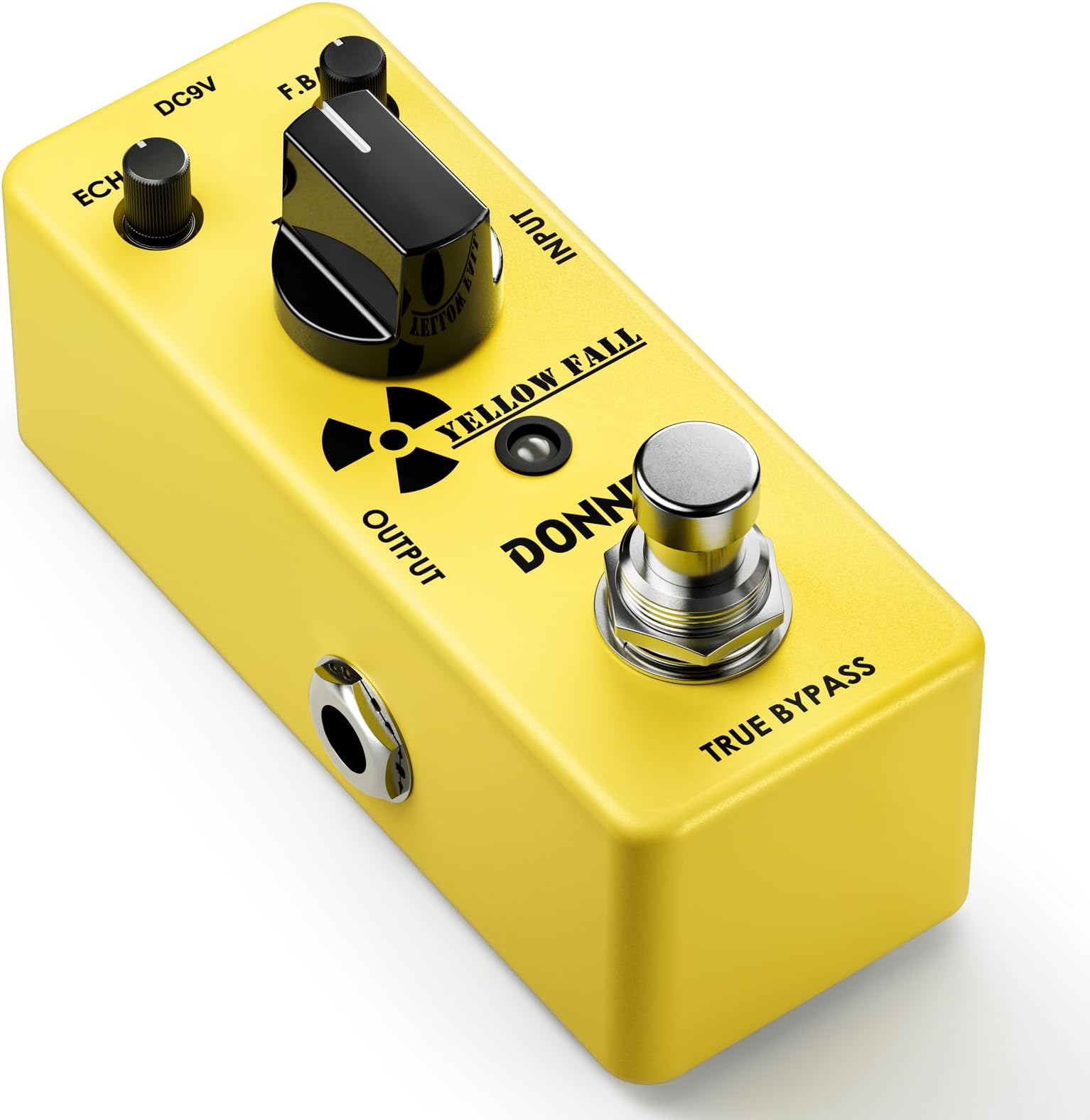
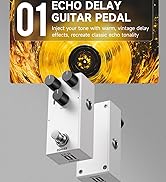
The Donner Yellow Fall Analog Delay Pedal delivers vintage-inspired warm delay tones with a flexible 20-620ms delay range. Its compact, durable aluminum body and true bypass circuitry ensure pristine sound quality and pedalboard-friendly reliability. Perfect for electric guitarists seeking classic analog delay effects with modern build quality.


| Amperage | 36 milliamps |
| Asin | B00GRRN2RI |
| Audio Output Effects | Delay |
| Best Sellers Rank | #163 in Musical Instruments (See Top 100 in Musical Instruments) #1 in Electric Guitar Delay & Reverb Effects |
| Brand Name | Donner |
| Color | Yellow Delay |
| Connector Type | 2.1mm DC power jack |
| Controls Type | Knob |
| Customer Reviews | 4.5 4.5 out of 5 stars (3,522) 4.5 out of 5 stars |
| Hardware Interface | 1/4-inch Audio |
| Included Components | 1 x Donner Yellow Fall Delay Guitar Effect Pedal, 1 x User's Manual |
| Item Dimensions | 3.7 x 1.7 x 2 inches |
| Item Dimensions L X W X H | 3.7"L x 1.7"W x 2"H |
| Item Weight | 0.25 kg |
| Manufacturer | Donner |
| Manufacturer Part Number | Yellow Fall |
| Model Name | Yellow Fall |
| Model Number | Yellow Fall |
| Number Of Items | 1 |
| Power Source | Corded Electric |
| Signal Format | Analog |
| Sound Profile | Warm and Vintage |
| Style | Delay |
| Unit Count | 1 Count |
| Upc | 612306330455 612306329572 |
| Voltage | 9 volts |
| Warranty Description | 2 year manufacturer. |
User
Yellow Fall Analog Delay - Great budget micro pedal with ambient delay
The Yellow Fall is my first Donner pedal, but I'm impressed enough with its value to consider buying others. First, some background - Donner (along with ENO and a few other brands) are basically an effort to burn through inventory used for the excellent Chinese-made Mooer pedal line, and rebranding them as a cheaper alternative. The pedal casing and chipset, from what I hear, are basically identical to the corresponding Mooer equivalent, though the primary knob has been switched and it would not surprise me to learn that a few other (cheaper) components have been substituted.Still at around 30 bucks, the Donner pedals offer incredible value for the price. The Yellow Fall "analog delay" has a pretty good range of delay (I believe it goes up to 600 miliseconds - many cheap delays only get to 300ms). The two micro knobs control echo and feedback. Feedback is very clearly the number and duration of repeats. "Echo" is described in the manual as affecting the tone of the delay. I'm not sure if this is what it is actually doing or if it is acting more like a "level" on most delay pedals, which makes the overall effect more prominent. However, it did seem to make the echos trailing off seem brighter.Yes, the pedal is digital, but "analog" is describing the character of the delay. There are many modern delay pedals that use digital chipsets to simulate the analog or tape delays of the 60's and 70's. I think the Yellow Fall does this quite well. Some people have complained that the repeats sound "modulated", but that's sort of the point. This isn't for a clean, exact digital replication of notes (similar to a slapback delay or U2-style dotted eighth delay) - it has a more warm, haunting character, and sounds great for ambient soloing and chords alike.Also, as has been pointed out, there is an error/mistaken reference in the Donner literature about the 9V jack. It claims it is "positive tip", but what they actually mean is "negative center", which is the same as Boss, MXR, etc. and the vast majority of power supplys out there like OneSpot. There is no "tip" on a BOSS-style adapter, either, but that's more an issue of semantics. Rest assured, it will work fine with the BOSS-style adapters you may already have. But you will need one, since this pedal is so compact, there wouldn't even been room or a 9V battery to fit in there.
User
Great value
delivers warm, smooth analog-style delay in a small, affordable pedal. The repeats sound natural, the controls are easy to use, and it stays quiet without coloring your tone. Solid build, great sound, and perfect for slapback, leads, and classic rock.Excellent value and highly recommended
User
Yellow Tail is a great value, good (not great) sound, better build than most in this price range
The Yellow Fall delay is a steal in terms of price. I got this for a last-minute guest to use while we were jamming--not for my main personal pedal board. The knobs, potentiometers, jacks and finish are all impressive considering its low cost--much better than most in this price range. Tone-wise it is very good, and would make a good addition to a basic or budget pedal board. For a better-sounding pedal, expect to pay more than this costs. Not surprisingly, Yellow Fall is not as refined-sounding and useful as some costlier pedals. I strongly suspect the Yellow Fall is a digital device, and is not truly an analog Bucket Brigade Chip delay. The only reason that matters to me, is this one lacks a certain organic warmth of tone and response that I hear in true analog delays and higher-priced digital versions. Also, I found it hard to dial in just the right depth setting with the Yellow Fall for subtle delay levels, feeding into the front of a cranked non-master volume tube amp. In that context (going into overdriven power tube saturation/distortion), too deep a mix of delay-to-dry ratio can get muddy and it can obscure the core tone of the guitar. So the ideal would be to dial in just enough delay to give the sound a sense of space, but still not cloud things up. The depth control on the Yellow Fall is a bit touchy for that, meaning the taper of the knob tends to make the depth setting either too much or too little with only a minuscule nudge of the knob separating the two. Also, I found the tone of the delayed sound on the Yellow Fall did not sound as good into an amp set very clean-it sounded a bit less realistic. The YF sounded much better into a tube amp on the edge of breakup. A great delay should also sound great squeaky clean. Yellow Fall is a worthy budget choice, but, depending on your priorities and means, it may be better to save for a used model of a slightly more refined delay (e.g. Carbon Copy Mini, TC Flashback Mini, Ibanez Mini). The Yellow Fall is not in the same class with any of those three.
User
Awesome overall; slightly mixed bag, but the good ones are great!
I love these pedals! For the price they are pretty decent basic effects, and you can pack your pedal board and try swapping different effects and playing around with various sounds for the price of a couple of grocery runs. Once you have a soundscape you love, you may want to look for some higher end replacements for some of these pedals, but as a starting point, these are exceptional in terms of their performance to price point, and serve as the perfect place to start as you try to define your sound!The yellow fall specifically falls a bit short of my needs, and I have purchased the versa yellow fall 2 because tap is a necessity for my use case. However, If it’s being used simply to add some basic texture to the mix, it can be a valuable addition. It all depends on your needs.So far I have also tried the ultimate comp, the harmonic square, and the verb square in this series, and I am pretty happy with them! I have the versa yellow fall 2, the triple looper, and the stylish fuzz 2 on the way, and can’t wait to try them out!
User
Good product, good price.
I've had it for a week. It works well so far. I'm using this pedal to give some delay to my novation bass station rack. The synth is analogue and the pedal is analogue as well, so it's a complete analogue signal path, sounds pretty good to me. There are other applications where I would like some MIDI implemented tempo syncing, but this still works well, in fact, a little bit of un- tempo syncing gives the effect a variable and swing. To sum things up, there are no presets, no esoteric knobs and settings, just 3 knobs: echo, feedback and time. Clean signal, simple operation. This is good for someone who is starting to build an effects chain for guitar, synths or keyboards or bass. If I had the money, I would have got the boss DD7 again (I sold it when I started selling all my gear years ago), but I don't. It seems like there are many newer or unknown brands out there today that are putting out decent effects pedals. I think it's time to give them a shot. I grew up with Boss, dunlap, TC, electro Harmonix, and they are all great, established brands. At this point in time I can't afford those. If there are cheaper alternatives, that can be nearly or just as good, I'm going with the alternative. I will certainly buy at least one more of the yellow fall, and I'm interested in checking out some of their other products. The only thing the yellow fall is missing is a stereo output, but even that small addition to the pedal would take away from the refreshing simplicity of this product. I would want to go into different panning algorithms, delay types and so forth. I say put either another delay pedal, or reverb, with a stereo output after this pedal. I am looking forward to exploring and taking chances on new or up and coming makers of effects pedals. Happy hunting.
User
I have ALL the Donner Mini and Nano Pedals -- Because they WORK
I am hijacking my wife's account to post this. Hopefully it helps. Over the past couple years, I have purchased every Nano and Mini Pedal that Donner has made. Some of them I have two of. Some I do not use at all. Only because I prefer specific ones over the others. For instance, I have the Verb Square, Echo Square, and Mod Square pedals, but prefer the Yellow Fall pedal for its simple operation. I also have all the Super Mini or Nano pedals, which are also great, but decided on the Mini Pedals for my set up, just because of how they can be configured so closely using Getaria cables.After many reconfigurations and finally watching a 1 hour YouTube video interview with Steve Vai about the principles of splitting a signal and playing in stereo, I set up a couple amps, and now have the option of playing in stereo using several Donner pedals that I feel produce the best signal path that I can control to create the voicings I am looking to emulate. For starters, I have a 1973 Peavey Studio Pro 40 that I use as my amp head that has been in the family my whole life, though I have only seriously learning to play guitar in the past few years. It was barely used until it was passed on to me, and probably not utilized the way I am using it now. I also have an Acoustic A20, an Acoustic G120 DSP, and configured an old set of Infinity speakers (two 1x12's) into a cabinet for testing the quality of the unbalanced line out on the Peavey.After two years of playing around with the pedal configurations and watching the Steve Vai interview, I have settled on this configuration as the optimum path for pushing the cleanest signal until I am ready to manipulate it:I run the clean signal from the GTR into the following Donner pedals listed in order powered by two DP-1 power supplies, and one DP-2 power supply, with the majority of the pedals mounted on a DB-3 Pedalboard for the main signal path:Donner Wah Cry (wah/volume),DT Deluxe Chromatic Tuner (tuner)*,Ultimate Comp (compression/sustain)**,Stylish Fuzz (fuzz/distortion),Extreme Driver (boost/overdrive/distortion),Pearl Tremor (phaser),Blues Drive (gain/overdrive),Boost Killer (gain),Morpher (distortion),Giant Metal (boost/distortion)***,and Viper (passive volume) pedals into Channel 1 (high gain) on the front of the amp.On the back of the Peavey Studio Pro 40 amp are jacks for an FX loop, an Unbalanced Line Out (ULO), and a footswitch controller. From the back, it comes out of the Send jack into the following Donner pedals:Noise Killer (noise gate/ suppressor)**,Jet Convolution (flanger),Harmonic Square (octave/pitch shifter),Tutti Love Chorus (chorus),ABY BOX (line switch) [pay attention here],Yellow Fall (delay),Golden Tremolo (tremolo),and finally into a Looper (loop station) which then goes into the Pwr In (Return) on the back of the amp to complete the effects loop.On the back of the Peavey, since it ALSO has the ULO jack, the signal coming out of the ULO can go to a mixer, recorder, another combo amp, or speaker cabinet. Using the ABY switch to split the signal before the Yellow Fall (delay effects), I can send a signal path to another amplifier and play in stereo (in this case, simultaneously using the Studio Pro 40 and the G120 with the slider switch set to ABY). If I use the ULO and utilize another speaker cabinet set-up, it enables me to use the Peavey as a monitor with a simultaneous split for a 3-channel Surround Sound Stereo effect.Using the ABY switch immediately after the Tutti Love Chorus, the signal path 'B' gets sent into Channel 1 of the Acoustic G120 DSP (high gain) on the front of the amplifier. The signal comes out the FX Loop on the backside (Send) into a MOOER GE-100 (configured to preset #64 'PreAmp Driver', or #65 'JC Amp'), and then into a second Donner Yellow Fall (which is the same delay pedal as on the 'A' signal side of the ABY BOX) with the echo, time and feedback settings compensated so the Acoustic G120 sound washes over the output of the Peavey Studio Pro 40 so that the delays in sync.For a regular set up (Dual Channel stereo), the Peavey is directly in front of me, with all the foot controls comfortably within reach, and most of them on the Donner pedal board. Any other amps or cabinets are about 10 - 15' away to the left and right facing out.This set up CAN BE VERY LOUD! The Viper (passive Volume/Expression) pedal is key to controlling the signal level and achieving the sound you want, based on your guitar, how hot the pickups are, the strings you use, etc. But it can also be soft, clean, warm, bright, rich, or spacey.With just one ABY switch at the end of the signal path, just before any time effects are applied, the signal is split into A and B, enabling me to play, A, B, or Both (Y). Playing 'Y' (A and B together), I can play in stereo (up to 160 watts), and with the 'B' signal passing through the MOOER GE-100, I can wither use its metronome feature, or select from a variety of preset drumbeat styles and adjust the tempo to play along with. It also has an MP3 input, to play along with your favorite songs or prerecorded tracks. It also has its own looper with over dub features, so between the MOOER GE-100 and the Donner Looper, I have 2 loopers available to play multiple riffs of up to 10 minutes at the same time.And if I really want to get crazy, the MOOER has 80 preselected voicings to use with its own integrated volume/wah pedal (as well as room for 80 more user programmed presets). This enables me to split the signal and have one guitar playing like there are two; either playing the same notes with two separate effects signals, or playing in unison with the same effects signal.Yesterday I added another ABY BOX Line Selector between the GTR and the Wah Cry to go into an Acoustic A20 amp (for acoustic and hollow body guitars) to use as a lower watt amplifier head and/or monitor plugged into Channel 2 on the Acoustic G120 DSP. Using the ABY Boxes and a Line 6 (2 button latching footswitch) to switch Channels on the G120, I can direct the signal to go from the Peavey into the G120 DSP (toggling between channels 1 & 2) or into the A20 and come out the FX loop and through the MOOER and any other effects (I can take the MOOER out and toss in an entirely separate set of Donner effects or cabinet simulator effects pedals -- Dynamic Wah, Sweet Juice, Incredible V, Green Land, Force 2, Black Devil, or MOOER M005 Brown Sound as well or in the ULO path for different cabinet simulations).[A side note here: I am exploring the possibility of adding a EarthQuaker Devices Swiss Things Pedal Board Reconciler for more control in place of the first ABY Box (between GTR and the Wah Cry) and letting it manage one of the signal paths to either the G120 DSP or a more aggressive cabinet setup like a 200w Marshall stack (400W total).]All the effects pedals (stomp boxes) are true bypass, so depending on whether I want to play some blues, pop, funk, rockabilly, country, rock, metal, or jazz -- it just depends on which guitar I pick up (acoustic, electric, hollow body, semi-hollow body), what effects I apply, and where I direct the signal. I have my sights set on a Marshall cabinet (or stack of two) to have a 200w (possibly 400w) option available and still use the Peavey as the amp head because it has the one thing the Acoustic G120DSP doesn't -- an Unbalanced Line Out to be able to play in stereo or with a smaller amp and integral FX loop as a monitor. With a double latching Peavey footswitch connected to the Studio Pro 40 (I cannot find a vintage Automix, so I have a Peavey multi-purpose 2 function footswitch), and a double latching Line 6 footswitch connected to the G120 to change between high gain or low gain input channels, though they create a pretty large footprint with all the pedals and footswitches, I have total control as I play. It is important to note that the placement of the PolyTune 3 serves as a kill/mute switch for everything but the drumbeat or metronome (there is a Rhythm switch on the MOOER GE-100 to turn this feature on and off).This set up can be pretty interesting, and is definitely a lot of fun! Though I have them all, I have spent significantly less on the Donner brand than any Boss, MXR, or other major brand to have all the effects available to recreate any voicing -- from a clean 50's vintage tube amp, to a heavily distorted or modulated brown sound -- I can dial it in through the Donner configuration, or choose a preset in the MOOER GE-100 and play along or improvise my own music.*Note 1: I will be replacing the Donner Chromatic Tuner with a PolyTune 3 for more immediate recognition of which string may be out of tune and higher tolerance.**Note 2: Depending on your amplifier's ability to apply more equalization to the signal pre amp and/or post amp, you may want to consider a 5-band Graphic EQ (filter) either between the Ultimate Comp and the Stylish Fuzz, or immediately after the Noise Killer.***Note 3: Fuzz, gain, overdrive, boost, distortion are in increasing order of how many ohms they utilize and the dB they output in order to eliminate accumulation of line hiss that is common when high gain/distortion pedals are in series despite whether they are true bypass.Summary:GTR <cord >>ABY BOX 1 (line selector) [optional placement of EarthQuaker Swiss Things Pedal Board Reconciler (ABY/FX channel controller]> Path 'A' [Box 1] <cord>[Donner DP-3 Pedal Board]>Wah Cry (wah/volume) [may substitute with Auto Wah},>PolyTune 3 (tuner),>Ultimate Comp (compression/sustain),>Graphic EQ (filter) [optional placement]>Stylish Fuzz (fuzz/distortion),>Extreme Driver (boost/overdrive/distortion),>Pearl Tremor (phaser),>Blues Drive (gain/overdrive),>Boost Killer (gain),>Morpher (distortion),>Giant Metal (boost/distortion),>Viper (passive volume/expression) <cord>into +Channel 1 (high gain) on the front of the amp (Peavey Studio Pro 40).>Path 'B' [Box 1] <cord>into +Channel 1 (high gain) on the front of the amp [Acoustic A20].{Acoustic A20]+Direct Outinto +Channel 2 (low gain) on the front of the amp [Acoustic G120 DSP].[If your amp does not have an FX loop, then just connect the rest of the following pedals in series immediately after the Viper and then plug the entire signal chain into the high gain channel of your amp.][Peavey Studio Pro 40]+FX Send>Noise Killer (noise gate/ suppressor),>Graphic EQ (filter) [optional placement]>Jet Convolution (flanger),>Harmonic Square (octave/pitch shifter),>Tutti Love Chorus (chorus),>ABY BOX 2 (line selector),>Path 'A' [Box 2]>Yellow Fall (delay),>Golden Tremolo (tremolo),>Looper (digital looper) <cord>into +FX Return (Peavey Studio Pro 40).+ULO (Peavey Studio Pro 40) <cord>>Marshall MG412BG and MG412AG cabinet stack+Peavey Two Button Multipurpose Footswitch{Activates or Defeats Saturation and Reverb functions}>Path 'B' [Box 2] <cord>into + Channel 1 (high gain) on the front of the amp (Acoustic G120 DSP).[Acoustic G120 DSP]+FX Send <cord>>MOOER GE-100,>Yellow Fall (delay) <cord>into +FX Return (Acoustic G120 DSP).
User
Quality and price are nice
Nice little unit. I like the controllability. I can set it just the way I like my sound to be.
User
Difficult to dial in a subtle slap back, Delay is either off, or full on, with little in between
It sounds good overall and does not introduce any noise into my signal chain. The input, output, and overall build quality are solid.My main issue is the echo control. If you are looking for a subtle slapback effect, this pedal is very hard to dial in. Turning the echo knob all the way down removes the delay completely, but the moment you turn it even slightly clockwise, the slapback becomes very loud. Using a clock analogy, 9 o’clock is off, 9:05 is subtle, and by 10 o’clock the delay is already overwhelming. From about 10 to 3 o’clock, there is very little noticeable change.It is possible I received a bad unit, but based on this experience, I will not be purchasing Donner pedals going forward. I would rather spend a little more for a more reliable brand.
User
Good for synths
Bought this bright bad boy for my synth set up and wasn’t disappointed. It’s good value, has a decent sound range and is robust. I’d originally bought a Behringer pedal but it was dreadful so swapped it for the Donner and am so pleased I did.
User
Good budget pedal
It does what it's supposed to & its quiet.
User
Cooler Sound
Macht richtig Bock das Teil ...cooler Echo fx
User
Custo benefício e timbre excelente
Pedal é ótimo! Com a fonte adequada não faz HSSs ou alguma barulho. Delay suave e perceptível para criar sustain. Também permite experimentações com feedback e eco. E ele não altera a tone das notas, deixando o som cristalino do jeito que entra na cadeia de sinal. Vale a pena
User
Suono discreto
Suono discreto, lo uso per dare corpo al suono nei solo e negli arpeggi, ma la regolazione è un po’ difficile su tempi brevi per l’ escursione del pot. Sui tempi lunghi il suono diventa sottile e artificiale.
Trustpilot
1 month ago
5 days ago