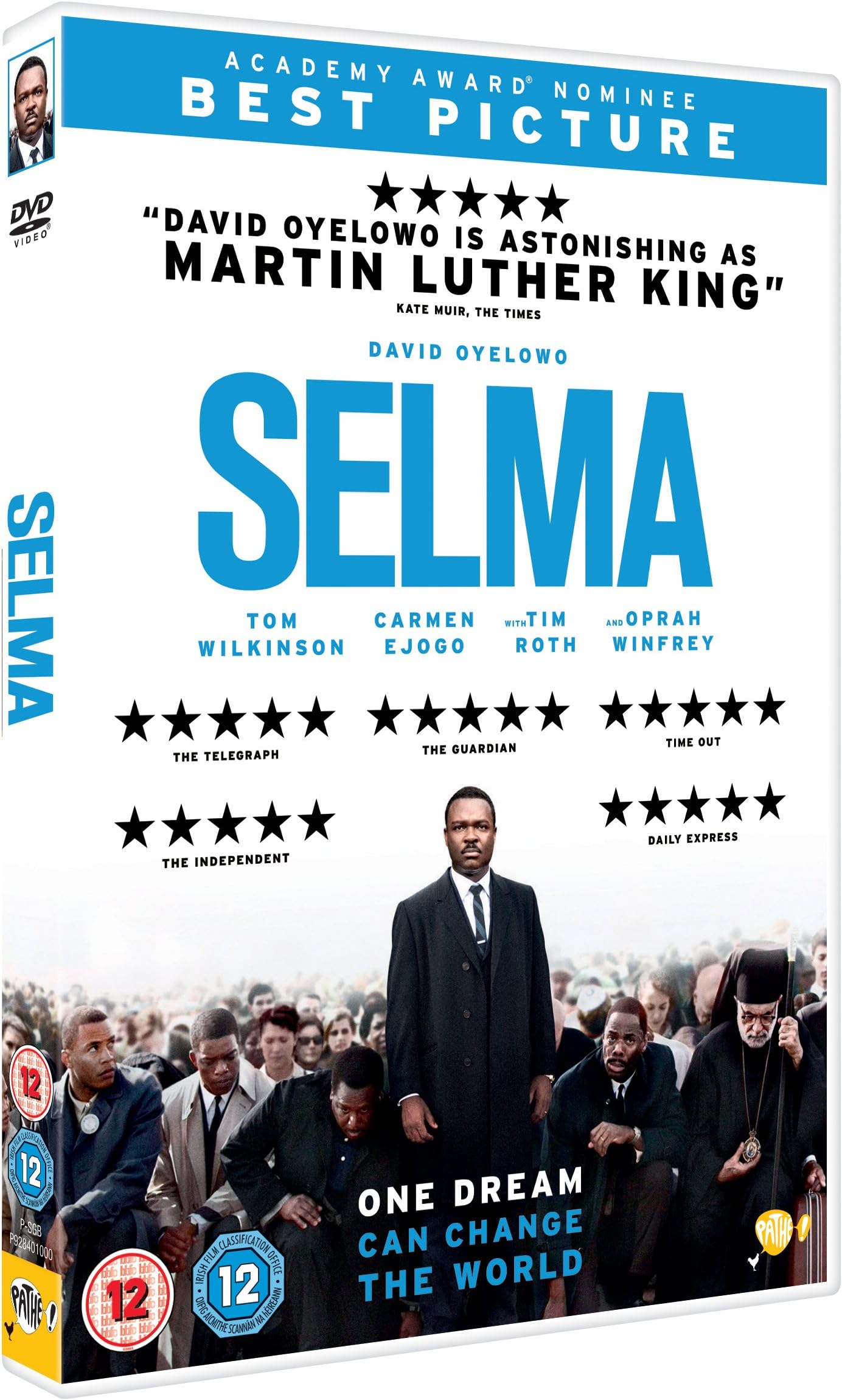


Produced by Oprah Winfrey, Brad Pitt’s company Plan B (12 Years A Slave ) and Christian Colson (Slumdog Millionaire ), the acclaimed film Selma tells the gripping and moving true story of the pivotal moment in Dr Martin Luther King Jr’s epic civil rights struggle - the 1965 protest march from Selma to Montgomery, Alabama to secure voting rights for African-Americans. Starring British actor David Oyelowo (The Butler, A Most Violent Year) as Martin Luther King Jr alongside Tom Wilkinson, Carmen Ejogo, Tim Roth and Oprah Winfrey, the 2015 release of Selma celebrates the 50th anniversary of the passing of the voting rights act and this triumphant story of the power of the people. Review: Dedication and vigilance - The film begins with the deaths of four young girls, aged 11 to 14. Their names are Carol Denise McNair, Addie Mae Collins, Cynthia Wesley and Carole Robertson. They were murdered at their local Baptist church in Birmingham, Alabama on 15 September 1963, dressed in the their Sunday finest. They lived in a Christian country and prayed to the Christian god but were marked for destruction because their skin was dark, not white. The Jim Crow bomb that killed them on the steps of the church that morning was a symbolic message sent to the black community. It said, in effect: “Cease and desist. Give up your struggle. Things are as they are and will not change. Peace will return when you go back to being quiet and dutiful citizens.” That was the game: democracy and rights for whites, knowing your place for blacks. Segregation was good for both sides. You have your patch, we have ours. But the dice were loaded, the game rigged and unfair and everybody knew it. In 1863, 100 years before the girls were killed, Lincoln proclaimed the black population free during a civil war partly fought to achieve this. The Confederacy lost the war in 1865. The slaves were freed. But freed to do what? They still lived in the South. Their families and kin were there. It was what they knew, even if conditions were harsh. Many did not want to move, or had nowhere to go. Freedom is fine in principle, but life doesn’t exist in a vacuum. An infrastructure for emancipation was needed. Re-education of the whites was necessary too, plenty of whom had learned nothing from the war. The South was defeated but not its ideas. Slavery was abolished but not the slaver mentality. The black man was now free to be neglected, to be unemployed, to live in poverty and shoddy housing. Free to sit at the back of the bus, to be excluded from hotels and restaurants, to be denied the right to vote. Free to have access to inadequate, underfunded schooling. Free to be intimidated, terrorized and lynched. Free to be unprotected by the laws and by those elected to enforce them. How long? That was the question. How long does this evil go on? If a civil war couldn’t destroy it, what can? It had to be answered. The dynamics of the game made it inevitable. Rosa Parks was tired that day, she would later say. She had worked all day on her hands and knees. She was exhausted and wouldn’t shift herself to the back of the bus. She refused. She had reached her limit of endurance and compliance. Elsewhere blacks sat at lunch counters even when service was refused. The mood was shifting. A silent momentum was building. Silent until a mighty voice began to be heard. He was a preacher at a Baptist church in Atlanta. He spoke from a pulpit that seemed like a mountaintop, a place close to God and all the angels. The voice boomed, the church shook with hosannas, hallelujahs, wailing. If he was their Moses, the Red Sea in Alabama ran from the town of Selma to the courthouse in Montgomery. He would lead his people to salvation there. He would give them the courage to defy hatred and bigotry. They would do it non-violently. They would symbolize civility in a place of brutality and barbarity. It would not be easy. There would be violence, injuries, maybe even death for some. But it had to be done. They had to make a stand and march. The time had come. The voice was heard. The question of how long had to be answered. This was their answer. History would begin in May 1965. This film is about that march and how it happened. It’s about the eloquent Baptist preacher awarded the Nobel Prize for Peace in 1964, and of others around him in the civil rights movement, including his wife Coretta and their family. He was the first President of the Southern Christian Leadership Conference, a position he held from 1957 until his murder in 1968. He’s the man whose birthday (January 15) is now a national holiday in the U.S., a man named after the leader of the Reformation in Germany in 1517. He is of course America’s Mahatma Gandhi, Martin Luther King, Jr., a man in my opinion who is greater than the country that produced him. Key people in the movement surrounding Dr. King (and shown in the film) are Ralph Abernathy, Andrew Young, Amelia Boynton, Diane Nash, John Lewis, James Orange, et al. Then there are others beyond his immediate circle, including the gospel singer Mahalia Jackson, whose songs comfort Martin when he is down. One poignant scene in particular is deeply moving. It’s late at night and Martin can’t sleep, always so much on his mind. He calls Mahalia and asks her to sing to him over the phone. He knows his phone is bugged. He knows the FBI listens to everything he says. But he doesn’t care. She will sing to them too. The power of her voice may even teach them something significant and humane. She sings like an angel of course, and on the wings of that voice he is temporarily transported to Heaven. Annie Lee Cooper is another strong woman in the story. She is played by Oprah Winfrey, who was instrumental as an executive producer in getting the film made. Annie Lee is dignified and determined. She wants to vote and tries to register in Selma, but every time she is turned down on absurd, illegal grounds (asked to recite, for example, the preamble to the U.S. Constitution or to play a game of trivial pursuit with the local clerk in naming the counties in the state of Alabama — nothing but outright intimidation in denying a U.S. citizen her constitutional right to register to vote). These hicks, these rednecks, are the problem. But they’re everywhere in Alabama and throughout the South. The governor of Alabama, George Wallace, is a proud bigot. Jim Clark, the Jim Crow sheriff of Selma, is just as bad. He’s more than bluster. He’ll swing a night stick if he has to. Man or woman, doesn’t matter. If the person is black, that person is the enemy. Then there’s Washington, D.C., especially the egregious FBI director J. Edgar Hoover and Lyndon Johnson, the President by default in the wake of JFK’s murder in 1963. Johnson looks harried throughout, overwhelmed by events and people beyond his control: Vietnam, student unrest and demonstrations, the civil rights movement, Malcolm X, Muhammad Ali, the Black Panthers, etc., etc. He is under siege. He understands and appreciates Dr. King’s cause and supports it ethically, but will not commit politically. The Selma march is thus designed to force Johnson’s hand politically. Dr. King says only LBJ can sign federal legislation that forces voter registration in the South to be free and open. That’s the key: the vote. Without it the blacks will remain indentured to these white slavers in the South forever. Dr. King is played by the British actor David Oyelowo whose family emigrated to Britain from Nigeria. For several years he studied the accent, speeches and speech patterns of Dr. King in the hope and off-chance that a biopic of the great man might one day be made. When audition time came, if it ever did, he would be ready. It did; he was. He embodies the Reverend King as well as any actor can be expected. A wise choice. However, Martin Luther King, Jr. was iconic, larger than life. We have seen and heard his speeches on video and know how he sounded. No actor, absolutely none, can duplicate this. Impossible. I thought about King and James Baldwin’s first novel, Go Tell it on the Mountain (1953), while watching the film. Why this connection? Because Baldwin had been a teenage Baptist preacher in Harlem. The novel is all about that experience, the church, and his domineering father. Baldwin knew what King was like because he himself had once been like him. He was a product of the church. He knew the cadences of sermons delivered from the pulpit, its rhythms of call and response with the congregation. Black Baptist preaching wasn’t just a church service; it was a revival meeting, a gospel show, a communion with Heaven that shook the rafters of the church. Soul. Exactly that. That’s what these people had, and Baldwin writes of it well in his remarkable book. One paragraph, please. Because after reading it you will understand where Dr. King’s power, charisma and eloquence came from. “On Sunday mornings the women all seemed patient, all the men seemed mighty. While John [the young preacher] watched, the Power struck someone, a man or woman; they cried out, a long, wordless crying, and, arms outstretched like wings, they began the Shout. Someone moved a chair a little to give them room, the rhythm paused, the singing stopped, only the pounding feet and clapping hands were heard; then another cry, another dancer; then the tambourines began again, and the voices rose again, and the music swept on again, like fire, or flood, or judgement. Then the church seemed to swell with the Power it held, and, like a planet rocking in space, the temple rocked with the Power of God. John watched, watched the faces, and the weightless bodies, and listened to the timeless cries. One day, so everyone said, this Power would possess him; he would sing and cry as they did now, and dance before his King.” Yes, power and kingship. King was powerful because he had the Power. It’s so obvious when you hear him speak and watch what such speech did to others. Which is why he was dangerous, or thought to be, and made people nervous. Whites, that is. Insecure whites with much to lose, or much that was appropriated by them, stolen from black slave labour as well as from the original Americans, the true inhabitants of the land. This is history yet it’s not, or not only that. A disproportionate share of the U.S. prison population is black (10 to 1, black to white, in some states). Unarmed young white men are not shot to death in U.S. streets by black policemen. That equation is reversed. Some black athletes now kneel (not stand) for the national anthem because they know it was written by a racist (Francis Scott Key) who damns himself in verse in the third stanza of the song, a stanza never sung in public (“No refuge could save the hireling and slave/From the terror of flight or the gloom of the grave”). And even now in many states right-wing Republicans are doing their best to prevent persons of colour from voting via arcane, convoluted rules that are illegal but not yet struck down. So the march goes on because apartheid in America never truly goes away, the myth of race still embraced by some despite what science and the Human Genome project know and teach (to those who wish to learn). Truly fine film, utterly relevant, then as now. Progress has been made of course, but as with everything it has to be protected and passed on with dedication and vigilance. Review: For a friend - Friend is delighted with the dvd, brand new and a bargain.
| ASIN | B00SYIQ3KG |
| Actors | Carmen Ejogo, David Oyelowo, Giovanni Ribisi, Tessa Thompson, Tim Roth |
| Best Sellers Rank | 18,627 in DVD & Blu-ray ( See Top 100 in DVD & Blu-ray ) 582 in Historical (DVD & Blu-ray) 6,208 in Drama (DVD & Blu-ray) |
| Country of origin | United Kingdom |
| Customer reviews | 4.5 4.5 out of 5 stars (335) |
| Director | Ava DuVernay |
| Is discontinued by manufacturer | No |
| Language | English |
| Manufacturer reference | MSE1293148 |
| Media Format | PAL |
| Number of discs | 1 |
| Package Dimensions | 19.2 x 13.7 x 1.2 cm; 80 g |
| Producers | Brad Pitt, Cameron McCracken, Christian Colson, Jeremy Kleiner, Oprah Winfrey |
| Release date | 15 Jun. 2015 |
| Run time | 2 hours and 8 minutes |
| Studio | Walt Disney Studios HE |
| Subtitles: | English |
| Writers | Paul Webb |
J**T
Dedication and vigilance
The film begins with the deaths of four young girls, aged 11 to 14. Their names are Carol Denise McNair, Addie Mae Collins, Cynthia Wesley and Carole Robertson. They were murdered at their local Baptist church in Birmingham, Alabama on 15 September 1963, dressed in the their Sunday finest. They lived in a Christian country and prayed to the Christian god but were marked for destruction because their skin was dark, not white. The Jim Crow bomb that killed them on the steps of the church that morning was a symbolic message sent to the black community. It said, in effect: “Cease and desist. Give up your struggle. Things are as they are and will not change. Peace will return when you go back to being quiet and dutiful citizens.” That was the game: democracy and rights for whites, knowing your place for blacks. Segregation was good for both sides. You have your patch, we have ours. But the dice were loaded, the game rigged and unfair and everybody knew it. In 1863, 100 years before the girls were killed, Lincoln proclaimed the black population free during a civil war partly fought to achieve this. The Confederacy lost the war in 1865. The slaves were freed. But freed to do what? They still lived in the South. Their families and kin were there. It was what they knew, even if conditions were harsh. Many did not want to move, or had nowhere to go. Freedom is fine in principle, but life doesn’t exist in a vacuum. An infrastructure for emancipation was needed. Re-education of the whites was necessary too, plenty of whom had learned nothing from the war. The South was defeated but not its ideas. Slavery was abolished but not the slaver mentality. The black man was now free to be neglected, to be unemployed, to live in poverty and shoddy housing. Free to sit at the back of the bus, to be excluded from hotels and restaurants, to be denied the right to vote. Free to have access to inadequate, underfunded schooling. Free to be intimidated, terrorized and lynched. Free to be unprotected by the laws and by those elected to enforce them. How long? That was the question. How long does this evil go on? If a civil war couldn’t destroy it, what can? It had to be answered. The dynamics of the game made it inevitable. Rosa Parks was tired that day, she would later say. She had worked all day on her hands and knees. She was exhausted and wouldn’t shift herself to the back of the bus. She refused. She had reached her limit of endurance and compliance. Elsewhere blacks sat at lunch counters even when service was refused. The mood was shifting. A silent momentum was building. Silent until a mighty voice began to be heard. He was a preacher at a Baptist church in Atlanta. He spoke from a pulpit that seemed like a mountaintop, a place close to God and all the angels. The voice boomed, the church shook with hosannas, hallelujahs, wailing. If he was their Moses, the Red Sea in Alabama ran from the town of Selma to the courthouse in Montgomery. He would lead his people to salvation there. He would give them the courage to defy hatred and bigotry. They would do it non-violently. They would symbolize civility in a place of brutality and barbarity. It would not be easy. There would be violence, injuries, maybe even death for some. But it had to be done. They had to make a stand and march. The time had come. The voice was heard. The question of how long had to be answered. This was their answer. History would begin in May 1965. This film is about that march and how it happened. It’s about the eloquent Baptist preacher awarded the Nobel Prize for Peace in 1964, and of others around him in the civil rights movement, including his wife Coretta and their family. He was the first President of the Southern Christian Leadership Conference, a position he held from 1957 until his murder in 1968. He’s the man whose birthday (January 15) is now a national holiday in the U.S., a man named after the leader of the Reformation in Germany in 1517. He is of course America’s Mahatma Gandhi, Martin Luther King, Jr., a man in my opinion who is greater than the country that produced him. Key people in the movement surrounding Dr. King (and shown in the film) are Ralph Abernathy, Andrew Young, Amelia Boynton, Diane Nash, John Lewis, James Orange, et al. Then there are others beyond his immediate circle, including the gospel singer Mahalia Jackson, whose songs comfort Martin when he is down. One poignant scene in particular is deeply moving. It’s late at night and Martin can’t sleep, always so much on his mind. He calls Mahalia and asks her to sing to him over the phone. He knows his phone is bugged. He knows the FBI listens to everything he says. But he doesn’t care. She will sing to them too. The power of her voice may even teach them something significant and humane. She sings like an angel of course, and on the wings of that voice he is temporarily transported to Heaven. Annie Lee Cooper is another strong woman in the story. She is played by Oprah Winfrey, who was instrumental as an executive producer in getting the film made. Annie Lee is dignified and determined. She wants to vote and tries to register in Selma, but every time she is turned down on absurd, illegal grounds (asked to recite, for example, the preamble to the U.S. Constitution or to play a game of trivial pursuit with the local clerk in naming the counties in the state of Alabama — nothing but outright intimidation in denying a U.S. citizen her constitutional right to register to vote). These hicks, these rednecks, are the problem. But they’re everywhere in Alabama and throughout the South. The governor of Alabama, George Wallace, is a proud bigot. Jim Clark, the Jim Crow sheriff of Selma, is just as bad. He’s more than bluster. He’ll swing a night stick if he has to. Man or woman, doesn’t matter. If the person is black, that person is the enemy. Then there’s Washington, D.C., especially the egregious FBI director J. Edgar Hoover and Lyndon Johnson, the President by default in the wake of JFK’s murder in 1963. Johnson looks harried throughout, overwhelmed by events and people beyond his control: Vietnam, student unrest and demonstrations, the civil rights movement, Malcolm X, Muhammad Ali, the Black Panthers, etc., etc. He is under siege. He understands and appreciates Dr. King’s cause and supports it ethically, but will not commit politically. The Selma march is thus designed to force Johnson’s hand politically. Dr. King says only LBJ can sign federal legislation that forces voter registration in the South to be free and open. That’s the key: the vote. Without it the blacks will remain indentured to these white slavers in the South forever. Dr. King is played by the British actor David Oyelowo whose family emigrated to Britain from Nigeria. For several years he studied the accent, speeches and speech patterns of Dr. King in the hope and off-chance that a biopic of the great man might one day be made. When audition time came, if it ever did, he would be ready. It did; he was. He embodies the Reverend King as well as any actor can be expected. A wise choice. However, Martin Luther King, Jr. was iconic, larger than life. We have seen and heard his speeches on video and know how he sounded. No actor, absolutely none, can duplicate this. Impossible. I thought about King and James Baldwin’s first novel, Go Tell it on the Mountain (1953), while watching the film. Why this connection? Because Baldwin had been a teenage Baptist preacher in Harlem. The novel is all about that experience, the church, and his domineering father. Baldwin knew what King was like because he himself had once been like him. He was a product of the church. He knew the cadences of sermons delivered from the pulpit, its rhythms of call and response with the congregation. Black Baptist preaching wasn’t just a church service; it was a revival meeting, a gospel show, a communion with Heaven that shook the rafters of the church. Soul. Exactly that. That’s what these people had, and Baldwin writes of it well in his remarkable book. One paragraph, please. Because after reading it you will understand where Dr. King’s power, charisma and eloquence came from. “On Sunday mornings the women all seemed patient, all the men seemed mighty. While John [the young preacher] watched, the Power struck someone, a man or woman; they cried out, a long, wordless crying, and, arms outstretched like wings, they began the Shout. Someone moved a chair a little to give them room, the rhythm paused, the singing stopped, only the pounding feet and clapping hands were heard; then another cry, another dancer; then the tambourines began again, and the voices rose again, and the music swept on again, like fire, or flood, or judgement. Then the church seemed to swell with the Power it held, and, like a planet rocking in space, the temple rocked with the Power of God. John watched, watched the faces, and the weightless bodies, and listened to the timeless cries. One day, so everyone said, this Power would possess him; he would sing and cry as they did now, and dance before his King.” Yes, power and kingship. King was powerful because he had the Power. It’s so obvious when you hear him speak and watch what such speech did to others. Which is why he was dangerous, or thought to be, and made people nervous. Whites, that is. Insecure whites with much to lose, or much that was appropriated by them, stolen from black slave labour as well as from the original Americans, the true inhabitants of the land. This is history yet it’s not, or not only that. A disproportionate share of the U.S. prison population is black (10 to 1, black to white, in some states). Unarmed young white men are not shot to death in U.S. streets by black policemen. That equation is reversed. Some black athletes now kneel (not stand) for the national anthem because they know it was written by a racist (Francis Scott Key) who damns himself in verse in the third stanza of the song, a stanza never sung in public (“No refuge could save the hireling and slave/From the terror of flight or the gloom of the grave”). And even now in many states right-wing Republicans are doing their best to prevent persons of colour from voting via arcane, convoluted rules that are illegal but not yet struck down. So the march goes on because apartheid in America never truly goes away, the myth of race still embraced by some despite what science and the Human Genome project know and teach (to those who wish to learn). Truly fine film, utterly relevant, then as now. Progress has been made of course, but as with everything it has to be protected and passed on with dedication and vigilance.
H**]
For a friend
Friend is delighted with the dvd, brand new and a bargain.
J**G
Powerful DVD, worth seeing.
Excellent film Had to wait to get the DVD because the film didn't come with subtitles in the cinema but the DVD version did. Did however have to query 'subtitles or not?' with Amazon before purchasing by contacting them and did suggest they put this information on DVDs so that information is available to people who are 'hard of hearing like myself.' They seem to have acted on this because the information is has been more readily visible when i've been looking at other DVDs to purchase. David Oyewola managed to capture the power and dignity of Martin Luther King and was well supported by the other characters/ actors in the film. His was however a stand out performance and given that he is not American, he conveyed the accent extremely well.
H**N
Seeing the glory...
If you've ever wondered what it must have been like to encounter Dr King or experience those harsh yet amazing days, then this wonderful piece of cinematography will get you about as close as our times can get. Brilliant performances, which left people truly jolted when I viewed it on the big screen... a real must for the collection. I understand that copyright forbade the makers from actually using King's words, but you'd never know it - the scenes of him speaking are like lightning striking the earth. Splendid stuff.
R**L
Selma
Not what I expected, I was expecting the Idris Elba film now I know that Is called Luther
C**S
Breathtaking.
Breathtaking at every single level. I struggle to think of many films that can match Selma for power and impact - it is nothing short of a modern masterpiece. Moving, enthralling, humanity shown at it's very best and worst. The acting is brilliant, as is the direction and story telling, in fact every single thing about this film is brilliant. The film grabs you by the neck, heart and mind and never let's go. I honestly cannot praise this film too highly, not only the best film of it's year (how did it not sweep the Oscars?) but for me one of the best films I have seen in my whole life. WATCH IT.
T**O
Gripping historical drama.
Excellently done and gripping film of the Selma march and the buildup to it, giving a very good idea of what times must have been like then. David Oyelowo totally convinces as Martin Luther King, particularly giving speeches etc, and everyone else is very good in it too. Another great film worth watching and related to this period of the Civil Rights struggle in America is The Butler, with Forest Whitaker and Oprah Winfrey (who is also in Selma).
P**N
A film every one should see
Having been to Montgomery and seen the church where Martin Luther King preached I was interested to see this movie. It is a very intense movie no laughs (though not expected with the subject matter) it shows just how coloured people were treated not so many years ago. I recommend this film for anyone with an interest with the civil rights movement ,it doesn't hold back any punches
C**N
Nella primavera del 1965, un gruppo di manifestanti, guidati dal reverendo Martin Luther King, scelse la cittadina di Selma in Alabama, per manifestare pacificamente contro gli impedimenti che vietavano ai cittadini di colore di esercitare il loro diritto di voto. Tra resoconto documentario e racconto intimo, Selma è un film che emoziona, che non manipola le coscienze o i sentimenti e ci ricorda come anche i grandi della Storia siano stati uomini spaventati dalla responsabilità delle loro decisioni. Ottimamente interpretato, ci permette di scoprire una pagina di storia americana, forse dimenticata o sconosciuta alla maggior parte di noi. Da vedere? Assolutamente sì, ma in lingua originale.
M**S
Anspruchsvoll, ergreifend, unterhaltsam und auch historisch zu weiten Teilen korrekt. Auch meine achte Klasse (Gym) fand den Film sehr spannend, auch wenn er sprachlich (engllisch, mit englischen UT) für die Oberstufe besser geeignet ist. Insgesamt sehr empfehlenswert!
Trustpilot
1 month ago
3 days ago