Desertcart purchases this item on your behalf and handles shipping, customs, and support to South Africa.
🚀 Unlock the airwaves like a pro—never miss a signal again!
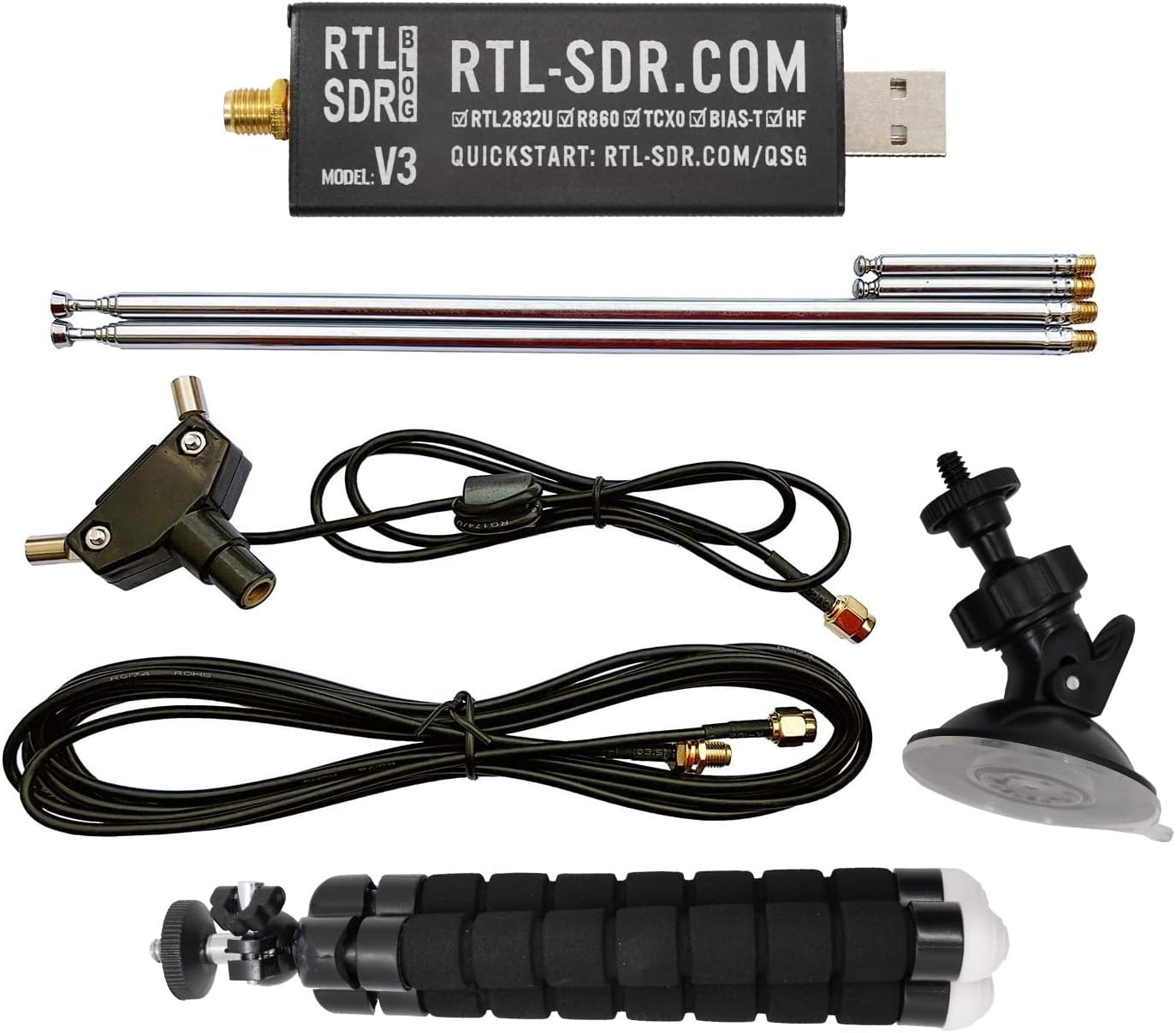
The V3 R860 RTL2832U SDR dongle with 1 PPM TCXO and bias tee offers a wide 500 kHz to 1.7 GHz tuning range, stable frequency accuracy, and passive cooling in a sleek aluminum case. Bundled with a multipurpose dipole antenna kit, it supports terrestrial and satellite reception across multiple platforms, making it the ultimate tool for both beginners and pros seeking versatile, high-performance software-defined radio.
| ASIN | B0BMKB3L47 |
| Antenna | Satellite |
| AntennaDescription | Satellite |
| Best Sellers Rank | #6,822 in Electronics ( See Top 100 in Electronics ) #2,104 in Home Theater Accessories |
| Brand | RTL-SDR Blog |
| Built-In Media | RTL-SDR Dongle, Antenna Set |
| Color | Black |
| Compatible Devices | Laptop, Desktop, Tablet, Smartphone |
| Connectivity Technology | USB |
| Connector Type | SMA |
| Customer Reviews | 4.4 out of 5 stars 6,491 Reviews |
| Manufacturer | RTL-SDR Blog |
| Mfr Part Number | RTLSDR_AND_ANT_SILVER |
| Number of Items | 1 |
| Tuner Type | Satellite Radio |
| UPC | 783495030836 |
| Unit Count | 1 Count |
| Warranty Description | 2 years warranty on manufacturing defects |
B**S
Finally an Affordable Software defined Radio Dongle!
I am not new to Radios, I knew what I was getting into. I know that prior to year 2012, A Software Defined Radio (SDR) such as this one reviewed here were certainly not for general public, as they were considerably more expensive. In the last few years however there have been a ton of development activity in the field of Software Defined Radio (SDR), soon after it was discovered that a un-seemingly simple "DVB-T" dongles based on the Realtek RTL2832U can be used as a cheap SDR. Since that Realtek branded chip allowed transferring the raw "I/Q" samples to the host, which was used for DAB/DAB+/FM demodulation based on the Realtek RTL2832U chip now could also be dialed into frequencies well outside their advertised ranges. Thus, what was designed and sold as a simple device for watching "Digital TV" on your computer could now be turned into a full fledged "radio" capable of receiving frequencies anything between 64 MHz to 1700 MHz with free open source software. Fast forward few years more into development, This current RTL-SDR Blog Version [V3] R820T2, RTL2832U with 1PPM Temperature compensated crystal oscillator [TCXO] & HF Bias Tee for providing power to Low noise Amplifier, Software Defined Radio dongle can now tune from "500 kHz" (Medium Wave (MW) & Long Wave (LW) Radio) up-to 1.7 GHz and upwards. The dongle has up to 3.2 MHz of instantaneous scannable bandwidth while "2.4 MHz" being the most stable on most computers. The RTL-SDR project has become the Radio tinkerer's “first step” for someone looking to experiment with radios. It’s cheap, it’s easy, and since the hardware is incapable of transmission, you don’t have to worry about having a HAM radio license to use it. You can however listen to, decode and scan all the frequencies (Works as an excellent frequency scanner) by pairing with capable software on most personal computers. The official software called as "SDR sharp" from "Airspy" is free and there are also several other capable SDR software one can use with the dongle (Like cross platform SDR++) which passionate developers have been making for the community. Installing the software for using RTL-SDR Blog Version [V3] USB dongle while might be relatively simple for tech savvy persons still remains mostly complicated for average user, that certainly needs to be addressed going forward. Especially the manual method of injecting the right USB drivers using a third party "Zadig" software and relying on various add-on libraries and Microsoft .NET 5.0 32-bit redistributable installed to use SDRSharp. Thankfully, there are other several developers who have taken this to next level by having the whole package preconfigured and ready to use using UBUNTU (LINUX based) .. Check out "Dragon OS". DragonOS which is a Debian Linux based operating system that comes with many open source software defined radio programs & additional decoding software pre-installed that takes all that driver installation requirements seen on windows based PCs totally seamless. Also, I found out that same DragonOS can be installed "alongside" windows if needed for a much seamless operation. Or you can just create a non-persistent "liveCD" environment using DragonOS and boot off USB stick to test it out. Bottom-line: The product reviewed here is an excellent value package, reasonably priced and has all the necessary accessories to get you started into Software Defined Radio (SDR) world. In my humble opinion it is worth more than 5 stars.. Five stars rating. Happy scanning!
D**.
Works as advertised (HF, too) and FUN!
This is a very high value item--what it can do for the price is tough to beat. It definitely performs as advertised, but be aware that you will have to read online user guides, since no documentation comes with the unit. The website printed on the module is a great resource. For those wondering about HF reception--I can confirm that when using the Q-channel direct sampling setting, this will tune down to 500 kHz as advertised. I have successfully received AM broadcast and shortwave broadcast on the 49m, 31m and 25m bands. I haven't had as much luck with the ham bands, but that's mainly due to the fact that the included antenna is mostly inadequate for that. Given that I can receive AM and SW bands, I don't see why it wouldn't also work on the ham bands with a proper antenna arrangement. VHF/UHF works great. Weather, public safety, FM broadcast are effortless with the included antennas. I've even had limited success decoding P25 Phase 1 using DSD+ software with virtual audio device software. There's tons of Windows software available to use this module, and it is straightforward to get running using the quick start guide at rtl-sdr.com. Unfortunately, I wanted to use my Mac. There are a few Mac applications, but they are not as full-featured as the Windows applications. However, I can also confirm that it is possible to get the module to work on a Mac with the HDSDR and SDR# Windows apps (these tend to be the most popular) when you use Wine and install the correct drivers (thanks to Homebrew). This process is not for the novice, but if you know macOS, Wine and Homebrew, you should be able to figure it out. Let's just say I learned a lot in the process. Bottom line, if you even have the slightest interest in trying out SDR, you would be doing yourself a disservice to pass up a piece of hardware this cheap. It works, no question about it. UPDATE: I strung up a random wire antenna in the backyard and can now report a great deal of success receiving HF amateur activity down to the 160m band. With the right software, I can decode CW, SSB and a multitude of digital modes. Using DSD+ software, I'm decoding Project 25 and DMR on the UHF public safety bands, too. I still can't believe this is all possible with a $20 dongle!
J**B
Need to be computer programmer to use for ADS-B
Works as it should, no problems with that. Do not buy if your looking to decode ADS-B for tracking aircraft unless you are a computer programmer. Normal people can not download and install the multiple software needed. Just use simple apps on phone.
M**K
A Nice Step Up In the World of RTL-SDR Clones
I already own an RTL-SDR, one of the first versions, but this one is better for a few reasons. First off, it covers a wider chunk of spectrum. The originals covered from 24 to 1850 MHz. This one extends down to 500kHz, giving the entire shortwave spectrum and the AM broadcast bands. Second off, it upgrades from a free-running crystal to a temperature compensated crystal. These are more precise; it's within 1 part per million, while the others are probably within 25 and drift around more if their temperature changes. What that means in practice is that when you enter a frequency to listen to, you're going to be much closer to the frequency with this one than with the first generation. At 1000 MHz, you'll be within 1000 Hz with this one, so you'll hear and understand the modulation; with the first style you can be 25 kHz off; if it's narrowband modulation, you won't even hear it. A really useful part of this well-thought out kit is the telescoping (changeable length) antennas it comes with. With no fussing and fighting, you can shorten or lengthen the antennas to receive everything from around the FM band up to its frequency limit. They're too short for a shortwave antenna, but just add more wire to the ends of the telescoping antennas. The old rule of thumb for beginning shortwave listeners to "put up as long a piece of wire as you can get, put it outside and put it as high as you can put it" is absolutely true. If you're looking at this review, you're probably familiar with the world of these little radios. They're based on a TV receiver chip and give you a good starter kit to get into hundreds of radio specialties. None of them equal the performance of a professional level receiver, but they're amazingly useful little radios to have around. And the high quality receivers are going to hundreds of dollars and even thousands, not this kind of price. For most of the problems that these are prone to (overload from a local FM radio station or other broadcaster is the big one), there are patches and workarounds. In any radio, being able to listen to a weak signal close in frequency to a strong signal is what separates the great receivers from the not so good ones. At the risk of sounding pompous, let me say, I'm not just a lifelong radio hobbyist, I used to design those professional receivers for a living. For a few bucks more than the bare bones radios you can get from other folks, this one is a step up and well worth the out of pocket expense. Once you get the radio, there's a world of software to experiment with and much of it is open source. You'll learn more of that at the RTL-SDR blog website itself.
G**T
An Excellent Value and Very Decent Performance on HF
I won't repeat what the other reviewers have generally said but focus on some bullet points on its HF capabilities. - Overall, very good HF reception, given its price. An inexpensive introduction to the SDR HF world and see if you want to invest more money and time in this aspect of the radio hobby. - The RTL-SDR is running just slightly warm when using it on HF - Based on using the RTL-SDR with the free program SDR#; was easy to download, install and run on my Windows 10 laptop PC. Go to the RTL-SDR web site for instructions and lots of related information. - SDR# has many options to tweak the received signals. Takes a little time to experiment and zero in on the best settings. - I'm in a typical medium sized city suburb with local AM and FM radio stations. An AMBCB filter was used to keep the local AMBCB out of much of the HF spectrum. A similar FM trap filter (which I do not have) would no doubt tame down the FM spurs that I see in the VHF signals. But the FM spurs do not show up in the HF band. - A decent HF antenna is a must .. I'm using a 40 year old HyGain trap vertical with signal strengths in the same ballpark as my Yaesu FT450D using an OCF dipole antenna. The small whip antennas included with the RTL-SDR are pretty much not worthwhile with HF signals - Tuning hams and other SSB signals is straightforward and gives good results. - For shortwave broadcaster reception, a $50 radio will give improved results. For SSB reception, a $100 radio will be better. I'm referring to general sensitivity, selectivity, audio quality and ease of use. - But the SDR-RTL does show the HF spectrum and its simple to scan around looking for various broadcast stations, hams, utilities, etc. In viewing the HF spectrum, many signals popup and then are gone. A conventional radio is more difficult to find these sporadic signals. - Lots of room to experiment. I may eventually buy a Ham It Up upconverter or an SDRPlay RSP1 or RSP2, etc. which will give improved results. - An excellent value .. recommended 5/14/17 Here is a screen shot (from the program SDR Console) of the RTL-SDR on the 40 meter Amateur Radio band on Sunday night. Lots of signals! Here I'm using the SDR as a 'panadapter' for my Yaesu FT450D ham transceiver. The program supports two way frequency synchronization with the FT450D .. meaning I can tune either the SDR or the FT450D and the other tracks the tuning. Neat!
K**R
Well, worth the wait!
It almost took almost 2 months for this thing to arrive, but when it did arrive and I got it set up I am enjoying it. The antenna that it comes with is okay. It’s good for beginners but truthfully, investing in a quality discone antenna will most certainly enhance ease of of tuning. It’s a solid value that’s for sure. It’s a great way to get into Amateur Radio
D**E
Buyer Be Aware...
Disappointed in the latest batch of units...Ver 3 has traditionally been a silver case with Ver 4 in a black case. For some reason the Ver 3 are now ALSO in black cases, so if you want Ver 4 makes sure it says V4 not V3.
C**O
If you get the RTL-SDR Blog dongle I guarantee you will have fun and enjoy anything you do with it
You have the $12 dongle in your cart. You're looking at this one wondering if it's worth the extra money. I mean you don't even know if you'll use it a lot. If you get the RTL-SDR Blog dongle I guarantee you will have fun and enjoy anything you do with it. I've been in the dongle game since the first word trickled out that you can do a LOT more than watch lame TV with these things many moons ago. It was fun using the originals. They had their flaws but a SDR was still new tech and something so CHEAP was insane! But after a while the flaws began to grind the fun down. As they warm up the crystal drifts which means tuning is a pain. If you use it inside and keep your house at a constant temperature it's not too bad but if you use it mobile tuning is all over the place. Not something you want to deal with behind the wheel. This dongle uses a temperature sensor to adjust the frequency which ensures tuning is always spot on. Aside from mobile use that makes this dongle great for unattended use. Say in an attic or garage hooked to a Raspberry Pi or even in a container up on a mast to cut down on antenna cable losses. Speaking of antennas the RTL-SDR Blog dongle has an SMA connector. Big whoop! It is when experimenting. The cheaper dongles have an MCX connector. It's great for projects that are placed in a case with an adapter that has its own bulkhead connector. Definitely not for experimenting. The MCX connectors tend to lose their strength after a while. There's no easy way to repair the small components so you'll end up spending twice as much! Might as well buy this dongle right off the bat! The case for this dongle is phenomenal. Not only does it add a new level or durability but it also acts as a shield and heat sink because it's metal. Yup! Metal! Obviously you want your equipment to run as cool as possible at all times, especially things that are built in such an efficiently compact way. The dongle case does that in spades. You won't have a problem with overheating like you might have with the cheaper plastic case dongles. The cheaper dongles have very little if any shielding at all. Bad for receiving on the dongle but it's also bad if you're trying to receive something else with another radio. You don't need a little noise maker on your desk dumping static into your ears. Finally the warranty is magnificent. My first dongle developed a problem that might have been my fault. I can only believe it was since the quality of the thing is so high. What I know was my fault was the ham fisted attempt at repairs me and my buddy tried. Those failed miserably. I emailed the RTL-SDR Blog folks to see if there was any way to repair what I did. They gave some suggestions and offered to send me a replacement if I couldn't get the thing going. We tried and tried and fried and fried and thankfully I have a new dongle on the way. They didn't have to replace what I messed up but they did. Now that is supporting the SDR hobby. Hell its the best support I've had in years from anyone! Soon I'll be able to play with ADS-B, listen and not know what my smart electric meter is doing, and see what digital modes are used on repeaters before deciding what kind of radio to blow money on. Probably none. But we'll see! So that cheap dongle in your cart? Delete it and add this one. Slip it in with some household stuff so your SO might miss your new toy. ;) They won't be so angry at the purchase when you're quietly wining around accurately while switching antennas without breaking a dinky connector.
E**.
Producto revisionado pero inflado de precio
Conocía el producto y quería evaluarlo. Es el mismo producto SDR de RTL-SDR que en su versión "plateada" pero revisionado, certificado y con una carcasa metálica en negro. De lo mejor si te quieres adentrar en el mundo del SDR. Pero no le puedo dar cinco estrellas porque el producto está excesivamente inflado de precio. Por la mitad del mismo se puede adquirir en otros lados incluida distribución nacional y en menos de 24 horas.
R**H
Outstanding SDR for Beginners & Enthusiasts!
The RTL-SDR Blog V3 is an incredible software-defined radio that offers amazing performance at an affordable price. Whether you're a beginner exploring SDR or an advanced user, this device delivers! What Makes It Great: ✔️ Wide Frequency Range – Covers from 500 kHz to 1.7 GHz, allowing me to monitor everything from AM/FM radio to airband, ADS-B, NOAA weather, and even ham radio. ✔️ High Stability & Low Drift – The 1PPM TCXO ensures stable tuning with minimal frequency drift. ✔️ Versatile Modes – Supports direct sampling for HF and quadrature sampling for VHF/UHF. ✔️ Plug & Play with SDR Software – Works seamlessly with SDR# (SDRSharp), HDSDR, and other popular programs. ✔️ Excellent Build Quality – Solid aluminum casing helps reduce interference and improves heat dissipation. ✔️ Bias-T Power Option – Great for powering active antennas or LNA directly from the dongle. Final Thoughts: This is easily the best entry-level SDR out there. It’s incredibly flexible, easy to use, and packed with features that make it a must-have for any radio enthusiast! Highly recommended! 📡🚀
M**H
パソコンの知識があれば安価に無線受信ができる
1700Mまでしか受信できないとはいえ、普通のラジオはもちろんそれ以外にもいろいろ面白い電波が受信できる。ADSBやらエアバンドやら… 25M以下を受信するにはソフトウェアから設定の切り替えが必要なので要注意。
R**N
Amazing product
Works exceptionally well, minimal configuration required to get a satisfactory result. Overall a very fun and interesting product to mess around with!
Y**Z
buen producto
entrega antes de tiempo fue muy rapido se ve de muy buena calidad
Trustpilot
2 months ago
1 month ago