
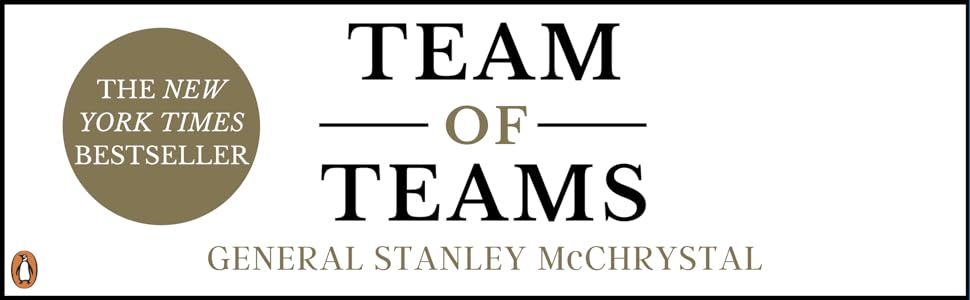
Team of Teams: New Rules of Engagement for a Complex World
Product ID: 48928019
⚡Agility & adaptability focus
📈Proven leadership framework
🔗Decentralized team cohesion
Desertcart purchases this item on your behalf and handles shipping, customs, and support to South Africa.
⚡ Lead like a visionary: build teams that win in complexity!
Team of Teams reveals how General Stanley McChrystal transformed military operations by breaking down silos and empowering decentralized teams. This bestselling leadership book offers actionable insights for managers seeking to boost agility, communication, and adaptability in any organization facing complex challenges.
| Best Sellers Rank | 31,422 in Books ( See Top 100 in Books ) 197 in Business & Economic History 234 in Business Life (Books) 3,570 in Reference (Books) |
| Customer Reviews | 4.6 out of 5 stars 5,109 Reviews |
M**N
Turning abstract ideas into real solutions
I first heard of Team of Teams back in 2019 when I attended a meeting hosted by thought leader Gene Kim in which he mentioned General Stanley McChrystal's work. Since then, I have listened to many podcasts, webinars and conference talks in which this book is referenced. As a result, I felt I needed to read it! I am glad I did! What I find most appealing about Team of Teams is that McChrystal has written about how he changed a large organisation to adapt to a new threat that traditional structures were unable to tackle. Taking this experience and documenting it in an easy-to-read and engaging thesis takes the reader on a journey of change based on real events that put theory into practice with dramatic positive outcomes. If you are serious about addressing problems associated with ancient institutional structures that limit the capacity for your organisation to adapt to the more complex environments in which it functions, then this book helps you understand why change is necessary and offers a blueprint of how that change should look. Some of the ideals of DevOps are based on the ideas that are explained in this book, such as organisations promoting psychological safety as well as building teams and communication that emphasise locality and simplicity. For me, this book gave me those 'aha' moments when abstract concepts become crystal clear actions in my own mind. I also read this book in short time owing to the engaging way it is written. I have dog-eared many pages for reference and so will return to this book over and over as I continue along my own journey.
M**N
I first came across General McChrystal on TED speaking about ...
I first came across General McChrystal on TED speaking about his leadership in the Middle East. His sincere respect for and valuing of the people he led came across very strongly. This book is actually about the benefits of empowerment, something that I am passionate about as a leadership trainer and coach. McChrystal does not only refer to his own experiences of trying to combat Al Qaeda but demonstrates how empowerment with appropriate leadership support works in many different situations, fields and industries. It's a perverse endorsement to say that it's probably one of those books that will be shunned by the people who need to read it most, the (still too many) self-focused leaders who believe authoritarian control is the only way to get through crises and big change. I saw yet another one of them fail with that approach this year. With a bit of humility and courage he could have applied what this book teaches and engaged the talents of his people to solve the knotty problems he faced instead of creating an aggressive, bullying culture that sent morale through the floor and got him sacked.
A**N
Wall St know-how applied to the War on Terror
This is the story of how General Stanley McChrystal brought Wall Street trading floor working practices (which have existed for decades) to the battlefield in Iraq. The general implemented the trading floor business model on the battlefield in Iraq because he had to. When you have to respond to a distributed network of terrorists (or are put in a "winner's curse" competition with other dealers to buy or sell a bond) you cannot plan your reaction. Either there’s somebody ready to be deployed in the field who can react in real time and feed back all intelligence in real time to other assets in the battlefield (marketplace) who will act upon it in real time, or you may as well give up. McChrystal woke up to the fact that he was facing complexity every bit as much as a trading floor does that’s pricing tens of deals for tens of types of customers at the same time and that the top-down structure was not fit for purpose in Iraq. No matter how strong his navy SEALS or Army Special Forces were, “whatever efficiency is gained through silos is outweighed by the costs of interface failures.” (p. 151) In his words (p. 74), “unpredictability is fundamentally incompatible with reductionist managerial models based around planning and prediction.” To defeat Al Qaeda in Iraq, the military would have to move from “doing things right” to “doing the right thing.” This was not going to be about refining a process down to the last detail, but about having the right people in the right place armed with the right information and letting them figure it out. I’ve spent more than twenty years on trading floors, here’s how it all works: Each desk is comprised of three to eight traders who know each other well, have worked together for years and trust each other blindly. Each trader specializes in a very narrow set of securities or derivatives he knows inside out and each can count on his buddies to cover for him out of his own book when the circumstances dictate he should. There’s as many desks as there are products to trade. The desks acknowledge each other and work together seamlessly to do transactions that cut across more than one specialties. Example: Suppose a new issue needs to be brought to market. The syndicate desk will act as the new bond’s midwife, guiding the issuer as to the best pricing and timing and carries the eventual risk of any unplaced bonds on its books. The syndicate desk can count 100% on multiple sales desks to place the new issue and it can count 100% on the swaps desk to take away all market-directional risk the client would otherwise bear. The swaps desk, in turn, can 100% count on immediate execution of bond and futures hedges from seamlessly (often electronically) connected bond and bond futures desks. Everybody sits in one room and within earshot of each other. Everybody is part of a small desk, but there are unofficial, unwritten and constantly revised protocols for how the desks will interact. There is a morning meeting for the whole trading floor (with participation from Japan), delivered over the stentor and another global (that means London and New York) meeting at seven thirty New York time. The economist speaks and previews today’s data, all desk representatives speak in a formal order to discuss new supply (auctions or syndications), market trends, the biggest flows and where they reckon the market is going. This is called “market color.” The sales desks follow with the most important business from the day before and any important transactions that are coming up. Everybody knows what’s coming and how it fits together. Everybody can interrupt the meeting, more than a thousand people. The Monday morning meeting is typically done out of New York. Sometimes a high-up guy attends and addresses the troops, and this is done in an auditorium and is fed through to the stentor for those who are on their desks. The heads of desk all meet regularly with one another and with the head of the entire trading floor, both formally and informally. There is tension between the sales desks and the trading desks, because the sales desks mainly get compensated for volume. No good way has been invented to measure the profitability of trades, but it’s plenty easy to see if the competition is doing the business and business does not much happen in the absence of profit. Senior management merely choreographs these interactions. It fosters exchange of information, listens to the salesforce to find out what the customers are doing and to the best traders to find out how it all makes sense. Eyes on, but hands off. All decisions are made in real time by the most junior person on the floor who is qualified to make them. Management’s role is to stop him out if he’s losing, give him more rope to hang himself if he’s winning and compensate him, promote him or fire him at yearend based on an assessment of his performance. Management manages people, not individual trading decisions. If a trade is big enough that management finds out about it, you really should consider passing on it and there had better be some awesome outside PR benefits to winning it. The model is very much a “team of teams.” So General McChrystal had the epiphany that his team would have to abandon the command-and-control structure and morph into a network. A network that would be just as networked as Al Qaeda’s, but, better. He visited Michael Bloomberg, a former Salomon Brothers trader, head of technology at Salomon and eventually founder of a trading systems empire and got the blueprint. He put together the whole thing, soup to nuts: 1, he recognized that every attack would be different 2. he anticipated that solutions would have to come out of a bottom-up result of interactions, much like Al Qaeda’s 3. he decided to emphasize connectivity and trust over reductionist precision 4. he recognized that there would be efficiency costs to this approach and was prepared to take the associated criticism He did not start from scratch. He already had some amazing teams under his command. Navy SEALs, Army Special Forces, intel analysts, all had solid, tightly knit, professional and highly trained teams going, but the task was to make them work together (though I don’t think the word “Marines” comes up once if you do a word search; we all have our prejudices). Job #1 was to create a “shared consciousness” and he did it exactly how you’d do it on a trading floor, using communication protocols that were first established by NASA to launch the Apollo project. He got himself a massive space and turned it into what Stanley Kubrick would call a “war room.” He ran out of there daily one-hour long meetings that he chaired himself, inviting everybody to the table. Not only all three forces, but also the CIA, intelligence, airpower controllers, medical staff, everyone. He covered the walls with screens bringing back footage from ongoing raids, logs of captures, maps of recent gains and losses, casualties etc. and made the room the permanent office for himself and his top lieutenants, with people arranged to sit in a U around them. No cubicles, no special room for General McChrystal. The point was that anyone in the room could have the latest information, pretty much at the same time as his or her commanding officers. Takeup was far from immediate. Lots of the seats were initially left empty. But over time, this became the place you had to be, because that became the best way to be current. Eventually everybody joined, including the Intelligence folks, as the process “developed its own gravitational pull” and “the information shared was so rich, so timely, and so pertinent to the fight, no one wanted to miss it.” (p. 168) Job #2 was to build trust between the teams he commanded. “Each agency feared that sharing intelligence would work against its own interests. Competition between agencies made them reluctant to provide information; what if a partner agency did not reciprocate?” To get there, he instituted an embedding program, whereby he forced teams to send some of their best players to go work with other teams. “If you won’t miss him, don’t send him” was the rule. Often these people would be given menial tasks by their host teams, but because they had been carefully selected they invariably ended up having a lot to offer. And over time, not a long time, connections of trust between the teams were formed around the embedded emissaries. Everybody at every team could say with no exaggeration that he knew and trusted somebody in each of the other teams. And that’s how the structure came about of a “team of teams” with “shared consciousness,” a shared purpose and widely shared information who could act as one. Soon enough, the results started coming in. The number of raids the team could successfully execute leapt by an order of magnitude. And previously unheard of stuff like follow-on targets became a daily reality. But also treason, as megabytes and megabytes of information found its way onto Wikileaks. General McChrystal does not dwell too long on the Bradley Manning affair, but it has to be recognized as a downside of the approach he took. On the other hand, he did get Zarqawi and he makes the case very persuasively he never would have without applying his method. The biggest epiphany he had though, was to do with his own role. Once the team of teams was up-and-running, he realised his authority to order raids was actually in everybody’s way. Job #3 became to redefine his job. He had to let go. “The wait for my approval was not resulting in any better decisions, and our priority should be reaching the best possible decision that could be made in a time frame that allowed it to be relevant.” So he reluctantly devolved his powers to sanction raids to the lowest operative who could reasonably expected to make the decision. The thinking was that the extra speed would compensate for the possibly inferior decision making. He was in for a surprise. The empowered and informed leaders in the field actually obtained better, more precise results than they’d done before, when he’d been masterminding the attacks. He thought he’d give something up to gain something more important. He actually got both. And thus he realised that he’d have to redefine his job. Yes, he’d have to keep his eyes on the ball. But he’d have to keep his hands off. From the heroic leader / chessmaster he had been trained to be and had dreamt of becoming one day, he had already morphed into a gardener, a man who keeps the correct environment going and merely tends to his garden while allowing nature to take its course. Which neatly brings me back to the trading floor and the world of investment banking. The head of the trading floor knows everything, but never has to give an order. He lets traders do their thing. His decisions revolve around personnel, the overall direction of the business, and the allocation of resources, most important of which is compensation. Thing is, when something wrong happens it is nigh-on impossible to pin it on himl And so it came to pass that the highest-ranking person who will go to jail for the LIBOR scandal will probably be a 34 year old Aspergers sufferer called Tom Hayes. Legend has it the man sleeps in a Spiderman duvet. Leaving to one side the question of whether he was doing anything wrong (my personal view is nothing in principle, but plenty in the detail) he's finding it very difficult to prove he was acting on the orders of his superiors. But of course the law knows how to follow the money and fully realises he was. And what does the law do? Ah, that's the fun bit. It's forcing trading floors across London, Tokyo and New York to abandon the "team of teams" structure they passed on to General McChrystal and is demanding that all banks provide full top-down organograms, of the kind that will allow orders to flow downward and blame upward. And it's forcing banks to hire thousands and thousands of lawyers to ensure they comply with the new structure. Not only that. Additionally, the regulators are forcing trading operations to ban mobile communications, Twitter, social media etc. from trading floors, while teams of lawyers are trolling over all Bloomberg chats from the past ten years, making any and all communication dangerous, in case it's taken out of context. What's the result? When once traders, with their access to Reuters, Bloomberg, TV channels and multiple chats once stood in the center of the information flow, they now find themselves the most isolated from the real world they've ever been. Instead of sitting in the middle of a communication hub, they need to wait till they've gone home to find out from their spouse what happened today in the world. What will come of it? Very simple. First, those organizations and individuals who have alternatives will exit the business and focus on more profitable stuff, driving prices wider. That's only the beginning. Prices will have to widen even further, to accommodate the fact that the wrong business structure will result in a blunter, slower, defensive response to the better networked, sharper, customer enquiry. Finally, somebody will have to pay for the thousands and thousands of compliance officers, and that's the third powerful force that will drive margins wider. Will be fun to watch!
N**E
Engaging Insights with a Great Design!
Team of Teams is an outstanding book, both in content and presentation. The design is appealing, and every aspect of the book feels thoughtfully crafted. A highly engaging read that offers valuable perspectives on teamwork and adaptability in today’s complex world. Highly recommended!
B**A
Team of Yeams
A good read
A**D
Great for anyone in management or project lead
Really interesting book. Brought to read as part of an ongoing project
A**R
Fascinating
Needing to adapt our management style as technology and the conditions of a global market force new challenges upon us is not a new topic for me. Neither is the notion that we have to embrace these changes and be willing to deploy entirely new approaches to succeed. But to have that all validated by a book about military strategy made this such an interesting read. If they can adapt to the requirements of an agile world, then businesses have no excuse not to.
L**N
up there with the hard thing about hard things and high output management
I tend to be a bit nervous about recent-ish business books, especially ones which rely on anecdote. Too many times you’re reading about an amazing management innovation in a book, and already the main protagonists are in jail or disgrace. Hopefully this won’t happen here :-) what I particularly like is that he’s focusing on appropriate management structures for the Information Age, and he’s doing so from the perspective of a master practitioner of the command and control model. I will definitely read again, likely within the next couple of years - will be interesting to see if I’m still so bullish on it then.
A**O
AMAZING
Amazing if you lead team works or not
J**K
Hard fought lessons created a new model
Team of Teams offers insights into the modern practice of leadership and management required to navigate and succeed in this complex world. The book is not a military history, but instead a concise and exceptionally “fun to read” collection of insightful ideas told through entertaining stories ranging from industry to hospital emergency rooms. I recommend it for leaders and associates from all types of organizations who need to break down the effects of siloed teams in which information flow and decision making is ineffective in today’s increasingly complex environment. If you are working your teams harder and putting more resources against a problem that isn’t improving, READ this book and be prepared to look closely in the mirror. The discussions in the book are grounded in organizational management theory and leadership methods, but along the way gives a once in a lifetime look at the inside of the most storied Special Operations Forces (SOF) unit in existence today. This is not a book about the latest way to become a great leader. In fact it’s about becoming the kind of senior leader that can develop and sustain an entire workforce of great leaders. The lessons the authors put forward to challenge the typical (and often failing) organizational models and leadership approaches were paid for in blood over the last decade. I do not come at this review as a scholar of organizational management but rather as a participant and recipient of the Team of Teams approach in the military where I was a leader for over 20 years. I have known the author for more than 2 decades having served as a front line Soldier and leader in his unit and also as his assistant/confidante/advisor during his most senior command. Stan, along with his 3 co-authors, believes that the world is now so complex (vice complicated) that the old models of command and control are extinct. They are so passionate about this evolution that they have started a successful consulting firm to share their lessons. I have worked with 90 plus U.S. and international organizations in and out of government and I cannot think of one that would not benefit from this study. An alternate title to this book might have been Trust and Purpose meets Empowered Execution. The Task Force’s journey towards shared consciousness and smart autonomy starts in 2003 with the stunning realization by the commander of the world’s most precise and lethal Counter-Terrorism Task Force that they were losing the strategic war against Al Qaeda. From there the authors interlace examples and case studies of organizational models, leadership techniques, and technological advances from a myriad of areas. They include weather forecasting, basketball and soccer, engineering marvels, big data, airline customer service, aircraft crews, NASA, SEAL training, plastic surgeons at the Boston Marathon bombing, GM versus Ford, MIT studies, and the enduring effects of Ritz Carlton and Nordstrom. My favorite example is the Star Wars bar comparison. The discussions found in the various chapters of the book are wide-ranging but relevant to leading all organizations in this modern world. The following should be of interest to today’s leaders: the difference between complicated and complex environments; how having more information available does not improve prediction nor mean lead to smarter decisions at the top; Taylorisms and efficiency ideals may actually cost you more than they save; the ‘need to know’ fallacy; the value of using your best people as ‘liaison officers’ or ‘embeds’; how resilient people make organizations stronger because they can adapt to changing environments; learning from your adversary is time well spent--they might have a better organizational model not necessarily better people; how to delegate authority to take action until you are uncomfortable; how to build trust and a shared awareness of the big picture; ‘eyes on, hands off’ leadership; and the difference between creating Strategic Corporals and an organization full of Lord Horatio Nelsons. The book carries you forward in time to see how far the Task Force had come by changing their culture, structure, and habits to allow the larger corporate command to become as agile and capable as its commandos. Pages 184-188 detail the successful operations that the “Task Force” were able to undertake after the shift. This short example, that covers just 46 minutes of a follow-on-target operation, highlights sharply the outcome of The Task Force’s investment in transparency, trust building and empowered execution. The command took risks and luckily their bosses supported them and let them learn to beat AQI at its own game. Sir Lieutenant General Lamb, a close friend of Stan McChrystal, shared a paper with me once that he titled 'In Command and Out of Control' and it raises a lot of the same questions and concepts about how to lead in a complex and fast-paced world. The conclusions were similar. Success comes from giving freedom to subordinates, increasing speed of action, achieving self-synchronization---in a nutshell: decentralized command. The concept is literally about getting 'out of the control' business and realizing that in order for organizations to take advantage of fleeting opportunities teams must be empowered at the lowest levels to take action. McChrystal echoes this and the need to repeatedly broadcast so that everyone knows the goals and strategy of the organization. This includes letting everyone in the organization have a say about the direction of the ship and feel free to alert others of impending icebergs. McChrystal and Lamb’s cooperation in Iraq was not by accident but from years of trust building and a shared awareness of the big picture. Missing from the book is a deeper discussion on the role of planning, plans, strategic thinking and strategy. While the Team of Teams approach allows organizations to be adaptable and resilient there is still a key role for planning and strategy. Maybe it’s as simple as the old adage ‘the plan is nothing but planning is everything’ or maybe this is the topic for their next book. Although its demonstrated throughout the book its unstated that great leaders are often well-read. Only by studying leaders and organizations can you begin to see the need for the Nelson touch, to avoid the Perry principle, or understand the butterfly effect. The book is only 250 pages long but it is full of simple time-tested ideas that can be put into action with little cost. The difficult part of acting within the shared consciousness that Stan McChrystal describes is getting your people to realize they are empowered to make decisions. This task mostly falls on the senior leaders of an organization. This method can be exhausting and requires resilient and disciplined leadership at all levels, but the rewards are unmatched. I have personally served in organizations that utilize shared consciousness and empowered execution or have previously undergone a Team of Teams evolution. The fact that the culture endures after the leader departs says a lot about how powerful a culture change in an organization can be. I have also served in government agencies that just couldn’t accept that their strength truly lied in informed and empowered employees. Luckily the latter are destined for the dustbin of history. More and more often today leaders reinforce an environment that speeds up business failure. The world has changed and leadership models haven't kept up. This book can show you how to adapt to the complex world we find ourselves in. Team of Teams documents how the most professional and deadly special operations force found itself humbled by an enemy that was better adapted to the 21st century way of war. More importantly it’s about how leaders at all levels need to be humble enough to realize when to change their old ways and trust their people to make rapid yet informed decisions.
S**S
A challenging perspective
An excellent concept, which is well worth the read. The concepts of shared consciousness and empowered execution are worthy of consideration. A thought is that are these concepts enabled by a reductionist baseline or can they be developed from the outset? Do you need an organisation to have been based in a clear roles and responsibilities framework, In order to be able to optimise the New system. At the end of the day ' trust' is the cornerstone, and it reminds me of the saying that 'some leaders trust that you are good until you prove yourself otherwise, and some leaders don't trust you until you prove yourself worthy.' Both have their place and whilst naturally people like to think they are in the former, most, if honest, would admit to being in the latter. In this book the special forces selection process and the assumption of competence inherent in that culture need to be factored in as enabling considerations, kind of like the seeds for the gardener to grow and tend. Iam a convert, and can see the utility and benefits.
T**G
Masterclass in Network Agility
Team of Teams is an essential guide for navigating today’s "Complexity Gap." Stanley McChrystal’s core insight is profound: in a world of high ambiguity, efficiency is no longer enough—you need adaptability. The book masterfully explains how to transition from a rigid hierarchy to a network of decentralized but deeply connected teams. The real learning here is the power of "shared consciousness," which allows for the speed and agility required to correct course in real-time. It’s a must-read for any leader looking to empower their people to master dynamic challenges with confidence and precision.
L**N
D’utilité publique !
Juste génial, limpide, pédagogique. Le propos est clair, truffé d’exemples. On savait que l’on vit dans un monde siloté avec des strates de petits chefs, on sait donc ce qui ne marche pas. La démonstration d’une organisation qui marche est évidente. Inspirant !!
Trustpilot
1 month ago
1 month ago