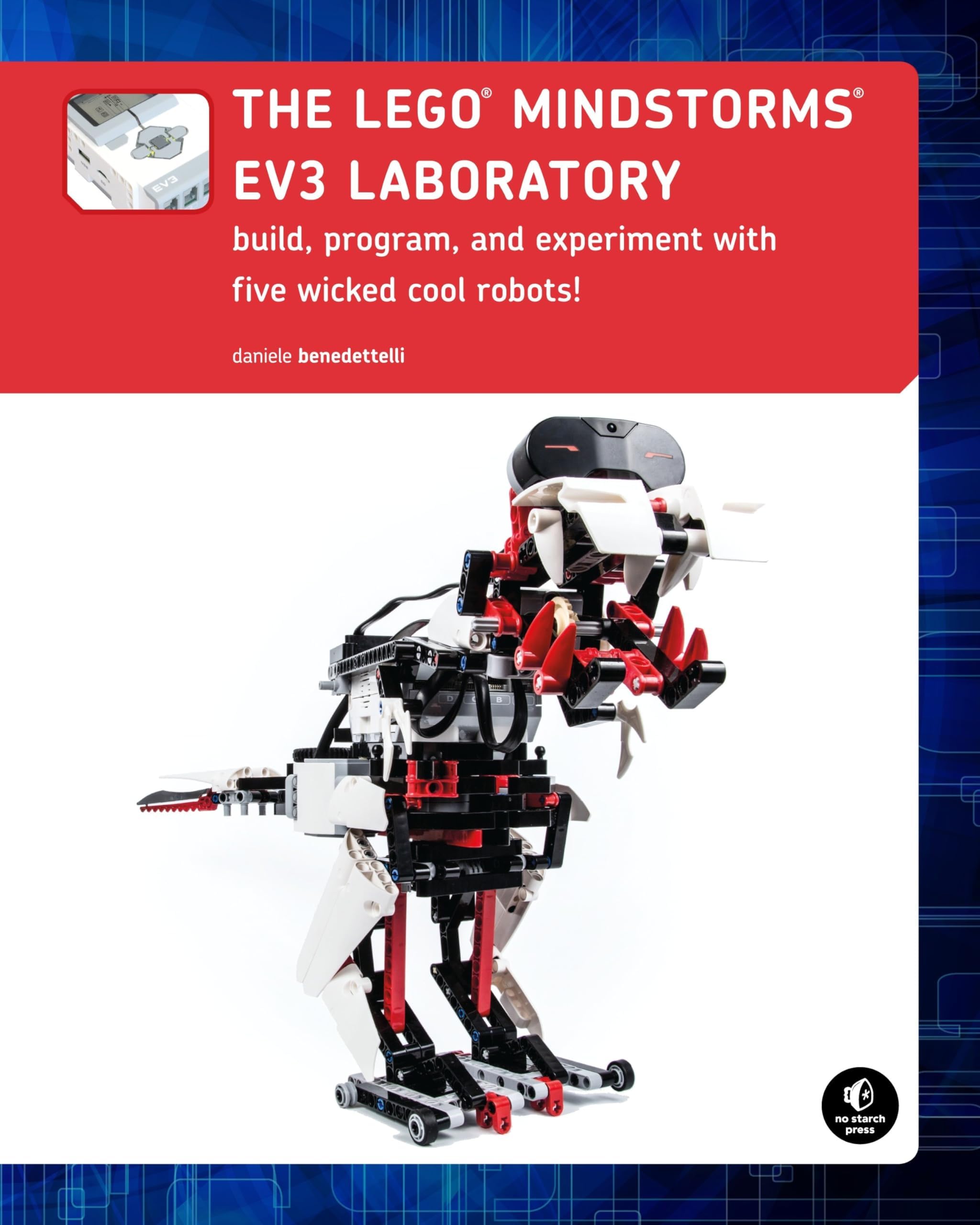
The LEGO MINDSTORMS EV3 Laboratory
Product ID: 47993433
📚stepwise learning curve
🤖5 programmable robots
⚙️mechanical & software engineering
🤖 Unlock the future of STEM with LEGO EV3 — where play meets professional-grade robotics!
The LEGO MINDSTORMS EV3 Laboratory book offers a comprehensive, pedagogically sound guide to building and programming five distinct robots using the EV3 kit. It combines mechanical engineering fundamentals, progressive programming lessons, and real-world math applications to engage young learners and aspiring engineers alike. Ideal for those seeking a deep understanding of robotics beyond simple assembly, this book fosters critical thinking and hands-on experimentation.
| Best Sellers Rank | 1,214,328 in Books ( See Top 100 in Books ) 719 in Electronics & Telecommunications Engineering 972 in Models & Model-Making 1,389 in Computer Information Systems |
| Customer Reviews | 4.4 out of 5 stars 230 Reviews |
P**E
A must buy.
There are a lot of Lego NXT books out there, and I own a few of them. This book is by far the best I have purchased (I read it cover to cover in a single sitting the day I received it), but it will not please everyone. Why? Let me explain. I am not an automatic fan of everything Lego. I don't collect sets, and I don't furiously build everything I stumble upon. I bought the NXT 2.0 kit with the sole purpose of educating my kids, just as I bought real fossil sets, kumon math books, small and not so small microscopes, etc... Call me a sucker for anything that claims, with a reasonable grounding in reality, to be technically and scientifically educational. Sadly, I was probably a bit over-optimistic: a 6 years old boy and a 3 years old girl are not a good audience for a robotic kit. Now that they are a few years older, I decided to try again, with the same goal - entertaining education - and an EV3 kit. It is from that perspective that I will judge this book. The book begins with a good and brief introduction to the EV3 kit pieces and their names. Unlike some of the other NXT 2.0 books I own, this part is not an overly verbose page filler. Mentions of structures and frictions are a hint of things to come. Chapter 2 and 3 introduce the mandatory base platform and the visual block programming. This is probably the weakest part of the book: while they are excellent and have to be there if only for the users who will only buy one book, I can't help thinking it deprives us from a bit more of what follows, which is even better. Chapter 4, 5 and 6 dive deeper into programming and the first application. Interesting experiments are suggested, not randomly but in the framework of a logical pedagogical approach. Chapter 7, "The math behind the magic" floored me, because I didn't expect it. It could have said something like "the robot doesn't perform greatly, but hey, its only Lego and real robots performed better" No, like an invisible hand guiding us through experiments, it quietly introduces the notion of measurement noise. A fundamental notion that touches so many things in our modern science and technology, that our kids could eventually encounter during their secondary studies if they have a good math or science teacher, is presented in a way that a 12 years old boy can understand! And followed up by experiments that lead to immediate practical improvements in the robot's behavior. Chapter 8 is a cookbook of Lego recipes that addresses structural integrity, friction, typical machine parts. It is goal oriented: do you want strength? A lot of friction or none? This is again a place where I have seen other books (and Lego's own instructions) fail: they give you building instructions but don't tell you why the model is being build that way. Here, your get a good primer on common mechanisms and structural issues. After reading it, you won't think in terms of "I put a beam here because the instructions say so" but you'll know the reason why you are doing it "I put a beam here because I want to improve the rigidity of that important piece". Again, fundamental issues of mechanical engineering insidiously pushed into the brains of our kids (and I like that!) The rest of the book follows a regular pattern. Build a robot, experiment a bit, improve, experiment more, think. It touches essential programming concepts (the notion of variable, arrays, logic etc....), fundamental software architecture patterns (state machines!) in a style that is never boring or paternalistic. A bit of math is used here and there but nothing (except maybe the basic use of trigonometry) that a 12 years old couldn't understand. The added bonus, of course, is that kids realize that the math they learn at school is useful in the real world. To summarize: this book marvelously introduces kids to fundamental scientific, engineering and software programming concepts. Its flow and pedagogical approach is so smooth that kids aren't bored and don't even realize they are taught those things (which is a very, very good thing with kids - try to force them study polygons properties by rote because polygons are important). Now, for the caveat: The only audience that could be a bit disappointed is the type of audience that wants to build spectacular robots for the fun of it, or because they find the Lego build process mindlessly relaxing. The robots in the book aren't fancy or truly spectacular. For the adult who wants to build solid robots and learn sound building and design techniques: an excellent book. For my purpose: the almost perfect book. (I find something like Bricx to be ultimately better than the standard visual development environment and its quirks)
T**P
An amazing book
This book shows what can be done with an EV3 kit. The learning curve is progressive and I would advise people to go through it step by step and in the end the rewards are well worth it. The mechanical aspects of the models are well explained (torque, speed, differential, structures Tec it's all there). As far as the programming side is concerned, this book will guide you through from basic techniques to more advanced programming and control techniques (arrays, logic ,PID control). Well done Danny.
R**N
Great book if you want to learn LEGO EV3 in depth
This is a great book for really learning how to program the ev3 in depth. There is also a wealth of detail on constructional techniques, which are illustrated in the excellent models described in the book with full constructional details. My only problem was that with a couple of the models SENTIN3L and T-R3X particularly I found them to be a bit unstable, and they could fall over. I think this was because I used rechargeable NiMh battery cells which are quite heavy in the eV3 brick. I asked the author on his web site (quick response) and he had used the rechargeable pack that LEGO supply as an extra (it is standard with the Educational set but not the retail one) and I think this is lighter, altering the centre of gravity of the model. This is why I give it 4 rather than 5 stars. Notwithstanding, this is an excellent book and a must if you are really serious about getting to grips with the potential of the ev3 system. The analysis of steering geometry and the programming to allow for it in the steerable SUP3r CAR is superb! I bought the Kindle addition which worked well if you have a second monitor on your PC on which to display it, with the LEGO program on the main monitor.
A**R
Great LEGO development guide.
Awesome, great intro to LEGO Mindstorms technology, logical development path.
F**S
Mindstorms EV3 lab
Comprehensive and well illustrated book. My Mindstorm hooked son just loved it. Can recommend to everyone that is exploring the Mindstorm world.
I**L
Great book
Great book laid out well and easy to follow,look forward to attempting many experiments, great aid to programming, would recommend.
A**R
Good book, awesome robots as well
Good book aimed at the retail EV3 pack, even lists the parts needed to make your retail kit into the education pack and even the add on pack as well
Y**D
Great for new builders
Nice set of robots and useful details of what exactly the programming is doing and brings about, so useful teaching. It is, however, only really dealing with the robotics side of the EV3 so the datalogging part is not dealt with. Delivery very speedy indeed.
Trustpilot
2 weeks ago
2 months ago