Desertcart purchases this item on your behalf and handles shipping, customs, and support to South Africa.
🚀 Amplify your signal, amplify your reach — don’t miss a beat in the wireless world!
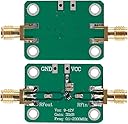
The HiLetgo 0.1-2000MHz RF WideBand Amplifier is a high-performance low noise amplifier (LNA) designed to enhance weak RF signals across a broad frequency spectrum. Delivering up to +32.5dB gain with minimal noise, it’s ideal for SDR enthusiasts, shortwave listeners, and FM radio users seeking to extend communication range and improve signal clarity. Its flexible power supply options and compact, thermally efficient design make it a must-have upgrade for professional-grade RF reception.
| ASIN | B01N2NJSGV |
| Best Sellers Rank | #99,607 in Electronics ( See Top 100 in Electronics ) #577 in Audio Component Amplifiers |
| Brand | HiLetgo |
| Brand Name | HiLetgo |
| Customer Reviews | 3.9 out of 5 stars 438 Reviews |
| Manufacturer | HiLetgo |
| Maximum Output Power | 0.01 watts |
| Maximum Supply Voltage | 12 volts_of_direct_current |
| Minimum Supply Voltage | 9 volts_of_direct_current |
| Model | 3-01-1225 |
| Mounting Type | Surface Mount |
| Number of Channels | 1 |
| Number of Items | 1 |
| Output Power | 0.01 watts |
| Part Number | 3-01-1225 |
| Specification Met | CE |
| Voltage | 10 volts, 8 volts |
N**Y
Great match for the RTL-SDR
This amplifier is perfect for increasing the reception of an RTL-SDR dongle. It just about covers its entire tuning range, and then some. I've mainly been using it for shortwave where it has dramatically increased the number of channels received. It's also proven itself well on FM (just don't overdrive the SDR frontend!) and other bands. Just one caveat: you'll need to BYOP (Bring Your Own Power) as its DC-blocking capacitors prevent it getting power from the coax. A nine-volt battery should do the trick however. Interestingly enough though, the amplifier ("N02" INA-02186 perhaps?) is designed to take bias-T power on its output pin (7V max), meaning that those adventurous enough to make some slight modifications might just be able to power the amplifier straight from the RTL-SDR! As mentioned before, this amplifier performs quite well and can in fact attain its advertised +30dB gain. However, do note that, like any other LNA, it will amplify the noise floor somewhat as well. In summary, this amplifier is ideal for anyone wanting an inexpensive upgrade for their RTL-SDR.
C**G
Good RF amplifier for cheap, cah be easily modified to be powered from cheap SDR dongles
This LNA is a good deal for a good and easy-to-live-with amplifier. It uses a BGA2869 as the main amplifier IC (thanks to another reviewer for the info!). One notable point is that apparently a batch of these were populated and shipped with incorrect values for the resistor that drops voltage from the 9-12V input down to the 5V that the chip requires, so check when you receive it that it has a 220 ohm resistor and has the code 221 (5%) or 2200 (1%) marked on it if you plan to power it from the VIN pad. This problem is apparently so rampant that some other product photos for other listings on Amazon actually have the wrong part visible. Note that there were some earlier revisions that have a different MMIC amp or different layout as well that have reviews included in this listing. Instead of powering it through the VIN pad, this PCB's real party trick is that it can be modified to be driven from a 5V bias T voltage from the receiver that many SRD dongles (like the RTL-SDR v3 and v4) can provide with only a piece of resistor leg or jumper wire, requiring no outside power supply. Just solder a jumper from the center RFout pin on the SMA connector to the node that connects to the Vcc pin on the IC, as seen in the photo. The bias T option can be easily enabled in most SDR software like SRD# or SDR++. The LNA draws around 25mA and the RTL-SDR is rated to source 180mA. I also included screenshots of SDR++ tuned to a weak broadcast FM station using the dipole antenna kit offered with the RTL-SDR v4 so that you can see the gain difference. The only difference between the two screenshots are with the LNA included and removed from the coax line. You can see the difference between the waterfall graphs on the screenshot with the amp removed, and can see the difference on the SNR meter on the top right between the two. Note that both input and output on this amp are female, so you'll need a male-to-male SMA adapter to connect it in-line with this antenna kit. Overall, this is a nice amp for a good price, the PCB is laid out well with good via fencing for RF signal integrity, and has a fair amount of vias to thermally connect the chip to both the top and bottom ground plane for cooling.
B**9
A tricky device. Things you should know.
This preamp works fine, but I think you have to apply it correctly. It's a GaAs Rf amplifier chip, similar to unit such as the Avago 82563, but not that -- possibly a Chinese clone or variant of a different chip. This one appears to run with a current of about 35 ma to deliver its full gain, and is intended for 5V operation. The sellers have adapted it to run at 9-12 volts by adding the 220 ohm resistor, to drop the voltage down. If the voltage is reduced too much, its gain goes down. In fact, this is a good way to make a variable gain preamp - by driving it with different voltages (without a dropping resistor), say between 3V and 5V. At the lowest voltages, it actually becomes an attenuator. Of course, the current consumption is fairly high for that application -- you might do better in your attenuator circuit by just using a PIN diode. The 220 ohm resistor permits full output when connected to 12V, but at 9V the gain will be much less, which may be why some reviewing it here have had mediocre results with it. If you intend to use it at 9V, you best reduce the resistance. In my application, using two Lithium Ion batteries (3.2-4.2V each) I found a good choice was to change the 220 ohm resistor to 120 ohms. However in my circuit, I also added a 1 mH choke as shown, which has 33 ohms series resistance, so my resistor is actually 100 ohms. The lower the voltage you run it from, the more the inductor is necessary for best output. Check that it is drawing at least 25-35 ma. Also note that it's good to mount the unit in a grounded metal box. Traditionally, the hobbyist mounts these kinds of devices inside an Altoids tin. In my case I used some copper tape lining inside a plastic box. The seller has stripped down their product here to the bare minimum, and I think they could have done a better job making it usable over a wider voltage range. But with care, it will give excellent results. I have two cautions. First, don't try to run this from 5V -- unless you make the modification I suggest (small resistor + RF choke). Second, be careful soldering around this, because GaAs circuits die very easily when treated roughly. If you're not comfortable making changes to the circuit, perhaps it would be better to get one of the other units. Or, get a transistor-based (Jfet) preamp. Those would be more costly, though. Only the very low cost justifies this circuit.
R**L
These were great a couple years ago but the units I recently bought didn't work.
These little amps worked great a couple years ago, but the new units I recently returned did not work at all. The active component was different than the previous units. Don't know why but no gain at all. So after having installed them, I had to remove and return. Now the latest email says one wasn't returned, even after the return was completed in full on the order page. So a problem there perhaps. Anyway, don't buy these and if you do, test them before going to any effort of installing and counting on them.
T**D
Great product and would recommend to anyone that needs a preamp
excellent preamp. works extremely well on HF frequencies.
S**L
Ordinary cheap product
It works okay. You get what you pay for. It's not fantastic. There were some design tradeoffs made, probably to reduce cost. If it needs so desperately to be powered at a very particular voltage (below which you get very little gain and above which you get too much noise... that voltage seems to be right around 9.4V on the board I got) why didn't they just put a regulator on it? I would hope that their QA process could include tuning each piece to its optimal power supply voltage. This would've gotten more stars but I don't understand the seller's concept of customer support. I got several emails from them, each one over a page long that said to ask on Contact Seller for technical information. I looked at the questions and there are some completely inane ones that I'd have to sift through to see if one of them already has the posted information. (For example, Q: What's the noise figure? A: None.) The seller could have very simply sent me a single follow-up email that contained all the links to all the information that they have available about this product. I will probably avoid this seller in the future unless I have no other option.
D**N
Lots of gain!
I bought this amp to boost the signal level from my small receiving loop antenna for Amateur Radio. I use that antenna as a noise source for my MFJ 1026 Noise Cancellation unit. I had a 10 dB preamp on there before, and it just didn't provide enough noise for the MFJ to work effectively. With this unit, I can amplify the noise to the point where it's even louder than the main antenna, even with the built-in preamp in the MFJ turned off. The MFJ now cancels all of the noise from my immediate neighbor's house almost totally. I am powering the from an old 6VDC wall wart that puts out 9V with this minimal load. This is probably the best $10 I ever spent.
D**U
Raises noise 30db but little gain.
I wonder about the tests on these LNA's. i got 3 diff types of them and if i use a 50 ohm dummy on a sdr on the bench i get a -80 line. if i connect an unpowered preamp to the input of the sdr i get -80 line. If i power the preamps i get a -50 db noise line. so 30 db of noise on all 3. If i use an antenna for the weather station at 162.550 I get a increase of noise on both the sdr and preamps of 10db. the signal to noise of the sdr is 26db. If i use the preamps i get a snr of 32. So i wonder how they really test these in the real world. The amp alone has a 30 db noise added. Max gain of a signal above the noise was 6db. So very not a LNA and 30 db? No maybe 6 to 10db so maybe they think that because they raise the noise floor 30db it has a 30db gain. Not taking into account that signals only get a 6db boost.
F**O
prodotto molto valido preamplificatore d'antenna per le HF validissimo.
Prodotto usato come preamplificatore HF in un ricevitore FT-277 che normalmente non ha di preamplificazione. Segnali passano da 3 a 8 e basso rumore di fondo. Consigliato. Pilotato con alimentazione tramite potenziometro da 500 ohm in serie è possibile variare il livello di amplificazione ma non solo, diminuendo la tensione si ottiene una attenuazione del segnale in ingresso. In pratica variando la tensione si passa in continuità da amplificatore ad attestature. Occhio alla schermatura, è facile ottenere inneschi a motivo dell'elevato fattore di amplificazione. Io l'ho chiuso completamente in una scatoletta di lamierino completamente saldata. Allego toto del montaggio e della scatoletta variatore di tensione.
U**L
AT LAST one that works
I've tried a few of these cheap Chinese preamps and most suck, but this one boosts the signal (and noise of course) from both tuned shielded receive loops and untuned loops on topband and 80m, allowing me to phase receive antennas against my main transmit antenna (3/8 wave inverted Ls on those bands) and null out local interference - or to phase receive antennas against each other. Obviously they work better right by the loop. I used a 12v supply with them. The actual noise figure of the amp itself isn't something I can test.
F**O
Amplificatore 0.1- 2ghz
Il mio non funzionava restituito . Alcuni dicono che e' errata la resistenza da 2,2 k, infatti sostituita correttamente con 220 ohm tutto ok
S**C
Works well.
Works well. Using on 137mhz ( Pi SDR server) & 156/7mhz (traditional scanner). I do have an FM band stop filter fitted before the amp. Fast dispatch. Recommend.
L**N
Does work
I have only so far used it on HF below 30mhz and it does pull up the signal, however it also lifts the noise, when using a 9v battery there is a big drain in battery. I bought a voltage dropper which dropped the 12v Motorcycle battery down to 9v, i then ran the unit for 24 hours receiving FT8 signals on my SDRplay and hardly any voltage drop. I haven't yet used it on 1090mhz as another buyer did but intend to do that quite soon, all in all worth the money.
Trustpilot
5 days ago
1 month ago