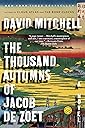
The Thousand Autumns of Jacob de Zoet
Desertcart purchases this item on your behalf and handles shipping, customs, and support to South Africa.
Description
📖 Unlock the timeless allure of Japan’s hidden past — don’t miss the novel everyone’s talking about!
- COMPLEX REWARDING READ - Sophisticated prose and a layered plot that challenges and captivates discerning readers.
- GENRE BLENDING NARRATIVE - A seamless fusion of historical fiction, romance, and subtle fantasy elements for a unique literary journey.
- AWARD WORTHY CRAFTSMANSHIP - Four years of meticulous writing by a globally influential author, longlisted for the prestigious Man Booker Prize.
- MASTERFUL HISTORICAL IMMERSION - Experience Feudal Japan with exquisite worldbuilding and authentic period detail.
- CRITICALLY ACCLAIMED BESTSELLER - Highly rated with 647 reviews and a strong presence in historical romance and literary fiction charts.
The Thousand Autumns of Jacob de Zoet is a critically acclaimed historical novel by David Mitchell, set in 1799 Dejima, Japan’s sole Western trading post. Blending rich historical detail with a compelling love story and subtle fantastical elements, this Man Booker Prize longlisted work showcases four years of meticulous craftsmanship. Praised for its nuanced prose and intricate plot, it’s a must-read for lovers of literary fiction, historical romance, and immersive storytelling.
Specifications
| Dimensions | 13.89 x 2.92 x 20.93 cm |
| Edition | Illustrated |
| Isbn 10 | 0812976363 |
| Isbn 13 | 978-0812976366 |
| Item Weight | 386 g |
| Language | English |
| Print Length | 512 pages |
| Publication Date | 8 March 2011 |
| Publisher | Random House Trade Paperbacks |
Reviews
User
Excellent historical fiction...
So far I've written reviews about fantasy, science fiction and horror novels and novellas, but this time I'll write a short review about a historical novel, because The Thousand Autumns of Jacob de Zoet is of exceptional quality and it contains a couple of slightly fantastical elements. At first I wasn't sure if I should write this review or not, because this novel isn't speculative fiction, but I decided to write it, because The Thousand Autumns of Jacob de Zoet is a damn good novel (and I think that several fantasy readers will enjoy reading it).David Mitchell is an interesting author, because he writes different kind of books and he isn't afraid to blend different genres (for example, Cloud Atlas is a combination of mainstream fiction and science fiction). His new novel, The Thousand Autumns of Jacob de Zoet, is a successful and satisfying combination of love story and historical adventure. It's literary fiction at its best and it's David Mitchell's best book so far.David Mitchell spent four years working on this novel and it shows in the text: all the small details are accurate and believable, the story is intriguing and the prose is nuanced, eloquent and beautiful. It's almost amazing how beautifully the author creates a fascinating and stunning vision of Feudal Japan. By using historical details, exquisite worldbuilding and excellent characterization, he brings the story to life.Here's a few words about the plot and the characters: The events take place in Dejima (in Nagasaki Harbor) in 1799. The artificial island of Dejima is Japan's only window to the West. The main characters are Jacob de Zoet, a clerk and Orito Aibagawa, a midwife. Jacod de Zoet tries to earn his fortune in Dejima, but fate has different things in store for him, because he falls in love with Orito Aibagawa. Uzaemon Ogawa is also an important character, because he's an interpreter. The author writes fluently about the lives of Jacob de Zoet, Orito Aibagawa and Uzaemon Ogawa. He also writes fluently about political intrigue and dark cults (dark and mysterious cults add a slightly fantastical element to this novel).The author has divided this book into three parts: "The Bride for Whom We Dance", "A Mountain Fastness" and "The Master of Go". The first part tells how Jacob de Zoet arrives to Dejima, the second part tells what happens to Origo Aibagawa in the mountains and the third part tells how things end. Each part is different and together they form a solid novel.The Thousand Autumns of Jacob de Zoet isn't a novel for hasty readers, because it's a complex and sophisticatedly written novel. It demands quite a lot from its reader, but it's worth reading, because it's a rewarding reading experience. If you like good prose and appreciate a gradually developing plot, you'll love this novel.The Thousand Autumns of Jacob de Zoet was longlisted for the 2010 Man Booker Prize for Fiction, but unfortunately it wasn't selected to the shortlist. In my opinion this novel should've won the Booker Prize, because it's a fascinating and extremely well written historical novel.By the way, if somebody happens to wonder where the name of this book comes from, it's a reference to one of the native poetical names for Japan, The Land of a Thousand Autumns.The Thousand Autumns of Jacob de Zoet is one of the best historical novels I've ever read. It should be read by everybody, who's interested in history (and especially Japanese history). It can also be recommended to fantasy readers, because the second part of this novel reads almost like a fantasy book.
User
Excellent historical novel about Nagasaki/ Dejima
Well written and well crafted tale set around 1800 in Nagasaki when the Dutch had a trading monopoly with the Japanese. Note there is a list of characters the back of the book that I did not find until I had finished it. Thoroughly recommend this yarn, a good page turner.
User
A delightful read. Sorry to have finished so soon.
Wow. I had a wonderful time with this. Captivating characters, extreme situations, how will it all come out. Not a disappointing ending either.
User
Absolutely Engrossing!
I was inspired to read this after the Cloud Atlas and wasn't disappointed at all.The book pulls you in right from the first chapter. But it is not just continuous thrills on every page to keep you reading, it's more of a story-building where you connect with the characters and want to find out what happened next in their lives.
User
Fast allein unter Wölfen
Wir schreiben das Jahr 1799. Japan hat sich völlig vom Rest der Welt abgeschottet: Kein Japaner darf das Land verlassen, kein Ausländer darf japanischen Boden betreten. Es gibt nur einen Hafen, über den das Land Handel betreibt - Nagasaki, auf dessen vorgelagerter Insel Dejima die Holländer eine Niederlassung der Ostindischen Handelskompanie betreiben.Der Roman beginnt an dem Tag, an dem der junge Jakob de Zoet zum ersten Mal Dejima betritt. Ihm ist die heikle Aufgabe übertragen worden, die schlampige Buchführung der Niederlassung in Ordnung zu bringen und den neuen Niederlassungsleiter dabei zu unterstützen, den schlimmen Korruptionssumpf trockenzulegen."The Thousand Autumns of Jacob de Zoet" beeindruckt in vielfältiger Hinsicht: Als aufschlussreicher Historienroman vor dem farbenprächtigen Hintergrund dieses in jeder Hinsicht fremden Landes, mit dessen Einwohnern man sich nur mit Hilfe mehr oder weniger zuverlässiger Dolmetscher verständigen kann. Es verschafft auch einen Eindruck von den Schwierigkeiten eines globalen Handels, wo der einzige Kontakt zum Mutterland ein einmal pro Jahr einlaufendes Schiff ist, und wo Briefe schon mal mehrere Jahre unterwegs sein können. Da kann man sich nie sicher sein, wer mit wem in Europa gerade Krieg führt und ob die Niederländische Ostindische Handelskompanie überhaupt noch existiert.Das ist die große Kulisse. Nicht minder schwierig ist das Spannungsfeld, in dem de Zoet arbeitet, der nie mit letzter Sicherheit weiß, wem er vertrauen kann, und dessen Integrität mehr als einmal schwer geprüft wird. Und dann verliebt er, der eigentlich frischverlobt aus Holland abgereist war, sich auch noch in Orito, die begabte, attraktive und ziemlich eigenartige Hebamme, die für ihn, den Holländer, so unerreichbar ist wie das japanische Festland. Oritos Schicksal entwickelt sich zum zweiten, noch aufregenderen Handlungsstrang des Romans, der uns dann endlich auch ins Innere des Landes führt.Mich hat schon in "Cloud Atlas" fasziniert, wie es Mitchell stets gelingt, Ton, Denkweise und auch den Humor der jeweiligen Zeiten zu treffen. Das macht die Lektüre mitunter etwas gewöhnungsbedürftig, aber es hilft dem Kopfkino ungemein. Ein Buch, in das man sich etwas einlesen muss und das man dann nicht mehr aus der Hand legt.P. S. Mit der Erklärung des Titels lässt David Mitchell sich unnötig viel Zeit. Ich hatte vor kurzem die "Bone Clocks" gelesen und deshalb damit gerechnet, dass er etwas mit Seelenwanderungen und ewigem Leben zu tun hat. Weit gefehlt: Japan wird in der Shinto-Mythologie auch als "Land der tausend Herbste" bezeichnet, und der Titel ist somit nichts anderes als eine blumigere Version von "Die japanischen Jahre des Jakob de Zoet".
Common Questions
Trustpilot