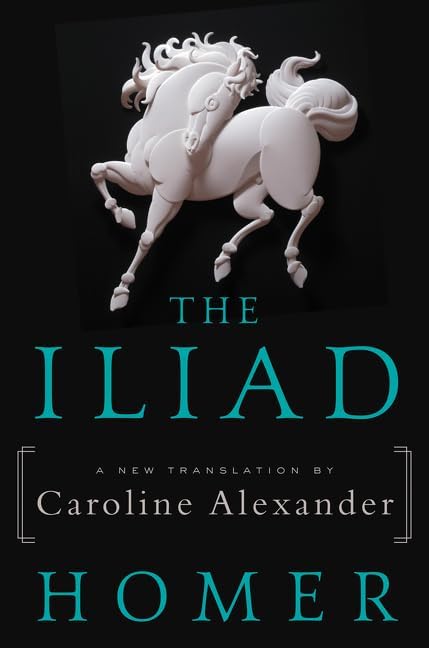
The Iliad: A New Translation by Caroline Alexander
Product ID: 35130278
Desertcart purchases this item on your behalf and handles shipping, customs, and support to South Africa.
With her virtuoso translation, classicist and bestselling author Caroline Alexander brings to life Homer’s timeless heroic tale of the Trojan War. Composed around 730 B.C., Homer’s Iliad recounts the events of a few momentous weeks in the protracted ten-year military war between the invading Achaeans, or Greeks, and the Trojans in their besieged city of Ilion. From the explosive confrontation between Achilles, the greatest warrior at Troy, and Agamemnon, the inept leader of the Greeks, through to its tragic conclusion, this foundational work of ancient Greek literature explores the abiding, blighting facts of war. Soldier and civilian, victor and vanquished, hero and coward, men, women, young, old― The Iliad evokes in poignant, searing detail the fate of every life ravaged by the Battle of Troy. And, as told by Homer, this ancient epic of a particular Bronze Age conflict becomes a sublime and sweeping evocation of the destruction of war throughout the ages. Carved close to the original Greek, acclaimed classicist Caroline Alexander’s new English translation is swift and lean, with the driving cadence of its source―a Homeric epic in scale and yet devastating in its precision and power. This essential translation of the foundational ancient epic offers: A New Translation: Experience the Trojan War through the eyes of acclaimed classicist Caroline Alexander, whose swift and lean prose is carved close to the original Homeric Greek. The Wrath of Achilles: Witness the explosive confrontation between the godlike warrior Achilles and the Greek leader Agamemnon―a bitter feud that changes the course of the war. Greek Mythology: Enter a world of gods and mortals, where the fates of soldiers, civilians, victors, and vanquished are tangled in a devastating conflict. Ancient Poetry: Discover the power of Homer's enduring Bronze Age masterpiece, a sublime and sweeping evocation of the destruction of war that resonates through the ages. Review: A fresh, exciting translation of a classic tale. - One of the most ancient stories in the world, The Iliad as recounted by Homer is an epic in the truest sense of the word. It is a story that has been told, and retold, for thousands of years. Dozens, possibly hundreds, have tried their hand and tested their skill at translating the poem from its original Greek over the years. I was a teenager when I first read Fagle's classic translation, often considered the modern standard for the tale. It is hard not to get swept away by the grandeur and the scale of it, the tragedy of men and gods. "Wrath--sing, goddess, of the ruinous wrath of Peleus' son Achilles..." So begins the poem as translated and retold by Caroline Alexander. Here, after millennia, Alexander is not choosing to reinvent the wheel but refine it, and she does so remarkably. She seems to have found a way to streamline the rhythm of the poem, shaping and refining its cadence. Modern readers are wont to remember The Iliad was originally intended to be an oral story, spoken aloud, and I implore readers to try it as they make their way through. It's truly remarkable, the way it almost seems to flow and carry itself forward. Inflection and emotion come alive in that way and, for a moment, one could easily find themselves swept away by the tale of gods and heroes. It's a wondrous experience for those who might be experiencing The Iliad for the first time, as well as those--like myself--who have read it a few times, by a few different translators. In sum, Caroline Alexander has done a remarkable thing and made the ancient new. The Iliad is, and always has been, a living story but in this new edition it feels reinvigorated and exciting and fresh. I absolutely cannot recommend it enough. Review: and the contents of corresponding lines in the two translations match pretty closely in places I chose at random - Understand that I know no Greek, so I cannot comment on the accuracy of the translation. I found this an enjoyable read. In comparison to the other translations I have read, it seems most similar to Lattimore, which is widely thought to be quite accurate. Alexander is, I think, easier to read, although this may just reflect the age of Lattimore's translation: more than 60 years old. Both of them attempt to match the original Greek line-by-line, and the contents of corresponding lines in the two translations match pretty closely in places I chose at random. I have also read the Fitzgerald and Fagles translations. Fitzgerald seems to be the most free of the translations, which means that the text does not match up line-by-line with Lattimore or Alexander, but sometimes is the clearest in conveying what is going on. I do not have Fagles in hand, but when I read it I felt it had a good deal of Fitzgerald's flexibility with an increased amount of Lattimore's accuracy with respect to the Greek. So in summary (and remember: no Greek), I think the spectrum from most accurate to most readable goes Lattimore, Alexander, Fagles, Fitzgerald. Sample them all--your local library should have several if not all--then buy and read the one you like best. If you are like me, you will then buy and read another translation, too.

| Best Sellers Rank | #16,162 in Books ( See Top 100 in Books ) #1 in Haiku & Japanese Poetry #40 in Ancient & Classical Poetry #52 in Epic Poetry (Books) |
| Customer Reviews | 4.6 out of 5 stars 1,063 Reviews |
M**S
A fresh, exciting translation of a classic tale.
One of the most ancient stories in the world, The Iliad as recounted by Homer is an epic in the truest sense of the word. It is a story that has been told, and retold, for thousands of years. Dozens, possibly hundreds, have tried their hand and tested their skill at translating the poem from its original Greek over the years. I was a teenager when I first read Fagle's classic translation, often considered the modern standard for the tale. It is hard not to get swept away by the grandeur and the scale of it, the tragedy of men and gods. "Wrath--sing, goddess, of the ruinous wrath of Peleus' son Achilles..." So begins the poem as translated and retold by Caroline Alexander. Here, after millennia, Alexander is not choosing to reinvent the wheel but refine it, and she does so remarkably. She seems to have found a way to streamline the rhythm of the poem, shaping and refining its cadence. Modern readers are wont to remember The Iliad was originally intended to be an oral story, spoken aloud, and I implore readers to try it as they make their way through. It's truly remarkable, the way it almost seems to flow and carry itself forward. Inflection and emotion come alive in that way and, for a moment, one could easily find themselves swept away by the tale of gods and heroes. It's a wondrous experience for those who might be experiencing The Iliad for the first time, as well as those--like myself--who have read it a few times, by a few different translators. In sum, Caroline Alexander has done a remarkable thing and made the ancient new. The Iliad is, and always has been, a living story but in this new edition it feels reinvigorated and exciting and fresh. I absolutely cannot recommend it enough.
J**D
and the contents of corresponding lines in the two translations match pretty closely in places I chose at random
Understand that I know no Greek, so I cannot comment on the accuracy of the translation. I found this an enjoyable read. In comparison to the other translations I have read, it seems most similar to Lattimore, which is widely thought to be quite accurate. Alexander is, I think, easier to read, although this may just reflect the age of Lattimore's translation: more than 60 years old. Both of them attempt to match the original Greek line-by-line, and the contents of corresponding lines in the two translations match pretty closely in places I chose at random. I have also read the Fitzgerald and Fagles translations. Fitzgerald seems to be the most free of the translations, which means that the text does not match up line-by-line with Lattimore or Alexander, but sometimes is the clearest in conveying what is going on. I do not have Fagles in hand, but when I read it I felt it had a good deal of Fitzgerald's flexibility with an increased amount of Lattimore's accuracy with respect to the Greek. So in summary (and remember: no Greek), I think the spectrum from most accurate to most readable goes Lattimore, Alexander, Fagles, Fitzgerald. Sample them all--your local library should have several if not all--then buy and read the one you like best. If you are like me, you will then buy and read another translation, too.
T**S
Good translation! I recommend
A good translation. Flows very well!.
Z**K
Flows nicely, but…
I think choosing the translation that makes you want to read it is the most important. So don’t get too caught up in choosing the “right” one. I am no expert and am only comparing this to the Fagles translation, but the Fagles translation packs a bit more rawness and “punch” with the war sections sometimes. But Caroline’s does have a nice flow and sometimes has a clearer description of what’s happening in some situations, which can make readers not have to go back a few lines to decipher something that didn’t quite make sense immediately. Either way, read some samples and choose the one you like, if you finish you’ll probably end up wanting to read another translation too. I like having one translation on my Kindle or phone and another paperback translation and will compare parts sometimes.
G**S
Wonderful translation - wonderful narration
I bought the Kindle and the Audible edition. And found both wonderful. Caroline Alexander translated the Greek text that sounds like a song - or was a song - into an English that sounds like an oral narration. The translation is clear and serene and compares supreme to other translations most of whom are - for what purpose ever - full of quirks and flourishes and become tedious after the third page. I had the feel to be very close to the wording and the meaning of the Greek text and the intention of its author, Homer. As brilliant as the translation is the Audible edition. Dominic Keating is the narrator. He has a pleasant voice. He reads as serene as the text is. He renounces to play his own personality. He just lends his voice to Homer to let him tell his Iliad in English. And he (Homer) lets about half the time his heroes talk in their own voices: Achilles, Hektor, Ajax (major), Agamemnon, Menelaos, and many others. Men and women who have lived (or are said to have lived) three thousand years ago become living souls and flesh again. They are in the tenth and last year of the Trojan War, a war between the Greeks and the Trojans outside the walls of the town Troy near the place where today's Turkey's biggest city is, Istanbul Many men slaughter many men. The reasons are not fully clear. The Greeks came to get the Spartan queen Helen back, which the Trojan prince Paris has abducted and made his mistress. Unclear is why a single woman is worth a war or even a ten year war. The Trojans fight for their lives, because they know that in defeat all the men would be killed and the women and children would be enslaved (and so they will be at the end). Unclear is why the Trojans do not hand the abducted Spartan queen Helen back to the Greeks; this is all the more a riddle as the queen is fed up with her lover and the Trojans. But the war has gained a life of his own, and the gods have taken actives roles in it. The warriors, Greeks and Trojans alike, see no other way than to battle on till one or the other side perishes.
T**.
A masterfully deep yet comprehensible take on a classic.
Even after finishing Caroline Alexander's rendition of The Iliad, I am left astounded as to how she made a version so readable and comprehensible to the average reader, yet contains all the nuance and depth the original text contains. Nothing is left out and nothing is bolstered beyond the original vision of Homer. This, in my opinion, is the best version of this text currently in the market. Highly recommend!
J**J
A thrilling experience
(April and May 2020). I read the book and listened to the audible narration at the same time. It was a great experience because it helped me get into the story and allowed me to experience it fully. I was immersed in the Trojan war into the story and went to ancient Greece. If I could only keep a few books with me, this would be one of them (such as if I had to leave ASAP and could only take a few things with me or if I was stuck on a desert island). “The Iliad” is a great story about being human, war, pride, power, how leaders treat others, accepting one’s fate, responding to events out of your control, grief, fear, joining a fight and wondering what you are fighting for, courage, and death.
M**U
Great book! Poor packaging
I was really excited to get this book after watching the odyssey and wanting to re read these stories. Unfortunately my book arrived with a small amount of damage on the front. This was pretty upsetting to see.
R**L
Mwah!
A gorgeous edition! And a "new" translation to make it much much more readable. Anyway, always a classic, always so immersive and fascinating. A story that's burst through the centuries and millennias! It's truly awe inspiring that we still have access to the integral story written somewhere in 400 BCE. Just wow. I can't get enough of anything to do with the Trojan war and Achilles and Patroclus (and they WERE indeed lovers, you can fight me about this and I'll die on this hill).
N**N
Fantastic translation, awful book quality.
I like the translation a lot, but the overall book quality (pages, binding, overall feel) is so poor I had to return it. Very sad for such a great translator, as it’s not her fault!
A**E
Excellent translation!
I'd been put off reading the iliad for years on account of an unnecessarily conflated translation that had been hanging around the fmaily library. You'll have no such problems with Alexander's translation, her work is acessible while retaining the epic feel of the poem. Her introduction and further reading suggestions are also incredibly informative for those looking to dig deeper into the content.
I**N
Llegó roto y doblado
Llegó roto y doblado
I**H
... classic we all know about but the translation is easy to read
It's a classic we all know about but the translation is easy to read.
Trustpilot
3 days ago
2 weeks ago