
The Mom Test: How to talk to customers & learn if your business is a good idea when everyone is lying to you
Product ID: 31713157
Desertcart purchases this item on your behalf and handles shipping, customs, and support to South Africa.
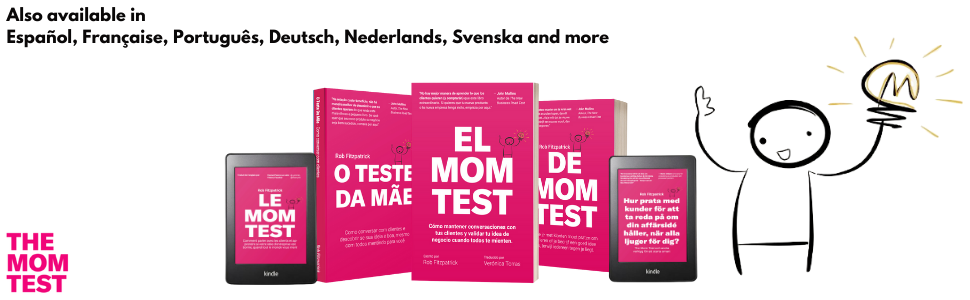
The Mom Test is a quick, practical guide that will save you time, money, and heartbreak. They say you shouldn't ask your mom whether your business is a good idea, because she loves you and will lie to you. This is technically true, but it misses the point. You shouldn't ask anyone if your business is a good idea. It's a bad question and everyone will lie to you at least a little . As a matter of fact, it's not their responsibility to tell you the truth. It's your responsibility to find it and it's worth doing right . Talking to customers is one of the foundational skills of both Customer Development and Lean Startup. We all know we're supposed to do it, but nobody seems willing to admit that it's easy to screw up and hard to do right. This book is going to show you how customer conversations go wrong and how you can do better. Review: Changed the way I approach customer conversations - This book is short, sharp, and absolutely packed with practical advice. It helped me recognize how much I was unintentionally biasing conversations with potential customers just by asking the wrong kinds of questions. What makes it stand out is how specific and actionable the examples are. It doesn’t waste time with fluff... it shows you exactly what to say and what to avoid if you want honest, useful feedback. I’ve applied its principles in real conversations, and the difference in the responses has been huge. A must-read for anyone testing or building a product. Review: This book can save you billions of dollars (and make billions as well) - A billion dollars? Yeah. First about me: I've spent the last three years applying the tools of human-centric design to business projects. I'm also thoroughly trained in the scientific method. This book is WILL save you billions. And if you have great ideas, you can make billions, too. In science, we know that proving a hypothesis does not provide one with strong evidence. It's primarily a matter of picking the right kind of evidence.(Often how a case is made in court.) The strongest kind of evidence is falsifying a hypothesis. Everything points in one direction, making something highly probable. But you might be wrong. You need to look for that one piece of evidence that shows you're wrong, even if everything else seems to support it. It took me a while to truly understand the significance of that. You don't have to, if you read The Mom Test, but you will benefit from what it means in practical know-how when you talk to customers. (And they are the ones who will, or will not, open their wallets.) Fitzpatrick shows you the questions we tend to ask - and we learn to identify which ones are extremely bad to ask. They are making our interviewees partners in crime of confirming something which simply isn't true. Every practical piece of advice in this book is highly valuable; one favorite of mine is to make sure you don't zoom in too early. You can get someone get highly emotional about a problem. Yet, if this is a lower-level problem, that the customer has never bothered to take action to change, it's still not a big problem for you to solve. Obvious, yes. This whole book is obvious. And yet, it's funny how often the most obvious stuff is ignored when it really counts. Don't mistake the laid-back-style of writing with its importance. Usually it takes years of practical experience to learn from mistakes, that will make you correctly apply an important theory that you grasp, into successful practical application.This book gives you that in - what, an hour of enjoyable reading? I've read many books on customer research. This books is invaluable. Read this one and you will probably go crazy when observing even more seasoned customer researchers for the traps they're stepping into, unknowingly, potentially wasting lots and lots of resources towards the wrong pursuit. Enjoy!
| Best Sellers Rank | #5,173 in Books ( See Top 100 in Books ) #1 in Starting a Business (Books) #8 in Small Business (Books) #25 in Entrepreneurship (Books) |
| Customer Reviews | 4.7 out of 5 stars 4,377 Reviews |
R**L
Changed the way I approach customer conversations
This book is short, sharp, and absolutely packed with practical advice. It helped me recognize how much I was unintentionally biasing conversations with potential customers just by asking the wrong kinds of questions. What makes it stand out is how specific and actionable the examples are. It doesn’t waste time with fluff... it shows you exactly what to say and what to avoid if you want honest, useful feedback. I’ve applied its principles in real conversations, and the difference in the responses has been huge. A must-read for anyone testing or building a product.
O**Y
This book can save you billions of dollars (and make billions as well)
A billion dollars? Yeah. First about me: I've spent the last three years applying the tools of human-centric design to business projects. I'm also thoroughly trained in the scientific method. This book is WILL save you billions. And if you have great ideas, you can make billions, too. In science, we know that proving a hypothesis does not provide one with strong evidence. It's primarily a matter of picking the right kind of evidence.(Often how a case is made in court.) The strongest kind of evidence is falsifying a hypothesis. Everything points in one direction, making something highly probable. But you might be wrong. You need to look for that one piece of evidence that shows you're wrong, even if everything else seems to support it. It took me a while to truly understand the significance of that. You don't have to, if you read The Mom Test, but you will benefit from what it means in practical know-how when you talk to customers. (And they are the ones who will, or will not, open their wallets.) Fitzpatrick shows you the questions we tend to ask - and we learn to identify which ones are extremely bad to ask. They are making our interviewees partners in crime of confirming something which simply isn't true. Every practical piece of advice in this book is highly valuable; one favorite of mine is to make sure you don't zoom in too early. You can get someone get highly emotional about a problem. Yet, if this is a lower-level problem, that the customer has never bothered to take action to change, it's still not a big problem for you to solve. Obvious, yes. This whole book is obvious. And yet, it's funny how often the most obvious stuff is ignored when it really counts. Don't mistake the laid-back-style of writing with its importance. Usually it takes years of practical experience to learn from mistakes, that will make you correctly apply an important theory that you grasp, into successful practical application.This book gives you that in - what, an hour of enjoyable reading? I've read many books on customer research. This books is invaluable. Read this one and you will probably go crazy when observing even more seasoned customer researchers for the traps they're stepping into, unknowingly, potentially wasting lots and lots of resources towards the wrong pursuit. Enjoy!
A**S
Epic, but littered with typos.
I soaked everything up like a sponge. It was very annoying to have to go back over sentences, confused, only to realize there are terrible typos and grammatical errors throughout.
K**R
Awesome book with tons of practical advice
I love the simplicity of this book and how it gets straight to the point on how to test product ideas with people. It was eye opening to read how we as product developers can get led astray fishing for compliments instead of listening more, walking into a meeting with declarations of what your idea is without getting the person just talking about their day pain and tasks, etc. I walked away with a lot of practical ideas that I can carry with me to the next product meeting and customer interaction.
W**N
Discover The Truth
Wow. This book created a paradigm shift in my understanding of how to ask good questions. I have a better understanding on how to write meaty questions. This book has leveled up my ability to conduct proper customer interviews. Rob manages to discuss not only what questions are good or bad, but why. He uses great example business ideas which are easy to understand. Frames the examples with bad questions and explains in great length why they will lead us to false truths. He discusses our need for validation and how it outpaces our primary goal of gathering good data. 130 pages and I don't believe a drop of it was wasted. Streamlined and ended with a cheat sheet. Before buying I was skeptical of the $30 price tag; after reading, I understand that the price equates to the quality.
H**N
I wish I wrote the book, because I would be so proud
When you have an idea that is great (inside your own head) you really want to go out there and get more positive feedback to build the idea further. Yes, positive feedback. The idea is a good one. So all those people saying "Not interesting" or "Yeah, but.." are not the ones we want to meet, but the ones saying "Yes! I love it! I would buy it when it is out!". It took me a while to learn that those are the worst kind. The negative feedback you can learn to receive, listen to, and ask "why?" and dig deeper and these people are really rewarding. The problem is the nasty ones that "don't want to hurt your feelings" or just want you to stop bothering them. And the best way to get you silence is to say that the like it - or even better say they love it. Then you will not ask anything more and go home with a smile. But they just want to get rid of you. This is the problem The Mom Test helps you solving. I have always been interested in people and what they think and love ask people questions. I have built a company which was required for $150m and I did 99% of the customer development and problem discovery. I have taken a course in open questions as an interview format. BUT STILL - I find myself tricking myself by not asking people the right questions. I loved The Mom Test and have recommended it to tons of people. Heck - I wish I would have written the book! When you ask to get feedback thing: 1. Tell me about the last time you X 2. What went wrong - explain more? 3. What are the consequences? 4. What tools/processes/etc do you use today and why is that not working? And - the book is worthwhile reading even if you are not building a product (even if it should be mandatory in every "entrepreneurship eduction"), but just want to learn how to listen and make conversations less about you and learn something every time you talk to someone.
A**.
easy to digest
Straight to the point with lots of examples demonstrating what the author meant. Also love the check list at the end. Feel like I learned a lot.
J**B
Good primer on talking with customers
I’d recommend this book to people who are just beginning to learn the craft and mindset behind asking good questions. For those of us who are quite self aware and good at getting to the “why”, this book offers a helpful no bs framework to approach customer interviews. But you’ll probably most of the information quite obvious.
A**P
Great in depth knowledge on how to ask
Asking correct questions and not getting carried away with complements are main leanings from this book. Gives in depth ideas on how to ask.
K**N
Great book
Great book.
A**S
Great book for idea validation and refinement
Recommends a good framework for consumer research and helps validate startup ideas and also refine them before spending time, money and effort
G**A
Interessante
Offre spunti molto utili per ottenere informazioni dalla “voice of customer” e costruire una buona strategia di sviluppo prodotto. Lettura piacevole, poco impegnativa e ricca di esempi pratici. Lo consiglio.
D**Y
Essential reading for anyone with a business or the desire to begin one. Excellent, quick read.
I bought this book as it had been recommended to me over the course of an entrepreneur's course and every single mentor insisted we all read it. They were not kidding - it is full of excellent, practical and valuable insights and information that will fundamentally change how you approach getting to know your customers and building effective and relevant businesses. An excellent and easy, quick read.
Trustpilot
2 weeks ago
2 weeks ago