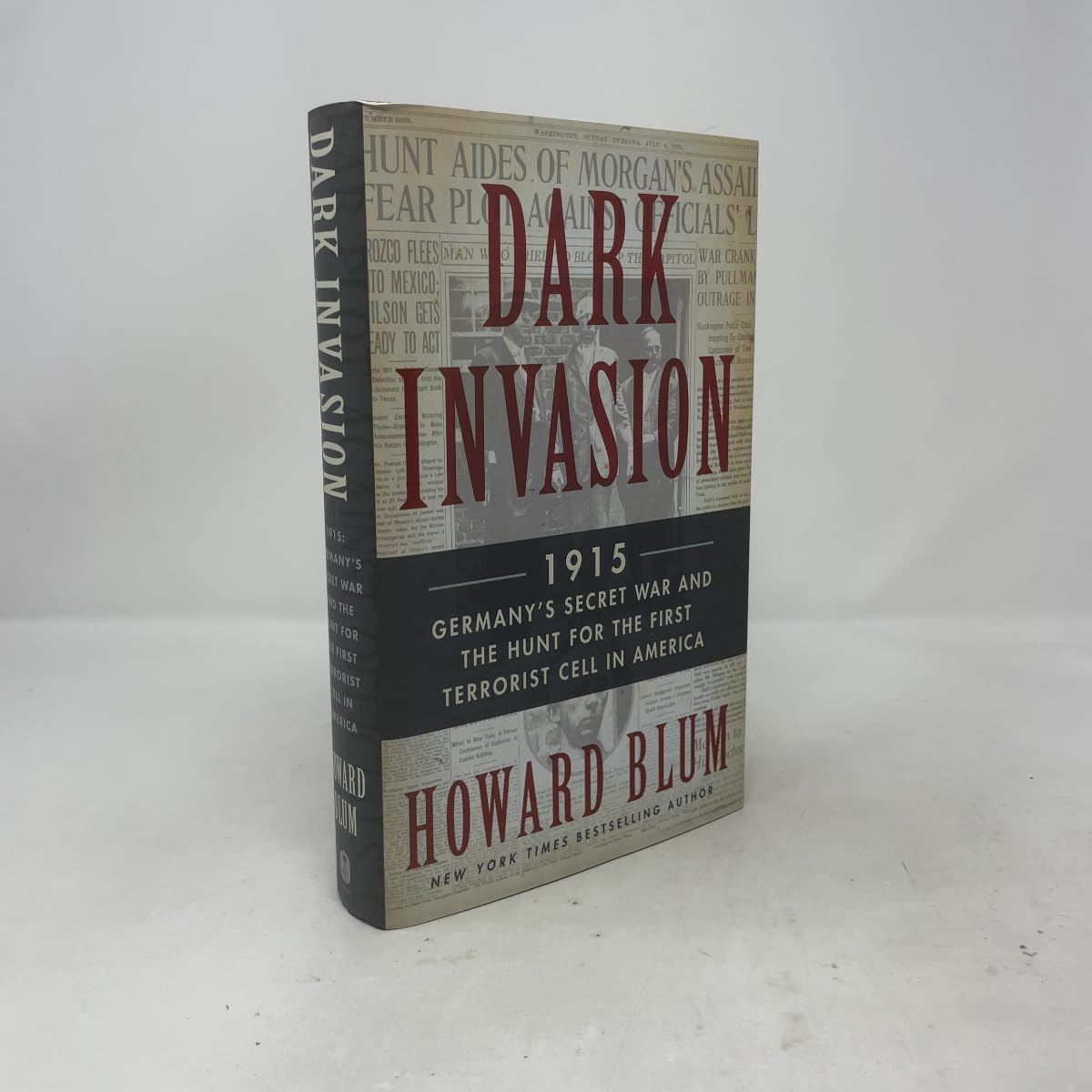
Dark Invasion: 1915: Germany's Secret War and the Hunt for the First Terrorist Cell in America
Product ID: 316084
Desertcart purchases this item on your behalf and handles shipping, customs, and support to South Africa.
Combining the pulsating drive of Showtime's Homeland with the fascinating historical detail of such of narrative nonfiction bestsellers as Double Cross and In the Garden of Beasts, Dark Invasion is Howard Blum’s gritty, high-energy true-life tale of German espionage and terror on American soil during World War I, and the NYPD Inspector who helped uncover the plot—the basis for the film to be produced by and starring Bradley Cooper. When a “neutral” United States becomes a trading partner for the Allies early in World War I, the Germans implement a secret plan to strike back. A team of saboteurs—including an expert on germ warfare, a Harvard professor, and a brilliant, debonair spymaster—devise a series of “mysterious accidents” using explosives and biological weapons, to bring down vital targets such as ships, factories, livestock, and even captains of industry like J. P. Morgan. New York Police Inspector Tom Tunney, head of the department’s Bomb Squad, is assigned the difficult mission of stopping them. Assembling a team of loyal operatives, the cunning Irish cop hunts for the conspirators among a population of more than eight million Germans. But the deeper he finds himself in this labyrinth of deception, the more Tunney realizes that the enemy’s plan is far more complex and more dangerous than he suspected. Full of drama and intensity, illustrated with eight pages of black and-white photos, Dark Invasion is riveting war thriller that chillingly echoes our own time. Review: Homeland Security - In the shadowy world of espionage and counterespionage things are not always what they seem and the truth is often hidden behind a veil of lies. In the US, President Woodrow Wilson was determined to stay out of the "Great War" raging in Europe and remain neutral. But that didn't stop American businesses from selling arms and munitions to the Allied Powers. Germany and the Central Powers were also free to buy war supplies from the US but, due to the UK's Atlantic Blockade, German ships were unable to leave the American ports and return home. Germany's greatest fear was that America would abandon it's neutral stance and join the Allies. Now, if the US was unable to sell supplies to the Allies or even enter the war itself, well, that might solve some of Germany's problems all at once. In Howard Blum's fast moving, suspenseful book "Dark Invasion" we follow New York City police officers and FBI agents as they investigate numerous bombings in local businesses and on ships at sea that have one thing in common; they are either supplying or transporting war supplies to the Allies in Europe. Are all these crimes connected? Are the perpetrators home grown lawbreakers or some kind of foreign agents? In NYC, Police Captain Tom Tunney finds himself up against a new kind of criminal and one that has no regard for the American lives they've taken. As Tunney navigates his team through the twist and turns of sinister spies and counterterrorism he fears that his best efforts are not enough and that he may well be in over his head. The narrative also follows the German agents who seek to undermine the American political and corporate power structure and to neutralize a potential battlefield enemy. I found this book to be well written and extensively researched giving me a close up look at a time in American History that, in many ways, set the stage for all that was to follow, right up to today's terrifying headlines. Once started it was hard to put down, a real "page turner", filled with interesting charactures, plot twist and turns and quite a few surprises as well. Illustrated with lots of archival photos of the people and places mentioned in the text, a map of the NYC subway system in 1915. The book also has a "Cast of Characters" that was very helpful in keeping track of the often unfamiliar people in the narrative. For the layman history buff, like me, this was a very good read and I'm glad I have it on my Kindle. I had no technical or downloading problems with this Kindle edition. Last Ranger Review: fascinating take on history that often sounds as though it could have been written about the world today. - so very interesting and so well-written. mr. blum uses the notes and papers of the people involved in such a way that readers feel they really know how the people involved felt. this book is a great demonstration of the old saying my history teachers always tossed around: "those who do not know history will be doomed to repeat it." in this case, the germans use of terrorist attacks seems so familiar. in the end, they are even considering germ warfare. it is amazing how the more things change the more they remain the same.
| Best Sellers Rank | #1,019,660 in Books ( See Top 100 in Books ) #378 in Espionage True Accounts #512 in Historical Germany Biographies #562 in Terrorism (Books) |
| Customer Reviews | 4.5 out of 5 stars 534 Reviews |
L**R
Homeland Security
In the shadowy world of espionage and counterespionage things are not always what they seem and the truth is often hidden behind a veil of lies. In the US, President Woodrow Wilson was determined to stay out of the "Great War" raging in Europe and remain neutral. But that didn't stop American businesses from selling arms and munitions to the Allied Powers. Germany and the Central Powers were also free to buy war supplies from the US but, due to the UK's Atlantic Blockade, German ships were unable to leave the American ports and return home. Germany's greatest fear was that America would abandon it's neutral stance and join the Allies. Now, if the US was unable to sell supplies to the Allies or even enter the war itself, well, that might solve some of Germany's problems all at once. In Howard Blum's fast moving, suspenseful book "Dark Invasion" we follow New York City police officers and FBI agents as they investigate numerous bombings in local businesses and on ships at sea that have one thing in common; they are either supplying or transporting war supplies to the Allies in Europe. Are all these crimes connected? Are the perpetrators home grown lawbreakers or some kind of foreign agents? In NYC, Police Captain Tom Tunney finds himself up against a new kind of criminal and one that has no regard for the American lives they've taken. As Tunney navigates his team through the twist and turns of sinister spies and counterterrorism he fears that his best efforts are not enough and that he may well be in over his head. The narrative also follows the German agents who seek to undermine the American political and corporate power structure and to neutralize a potential battlefield enemy. I found this book to be well written and extensively researched giving me a close up look at a time in American History that, in many ways, set the stage for all that was to follow, right up to today's terrifying headlines. Once started it was hard to put down, a real "page turner", filled with interesting charactures, plot twist and turns and quite a few surprises as well. Illustrated with lots of archival photos of the people and places mentioned in the text, a map of the NYC subway system in 1915. The book also has a "Cast of Characters" that was very helpful in keeping track of the often unfamiliar people in the narrative. For the layman history buff, like me, this was a very good read and I'm glad I have it on my Kindle. I had no technical or downloading problems with this Kindle edition. Last Ranger
S**N
fascinating take on history that often sounds as though it could have been written about the world today.
so very interesting and so well-written. mr. blum uses the notes and papers of the people involved in such a way that readers feel they really know how the people involved felt. this book is a great demonstration of the old saying my history teachers always tossed around: "those who do not know history will be doomed to repeat it." in this case, the germans use of terrorist attacks seems so familiar. in the end, they are even considering germ warfare. it is amazing how the more things change the more they remain the same.
D**N
Page turner about unknown chapter in WWI history
I finished Dark Invasion by Howard Blum today and I enjoyed every page of it and learned a great deal I didn't know before. It is fairly well known that German submarine warfare against American shipping was a major contributing factor for President Wilson declaring war on Germany in 1917. However, the Imperial German government also had spy and sabotage cells operating within the United States. Although the US was officially neutral at first, it exported the vast majority of its supplies, including much war supplies, to Britain, France and Russia, Germany's WWI enemies. With the British Royal Navy dominating the Atlantic, Germany was unable to obtain much needed supplies and its army was suffering shortages. So, there were networks of German agents as well as Americans working for them who planted bombs and other lethal devices on ships leaving American harbors for Europe and the ships would either blow up or catch fire and not reach their destinations. Hence, Germany's enemies would not receive their supplies, including weapons and other materials to be used against the German military. In addition, German scientists were creating chemical and biological agents to be used to spread among horses so as to decrease the number of horses exported to the allied powers. In those times, horses were very important to the war effort. The book is about the agents as well as the American law enforcement officials who worked diligently to capture and stop their activities. It reads like a spy novel and conveys how German spy and sabotage activity stateside also contributed to the United States entering the war.
R**N
Powerful of our Nation's First (de facto) Director of Homeland Security
I read "Dark Invasion" at the same time I was reading "Night of the Assassins," another Howard Blum book. Both books are right down my alley – centered on true espionage dramas involving Germany and the allies. As opposed to "Night of the Assassins" (which covers espionage activities overseas during WWII), Dark Invasion covers espionage events and direct acts of terrorism occurring in the United States during WWI. The acts of terrorism were varied and extensive (even extending to explosions on allied shipping taking place in International waters with bombs and fire-starting devices planted in U.S. waters). The central character in Dark Invasion is Tom Tunney, who evolves as the de facto “nation’s first head of homeland security.” (Blum’s words on p. 417). The direct and sometimes-fatal terroristic attacks occurred against the background of political indecisiveness at the highest (Presidential) level and against fumbling assertions of authority by various governmental agencies charged with protecting American citizens. The terroristic acts repeated and increased in effectiveness until NY City's Tunney learned the ropes of counterespionage. This Book reveals a major portion of our history about which I had been unaware. Both books ("Dark Invasion" and "Night of the Assassins") are nail-biters. These books are the 5th and 6th book by this author that I have read. Why? I can’t get enough of Howard Blum’s writings. He was an unknown author to me as of a year ago. Today, I have come to believe that there is a greatness to his writing. I consider his worthiness as an author to be at the very top of the list, along with other greats such as David McCullough. Blum tackles difficult “non-fiction” angles, more difficult than the straight-forward accounts of McCullough (whom I also admire and respect). It would seem that Blum searches out impossible stories. In the beginning of each of Blum’s projects-to-be-turned-into books, he picks out the murkiest possible situations and then seeks to find the truth. Such truth, as pointed out in his “notes on sources” at the end of each book, is close to impossible in espionage situations. Yet, Blum strives to present the “most viable” truth available from all sources. His writing is clear, poignant and difficult to put down. As with his other books, I found myself longing for more as I reached the concluding pages.
P**R
Great story, cheesy writing
DARK INVASION tells a fascinating story of a little known part of World War I history. If you can get past the gee whiz, BOYS LIFE prose--where every noun merits at least one adjective and every verb an adverb--that makes you feel like you're eleven years old again, then you'll find this to be an enjoyable book.
A**R
Love it--you won't BELIEVE this is non-fiction!
Love it like most of the reviewers I've seen here. I consider myself fairly well-versed in 20th century history, but this is something I'd NEVER heard of. I won't spoil anything that you won't read in the blurb, but in this book you'll read of sabotage consisting of arson, bombings, union shutdowns, attempted assassination, and biological warfare. Like a lot of people, I knew the standard reasons for us to enter WW1: unrestricted submarine warfare, the Zimmerman telegram, the sinking of the Lusitania, etc. Quite frankly, I had some ambivalent feelings towards our entry. Yes, we had reasons for entering it, but they had some legitimate reasons for at least some of what they did as well. The WW1 Germans weren't the Nazis of a later generation. Well, this book really made me reexamine that perspective. No, the WW1 Germans weren't genocidal monsters, but they repeatedly committed acts of war against this country, all the while pretending not to. Their reasoning? Our claims of neutrality were a sham, since we only sold weapons and other goods to the Allies and not to the Germans. Our response was that we were willing to sell to them too, but the problem was that the British Navy was too good at its blockade, so nothing could get through. Well, OK, but that doesn't justify their sneaking into our country and doing what they did. There were hundreds of people who died because of this low-grade warfare they engaged in against this country. Like I said, this really opened up a new perspective to me on this era. It gives some explanation, but not justification, for the blanket anti-German paranoia that swept America up to and during the War. Like other reviewers have said, this reads more like an episode of "24" than a historical work of non-fiction. I cursed the moment every day when I HAD to put it down in order to get at least 4 hours of sleep. If there's one wasted word in the book, I missed it. All the characters are fascinating, from the main protagonist Tom Tunney, head of the NYPD Bomb squad, to a wife-murderer and would-be assassin. There's only one minor quibble I have with the book: It ends too soon! It ends rather abruptly with the entry of our country into WW1 and leaves the story of Tom Tunney unresolved. What did he do once the war started? Did he stay in NY, or did he go to the front lines? Some sort of epilogue would've been the cherry on top for me. Anyway, we aren't able to give half-stars, otherwise I'd give it 4 and half or maybe 4 and three-quarters. Can't wait for the movie.
V**O
Good Book
The author writes in a very easy to read style. This book is well researched, and reads like a novel. In fact, there are plans to make a movie based on the book. The story involves Germany trying to conduct sabotage in the U.S. during WW I, before the U.S. entered the war. In fact, the Germans were very successful and the race to find the perpetrators added a sense of urgency to the story. The only complaint I would mention is that the author didn't inform the reader what ultimately happened to all of the characters after the time the book ended.
J**A
World War I Terrorist/Spy Story
While America purported to remain neutral at the outbreak of World War I, Germany was convinced American sympathies were on the side of England and France. The victuals of war necessary for victory were available to the Allies but were denied to Germany. This was more a function of the English fleet blockading the sea approaches to Germany than a political preference by the United States who after all had a very large German-American population; ten percent of the population had German origins. In addition, American businesses were making tremendous profits selling war goods to the Allies. There was a strong movement in the United States to join the Allies against Germany but President Woodrow Wilson was holding fast to a policy of neutrality. Nevertheless, the Germans felt the sting of not being able to buy goods from America while bullets, canned food, horses and other weapons were being sold to the Allies in great numbers. They decided to do something about that but it was important that the German government not be seen as a belligerent to the United States for fear of pushing them into the war on the Allied side. So they established a secret terrorist/spy cell in American to wreak havoc and disrupt the flow of supplies to the Allies. President Wilson was deaf to the transgressions of these German agents for fear of being pushed into declaring war. Therefore, he was not aggressively trying to expose the German terror cell or spy network for fear of what he might find. It fell to the police department of New York City to determine the root cause of a number of suspicious tragedies that had befallen the city. Howard Blum does a remarkable job of documenting the activities of the German terrorist cell in America which was sanctioned by Abteilung IIIB, the highest intelligence agency of the German government. Among its efforts was the attempted assassination of J.P. Morgan, a financier of the material being sent to the Allies. Some of the more strident acts of sabotage was the planting of fire bombs on ships heading to England and France. They also planted rudder bombs to disable ships at sea. At the height of their terrorist activities were the bombing of the Capital Building, the attempt to infect horses with glanders disease and the plan to start a plague in New York City using the anthrax virus. After blowing up the Black Tom dock ammunition depot in Jersey City, the newly formed NYC Bomb Squad took the lead in tracking down the terrorists. Many believe the sinking of the Lusitania brought America into WWI. Others credit the Zimmerman Letter in which Germany promised Mexico aid and support if it attacked America. But it’s clear in Wilson’s declaration of war speech that the subversive activities that he ignored so long played a pivotal role in his decision to ask for a declaration of war. John E. Nevola - Author of The Last Jump U.S. Army Veteran Military Writer's Society of America
C**E
Höchst interesant
Dieses Buch beschreibt ein Stück Zeitgeschichte, von dem wohl nur wenige bislang gehört haben. Wenn man das Buch über die "Terroranschläge" die im Namen des deutschen Kaiserreichs zwischen 1914 und 1917 erfolgt sind liest und sich dabei auch die Entwicklungen und Ereignisse der vergangenen rund 15 Jahre vor Augen hält, entdeckt man verblüffende und ebenso erschreckende Ähnlichkeiten. Wirklich sehr flott geschrieben - ok einige Vokabeln musste ich nachschlagen, weil sie schon sehr selten Verwendung finden - aber absolut informativ und nie langweilig. Na ja: Besonders gut kommt die "Amateur-Spionage -und Sabotage-Truppe des Kaisers" bei ihren Bemühungen nicht weg. Sie war durchaus erfolgreich - im Rahmen ihrer Möglichkeiten - und hat Schäden in sehr großer Höhe angerichtet - allein ca. $20 Mio bei einem Anschlag auf das "Black Tom Munitionslager" - für die damalige Zeit eine Wahnsinnssumme ! Aber sie haben auch reichlich Flops geliefert, die alle wunderbar in dem Buch dokumentiert wurde. Lesenswert !!
O**L
Good history and a good read
This is a great tale in an unexplored section of history. The author balances the history and the story so well that the book reads as a spy story with an excellent plot. i read this in one go on a flight and passed the book friends as the story is so good.
B**D
A good price for a difficult book to source
A good price for a difficult book to source. I would have liked a better quality of paper in the book though.
L**Y
Five Stars
one of the best books i,ve read reallly good insight of what went on
Trustpilot
3 weeks ago
2 weeks ago