
Desertcart purchases this item on your behalf and handles shipping, customs, and support to South Africa.
🚀 Your roadmap to riches awaits!
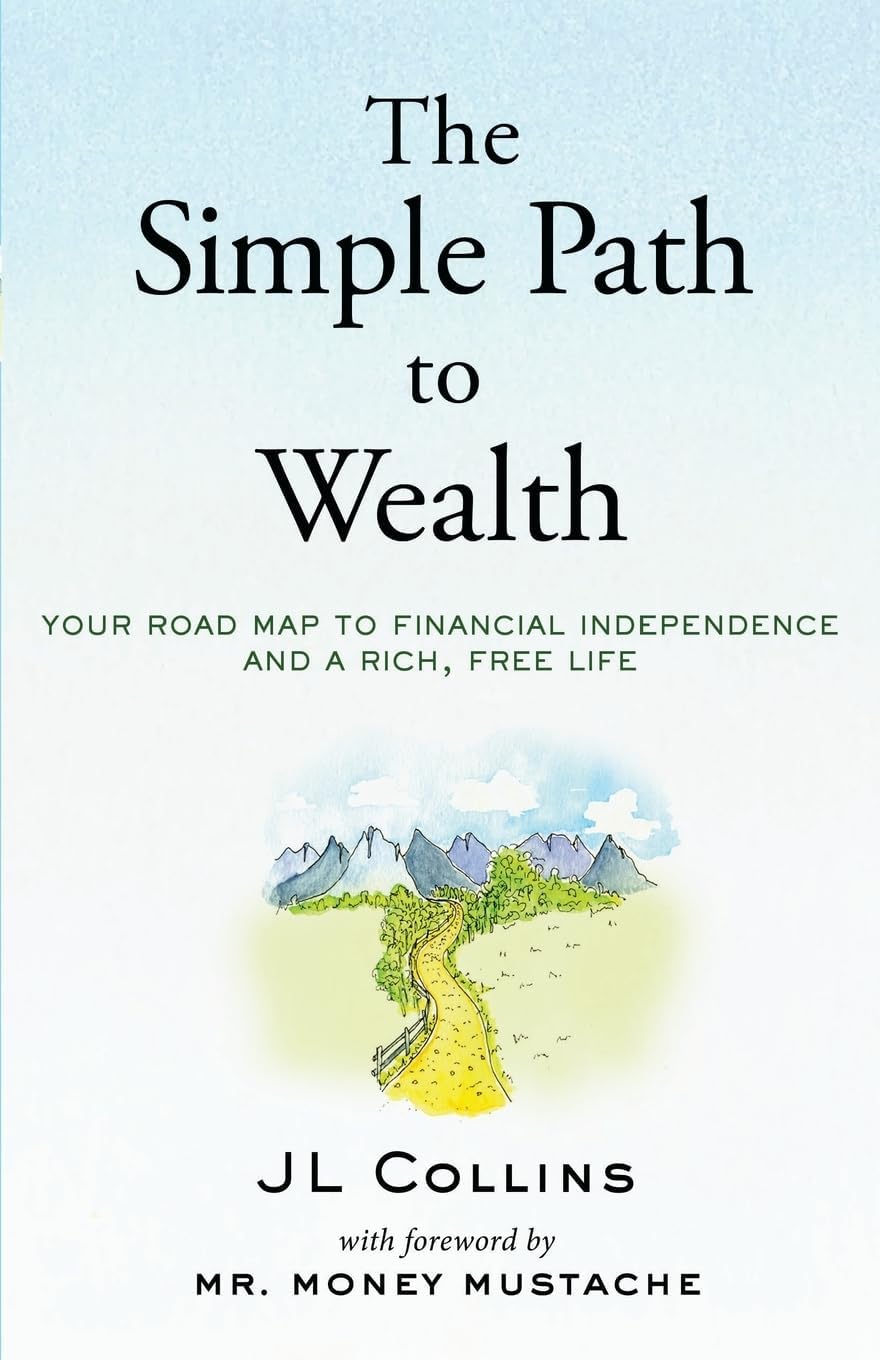
The Simple Path to Wealth is a comprehensive guide designed to empower readers with the knowledge and strategies needed to achieve financial independence. It offers a clear roadmap to wealth-building, focusing on proven investment techniques and practical advice for managing finances effectively.
| Best Sellers Rank | #14,965 in Books ( See Top 100 in Books ) #2 in Introduction to Investing |
| Customer Reviews | 4.7 out of 5 stars 16,340 Reviews |
J**D
Hands down, the best Personal Finance book
Review: The Simple Path to Wealth by JL Collins JL Collins’ The Simple Path to Wealth is an invaluable guide for anyone looking to take control of their finances, build long-term wealth, and ultimately achieve financial independence. Written in a refreshingly straightforward and no-nonsense style, Collins distills complex financial concepts into practical, actionable advice that readers can easily grasp, regardless of their experience with investing or personal finance. The core message of the book is simple yet powerful: live below your means, invest in broad-based index funds (specifically, Vanguard's Total Stock Market Index Fund), and let time and compounding do the heavy lifting. Collins is a strong advocate for what he terms "F-You Money," a concept that focuses on building wealth not just for the sake of luxury, but for the financial freedom to live life on your own terms. One of the book's greatest strengths is its clarity. Collins takes the intimidation out of investing by avoiding unnecessary jargon and presenting his advice in a conversational tone. For instance, he compares investing to owning "your own little business" in the stock market, where you focus on the big picture rather than getting caught up in day-to-day fluctuations. He advocates for simplicity—passive investing in low-cost index funds—and emphasizes the importance of keeping investment fees low to maximize long-term returns. In addition to his investment philosophy, Collins also addresses key financial principles such as avoiding debt, building an emergency fund, and understanding the power of financial independence. His advice is deeply rooted in personal experience, and he shares his own journey with readers in a way that feels relatable and inspiring. Though some seasoned investors might find the content familiar, the book's appeal lies in its accessibility. Collins strips away the complexity often associated with investing, making it clear that wealth-building doesn't require fancy strategies or insider knowledge—just consistency, patience, and discipline. However, one potential drawback is that the book’s investment strategy focuses heavily on the U.S. market, which may feel limiting to international readers. Collins acknowledges this but stays true to his message of simplicity, which some may see as a strength rather than a flaw. In conclusion, The Simple Path to Wealth is an excellent resource for both beginner and intermediate investors. It's especially suited for those looking to develop a solid, long-term financial plan without getting bogged down by the technical details that often overwhelm novice investors. Collins’ simple, effective, and time-tested approach makes this book a must-read for anyone serious about achieving financial independence and living life on their terms.
S**S
I detailed why I awarded the author five stars.
I liked the author’s podcast interview by the respected, data-driven and the whimsical Mad Fientist. I bought this book for two important reasons: it was self-published and the author’s persistent reference to Jack Bogle’s genius. I support self-published financial authors because the traditional publishers deploy editors to tweak the author’s voice, and original story, to make the final “processed” book more sellable. Instead, self-published authors do not have to satisfy shareholders or generate sales, so the author’s message about Bogle’s investment philosophy and the company he founded, Vanguard, remains organic for the readers’ best interest. This book is perfect for beginners, and some seasoned investors who are sick and tired of searching for that short-term investment miracle. Collins stuck with Bogle’s purest message from the beginning to the last word. As a Bogle devotee myself, I appreciate his courage to stand up, write a terrific book and argue effectively for the powerful and low-cost indexing strategy and against the delusional appeal of day-traders, hedge fund managers, active management strategies, timers, or individuals who claim they can successfully speculate and win big. Far too many normal investors get caught up in those phony, but exciting fantasies and lose. The new guy or gal investor gets the skills to construct a simple portfolio you understand, and then have the courage and the confidence to permanently ignore the media’s seductive financial noise machine. The Simple Path to Wealth's basic message to beginners is well-known in the Do It Yourself (DIY) and ESPECIALLY for the Youthful Financial Independence (aka FI and FIRE Financial Independence Retire Early) community. • think long-term • live below your means • plan ahead with a fully diversified portfolio (except international stocks, more on this below) • invest in Vanguards low-cost index funds Sooooo, what is not to like? I’ll admit it’s a boring plan, and not all DIYers embrace it. But I love my boring plan and it’s exactly where the power of what we can do lies—after setting up our plan, we must be patient. Collins writes much about psychology, for good reason. The power lies with us. It's not us versus the big intimidating stock market. With time and experience, we learn to be psychologically tough for long periods of time. In the movie Wizard of OZ, Glenda told Dorothy that she “always had the power to go home again?” It's the same for us investors. All of the features of constructing a balanced plan remains under our control. It fairly easy to learn. But the hard part is the unfair and counterintuitive psychology. Thinking long-term is the best antidote. Over time the growth will pay enough of a return to meet or beat the inflation rate. Meeting or beating inflation is a simple, realistic goal, and psychologically attractive. This book shows you how to like saving with minimal time and effort to discover the investing process. Patience, psychology, and philosophy are a difficult sell. Many investing aficionados are more interested in the adrenaline rush and chasing the opposite sex than building wealth over time. The market is not something to conquer or control. It is simply made up of wonderful organizations of hardworking people, called publicly traded corporations. The author explains how to harness all of that positive corporate energy, and just flow with it, whether it goes up or down, and over time it goes up. The author addressed the tough sell challenge with elegance and subtle toughness. The author discusses investment costs, taxes, tax-deferred retirement plans offered by employers, the retirement years and strategies to keep from running out of money. My favorite chapters are “Why I don’t like Investment Advisers” and “Some final thoughts about risk.” Financial advisers are an easy target with hundreds of reasons not to like. Most of us DIYers will never need a financial adviser, for two good reasons: Collins writes “Nobody cares about your money more than you do,” and “you can learn to manage your money yourself with far less cost and better results.” From my personal experience, knowing how to save investment costs alone was enough to pay cash for the Tesla Model S. On the subject of risk, my favorite part, and I quote as the author was speaking to the zombie apocalyptics among us especially the financial media: “Major Armageddon extinction events, like the asteroid that took out the dinosaurs some 65 million years ago, have happened about five times. So that’s about one every 10 million years or so. Are we really arrogant enough to think it’s going to happen in the geological eye-blink we’ll be around? That we’ll be the ones to witness it? Not likely.” Economic Armageddon ain’t going to happen either. There are a few minor omissions. The author is not well known, so he needs to talk more about himself about what he did. I felt like he had more to say as examples of his fears of risk and the mistakes he made. All of that would have made the book even more authentic and organic. What was the role of his wife? What exactly did the author and his wife do for a living? He did report that he worked as a financial analyst. So, was he in the financial industry? He did not explain why he had an overly aggressive portfolio for an individual in his 60s. He did not share his diversification plan, except that he doesn’t own international stocks (he explains why). Consequently, I give him an A for telling us how to set up a portfolio and his rationale, but I give him a B for not showing what exactly he did and for how long. His rationale is spot on, but portfolio construction and asset allocation strategies and information can be found in many books (The Boglehead Guide to Investors, any book written by Jack Bogle or his followers, Ferri, Swedroe, Roth, and Bernstein). • Some other minor items that I found perplexing and discouraging for people starting out. On page 246, he writes, “Save and invest at least 50% of your income.” What? I reread this twice, and could not comprehend why the author wrote this. In my working career, I could not even contribute the maximum allowed in my 403(b) plan let alone save 50% of my income (No, I never had new car payments because I could not afford car payments and invest too). Yet, I reached financial independence at age 61. 50% of one’s income is overreaching and dangerously discouraging (unless you are a highly elite and talented employee with a 7 figure income). For the rest of us, just start with what you can afford. For example, I started at age 37 with $200 a month in my 403(b), and that was a lot out of my meager income. But I kept it up for 24 more years. • Back to his strategy about avoiding international stocks. The author knows he will get pushback, and he probably has heard my argument for international investing many times. Mr. Collins is just following Bogle's advice about keeping it simple. But one can have it both simple and fully diversified worldwide by one fund. Diversification means investing in all available stocks, worldwide. So, let’s take advantage of these opportunities to invest in just one fund, the Vanguard Total World Stock ETF (VT). The author won’t have it. IMO, the author might be reflecting his age and the Familiarity/home bias that is so frequent with the silent generation. The author writes investing in the United States domestic market is enough diversification because of the worn-out 21st-century global connections argument. He offers what appears at first glance valid reasons, but they are out-of-date, and one about excessive costs is flatly wrong. Vanguard's Global fund charges .14%. I don’t know about you, but the opportunity to invest in all publically traded companies on the planet is inexpensive! Also, I am 74 years old and old enough to remember my elders saying that is too risky to invest in foreign stocks. We are well into the 21st century and the world has changed. Don’t you think that international corporations want to grow and prosper too? Of course. Don’t you think opportunities for diversification have evolved for the better? Yes. I want as much diversification as possible to reduce equity risk, and reduce volatility. I might even get higher returns, but that’s not part of my expectations. The global index funds or ETFs make full diversification in just one investment a synch. • Another minor objection is his downplaying the Roth IRA. I think he over-complicated with trying to predict the tax rate to decide to use or not use the Roth IRA. It’s futile and a waste of time to guess the future. Not having to pay capital gains taxes after investing in the Roth IRA is one of the best strategies for us regular investors (You can run the numbers on a brilliant Excel program created by The Finance Buff). After running the numbers on the Excel program, you will be thoroughly convinced to include the Roth IRA in your plan. • One last objection. I recommend to readers who don’t have a “lump sum” that is, a bundle of money to invest already, that you ignore the “Why I don’t like dollar-cost averaging” chapter. I had to use DCA during my entire working career investing in my 403(b). Because I started from NOTHING and had less than $50,000 for years. If you have a lump sum to invest, follow the author’s advice. But I think I can speak for most investors who have little choice but to use DCA. His opinion about DCA was more discouraging than encouraging. Collin’s strong opinions about some of his investment ideas represent more of his individuality than sound investment practice. Of course, the author never intended to be discouraging. I am just responding as a reader with a few of my opinions about his outstanding work. That’s perfectly fine for him as his opinions worked for him and they might work for you too. My opinions worked well for me. In the final analyses, he follows the “Boglehead” way. For that, I am delighted he wrote a great self-published book showing once again the work of the legendary investor, advocate, and teacher, Jack Bogle. Outside of these minor differences of opinion, Mr. Collins earned a well-deserved five stars. In sum, if any author self-publishes a book about investing, I think it is important to readers to know that the message is organic—no other agenda item hangs in secret, other than to explain and layout a simple plan which will connect with new investors and get them results.
A**R
If you are working and do not want to work for ever, you need to read this book
I highly recommend this book. I was first introduced to JL Collins through his blog ([...]). Through his blog, the letter to his daughter, the legendary Stock Series, and his opinion about shelter ownership are major contributions to the FIRE and personal finance knowledge base. His mantra of - live below your means, invest the remaining and avoiding debt - is refreshingly simple and powerful. It is amazing how much life is better when you are in control of your finances. Having F-you money enabled me to quit a stressful job and take some time (>1 yr) to focus on me and my goals (though I did know it had a name then). Being financially solid enabled me to pursue a more meaningful career, and work and live overseas though at a significant pay cut. His insight into the power of money, the fact it can buy personal freedom, is profound. Profound is not an understatement, because it totally changes how you see money and time, which changes your relationship to your employer, things, and folks who sell things and services. I have found this revelation as very empowering. Once you have figured out how you really want to spend your time, then you can begin eliminating the waste and focusing on just that. Happiness soon follows. I really like how he leads the reader to investing in the stock market. He uses common language to explain what investing is and why it is a powerful way to build wealth. Then he introduces the terms (i.e. 401k), after having a solid understanding. I think it is effective. This is opposite how most other personal finance preachers construct their presentations. His ability to explain in common language how to think about and use the Stock Market is amazing and so helpful. As others have said the emotional side of investing is addressed well. I personally follow his lead and recommendations for living off ~50% of income, investing the difference in low cost index funds (VTSAX) with Vanguard, and avoiding debt. I did not just take his word for it, I did my own research and many others support and practice the same tenets. I look forward to applying his recommendations on withdrawing and living off the accrued wealth. This book is great for those who want to get their personal finances in order, who want to have their money work for them and begin or be better at investing in the stock market, or to streamline your investments. To prevent the “I wish someone would have told me this 10, 20, or 40 years ago.” problem, it makes a great gift for high school graduates, college graduates, newly married, and those early in their careers. Yes, even those who have a large student (and / or consumer) debt can become masters of their financial matters and reach financial independence at a relatively young age. I have shared my copy with several others and purchased additional copies as gifts.
M**N
Good simple path
It's a good book, but mostly targeted for US residents. But simple investment strategy anyone can follow it, no matter where one lives.
E**A
Life Changing Book! Best $20 I've spent!
Its 3:46am on a Sunday morning and I've finally finished the book! And wow, it was truly life changing Before this, I knew investing was a thing and tried to learn previously but whatever I searched felt like a boatload of information that got more and more complicated the more I searched which made me overwhelmed not knowing how or where to start but THEN I found this book through James Clear's recommendation on a Newsletter. The fact that I read this in the first place kinda makes me emotional. As a mexican girl who grew up embedded in deep poverty, I have always had a wish to build my own wealth and do different from what Ive been shown my whole life in the handling of problems, priorities and money. I was the first out of two older siblings and parents to get my highschool diploma and that to me was completely mindblowing(Took me 5 years instead of 4 but I did it!) That brings me back to this book, academically my record has not been the best but in my later years of highschool I realized I was the only getting in my own way and that I could achieve the results I wanted(Went from straight F's freshman year which caused me to repeat to High Honol Roll my senior year). Although I didn't go to college(but plan to) and still struggle due to the lack of support and understanding I never had in my youth. As a 22 year old reflecting on life who has struggled with debilitating social anxiety and depression for 19 years of my life, Im trying to develop myself and start brick by brick. Maybe I am behind compared to others, but in my own story I'm just on time. I've never been much of a reader, am currently trying to be, but this book finally gave me that push to start my investing journey and allowed me to understand the basics. I've always been a good saver since I was younger but now I do realize saving will only get me so far. The book is easy to understand although very long for someone who doesn't read(took me 5 months, I know pretty slow but I'm trying here :[) and I'm so glad that I did! I actually invested in VTI which is basically the equivalent of VTSAX but as the ETF version mentioned in this book. I have a 20 year horizon and hope to be financially free by the time I'm in my early 40's. I only get paid 18k a year as a in home caregiver(hours are inconsistent) compared to what I used to as a Dunkin' manager(31k) but I feel a lot happier and I think just like I'm developing my interests and everything else in life, I'll also be able to build my foundation financially in life and find a career I love. Given my past and where I come from, I know this is highly difficult but I hope that the more I learn and grow I can share with those around me and those in need who did not have the same opportunities as me(although it's been hard I'm grateful for what I do have). I'm very grateful to authors who share this information and have a passion for writing because with this book alone, it's helped me take that first step towards investing seeing that a different life for me is possible. Thank you.
H**A
So good it got me started on my FI journey
As a near 40-year-old, this book came later I my life than I would have liked, but I’m so grateful it was recommended to me by a dear friend and colleague. I have considered myself financially responsible for years, but never realized the impact that investing simply in the stock market could really be until reading this book. I appreciate that the author brings levity to the field of personal finance, but provides clear, concise direction on how to attain financial independence (at any age). The information is realistic, highly actionable, and just-thorough-enough to explain some of the “why’s” of investing without making the topic dry and boring. For these reasons I highly recommend this book for any person interested in getting started with investing and thank JL Collins for writing this excellent book to share with the world.
L**E
This is the book you give your kid or your grandkid or your niece or nephew.
I read a lot of books - financial books, real estate books, stock books, life books, etc. Most I think are just OK. Infrequently do they give me what I am looking for. Only rarely would I say that a book gives you meat and potatoes. Substance. Real concrete direction. I just finished - The Simple Path to Wealth and I enjoyed it. You can read it in 2 days. The short version of this book is a simple life philosophy which we all know (but not everyone does) - spend less than you make, save and invest excess money, and try not to do dumb things. Ultimately his advice is to buy the Vanguard total market fund (VTSAX) and a Vanguard bond fund (VBTLX) in a 75/25 percent split and let it rip tater chip. Statistically you'd be wealthy 96% of the time. Average returns of 12% over the life of the fund. If you are older 60+ and retired you would not get a lot out of this book, but I think it is excellently written for a young person. It provides a clear and concrete path to wealth. It provides reason and direction in a simple format to guide a newbie like a grandchild, or niece/nephew. It is NOT a complex discussion on P/E ratios, Expense Ratios, or technical analysis. It is a simple straight forward guide on how to map out your wealth building future using the stock market and conservative life choices. To quote the Mandalorian, "This is the way". Consider getting it, reading it, and then passing it on to some young pup.
R**A
Great sound advice
After 30years of dealing with money managers. This gave me the extra confidence to take control and manage my own wealth. Clearly I am the only one who has my better interest in heart, mind and practice. Thank you
D**A
Financial Wisdom in the Simplest Form
This is one of the most practical and eye-opening personal finance books I’ve read. The author explains complex topics like investing, saving, and financial independence in a clear and straightforward way that’s easy to understand, whether you’re just starting out or already managing your money. What I liked most is the conversational tone — it really feels like a wise uncle sharing real-life advice without using complicated jargon. The core message of investing in low-cost index funds, avoiding debt, and thinking long-term may sound simple, but it’s backed by solid logic and real experience. Knowing that the author wrote this book for his daughter makes it even more meaningful, and I’d definitely give the same kind of advice to my own as well. A great read that I completely devoured in a week!
P**P
5/5
5/5
S**.
Easy to understand
Enjoying the reading! The author is able to explain concepts in a very simple way, making it easier to digest the complexity of this topic.
L**E
Do you have F-you Money?
The premise of this book is investing is simple. JL Collins states in the opening chapter: “Complex investments exist only to profit those who create and sell them.” The author argues index based investments with low fees perform better over time. His method involves elimination of debt, high savings state of 50% of income in investments and the importance of what he calls ‘F-You’ money. Collins advocates for financial freedom when it comes to money, rather than traditional thoughts about retirement. “Houses are an expensive indulgence, not an investment” –JL Collins Debt has become normalized. It is not an acceptable part of life in any form. Mortgage debt is still debt: “seek the least house to meet your needs rather than the most house you can technically afford”. Student loans have to be paid back (even if bankruptcy is declared). Collins suggests listing all debts by interest rates (paying highest first), eliminating all spending that is not essential. Throughout the book there is a strong emphasis on not paying fees to money managers. People can have very high incomes and still not have any money. The key to ‘F-You’ money is being able to save money, invest it and live within one’s means. It sounds simple because it is simple. The author argues that index investments, such as Vanguard Total Stock Market Index Fund (VTSAX) beat the market compared to other fund management for long term investing. Stock market index funds, bond index fund and cash are the three simple elements of a portfolio that can be rebalanced once a year to meet the investor’s needs. Expect average returns over the long term and do not pay anyone to manage your money. According to the principles outlined in the The Simple Path to Wealth, Financial Freedom is when someone can live off of 4% of investments. The amount is highly variable based on the standard of living of the individual. Those who can learn to live frugally can reach this stage much earlier.
T**A
Otimo livro!
Gosto muito do jeito que o autor discorre sobre finanças para a organização da nossa vida, com conselhos simples e um discurso fácil. As situações que ele narra mostram como podemos começar pequeno (e cedo) para garantir a certeza de uma vida bem vivida.
Trustpilot
2 weeks ago
1 month ago