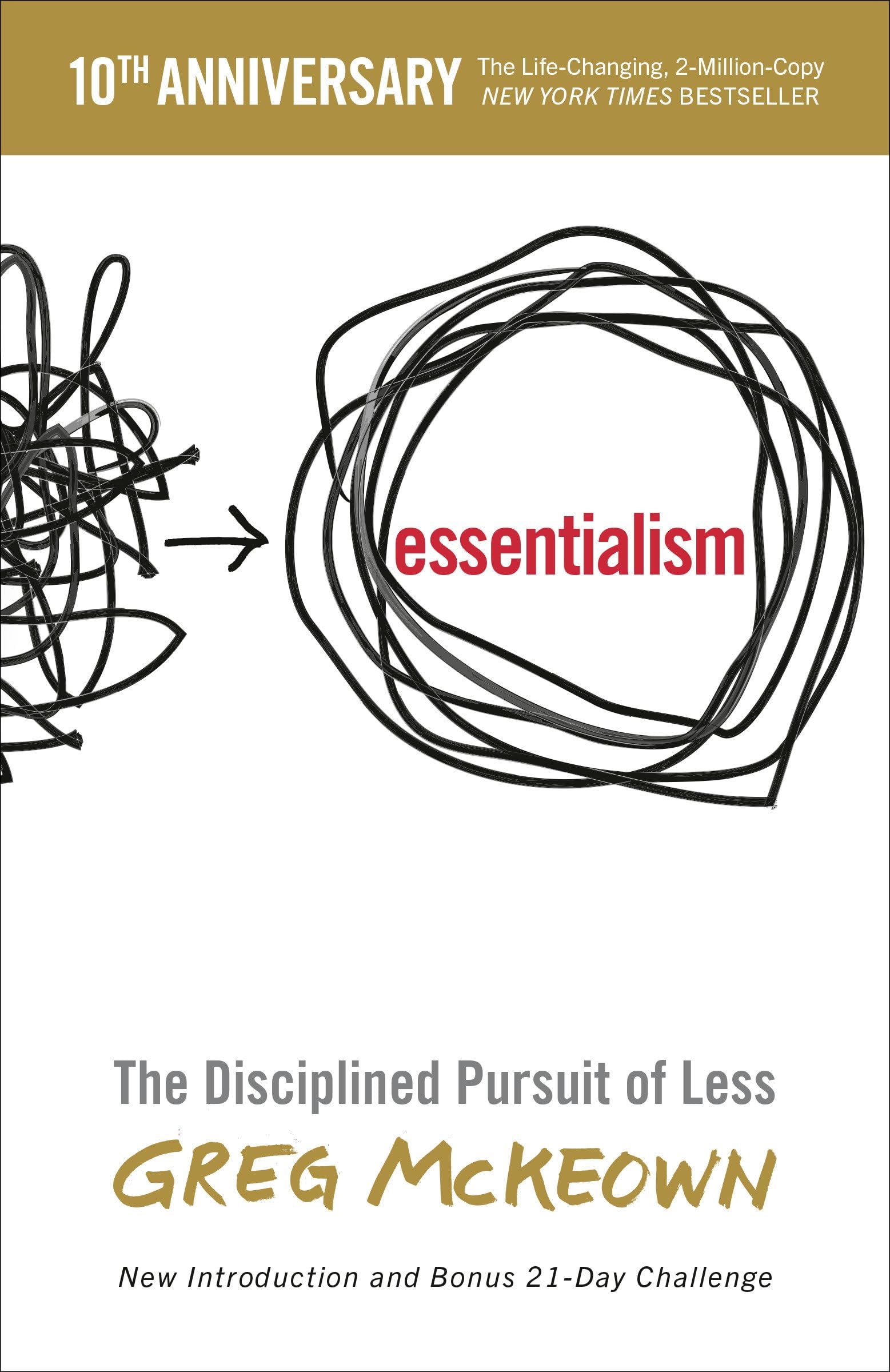
Essentialism: The Disciplined Pursuit of Less
Product ID: 291048020
Desertcart purchases this item on your behalf and handles shipping, customs, and support to South Africa.
THE LIFE-CHANGING NEW YORK TIMES BESTSELLER • MORE THAN TWO MILLION COPIES SOLD • Now in a 10th anniversary edition featuring a new introduction and bonus 21-day challenge. “Essentialism holds the keys to solving one of the great puzzles of life: How can we do less but accomplish more?”—Adam Grant, bestselling author of Think Again Essentialism isn’t about getting more done in less time. It’s about getting only the right things done. Have you ever found yourself stretched too thin? Are you often busy but not productive? Do you feel like your time is constantly being hijacked? If you answered yes to any of these, the way out is the Way of the Essentialist . Essentialism is more than a time-management technique. It is a systematic discipline for discerning what is absolutely essential, then eliminating everything that is not, so we can make the highest possible contribution toward the things that really matter. By forcing us to apply more selective criteria for where to spend our precious time and energy, the disciplined pursuit of less empowers us to reclaim control of our own choices, instead of giving others the implicit permission to choose for us. Essentialism is not one more thing to do. It’s a whole new way of doing less, but better, in every area of our lives. Join the millions of people who have used Essentialism to change their outlook on the world. Review: Very Good - I really enjoyed how the author wrote the book. I was able to obtain several quotes to apply to my life and work. It is an easy but important read for anyone wanting a change of life. Review: Great read - Very easy to read book. With clear ideas and single purpose. I enjoyed every single chapter and was enlightened by its ideas.


| Best Sellers Rank | #2,795 in Books ( See Top 100 in Books ) #3 in Time Management (Books) #11 in Decision-Making & Problem Solving #11 in Business Decision Making |
| Customer Reviews | 4.6 out of 5 stars 21,170 Reviews |
C**A
Very Good
I really enjoyed how the author wrote the book. I was able to obtain several quotes to apply to my life and work. It is an easy but important read for anyone wanting a change of life.
A**R
Great read
Very easy to read book. With clear ideas and single purpose. I enjoyed every single chapter and was enlightened by its ideas.
T**R
What's Essential? What's Nonessential? Who Decides?
Essentialism: The Disciplined Pursuit of Less by Greg McKeown offers encouragement and guidance to approach life from a direction that focuses on what is essential instead of trying to do/be everything. I had been looking forward to reading this book so much I almost started it when it arrived even though I was reading 4 or 5 other books at the time... Yes, I needed a lesson in essentialism. McKeown writes in an easy to understand format and presents some ideas that are quite relatable, yet I couldn't help but feel like this book is written from a place of privilege and therefore isn't as universal as it seems. When McKeown offers the example of a CEO whose doctor suggested he take a year off to address his health issues, I guffawed. Seriously? Who can actually do that? I can't even imagine a doctor making that suggestion. This is only one example of the privilege bleeding off the pages in the anecdotes he shares to make his points. I kept wondering who picks up the slack for the person who decides something isn't essential but that thing still has to get done. Maybe this is because that's my experience in life. I have often been the one left to clean up the messes of people who have decided something isn't important enough for them to do even though it has to get done. The idea presented in the book seemed to be that if it isn't essential to your goals, it isn't essential, but that's just not always reality. What's essential to one person might not be to another, and what isn't essential to one person might be absolutely essential to another. Granted he also often talks about the benefits of determining what's essential to a team's goal(s) in a job setting. Essentialism also offered some insights into the pitfalls of looking busy, feeling busy, and creating busy-ness because of an inability to focus on what is essential. He presents the idea of questioning doing things that don't contribute to one's overall goals in life in way that makes it feel like common sense. As a general concept, I like the idea of essentialism and I even like this book for the most part, but I think much of it is more aspirational than realistic. So, to be honest, my reaction to Essentialism is really mixed. I really wanted to love Essentialism, but I didn't quite make it there. I definitely didn't hate it either. I like Essentialism enough that I would recommend it but with the caveat that it doesn't apply to everyone equally. All that said, I am excited about applying some of concepts to scheduling my work and my life, and I recognize that my ability to do that means I have a certain amount of privilege in my life that some people don't have.
V**I
The way of the essentialist is the relentless pursuit of less but better. It is about constantly to ask “Am I ...
In a world where multi tasking is adored, this book gives a different perspective on how to de-clutter and simplify our lives. The wisdom of life consists in the elimination of the non-essentials. The way of the essentialist is the relentless pursuit of less but better. It is about constantly to ask “Am I investing in the right activities?” There are far more activities, opportunities in the world than we have time and resources to invest in. The way of the Essentialist involves learning to tell the difference – learning to filter through all the options and selection only those that are truly essential. Essentialism is not about how to get more things done, but it is about how to get the right things done. It is about making the wisest possible investment of our time and energy in order to operate at your highest point of contribution by doing only what is essential. Essentialist – Core mind-set of an Essentialist An Essentialist has to be operate with a different mind-set. The core mind-set of essentialist are: Individual Choice – We can choose how to spend our energy and time. Without choice there is no point in talking about trade-offs. The ability to choose cannot be taken away or even given away – it can only be forgotten. Prevalence of Noise – Almost everything is noise and a very few things are exceptionally valuable. This is the justification for taking time to figure out what is most important. A non-Essentialist things almost everything is essential. An Essentialist thinks almost everything is non-essential. Reality of trade-offs – We can’t have it all or do it all. If we could, there would be no reason to evaluate or eliminate the options. The way of essentialist is the path to being in control of your choices. In todays world of competing priorities the mindset is that “You can have it all”. The Essentialist approach would be: Explore and Evaluate – Will the activity that I am investing make the highest possible contribution toward my goal? Exploring meant the ability to discern the vital few from the trivial many. Evaluate what really matters. ESCAPE – The Perks of being unavailable LOOK – See what really matters PLAY – Embrace the wisdom of your inner child SLEEP – Protect the Asset SELECT – The Power of Extreme Criteria Eliminate – It is simply not enough to determine which activities and efforts don’t make the highest possible contribution; you would have to actively eliminate those that do not. How can we cut out the trivial many ? CLARIFY – One Decision that makes a Thousand DARE – Power of a Graceful “No” UNCOMMIT – Win Big by Cutting Your Losses EDIT – The Invisible Art LIMIT – The freedom of setting boundaries Execute – Once you have figured out the activities and efforts to keep, we need a system to make the executing as effortless as possible. How can we make doing the vital few things almost effortless? BUFFER – The unfair advantage SUBTRACT – Bring forth more by removing obstacles PROGRESS – Power of Small Wins FLOW – Genius of Routine FOCUS – What’s important now ? BE – The Essentialist Life The most important message from this book is – “If you don’t prioritize your life, someone else will.” The disciplined pursuit of less each and every time you are faced with a decision about whether to say yes or whether to politely decline. It is a method for making the tough trade-off between lots of good things and a few really great things. Essentialism is about learning how to do less but better so you can achieve the highest possible return on every precious moment of your life. This book will show you how to live a life true to yourself, not the life others expect from you, by disciplined pursuit of less to every area of your life. Summary: In summary the disciplined pursuit of less can change your life for the better in the following ways: More Clarity – Life will become less about efficiently crossing off what was on your to-do list or rushing through everything on your schedule and more about changing what you put on there in the first place. More Control – Gain in confidence in your ability to pause, push back and not rush in. Remember that if you do not prioritize your life, someone else will. But if you are determined to prioritize your own life you can. The power is within you. More Joy in the Journey – With the focus on what is truly important right now comes the ability to live life more fully, in the moment. The life of an Essentialist is a life of meaning. It is a life that really matters. The life of an Essentialist is a life lived without regret. If you have correctly identified what really matters, if you invest time and energy in it, then it is difficult to regret the choices you make. You become proud of the life you have chosen to live. If there is one think you take away from the book, whatever decision or challenge or crossroads you face in your life, simply ask yourself, “What is Essential?” Eliminate everything else.
T**S
A Fantastic Read
Life is complicated. Life is full of responsibilities and opportunities, planned duties and serendipitous possibilities. There is so much we could do, but so little we can do. Many of us battle our whole lives to focus on those few, significant items that we should do must do, and yet so few of us ever feel like we are even nearly succeeding. Help is here in the form of Greg McKeown’s book Essentialism. While it is not a perfect book, and while it benefits tremendously from adding a good dose of Christian thinking, it is one of the most helpful I’ve read on that constant battle to focus my time and energy on the right things. McKeown believes in what he calls Essentialism and describes the basic value proposition in this way: “only once you give yourself permission to stop trying to do it all, to stop saying yes to everyone, can you make your highest contribution towards the things that really matter.” The Essentialist pursues fewer but better opportunities and is rigidly disciplined in rejecting the many to devote himself to the few. It is “not about how to get more things done; it’s about how to get the right things done.” The way of the Essentialist means living by design, not by default. Instead of making choices reactively, the Essentialist deliberately distinguishes the vital few from the trivial many, eliminates the nonessentials, and then removes obstacles so the essential things have clear, smooth passage. In other words, Essentialism is a disciplined, systematic approach for determining where our highest point of contribution lies, then making execution of those things almost effortless. Now that sounds good! That sounds like what we all want—a clear design to our lives that simplifies decision-making and amplifies each of the opportunities we pursue. McKeown leads the reader to Essentialism in four parts: Essence. He begins by looking to the essence of Essentialism and the realities that make Essentialism a necessary but difficult practice today. Explore. Here he describes the way an Essentialist needs to think so he can pursue the highest possible contribution toward the best goals. Eliminate. Having determined the best goals, the Essentialist now needs to begin eliminating anything that will compete with the pursuit of those goals. “It’s not enough to simply determine which activities and efforts don’t make the highest possible contribution; you still have to actively eliminate those that do not.” Execute. And then comes the heart of it all—living in such a way that you now execute on those few goals, and continuing to follow the discipline of it. McKeown promises his book “will teach you a method for being more efficient, productive, and effective in both personal and professional realms. It will teach you a systematic way to discern what is important, eliminate what is not, and make doing the essential as effortless as possible. In short, it will teach you how to apply the disciplined pursuit of less to every area of your life.” And I think it can do that. It is chock-full of excellent insights and quoteable phrases. It is the kind of book you can use to implement systems in your life, or the kind of book you can plunder for its big and important ideas. Yet the Christian reader will want to read it with some discernment. This is a book that benefits from an infusion of the biblical ethos. As the book reaches its end, McKeown expands Essentialism to all of life and here he stops quoting business gurus and begins quoting religious gurus; the last chapter is easily the weakest and one that can be skipped without any great loss. Reading the book through a Christian lens improves it significantly. McKeown writes about people who always say “yes” and are afraid to say “no.” That sounds like a classic diagnosis of fear of man, a person so motivated by the praise of man that he takes on too much and says no to too little so he can win the praise of other people. Not only that, but God has a way of diverting us from what we believe are our most important tasks. He diverts us to tasks he determines are even more important, and a too-rigid adherence to Essentialism may keep a Christian from allowing and embracing those divine interruptions. Read the gospels and the book of Acts and you will see how Jesus and the Apostles were extremely focused, but also very willing to depart from their plans. Implementing Essentialism too rigidly may just lead to a self-centered life rather than a life of service to others. Reading through that Christian lens also allows us to see that Essentialism can be a means through which we honor and glorify God. It propels us to consider where God has specially gifted and equipped us to serve him and his people. Again, “Essentialism is not about how to get more things done; it’s about how to get the right things done. It doesn’t mean just doing less for the sake of less either. It is about making the wisest possible investment of your time and energy in order to operate at our highest point of contribution by doing only what is essential.” The principles of Essentialism, read and applied through the Bible, will help us understand how we are uniquely created and burdened by God to meet specific needs. And, equally helpfully, it will steer us away from those areas where we cannot contribute nearly as well. I heartily recommend the book, provided you read with Essentialism in one hand, and the Bible in the other. Let me close with a few of my favorite quotes: In many cases we can learn to make one-time decisions that make a thousand future decisions so we don’t exhaust ourselves asking the same questions again and again. If you don’t prioritize your life, someone else will. We can either make our choices deliberately or allow other people’s agendas to control our lives. There are three deeply entrenched assumptions we must conquer to live the way of the Essentialist: “I have to,” “It’s all important,” and “I can do both.” If … people are too busy to think, then they’re too busy, period. Making our criteria both selective and explicit affords us a systematic tool for discerning what is essential and filtering out the things that are not. Motivation and cooperation deteriorate when there is a lack of purpose. Half of the troubles of this life can be traced to saying yes too quickly and not saying no soon enough. “We need to learn the slow ‘yes’ and the quick ‘no.’ ”
G**D
Focus on Essentials!
I rate this book a 5-star not so much because every aspect of the book rates a 5-star, but because the core message of the book speaks into exactly where I am at the current time. I committed 2017 to a focus on essentials. Therefore, this book is of great value to me personally. When I came across this book while browsing through a book store, thumbed through it, and read a few paragraphs here and there, I knew I had to have this book and wanted to read it very soon. So, I did what every able-bodied person would do in this day and age, I went home and ordered it on Amazon, and with my Prime account I had it in two days. (That gave me an opportunity to finish the book I was in the midst of reading) Here are some key highlights for me personally: 1. The concept on page 16 of the word :priority" historically being singular as in a priority is priceless and is "this-is-the one-idea-that-is-worth-the-price-of-the-book." It is not about priorities, but a priority. The big idea. Get it? I did, but to be sure that was a sound idea I researched it on the Internet from various perspectives to see what others are saying about it, and I an confident that this is true and not a projection of something that might be true. I am using that concept now in my work and ministry. 2. "The way of the Essentialist is the relentless pursuit of less but better." This is on page 5. It coincides with the long tradition of saying that excellence in leadership is not about doing many things right, but doing the right things. (It is like that current commercial that says, "It is not how fast you mow, but how well you mow fast.") 3. The reference to Stephen Covey's saying on page 134 that he popularized many years ago--"The main thing is to keep the main thing the main thing."--fits well from an Essentialist perspective. My son who is in sales just attended a seminar this past Friday that focused on this concept and how to use it to balance his life and not overload himself with non-essentials. I suppose that three is enough. You need to pick the book up for yourself. Parts of the mid to late chapters dragged a bit for me during my first reading of the book, but when I went back and ready the things I had underlined, I realized there was more helpful insights in these chapters than I had first give the book and its author credit for. I recommend the book without hesitation.
E**.
Meh
I bought this book after it was recommended by Steve Harvey. The book and I found no good way to connect. It seemed flat to me.
S**R
Essentialism
Essentialism is a book in the Malcolm Gladwell tradition of exploring behavioral themes that, on the face of it, seem kind of obvious. The thesis here is that you should strip down your obligations to the bare minimum and thus achieve a more productive and rewarding lifestyle. In other words, prioritize tasks so you spend your precious time on only the most important things. A lot of this theme revolves around saying "no". The way you pare down the tasks on your to-do list is by declining to do things requested by others. Doing so would seemingly make you the villain in your personal and professional dealings, but the thinking is people will gain respect for you in the long run because you do tasks well precisely because you were selective about which tasks you take on. The problem is the examples in the book are all in situations where you're fielding requests from colleagues and potential clients. The obvious failing of this strategy is when dealing with your boss. I don't know about you, but I don't have the luxury of telling my boss "Sorry, but I decline to do that task you've requested of me". The key to paring down your tasks is to prioritize them. In other words to focus your efforts on the things that are truly most important. Consequently a fair amount of the book deals with value judgement and thinking hard about your priorities. The chapters take the form of examining various aspects of the essentialism lifestyle, covering the techniques and advantages of doing so. A frequent motif is a Goofus and Gallant-style table of how an essentialist behaves and how a non-essentialist behaves. Like Gladwell's books, there's a struggle here to stretch what would be a good magazine article into book length. That means padding it out by including a lot of tangential topics that are only slightly related to essentialism. The chapter about getting a good night's sleep is ok, but it's hard to see what that has to do with the rest of the book. Almost all the material in the book could be considered common sense, but there is some value to re-examining even the most basic common sense ideas in a new light, if only to reinforce concepts that you already adhere to.
M**E
Loved it.
Nice quality. Really excited to read this book. Thanks to Amazon for quick delivery.
J**T
Useful advice for our hectic times
Our world seems to be moving faster and faster. We are bombarded by endless information and rapidly multiplying demands on our time and attention. Many people struggle to cope with their bottomless to-do lists and their ever-expanding to-read piles. As a consequence, many people feel scattered or even burned out. In “Essentialism”, Grey McKeown provides an antidote by arguing that we should focus on the essential. Thereby, we can concentrate our efforts on the things that truly matter and ignore all of the noise. He goes into practical advice and illustrates the approach of the essentialist to many of life’s quandaries. The book is highly readable because of the many case examples that will resonate with many readers. The chapters are also kept short and to the point. That makes it easy to absorb the main message. However, I thought that book boiled down to a few central points that can be summarised in a page or two. However, this might be because I read quite a few books on similar topics and was, therefore, familiar with the content of some of the chapters. For instance, Deep Work by Cal Newport and Make Time by Jake Knapp and John Zeratsky cover similar ground. Altogether, I think the book is an excellent choice for anyone who feels on the edge of burn-out and wants to take some time to reflect on a better approach to work and life.
S**N
Akıcı
Akıcı, bir kitap ve faydalı buldum.
A**R
An Essential
Don’t sleep on this book. Each chapter is so meaningful and hits all the author’s points succinctly. I’ve found myself slowing down the read for fear of finishing it too fast
B**O
Insightful book! Must-read!
Really loved this book. Got lots of insights! I can keep rereading it.
Trustpilot
3 weeks ago
3 weeks ago