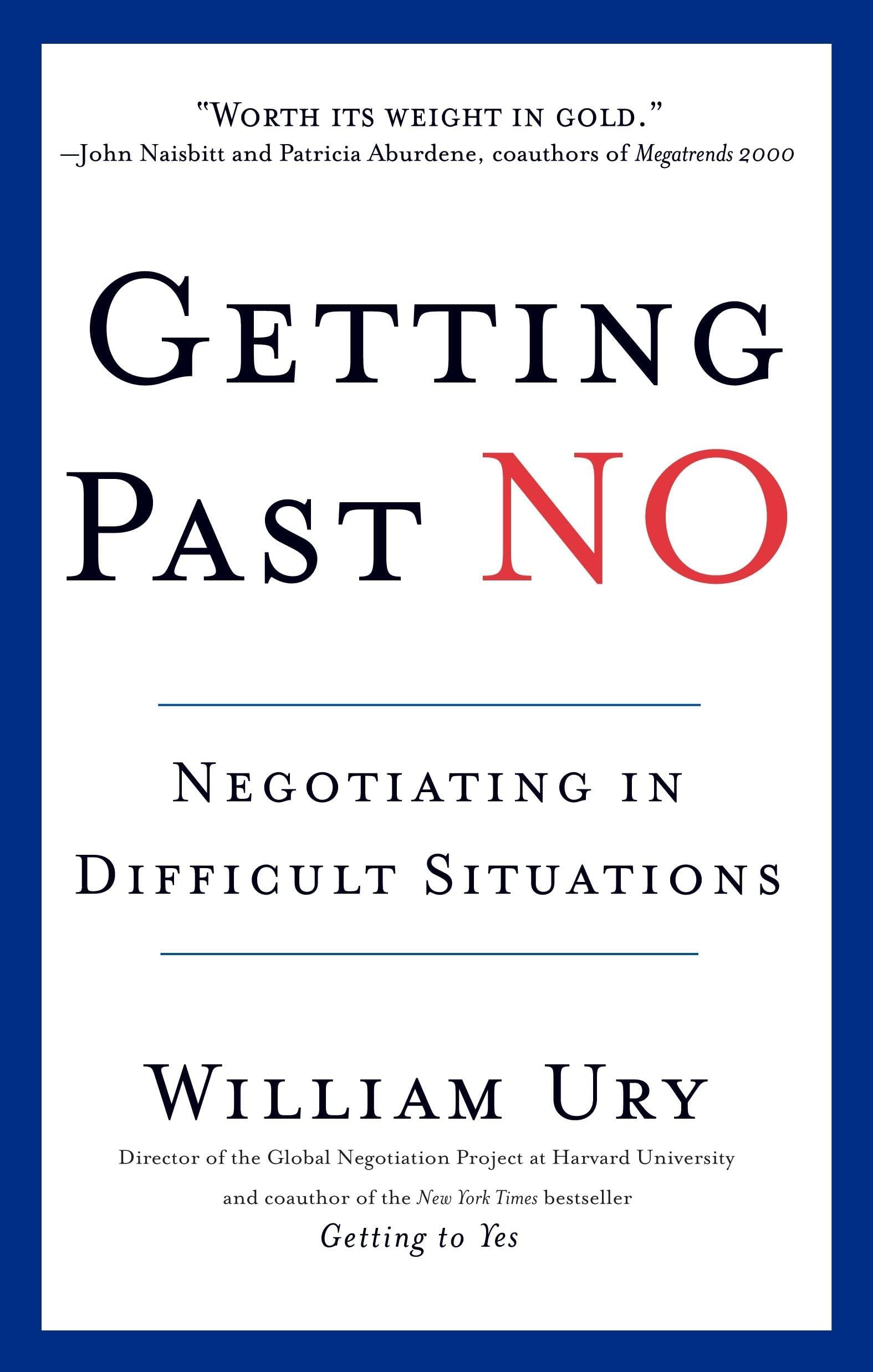
Getting Past No: Negotiating in Difficult Situations
Product ID: 2862782
🏆Award-winning breakthrough strategy
📅Revised edition since 1993
📘208 pages of expert negotiation wisdom
Desertcart purchases this item on your behalf and handles shipping, customs, and support to South Africa.
🤝 Turn tough talks into your biggest wins!
Getting Past No by William Ury is a revised, award-winning paperback that delivers a five-step breakthrough negotiation strategy. With 208 pages of expert guidance from a Harvard negotiation authority, this book equips professionals to handle difficult people and situations, defuse conflict, and secure mutually beneficial agreements. A must-have for managers and leaders aiming to master high-stakes negotiations.

| Best Sellers Rank | #20,690 in Books ( See Top 100 in Books ) #22 in Business Negotiating (Books) #245 in Business Motivation & Self-Improvement (Books) #250 in Motivational Management & Leadership |
| Customer Reviews | 4.6 out of 5 stars 1,145 Reviews |
J**N
Impasse Blockbusting
In his superb book, William Ury builds on the pricipals first put forth in his first book with Roger Fisher, "Getting To Yes." In "Getting Past No" Ury discusses the nuances and niceties of negotiating using a joint problem solving approach which is "interest based" rather than being "rights based" or "power based." Ury explains that the challenge is to convert a confrontational situation to a cooperative creative problem solving process, that integrates the parties in a negotiation into a cooperative mode, that results in the best long term agreements. The specific wonder of this book, is its focus on what to do, when you don't know how to get past a problem. Ury calls his method the "Breakthrough Strategy" and is virtually totally as applicable for mediators as it is for negotiators. In fact, several times, Ury mentions that a mediator may assist the process. Simply put, Ury contends that there are basically 5 things that one needs to do to preserve smooth negotiations and to break through an impasse if it occurs. He calls these 'steps' by the following designations: "Go To The Balcony", "Step To Their Side", "Reframe", "Build Them A Golden Bridge" and "Use Power To Educate." These simple concepts are extremely useful tools for negotiators and mediators alike. There is no disappointment in this book. The approach and the writing style are just superb. Once again, the Harvard Group, especially William Ury, have produced a book that anyone can gain from and is almost a must for those in dispute resolution and negotiation on a day to day basis.
V**R
Difficult but rewarding
I found this a surprisingly difficult book to read. I don't mean it's badly written, quite the opposite, or that it's too technical. In fact, it's full of practical advice, it's very well organized, and it's immediately useful. However Ury's advice also goes against our gut feeling. The author outlines five steps to negotiating in a difficult situation to break through an impasse. 1. Go to the balcony. 2. Step to the other side. 3. Reframe. 4. Build a golden bridge. 5. Use power to educate. These five headings summarize themes for each main section. Stepping to the other side means putting yourself in the other person's place in order to see from their point of view how they could accept a solution. Reframing means restating the issues in a way that makes agreement easier. Building a golden bridge means, among other things, offering concessions that cost you little but gives the other side a lot. It also means pointing out to the other party the advantages to them of reaching an agreement. Using power to educate means, as a last resort, to use your own best alternative to a negotiated agreement (your BATNA) to point the cost of failing to agree. But before all that, when negotiations get difficult, one should go to the balcony. This means taking a break and not reacting in anger. When confronted or insulted in the midst of talks, it's quite natural to react in anger. Ury quotes Ambrose Bierce: "Speak when you are angry and you will make the best speech you will ever regret." In other words reacting feels good but doesn't get you what you want. Every page gives similar principles and illustrates them with pertinent examples; so much so that I couldn't read through this book quickly as I had to stop and think all the time. And that's why I found the book a difficult read. A little humbling and very useful. Vincent Poirier, Tokyo
B**E
Nice addition to "Getting to Yes"
Getting past no by William Ury is a nice addition to the basic concepts which were laid out in "Getting to yes". Basically, the content of both books is very similar, Getting to Yes provides the basis and Getting past No provides concrete advise for negotiating and elaborates on the things discussed in Getting to Yes. That said, Getting Past No can be read independently from Getting to Yes. The book describes five steps of "Break Through Negotiation". These steps are hard since they often reflect doing the opposite of what your natural reaction might be in the particular situation. These five steps are: - Don't react. Don't react when being attacked, but step back. - Don't argue. Instead try to agree with them and understand their position. - Don't reject. Don't reject their position, instead try to reframe their position to understand their underlying interests. - Don't push your ideas or proposal. Try to work together with them to make a proposal together which is best for both interests. - Don't escalate. When the above fails, don't escalate the situation and instead think about your alternative and try to describe the situation as it just happened. The book is very readable and has lots of good and useful examples. It's thin and easy to read in a relative short time. It doesn't contain THAT much information though, for more negotiation techniques check their "Getting to Yes". Recommended to read after Getting to Yes.
S**P
Worth it's Weight in Gold
This book doesn't claim to be a book on LISTENING, and yet it subtly explains and beautifully uses the key elements of listening. This book doesn't claim to be a book on DIALOGUE, and yet it deftly explains and elegantly uses the key elements of dialogue. This book doesn't claim to be a book on APPRECIATIVE INQUIRY, and yet it reviews the basics and explains and uses the key elements of appreciative inquiry. This book doesn't claim to be a book on ASSERTIVE COMMUNICATIONS, and yet it identifies and uses the key elements of assertive communications. This book doesn't claim to be a book on SYSTEMS THINKING, however, it uses examples to explain and effectively uses the key elements of systems thinking. This book doesn't claim to be a book on MENTAL MODELS, and yet it explains the pitfalls of not understanding mental models. This book DOES claim to be a book on NEGOTIATION, and is clearly the best of the best. The book beautifully shows how one can effectively use all of the above skills during everyday communications AND negotiations All the examples are crystal clear and convincing. Read it, refer to it often and profit from it.
K**K
Excellent Negotiation Book
Having just read Getting to Yes, I thoroughly enjoyed reading this complementary book. Whether involved in low- or high-stakes negotiations, you will benefit from this book. Even simple things become clearer. For example, you learn how to move your counterpart from negotiating positions to interests. A position is a statement with support. An interest has supporting reasons that can be discussed. For example, a store might say that it does not accept returns beyond fourteen days. That’s a position. As a customer whose hasn’t even opened the packaging, you may question why it would be a problem to return the item if the price and availability remain the same as when you bought the item. The store’s interest is in not having outdated or used merchandise returned that cannot be readily resold. If you can reason with the store to view its position rather than its position, then there is room for negotiation. Even though this example is trivial, this position versus interest discussion happens in much larger and complex negotiations. I highly recommend this book, especially if you have recently read Getting to Yes.
R**D
Best of Breed
I have read extensively on negotiation, including everything written by folks affiliated with the Harvard Negotiation Project. I think that _Getting Past No_ is the best of all the books. Its conciseness is deceptive. The concepts expressed are profound. For example, I cannot count the number of clients to whom I have explained the concept of BATNA (best alternative to a negotiated agreement, i.e. what you do if the negotiations fail) before we head into a session of mediation or other negotiation. I have reread this book several times at widely spaced intervals and have found it better than I remembered each time. I think this particular book is also much more helpful to those who participate in negotiations that are less structured than labor or arms negotiations that are highly choreographed than was _Getting to Yes_, which at times seemed to assume that all players in the negotiation would be using the same text.
M**N
UNMATCHED - This book will change your life
Do you remember the last time you put to use anything you read? How many books are interesting but not useful, or useful but not interesting, or useful and interesting but too complicated or impractical. This book suffers from none of those dysfunctions, but is wholly interesting, wholly practical and wholly usable. If you are in the fortunate position of having the opportunity and motivation to put what the book teaches to use as you read it, you will undoubtly find that it dramatically increases your ability to 'let others have your way' and reduces the stress of negotiating (or selling, or whatever else you want to call trying to get, or give, something to or from someone else). The steps and principles are short and simple enough for even the shortest and least focused memory to remember and employ, and despite [sic] being based on research at the Harvard Negotiation Project, you will find them consistent with your past experience and immeasurably valuable for your future. Get this now and start getting past no.
C**S
Not so good condition
Good book to acquire and good information, but the quality was not as expected!
P**M
Okay one
Good high level negotiations strategies but just a couple of practical examples makes the book not so interesting.
G**I
Must read
Useful information presented in a clear form
A**A
Un très bon outil de travail!
Le bouquin est un succès auprès de mes proches aussi. Il est très complet avec des vraies clés de négociation.
H**K
Five Stars
Very Nice
C**E
Buen libro, buenos consejos para negociaciones reales
El libro cuenta con consejos y recomendaciones a tomar para negociaciones reales, donde la contraparte no está dispuesta a ceder o a negociar de buena fe.
Trustpilot
2 weeks ago
2 weeks ago