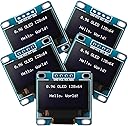



Frienda 5 Pieces 0.96 Inch OLED Module 12864 128x64 Driver IIC I2C Serial Self-Luminous Display Board Compatible with Arduino Raspberry PI (White)
Product ID: 274161201
⚡0.04W power
📏128x64 resolution
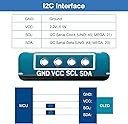
🔌I2C interface
Illuminate Your Ideas! 💡
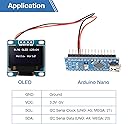
The Frienda 5 Pieces 0.96 Inch OLED Module is a compact, self-luminous display board with a resolution of 128x64, designed for compatibility with various microcontrollers including Arduino and Raspberry Pi. It features an I2C interface for easy connectivity and operates at low power consumption, making it ideal for innovative projects.
| ASIN | B08LYL7QFQ |
| Guaranteed software updates until | unknown |
| Manufacturer | Frienda |
| Manufacturer reference | Frienda-OLED Module-v-6414 |
| Package Dimensions | 10.31 x 6.5 x 1.7 cm; 18 g |
B**L
Clear display
All 5 displays operated correctly when driven by a Raspberry Pi Pico. Good clear display. no problems at all.
M**.
Very good items but may come as different colour than ordered.
Nice little handy displays, easy to use and setup. Used with a Arduino nano it is clear and functional. Only four stars overall because I ordered white ones and got blue ones instead and you don't know what you've got until you power them up which is then to late to send them back. I'll have to order again and hope they are white as I won't be using the blue ones.
P**S
Poor quality arrived damaged
Product arrived with several other products squashed into an envelope with very little protection - several of the soldered parts had fallen off and were loose within the packaging. Might have been ok if the packaging had been more robust.
S**Y
Damaged in transit...
These units were not individually wrapped so had one out of 5 with a couple of capacitors knocked off which when repaired worked fine.....so would recommend a tad more protection before shipping......:-)
A**R
The addresses are right, and people who say they are something else are also right
I keep seeing confusion about the addresses of I2C devices, so I'm going to try to clear things up. Some people report the addresses on the PCB are wrong and others report they work. Thing is - they're Both Right (sort of) I2C addresses are 7 bit, whereas "normal" numbers in a computer are multiples of 8 bits. So it comes down to how you align the 7 bits of I2C address in a byte - left edge or right edge (the other end being an implicit 0). Arguably either makes sense if you look at the I2C spec - "really" they should be right aligned, but the very next bit is the R/W bit, so it feels natural to roll the address and R/W into a single byte making it left aligned. The bit patterns for 3C/3D and 78/7A are identical, just aligned differently. And which number you need to type into your code depends on the convention used by the API you're using - both conventions are in use. 0111 100_ = 78 _011 1100 = 3C 0111 101_ = 7A _011 1101 = 3D HTH
A**R
Small white 128 by 64 OLED display for use with Arduino or other microcontrollers
Finally found one that works with the Adafruit library on Arduino. Standard I2C connection. Many others around that need a specialist library that is hard to identify. This one works every time.
Trustpilot
3 weeks ago
5 days ago