With the Old Breed: At Peleliu and Okinawa
Product ID: 273444902
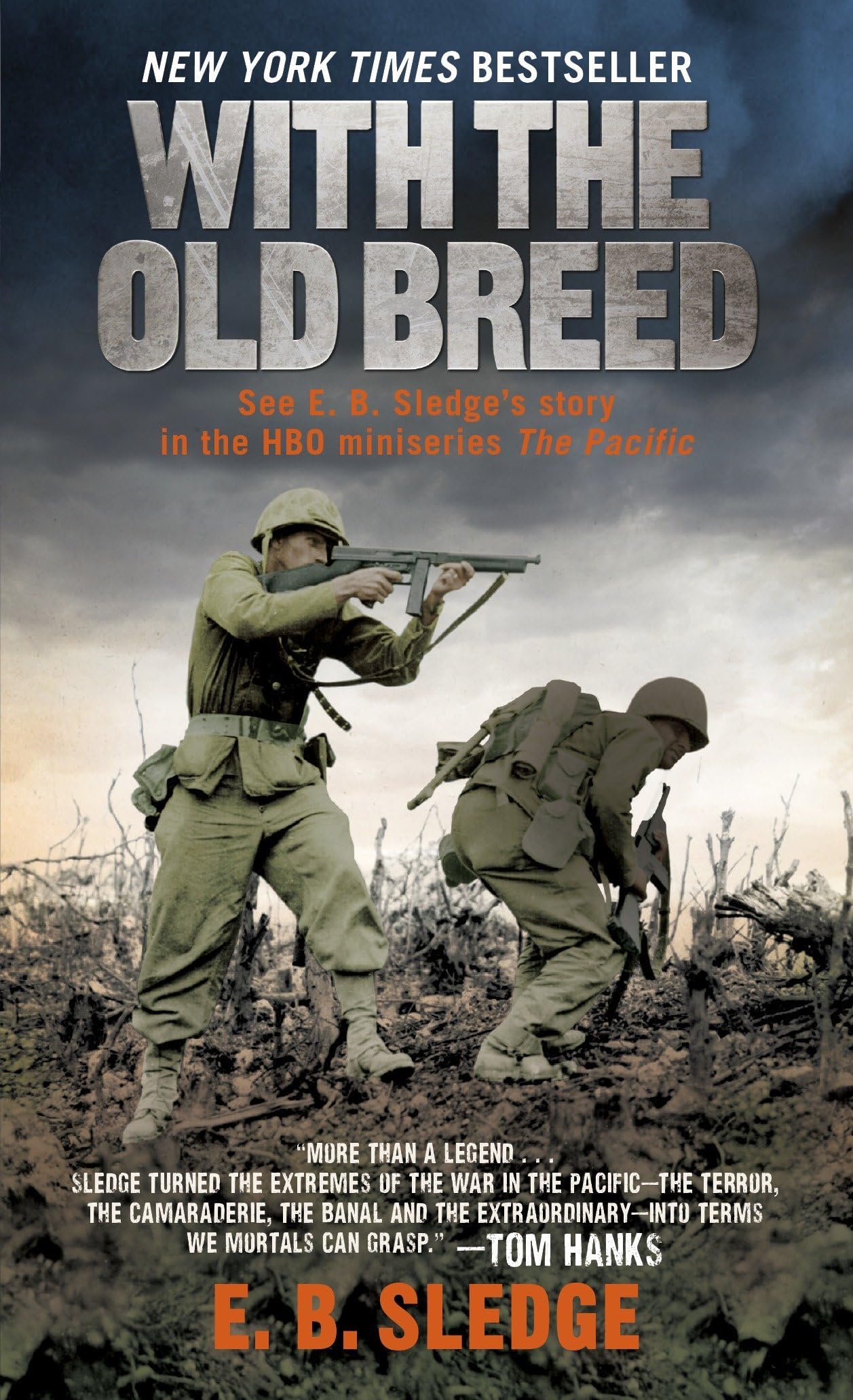
NEW YORK TIMES BESTSELLER - "Of all the books about the ground war in the Pacific, [this] is the closest to a masterpiece."-- The New York Review of Books "Eugene Sledge became more than a legend with his memoir, With the Old Breed . He became a chronicler, a historian, a storyteller who turns the extremes of the war in the Pacific--the terror, the camaraderie, the banal and the extraordinary--into terms we mortals can grasp."--Tom Hanks In The Wall Street Journal , Victor Davis Hanson named With the Old Breed one of the top five books on epic twentieth-century battles after its original publication in 1981. Studs Terkel interviewed the author for his definitive oral history, The Good War . Now E. B. Sledge's acclaimed first-person account of fighting at Peleliu and Okinawa returns to thrill, edify, and inspire a new generation. An Alabama boy steeped in American history and enamored of such heroes as George Washington and Daniel Boone, Eugene B. Sledge became part of the war's famous 1st Marine Division--3rd Battalion, 5th Marines. Even after intense training, he was shocked to be thrown into the battle of Peleliu, where "the world was a nightmare of flashes, explosions, and snapping bullets." By the time Sledge hit the hell of Okinawa, he was a combat vet, still filled with fear but no longer with panic. Based on notes Sledge secretly kept in a copy of the New Testament, With the Old Breed captures with utter simplicity and searing honesty the experience of a soldier in the fierce Pacific Theater. Here is what saved, threatened, and changed his life. Here, too, is the story of how he learned to hate and kill--and came to love--his fellow man. "In all the literature on the Second World War, there is not a more honest, realistic or moving memoir than Eugene Sledge's. This is the real deal, the real war: unvarnished, brutal, without a shred of sentimentality or false patriotism, a profound primer on what it actually was like to be in that war. It is a classic that will outlive all the armchair generals' safe accounts of--not the 'good war'--but the worst war ever."--Ken Burns
| Dimensions | 10.54 x 2.57 x 17.42 cm |
| Edition | Illustrated |
| Isbn 10 | 0891419195 |
| Isbn 13 | 978-0891419198 |
| Item Weight | 1.05 kg |
| Language | English |
| Print Length | 384 pages |
| Publication Date | 25 Sept. 2007 |
| Publisher | Presidio Press |
User
Eugene Sledge’s visceral recollections of the Pacific campaign
Eugene Sledge's book of his personal experiences as an enlisted man in the US Marine Corps during WW2 is one of the most honest, visceral accounts of close-up infantry combat ever written. Sledge’s style is not that of a practiced professional writer but is simple, straightforward and direct, and this endows the book with its unusual power.Sledge recounts his struggle to get accepted into the Marine Corps, as he felt a patriotic duty to fight for his country against the Japanese. Offered an officer’s commission, Sledge turned it down (twice) to be an enlisted man on the front line. The tough but thorough training in boot camp and then in southern California prior to being shipped overseas sets the scene. Then he recounts his part in two long campaigns to take the islands of Peleliu and Okinawa, the first in boiling tropical heat in late 1944 and the second in a sea of rain-drenched mud during May and June 1945.The fanatical Japanese resistance and the high toll the entrenched Japanese army exacted on the Marines relentlessly ground down the morale of Sledge and his dwindling number of buddies. Two aspects in particular stand out in memory: the terror of being helpless in an artillery barrage, and the continuous horror of being surrounded by the decaying corpses of Japanese soldiers which couldn’t be moved due to the danger of snipers, so they had to remain there while the Marines ate, slept and fought next to them. Sledge pulls no punches for the reader, yet retains his humanity throughout as he continues to perform his duties and obey orders.The narrative is spiced with acid comments about poor junior officers (as well as highly respected ones such as Ack Ack Haldane, killed on Peleliu) and contempt for “rear echelon types” who rarely get near the fighting but pester the front-line marines for Japanese weapons as trophies to take home, during the marines’ brief periods of rest in the rear areas.Sledge was one of a minority in his regiment who somehow, miraculously, survived these campaigns, and one of an even smaller minority who suffered no battlefield injuries despite being in constant danger. He kept his religious faith throughout - though does not dwell on this in the book - and used his New Testament to record his battlefield experiences and inner thoughts in the margins (combat troops were not supposed to keep diaries in case they were captured by the enemy and inadvertently revealed information useful to them). Remarkably, he didn’t write his book until 1980, 35 years after the events. We should be thankful he did, as it’s one of the true classics of the 20th century.‘The Old Breed’ BTW are those full-time professional Marines in the Corps prior to the influx of thousands of young volunteers and conscripts following the outbreak of WW2.
User
Into the Abyss
The decision of HBO to use `With the Old Breed' as one the key sources for their $ 200 million mini-series ` The Pacific' has brought Eugene Sledge's war memoirs has a whole new global readership. First published in 1981 but using notes taken at the time of the battles in 1944/5, this is an account of the author's recruitment and training in the US Marine Corps and his participation in two of World War Two's most brutal and horrific battles . The original working title of was `Into the Abyss' and nothing comes closer to describing the particular forms of hell that were the battles of Peleliu and Okinawa. Whilst the author refers to the wider strategic picture, that is only reference events and this remains a very personal account.Sledge doesn't shy away from describing in detail the horror of the battlefield with its rotting corpses, mangled body parts and human excrement. Too often in other literature comparisons with the First World War's trenches are drawn, yet on Okinawa the combination of multiple assaults against a well entrenched enemy and a rain saturated battlefield lead to a repeat of those conditions. It was only the lack of Japanese re-enforcements that ensured this campaign did not develop into the same stalemate.Despite all the horror around him and the killing he had to do, Sledge's own humanity, whilst tested, survives and shines through. There is no sense of blood lust for the death of the Japanese, even though their conduct is often appalling, and Sledge finds no glory in war even in the eventual US victory.The writing is one of the great strengths of this book. The author was well educated and after the war went on to become a Professor of biology. The narrative is always clear, events are easy to follow and there is the avoidance of poetic prose and unnecessarily over descriptive passages but still you are carried along by the events.I have no doubt that Spielberg, Hanks and HBO will try to do justice to this book and Sledge's story. However, they can never cover all the events and detail it contains. This is highly recommended for anyone interested in the frontline combat experience of war.
User
Gritty storytelling
You must first realise that Eugene Sledge is not a writer, well not in the true sense. He was an eye witness to some of the most brutal fighting in the Second World War. His story is anecdotal - it must have been hard for him to relive some of the scenes he witnessed, and to put them down on paper. Most veterans hardly mentioned their service, but Sledge puts you there - in basic training, landing at Peleliu, the horror of combat, the loss of friends and colleagues, and then onto the fight for Okinawa.I purchased this book to read alongside the TV series, The Pacific. I found that they had kept, as much as possible, to Sledge's storyline - I realise that they have to change certain parts for dramatic effect, but all things considered they have conveyed the turning of an 18 year old "boy" into a combat hardened, war weary soldier - exactly as in the book. For "Band of Brothers" the "book" was written by the war historian Stephen Ambrose, based on the interviews with the veterans - whereas, for "The Pacific", they have based it on the stories of three soldiers - two wrote books, and one is remembered from his military record and award citations.A good book - found it easy to read, once you get into some of the military language and the writers style.
User
One of the very best.....
“War is brutish, inglorious, and a terrible waste... The only redeeming factors were my comrades' incredible bravery and their devotion to each other. Marine Corps training taught us to kill efficiently and to try to survive. But it also taught us loyalty to each other - and love. That espirit de corps sustained us.” Eugene B. Sledge, With the Old Breed: At Peleliu and OkinawaA candidate officer flunks out of college to get into the action as an enlisted man, breaks regulations by keeping a secret journal and after the war gets a Phd and becomes a scientist. He goes on to write an incredible account of the horrors and savagery of island warfare in the Pacific that has no equal. Eugene "Sledgehammer" Sledge has left us a brutally honest and unvarnished account of personal combat and survival against all the odds in conflict where no quarter was given on both sides. Prisoners were seldom taken and men fought hand to hand day and night on baking coral rock, in swamps full of the rotting and decaying bodies of the casualties from both sides against an enemy that always fought to the death. “To the non-combatants and those on the periphery of action, the war meant only boredom or occasional excitement, but to those who entered the meat grinder itself the war was a netherworld of horror from which escape seemed less and less likely as casualties mounted and the fighting dragged on and on. Time had no meaning, life had no meaning. The fierce struggle for survival in the abyss of Peleliu had eroded the veneer of civilization and made savages of us all.” It is difficult to quantify the viciousness of the hatred felt by the men for the enemy or the idiocy of the generals and senior officers who threw the men of the 1st Marine Division into the grinder over and over again with little or no strategic purpose. Sledge writes with pithy insight that “As I looked at the stains on the coral, I recalled some of the eloquent phrases of politicians and newsmen about how "gallant" it is for a man to "shed his blood for his country," and "to give his life's blood as a sacrifice," and so on. The words seemed ridiculous. Only the flies benefited.”This heartrending memoir written from the foxhole is a stark and timely reminder to future generations that old men start wars and young men fight and die in them. “I am the harvest of man's stupidity. I am the fruit of the holocaust. I prayed like you to survive, but look at me now. It is over for us who are dead, but you must struggle, and will carry the memories all your life. People back home will wonder why you can't forget.”
User
Good read
this book didn't disappoint.
User
a sobering yet brilliant read
This book is a very simple honest look at the life of the US marine in the Pacific campaigns of Peliliu and Okinawa.#This books brilliant narrative is what impressed me the most. I found that the sheer honesty with which Sledge tells his story makes the entire reading expreince very real to the reader. One sees the true thought processes of the Marines as they fought a suicidal and highly tactical enemy, in what must be described as some of the worst campaigns of WW2. Little is known aboout the Pacific theatre of WW2, and it is only now thanks to HBo's The Pacific, that the history of it all is seeing a revival of sorts. This is absolutely necessary to do justice to the men who fought and died and indeed those who like Sledge survived a horrendous ordeal.The book to me tapped into another aspect through its honesty. It engaged in the psycology of warfare. It showed how in fighting a suicidal enemy who showed no respect for their foe, i.e. the US Marines, they then also lowered their moral standards top the point that they too became entirely desensitised to barbarity and cruelty to their enemy the Japanese soldier.This book is not just about the pacific in WW2, it is about the effects war can have on the human psyche and how thankful we should all be that those men gave all they had so that we can live as we do today.A true salute to the bravery of the men of the US Marine Corps. "Semper Fi" !!
User
An outstanding memoir of the Pacific theatre in WW2
There are many other great reviews of this excellent book already in place, but having finished it, I felt moved to write my own. I can only imagine how horrific it must be to serve on the frontline in any war. Some books convey that horror better than others. Guy Sajer's iconic account of WW2 German army life on the Russian front, The Forgotten Soldier, is without doubt one of the best. But this book can stand proudly, four square alongside it.The author, Eugene Sledge, kept illicit notes of his experiences on the islands of Pelelieu and Okinawa, and later used them to write this book. Written in an unassuming but compelling way, it lays out in horrifying detail the depravities of modern war, and the depths to which man can stoop when surrounded by utter carnage. Those with weak stomachs, stay away. I still have some of the images that I read about engraved in my mind's eye. Yet the book is not just about violence. It's also about the comradeship and love that the soldiers felt for each other, and the humour they used to help them survive.It's an incredible read. I heard about the book because of the HBO miniseries The Pacific. I'm currently reading another book, written by a contemporary of Sledge's, Robert Leckie. Helmet for my Pillow is another absorbing read, although it's written in an entirely different style. Like other reviewers, I've also wondered why there aren't more accounts of WW2 by British soldiers. I've read the brilliant The Railway Man by Eric Lomax, but not seen much else. Thanks to Amazon's lists, I've recently come across First Light, an account of the Battle of Britain, by a former fighter pilot. I aim to read it soon, and hope and expect that it will live up to the American books.Ben Kane, author of The Forgotten Legion.
User
"With the old breed" - The Pacific War and "hell's own cesspool."
E B (Gene) Sledge's memoir of his time in the Pacific War has been an incredibly rich source for for television history. Ken Burns drew extensively upon his account for his brilliant series "The War" particularly in Episode 9 "FUBAR" and his words are read and quoted. Now it extensively figures again in the what will be one of the great series of modern television, HBOs "The Pacific" a 10-part mini-series from the creators of "Band of Brothers" telling the intertwined stories of three Marines during America's battle with the Japanese in the Pacific during World War II. "Helmet for My Pillow" by Robert Leckie is the other key primary source and you may wish to read the reviews elsewhere of that excellent book. It is Sledge's memoir however that in my subjective opinion is the definitive account of this terrible conflict.Gene Sledge was no backseat General or causal observer, he gave up a graduation course leading to a commissioned officer's position to serve as a Private First Class in the Pacific Theater and saw combat at the raging infernos of Peleliu with its controversial airfield and Okinawa. He played others roles such as a stretcher bearer and constantly throughout his service, Sledge kept extensive "unauthorised notes" of what happened in his pocket sized New Testament. If you go over to the US Amazon site you will see that this book has nearly 300 reviews and Sledge is rightly compared to Robert Graves as a war author. This is no American hyperbole. Gene Sledge aside from his military feats is a great writer and remembrancer.This is by no means a "jolly romp" war memoir it is a brutal and often terrifyingly honest account of a soldiers experience and the deep fear and boredom that underpins this. Slegdes account of the first man he kills throws into sharp relief the the unimaginable dread of taking another life. His deep reflections and anxiety about whether he might turn out "yella" are brilliantly articulated. His sheer dismay at the "terror compounded" of being out in the open in an artillery barrage is almost heart rending and you wish he wasn't there. Indeed Joseph Conrad's immortal phrase "Oh the horror" in the Heart of Darkness could be subtitle for this book. Sledge in one sense also prefigures the some of the disillusionment that would be rampant in the later Vietnam War. He talks of the "awesome reality that we were training to be canon fodder", the word "expendable" is used and the sheer ruthlessness of the combat and treatment of soldiers is set out in raw detail. Sledge was deeply religious but combined his faith with sharp intellectual analysis of his own and his comrades precarious situation. "Something of me died at Peleliu" he states in capturing an island which was deemed by the military planners to be a four day "in and out" exercise that eventually took 2 months and thousands of lives. The Japanese were blasted and burned out of these Islands but in turn gave new meaning to the term "never give an inch". The battle rolled onto the mainland but not before the "two scorpions in a bottle" to use Sledge's term went from island to island slugging it out in increasingly brutal combat. Sledge ended up in the the apocalypse at Okinawa in a mortar section which went into battle singing "Little Brown Jug" at the top of their lungs.When you write a review of America's role in World War 11 some British reviewers get upset about the fact that our soldiers are often ignored or written out of history. The failure of British television in particular to undertake contemporary and exhaustive historical TV series of both World Wars and properly recognise the sheer effort/contribution of the British people is a travesty. The Thames production "World at War" is now nearly 40 years old and "The Great War" produced by the BBC in the early sixties. HBO should therefore be thanked alongside with recent American documentary makers for the important role they are playing. The same is true of Gene Sledge's brilliant book "With the old breed" since the messages it contains are timeless and universal, and we ignore them at our peril.
User
Un clásico de la guerra del Pacífico
Buen libro sobre las batallas que se libraron en el Pacífico en la II Guerra Mundial. A pesar de que se escribió décadas después de finalizar la guerra mantiene la frescura del soldado que acaba de llegar del frente y da una perfecta idea de lo duro que fué para los que formaron parte de aquellos enfrentamientos armados, tanto en el plano físico, como el psíquico y emocional. Es un must del género en lo que refiere al frente oriental de la segunda guerra mundial.
User
As expected
Excellent work
User
Wow - what a great book!
Wish I could find more books like this. I kept seeing references to this book, but it was not in our library system. Finally decided to bite the bullet and order it and hope for the best. All I can say is wow. It's a great book. It's a well written first person account of the complete war scene - boring, terrifying, smelly, loud, and true. Sledge is a excellent author here, and does not try to be bigger-than-life or an ultra-warrior. He documents what he sees, hears, and lives. He does all of this and I don't think he used a single cuss word in the entire book (but I could be wrong).
User
Diretto ed emozionante
Chiunque sia un appassionato di storia, in particolare della Seconda Guerra Mondiale, non può lasciarsi sfuggire questa testimonianza delle vicende e degli orrori del conflitto nel Pacifico. Per quanto esso sia scritto in inglese, la lettura risulta abbastanza scorrevole, coinvolgente e lo stile di Sledge è a dir poco fantastico: cercando di mantenere la lucidità mentre attorno a lui si scatena un inferno di morte e disperazione, l'autore ci permetterà di capire in maniera diretta, emozionante, cruda e analitica ciò che ha vissuto, passando dagli inizi incerti fino alla graduale trasformazione del suo carattere, delle sue abitudini e del suo rapporto con la guerra.Il prezzo di questo libro è davvero poco in confronto a ciò che lascia, senza dubbio la migliore testimonianza di un soldato (periodo WW2) mai scritta.
User
The book is much better than the mini-series from HBO.
Sledge's book is the best first- person account of the war in the Pacific, from a combat Marine's viewpoint, of any that I've read, & I've read quite a few. Though HBO's mini-series was based largely on Eugene Sledge's WW2 experience, it should have been portrayed closer to the book than it was, as many details he wrote about, HBO either changed or completely overlooked, especially in the mortar platoon on K/3/5's combat efficiency. Two in particular, where the squad took out some 50 Japs, & another, where their NCO disobeyed orders from a whacky lieutenant & continued on, killing some 200 Japs in the process. That Sgt. knew to keep killing the enemy ANYTIME they got the chance & were actually seen out in the open. And Gunny Haney DID NOT crack-up in the book, as portrayed in the mini-series. He retired after declaring Peleliu the roughest fight he'd ever experienced, and left because of his age. I've read the book twice now, & will probably tackle it again, now that I have the illustrated hardback edition, which was in like new condition & affordable. $20.00 used is a lot better than 200+ dollars for a first edition.
Trustpilot
4 days ago
2 weeks ago