๐ Light up your world with infinite colors and unstoppable style!
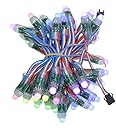
The ALITOVE WS2811 12mm Diffused Digital RGB LED Pixel Light set features 50 individually addressable LEDs with 24-bit color and 256 brightness levels, delivering 16.7 million colors. Its IP68 waterproof rating and durable materials ensure reliable outdoor and underwater performance. Designed for easy customization, the modular strips can be cut and connected with JST-SM connectors. Compatible with Arduino, Raspberry Pi, and various WS2811 controllers, this 5V LED pixel string is ideal for dynamic commercial and festive lighting projects.


| ASIN | B01AG923GI |
| Batteries Included? | No |
| Batteries Required? | No |
| Best Sellers Rank | #85,711 in Tools & Home Improvement ( See Top 100 in Tools & Home Improvement ) #896 in Outdoor String Lights |
| Brand | ALITOVE |
| Bulb Shape Size | B10 |
| Color | RGB (Red, Green, Blue) |
| Control Method | Touch |
| Controller Type | Button Control |
| Customer Reviews | 4.6 4.6 out of 5 stars (1,076) |
| Date First Available | January 11, 2016 |
| Included Components | 1x 50pcs WS2811 LED pixels light |
| Indoor/Outdoor Usage | Outdoor |
| Is Discontinued By Manufacturer | No |
| Item Length | 4 Meters |
| Item Weight | 0.32 ounces |
| Item model number | WS2811-5V |
| Light Color | Multicolor |
| Light Direction | Adjustable |
| Light Source Type | LED |
| Manufacturer | Shenzhen ALITOVE Electronic Technology Co., Ltd |
| Material | Plastic |
| Number of Items | 50 |
| Number of Light Sources | 50 |
| Occasion | Christmas |
| Part Number | LED PIXEL |
| Power Source | DC 5V |
| Seasons | Christmas |
| Special Feature | Color Changing , Dimmable , Waterproof |
| Special Features | Color Changing , Dimmable , Waterproof |
| Style | Modern |
| Theme | Outdoor Decorative Lighting |
| UPC | 678425399193 |
| Voltage | 5 Volts (DC) |
| Wattage | 15 watts |
P**E
Great lights so far. Sparse documentation.
This review is for the ALITOVE WS2811 12mm Diffused Digital RGB LED 50 LED set. I bought these with the idea that I'd use them for Christmas lights or just to play with. I plan to drive them with an Arduino or ESP8266 device. I decided to start figuring it out with an old Aduino Uno. I couldn't find a sample sketch or circuit from the vendor but there are plenty of examples on the internet. Google WS2811 and you'll get plenty of hits. This is a three wire setup and the wires are marked Red: +5V; White: DATA; Blue: GND on the amazon website and the LED's closest to the connector. I hate to admit that I tried every possible wrong combination of wiring before hitting on the right setup. The good news is that I didn't blow the lights up, which is a miracle and testament to the durability of the lights. Once working they are pretty spectacular. Instructions that worked for me: 1) Quadruple check your wiring. The key is to connect the data, power, and ground to the female plug. The female end ( I know some of you are confused by this ) is the end where you have to poke your hook up wire into the hole to make the connection. It doesn't make sense to me why I had to use the female connector but I got zero lights until I moved my connections this end. 2) There is information on the internet that says its a good idea to put a 470 ohm resistor inline on the data connection. I did this. 3) Give it plenty of power. I was not successful running this from the 5v Arduino pin or a 1/2 amp wall wart. I was successful using something that supplied 5v at 2 plus amps. ALITOVE sells a power supply that I wish I had bought at the same time. 4) There is information on the internet that says its a good idea to put a 1000 uf capacitor on the between the power and the LED's to smooth out the power. I did this. 5) Use the FastLED library in your Arduino IDE library. From menus choose sketch->Include Library->Library Manager then search for and install the FastLED library. I tried the Adafruit Neopixel library but have not able to get it to work to date. 6) From the Arduino IDE go to menus->File->Examples->FastLED-> and choose the FirstLight example. These sketches are well documented. You must change the define statement to match the data pin you are using and number of LED's to whatever is correct. Also check to see that the "FastLED.addLeds<WS2811, DATA_PIN, RGB>(leds, NUM_LEDS);" under setup in the sketch is uncommented. Some of the examples are set already and some are not. All other similar lines should be commented out. 7) Compile, upload and you should have flashing lights. There are other example sketches for the FastLED library, plus info on the web. I'm sure there are other or better circuits that could be designed, or ways to get the Adafruit library to work. I just wanted to post a review and outline what worked for me in hopes that someone will find it useful.
N**N
The colors Duke the colors!!
Love the color palette with this particular string. I use them to design signs and light boxes. Paired with a web controller it is an unbelievable product. Easy to set up if you understand the controller. And rated for outdoor so they can go anywhere you're above water. Works perfect and for the price point you can't go wrong.
T**S
Very Impressed I will be buying more in the future!
These LED's are Bright & Vivid. The construction quality of these LED strings are perfect, the housing of each LED is filled with a waterproof coating of some kind, likely silicone, and a semi soft shell on the outside giving you rigidity, The cables connecting each LED to one another is per the cable itself 20 A W G safe for up to about 11 Amps so it can carry quite a bit power for your projects. Each end has a open power input to re-inject voltage once you get the strings long enough to need this to keep the color consistent with really long runs.This product if you give it the proper power supply will bring your eyes to heaven. When I set all three colors to 255 brightness the soft white is brilliant and really closely matches sunlight through a soft white cloud.... tells me the color accuracy of each LED's (3) colors are being driven spot on. These run perfectly for me with the: Adafruit NeoPixel the RGB library; as the manufacturer says. 800 KHz works for the data pin, so your going to get better color fluidity than if you only had 400 KHz. NEO_RGB bit-stream instead of the pre programmed NEO_GRB in the Adafrut NeoPixel strand test library. I added: colorWipe(strip.Color(255, 255, 255), 50); // White RGB WARNING POWER HOG!!! MAKE SURE YOU HAVE THE AMPS! So I could test out the RGB pixels being turned on full to show its true colors... I was impressed to get a soft white diffused light that didn't lean too much into the blue or other spectrum.
D**B
These work great, waterproof. I've had many strings outside for couple years, year round, and no failures yet. But price varies a lot over the seasons, so get them on sale.
J**H
De helft is al kapot
M**A
Muito bom
C**O
Funzionale pratico ed economico
D**O
Pixel led fantastici, sono tre anni che illuminano una insegna e sono impeccabili, abbinati a un ottimo controller e un ottimo alimentatore vanno che รจ uno spettacolo.
Trustpilot
2 weeks ago
1 month ago