

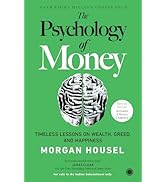
The Psychology of Money
Product ID: 229468385
⭐4.6/5 star rating
📈Top #5 bestseller rank
📚19 insightful stories
Desertcart purchases this item on your behalf and handles shipping, customs, and support to South Africa.
💡 Unlock the secret psychology behind money and master your financial future!
‘The Psychology of Money’ by Morgan Housel is a top-ranked bestseller offering 19 short, powerful stories that reveal how emotions, personal history, and behavior shape financial decisions. With a 4.6-star rating from over 80,000 readers, this book shifts the focus from math to mindset, providing timeless lessons on wealth, risk, and happiness for professionals seeking smarter money management.









| Country Of Origin | India |
| Dimensions | 14.2 x 0.9 x 21.7 cm |
| Generic Name | Paperback Book |
| Importer | Jaico Publishing House, JA-1, Jash Chambers, Off Sir Phirozshah Mehtra Road, Fort, Mumbai, Maharashtra 400023 Phone: 022 4030 6767 |
| Isbn 10 | 9390166268 |
| Isbn 13 | 978-9395970334 |
| Item Weight | 224 g |
| Language | English |
| Net Quantity | 1 Count |
| Packer | Jaico Publishing House, JA-1, Jash Chambers, Off Sir Phirozshah Mehtra Road, Fort, Mumbai, Maharashtra 400023 Phone: 022 4030 6767 |
| Print Length | 252 pages |
| Publication Date | 1 September 2020 |
| Publisher | Jaico Publishing House |
| Reading Age | Customer suggested age: 17 years and up |
User
A Paradigm Shift! "The Psychology of Money" is Essential Reading for Everyone!
I've always believed that managing money was about math and formulas – how much to save, where to invest, and optimizing returns. But "The Psychology of Money" by Morgan Housel completely shattered that notion and opened my eyes to a much more profound truth: financial success isn't primarily about what you know, but about how you behave.This book is an absolute revelation. Housel doesn't just present dry financial advice; he masterfully weaves together captivating stories and timeless principles to explain why our emotions, biases, and unique personal experiences play such a crucial role in our financial decisions. Each short chapter is a powerful lesson, making complex concepts incredibly accessible and engaging. You'll find yourself nodding in agreement, reflecting on your own past choices, and realizing how much of financial advice overlooks the messy, human element.What truly stands out is the book's emphasis on simplicity and common sense. It's not about getting rich quick, but about building sustainable wealth through patience, understanding risk, and defining "enough." Housel distills decades of financial wisdom into actionable insights that are relevant whether you're just starting your financial journey or are a seasoned investor. I particularly appreciated the focus on humility and the acknowledgment that luck and risk often play larger roles than we admit.This book has changed my perspective on money, investing, and even my own relationship with wealth. It's a powerful reminder that controlling your emotions and adopting a rational, long-term mindset are far more valuable than chasing the latest stock tip. If you're looking for a book that will not only improve your financial understanding but also profoundly impact your financial behavior for the better, then "The Psychology of Money" is an absolute must-read. It’s clean, insightful, and delivers on its promises. This is undoubtedly a 5-star product that has earned its permanent spot on my bookshelf and in my mind. Highly, highly recommended!
User
Must Read and Best Money Management Principles✨️
The concepts are written and illustrated in perfect manner to grasp the whole understanding about Money Management. Very precise and up-to-mark real world examples. I have never enjoyed any other Money Management/Financial Advice book as much as this. It gives the clear and real world picture about every monetary decisions which are been made around us in everyday life. Great Read!!
User
Must read once
Best seller book. having indepth money matter physiology.
User
Not a typical finance book
The Psychology of Money is not a typical finance book about formulas or stock tips; it is about how human behavior shapes financial decisions. Morgan Housel explains money through simple stories, showing how emotions, habits, and mindset matter more than intelligence or income.The book highlights that wealth is built through patience, discipline, and long-term thinking rather than quick profits. It teaches that risk, luck, and timing play a bigger role in success than most people admit. Each chapter is short, clear, and practical, making it easy for beginners and experienced readers alike.What makes this book powerful is its focus on real-life thinking patterns—fear, greed, and confidence—and how they affect saving and investing. Instead of telling you what to buy, it teaches you how to think.Overall Verdict:A thoughtful, easy-to-read book that changes how you see money. Perfect for anyone who wants financial wisdom, not just financial advice.
User
Must read
Good qualityAnd must read, really give us good insights abt money and things tht work with it
User
Amazing knowledge
It's very amazing
User
Nice read
What I liked most was live below the status you can actually afford, that will increase your savings rate and in turn independence
User
Very good book
This book is very good. It changed my thinking of how I thought about money. A must read book for anyone who wants to learn more about money.
User
Makes you rethink money in a very real way !
I bought The Psychology of Money expecting another finance book full of rules and strategies, but it turned out to be very different, well, in a good way. It’s not really about how much money you make or which stocks to buy, but about how we think and behave around money.What I liked most is how simple and relatable the examples are. Morgan Housel uses short stories that actually make you stop and think, especially about patience, risk, and how emotions play a much bigger role in money decisions than we like to admit. I found myself recognizing my own habits in a lot of the chapters.The book is easy to read, not technical at all, and you don’t need a finance background to get value from it. I’d read a chapter at a time and still feel like I learned something useful. Some ideas seem obvious at first, but the way they’re explained really makes them stick.If you’re looking for a book that helps you build a healthier mindset around money not just investing tips this one is definitely worth reading. I’m glad I picked it up.
User
Excellent book on money and our behaviour
The Psychology of Money is a fascinating book, although perhaps it's a bit late in the day for me to take advice around money, but what is fascinating is the authors way of looking at the world and how it's psychology more than anything else that helps us to keep money and make money and lose money. The book is peppered with fantastic stories and analogies of which I will list a few in the book that really made me think and really helped me understand the ways that we manage to deal with the money that we want to enquire. Some of the key points include the following:- The premise of this book is that doing well with money has a little to do with how smart you are and a lot to do with how we behave. And behaviours are hard to teach, even to smart people. Financial success is not a hard science but a soft skill where how your behaviours are more important than what you know. Engineers can determine the manner of how a bridge collapses because these will follow the law for physics, it’s not controversial. Finances are different as it’s guided by people’s behaviour. And as Voltaire once observed, “history never repeats itself; man always does.” This applies to behaviour with money also. And people who grew up in poverty think about risks and rewards in ways that the child from a wealthy banker or family no matter how much they tried. So, the challenges for us is it no amount of studying or openness can re-create the power of fear and uncertainty.- An interesting story is how the nephew of a Chinese worker wrote about her aunt who worked several years in what Americans called “sweatshops”. It was hard work with long hours and a “small” wage and “poor” working conditions. However, before her aunt had this work in a factory, she was a prostitute. Americans may feel that a sweatshop is exploitation but people who live in these countries feel that factory work labour could be better but it only when you compare it to American jobs. We tell ourselves stories about what we and others are doing and why they’re doing it, and that story helps shape our own unique experiences. Americans will spend more money on a lottery ticket than on movies, video games, music, sporting events and books combined. And the people who buy lottery tickets are mostly poor people. Money has been around for a long time and at the end of 2018 there were $27 trillion in US retirement accounts making it the main driver of the common investor savings and interest best in decisions. But retirement is very recent and at most two generations old. Before World War II most Americans worked until they died. And that was the expectation and reality. The labour force participation rate of men aged 65 and over with above 50% until the 1940s. Saving for retirement pots is a relatively recent invention. And even widespread use of consumer debt – mortgages, credit cards and car loans – did not take off until after the World War II, when the GI Bill made it easier for millions of Americans to borrow. Dogs were domesticated 10,000 years ago and still retain some behaviours of the wild ancestors. Yet here we are with between 20 and 50 years of experience in modern financial systems, hoping to be perfectly acclimatised. And for a topic that is so influenced by emotion rather than fact, this is a problem. And it helps explain why we don’t always do what we’re supposed to do with money.- There is a lot of luck and risk when it comes to dealing with money. And many people who are born into rich families will never view this has been lucky no matter how much they make, we always say that it is down to them. Donald Trump is a good example of this. We need to recognise that there is a role of luck in success, and the role of risk means we should forgive ourselves for understanding when judging failures. Nothing is as good or as bad as it seems.- I always find it fascinating that many people who can have thousands or millions in a bank account, always seem to seek more. It is almost like an addiction. They need to have more money than they can ever spend.- There are millions of ways to get wealthy and plenty of books on how to do this. But this book argues that the only way to stay wealthy is to have some combination of frugality and paranoia and it is a topic that we don’t discuss enough. It is not important just to make money but it’s also important to know how to keep it and to make it keep growing.- The thing I think most about having read this book with the author talking about the documentary “how to live forever” which asked an innocent question to a centenarian who offers an amazing response to the question “what was the happiest day of your life?” “Armistice day“ was her reply, referring to the 1918 agreement that ended World War I. The interviewer asks why? “Because we knew there would be no more wars ever again,” she says. World War II began 21 years later, killing 75 million people. There are many things in life that we think are true because we desperately want them to be true. And just because we feel something doesn’t make it real.- I really like some of the ideas about what has happened over the last 170 years regarding the US economy. Which includes some of the following:- 1.3 million Americans died while fighting nine major wars. Roughly 99.9% of all companies that were created went out of business. Four U.S. presidents were assassinated. 675,000 Americans died in a single year from a flu pandemic. Thirty separate natural disasters killed at least 400 Americans each. 33 recessions lasted a cumulative 48 years. And the number of forecasters who predicted any of those recessions rounds to zero.- The stock market fell more than 10% from a recent high at least 102 times. Stocks lost a third of their value at least 12 times. Annual inflation exceeded 7% in 20 separate years. The words “economic pessimism” appeared in newspapers at least 29,000 times, according to Google. However, it’s worth remembering the quote above from the woman who was asked what the happiest day of life was with the end of the First World War and who predicted that following that there would never be another war. How wrong she was.- Another insight is that more than the salary you earn or the size of your house or the prestige of your job, control over doing what you want, when you want to, with the people you want to, its these broad lifestyle variable that makes people happy.The United States are the richest nation in the history of the world, but there is little evidence that its citizens are, on average, happier today than they were in the 1950s when wagers were much lower. Even when this is adjusted for inflation. We buy bigger and better stuff, but we’ve simultaneously given up control over our time.- One of the best ideas for accumulating money is to save money, put your income or investments into savings.- 15 billion people were born in the 19th and 20th centuries. But imagine how different the global economy in the whole world would be if just seven of them never existed: Adolf Hitler, Joseph Stalin, mousy Dong, Gavrilo Princip, Thomas Edison, Bill Gates and Martin Luther King. Just 0.00000000004% of people responsible perhaps most of the world direction of the last century. Imagine the world without the great depression, World War II, the Manhattan project, vaccines, antibiotics, September 11 and the fall of the Soviet union. However, it’s important to realise the future might not look anything like the past is a special kind of skill that is not generally looked highly upon by the financial forecasting community. The lesson to learn from surprises is that the world is surprising.- The most important part of every plan is planning on your plan not going according to plan. You must factor uncertainty into everything. A good rule of thumb for a lot of things in life is that everything can break will eventually break. And the biggest single point of failure with money as a soul reliance on a pay check to short term spending needs, with no savings to create a gap between what you think your expenses are and what they might be in the future.- All of us are walking around with an illusion that history, our personal history, has just come to an end, that we have recently become the people we were always meant to be for the rest of our lives. We tend to never learn this lesson. Research shows that people from age 18 to 68 underestimate how much they will change in the future.- The US economy was in better shape in 2009 than it was in 2007 and yet in two years between 2007 – 2009, US household were $16 trillion poorer in 2009 than they were in 2007. And in two years 10 million more Americans became unemployed. And all of this was due to one thing, that house prices kept rising, mortgage default rose and then the banks lost money, then they reduced lending into other businesses, which led to payoffs, which led to less spending, which led to more lay offs and job losses and on and on.- Another interesting story is that of Ali Hajaji whose son was sick. Elders in his Yemeni village proposed a folk remedy: shove the tip of a burning stick through his son’s chest to drain the sickness from his body. After the procedure, Ali Hajaji told the New York Times “when you have no money, and your son is sick, you’ll believe anything”. Appalling fictions that are told by people who are extremely powerful can make you believe just about anything.- Daniel Kahneman once told the author about the stories people tell themselves to make sense of the past. “Hindsight, the ability to explain the past, gives us the illusion that the world is understandable. It gives us the illusion that the world makes sense, even when it doesn’t make sense. that’s the big deal in producing mistakes in many fields.” And most people when confronted with something they don’t understand, do not realise they don’t understand it because they’re able to come up with an explanation that makes sense based on their own unique perspective and experience in the world, no matter how limited these experiences are. We tell ourselves stories to fill in the gaps of what are effectively blind spots. What the stories do to us financially can be both fascinating and terrifying. Blind spots are everywhere. We need to come to terms with how much we don’t know, and this means coming to terms with how much what happens in the world is out of our control. That can be hard to accept.- Between 1993 and 2012, the top 1% saw that incomes grow 86.1% while the bottom 99% just saw 6.6% growth. However, economics is a story of cycles. Things come; things go. The US unemployment rate in the US is the lowest it’s been in decades, wages are now actually growing faster for low-income workers than the rich, college cost stopped growing once grants are factored in. If everyone studied advances in healthcare, communication, transportation and civil rights since the glorious 1950s, most would probably not want to go back to these times. It’s important to see that progress is still occurring – even for the poor.- This is a fascinating book about money but even more fascinating in its way of looking at how people behave with money and trying to make money. I loved it, though I don’t think myself as being rich when compared to others, I know how rich it is just to be alive at this moment.
User
Good book,highly recommend
Good book. Highly recommended
User
Interesante lectura y fácil de digerir
Me gusto mucho la forma en que explica todo, con ejemplos e historias para entender el punto de cada capítulo
User
Um livro sobre a psicologia do dinheiro, campo novo e incrível que vem redefinindo conceitos
Este é um livro sobre como você se relaciona com o dinheiro. Não apenas sobre como você investe, mas sobre o que te faz gastar e o que te faz querer mais. Sobre quando gasta, o que espera sentir e como você pode se planejar para o futuro. A abordagem não é calculista, muito pelo contrário, ela é humana.Vemos diariamente pessoas nos dizendo como ficar milionários fazendo investimentos. Morgan Housel dá uma dica muito importante: descubra qual jogo cada um está jogando e tente identificar se o jogo da pessoa que está te dando conselhos é diferente do seu.Você vive fazendo o jogo de surfar no "momento" dos investimentos que hoje estão em alta e fazer uma "grana rápida" ? Você investe pensando em qual horizonte de tempo: meses, anos, década, ou no dia de hoje?Como você lida com riscos?As ações são voláteis, você é do tipo que tenta driblar esta volatilidade, comprar na alta e vender na baixa? Você tem dificuldade em lidar com as perdas, e assim que seu portfólio sofre uma queda, começa a tomar medidas emergenciais? Você investe de maneira que se tudo der errado acabou, ou vai ainda ter um plano e conseguir seguir em frente?Talvez este livro seja para você. Housel prega uma mudança completa de mentalidade. O que ele busca trazer é uma forma de te dar autonomia, controle sobre o que fazer, quando fazer, como fazer, mantendo uma segurança apesar da inerente volatilidade dos investimentos.Seguem duas outras lições que, num primeiro momento, foram mais marcantes para mim:Riqueza vs. ser rico (rich people vs. wealthy people)Você precisa aprender o que é o suficiente para você e a restringir seus gastos a partir deste ponto. Os estudos mostram, que quando atinge certo padrão de vida, gastar mais dinheiro te traz muito pouca felicidade a mais. É um mindset, mas é exatamente o oposto do que todo o marketing que somos bombardeados o tempo todo diz para a gente. É o oposto do que o Instagram fica tentando esfregar na nossa cara ao estimular constantes comparações. Para salvar um percentual significativo da sua renda com consistência e guardar ao longo dos anos e décadas, é essencial que você pare de aumentar seus gastos simplesmente porque aumentou sua renda e "pode" gastar mais.Você possui seus vícios e manias, não é um robô que consegue disciplinadamente executar tudo que é bom para você sem qualquer falha ou recaída. Por isso, Housel fala sobre deixar espaço para coçar as coceiras. Assim como um nutricionista precisa incorporar um respiro em suas dietas (aquele domingo ou viagem quando você pode comer à vontade), você precisa entender aquela mania sua. É trocar de carro mais do que deveria? Trocar a mobília da casa? Trocar o celular todo ano? Tenha um espaço para isso e mantenha a mentalidade do "suficiente" para todo o resto.Não faça a besteira de ler alguns reviews e achar que entendeu o que este livro ensina. Para mim o Housel está no mesmo nível dos ganhadores do Nobel D. Kahneman e R. Thaler. A diferença sendo que ao invés de realizar experimentos para ampliar o conhecimento, Housel é especialista em investigar o conhecimento disponível, juntar os pontos e tornar a informação acessível e acionável. O livro é carinho (chegamos a 70 reais em um ebook!), mas o investimento se paga muitas vezes. Caso queira algo gratuito você pode também ler o blog do Housel (o blog chama collaborativefund, procure no Google, porque a Amaozn não permite links aqui). Eu sou um grande fã e este é, sem dúvida, seu melhor trabalho até hoje. Uma verdadeira obra de arte.
Trustpilot
3 days ago
2 months ago