Buy anything from 5,000+ international stores. One checkout price. No surprise fees. Join 2M+ shoppers on Desertcart.
Desertcart purchases this item on your behalf and handles shipping, customs, and support to South Africa.
🌌 Guide your way to the stars with rock-solid precision and effortless focus!
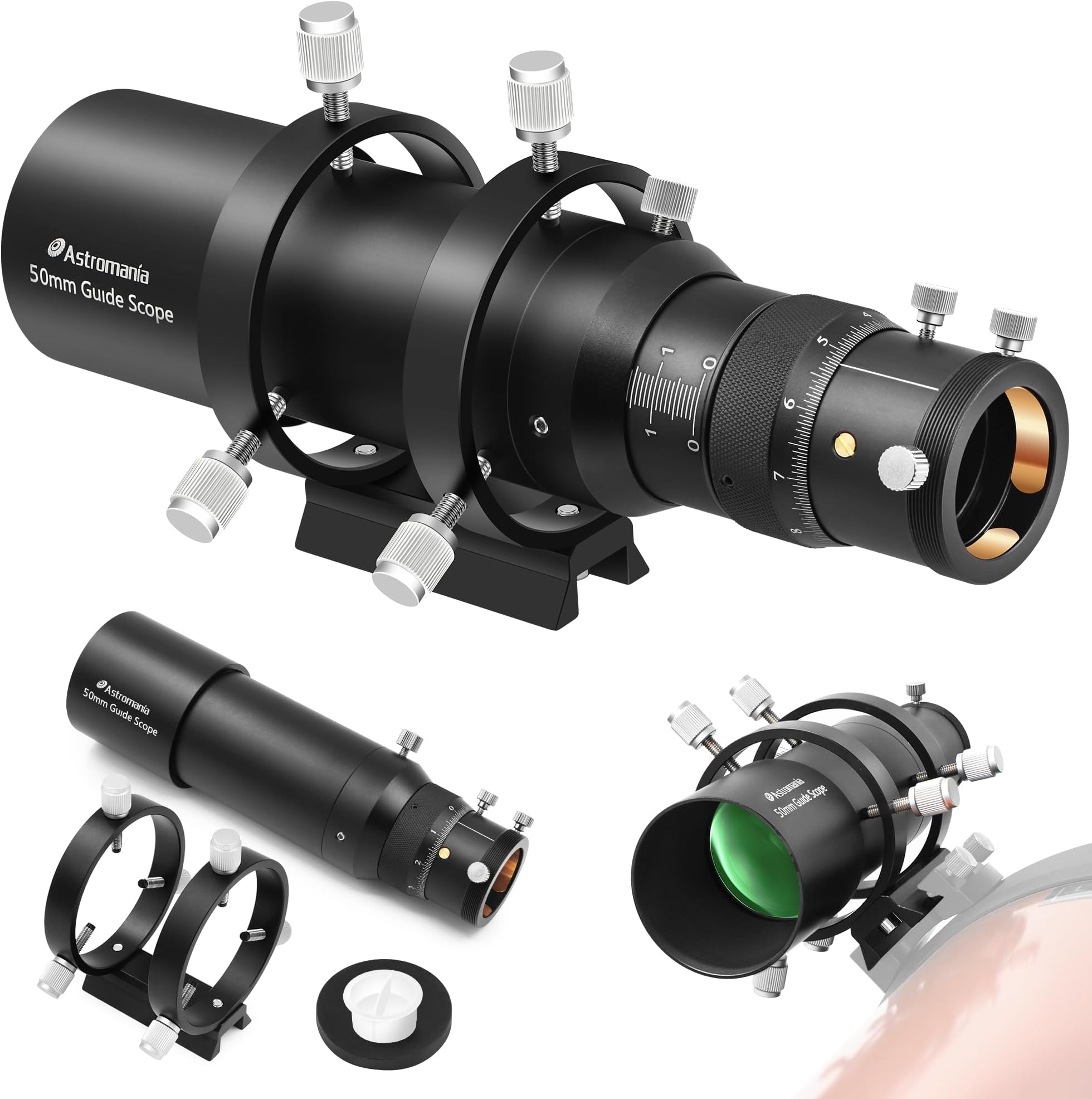
The Astromania 50mm FMC Compact Finderscope is a premium guide scope designed for astrophotography enthusiasts and professionals. Featuring a 50mm aperture and 200mm focal length, it offers a wide field of view ideal for locating guide stars quickly. Its double helical worm focuser provides ultra-precise, slop-free focusing with locking thumbscrews, ensuring stable imaging during long exposures. Constructed from durable black anodized aluminum, it is lightweight yet robust, and comes with versatile mounting hardware compatible with most telescopes. This guide scope is engineered to enhance your auto-guiding accuracy and reduce setup time, making it a must-have for serious astrophotographers aiming for flawless night sky captures.


| ASIN | B0156ICXMI |
| Additional Features | Helical Focuser |
| Best Sellers Rank | #12 in Telescope Finder Scopes |
| Brand | Astromania |
| Built-In Media | 1X 50mm Guide Scope |
| Coating | Fully Multi-Coated |
| Compatible Devices | Astronomical Telescopes |
| Customer Reviews | 4.2 out of 5 stars 224 Reviews |
| Eye Piece Lens Description | Kellner |
| Field Of View | 13.68 Degrees |
| Finderscope | Reflex |
| Focal Length Description | 190 millimeters |
| Focus Type | Manual Focus |
| Item Weight | 1.3 Pounds |
| Manufacturer | Astromania |
| Manufacturer Part Number | SKU_AM_GS50 |
| Model Name | 50mm Compact Deluxe |
| Model Number | SKU_AM_GS50 |
| Mount | Equatorial Mount or Altazimuth Mount |
| Objective Lens Diameter | 40 Millimeters |
| Optical Tube Length | 50 Millimeters |
| Optical-Tube Length | 50 Millimeters |
| Power Source | Battery Powered |
| Telescope Mount Description | Equatorial Mount or Altazimuth Mount |
A**B
It is rock solid..absolutely no flex once every screw tightened....great autoguider.
Edited review.....after some time witht his scope I decided to add some more info....see the additions at the bottom. First....the reviews here are for a combination of all models....50mm, 60mm, 70mm. Mine is the 70mm. I already have a 50mm home made autoguide scope that works fantastic...but needed a longer focal length scope to maintain the right ratio for one of my longer focal length scopes. The most important thing for an autoguide scope is it must have absolutely 0 slop....if it has even the slightest amount of slop it will never give good results. I was pleased that they addressed this issue and have a rock solid setup. While it has a long coarse draw tube, that would be problematic if it couldn't be locked down....there are three screws to lock it in. place...one thumb screw and two set screws. I never liked using Allen screw wrenches in the dark so replaced those two set screws with thumb screws. The double heclical focuser has no slop and works smoothly. Once focuse it has a thumb screw brake to keep the focuser from moving. Finally 1 1/4" focuser has a brass compression ring but goes one extra step by including two thumb screws to really lock the camera down. The scope rings have nice larger thumb screws for adjustment and have plastic tip inserts so you won't scratch the scope barrel. In the picture at Amazon it looked like the lens was very close to the front of the scope and I was concered I might have to make s dew shield. Turns out it has a decent dew shield that slides out to about 1 1/2" from the lens. That is just OK....my future project it to make a much longer one to cut down the chance of dewing. I have much longer dew shields on my main 6" APO refractor and also my old 50mm guider scope and surprisingly have NEVER had to deal with dew with either scope. But if necessary I do have dew heaters. Overall the scope looks very solid and is well engineered and at a good price. The only possible CON is that it is a much larger/heavier scope than the 50mm and 60mm versions. If you have a mount that is at its limit weight wise this may be the thing that puts it over the top and you may not get good results with your overtaxed mount. I have a Astro Physics 1100 so no problem. The old maxim that a guide scope should be around 1/3 of the focal length of the main scope is based on visual guideing. With todays guiding cameras the recommendation is to keep the ratio to a max of about 1/6th of the main scope focal length to as much as 1/10th of the ratio depending on the pixel size of your guide camera. The 70mm scope has a 400mm focal length so that should easily guide up to a 2400mm focal length with an average camera and as much as 4000 mm with a small pixel sized camera....but that would be pushing it. Todays software and cameras are so good that once setup you should have no problem getting rock solid guiding as long as you have a good mount. For short focal length refractors though this 70mm - 400mm focal length scope may be overkill....one of the cheaper, lighter guide scopes (50 or 60mm) will work just fine as they have around 165mm to 240mm focal length. ================================ Additional input from my original review.....I continue to be very impressed with this scope as a a guiding scope....so much so I bought the 60mm version for use with my travel scope and mount which is a ZWO AM5 mount with 80mm APO refractor. The 70mm worked fine with that setup but i was overkill....the guide scope was narely as lartge a the main scope ;-) Since Ilready had a 50mm home made guide scope I decided to go with the 60mm that has ad 240mm focal length. I definitely like the new scope as much as the 70mm and construction is idential on both. I used the larger 7omm version with my AP 1100 mount supporting either a 6" APO refractor or a 11" Celestron SCT HD. Guiding using Maxim DL was flawless and I never had any problem finding stars to guide on anywhere I aimed my telescope. I also removed the two hex screws that the stock setup had and replaced them with thumb screws identical to the one already existing holding the sliding rough focus barrel in place. That is probably the only con on both scopes. It would have been nice if they had thumb screws on all three of those positions....I HATE the idea of using allen wrenches in the dark and chancing droping them. I also read through some of the other reviews....there were a couple of bits of misinformation. This is an air spaced Achromat NOT a cheap cemented lens. For that reason this is a better optic. You can tell it is air spaced as you can see the three rectangula spacers around the lens.....this is NOT a defect but a good and normal design that most high end refractors use and do not show up in photos. Both of my scopes give nice stars although one person said they had weird stars and another mentioned their lens was placed backwards. In that case they were able to easiy reverse the optics and it works fine. Of course that should not have happened and signals a QC issue....but in my case the two scopes were well assembled and no glitches in the optics and the stars were nice and round. It is not an APO scope of course and not expected or needed at this price or as a guide scope The newer 60mm version has already seen use and like its 70mm brother works great....in fact unless you have a very long focal lengh scope it may be the better choice as long as you have a guide scope with pixels on the smaller side. But with my longer focal length scopes I like that precision. I use both with either a ASI 290 MINI or a much older SBIG STL 237 gjide camera that is slaved from my full frame SBIG camera. No issues with either camera/guide scope combination. In both cases i did fabricate longer dew shields as I refer that to having to use dew heaters. So my review is still very positive and I highly recommend the 60 or 70mm versions. Not having the 50mm version I can't comment on that one but have no reason to believe it wouldn't also be fine. In any case it is so much better than the cheaper toy-like guide scopes that are being pushed today.
J**E
Works beyond expectations.
I have the 70mm version and found this to be good quality optical instrument and a great guide scope - for folks who have a long FL main scope. There are other (and cheaper) FLs available. I bought a 0.5 FL reducer just in case – but haven’t used it, yet. Good dew shield, great worm focuser, well-built at 2.5 lbs and only about $160. To my surprise, for beginners who don’t want to spend too much money before they know they truly love Astrophotography and can master and afford it, it also makes for a decent primary scope (which is why I bought it – replace “beginner” with not-so-sure “returner”). Before you stop me and ask: “What about chromatic aberration? What about distortions around the edge of the field-of-view?” Well, the answer is: surprisingly, there isn’t all that much of that. This is actually a great beginner’s main scope if attached to a good (perhaps used, low $$ automated mound), a steady tripod, and a decent camera. Below, I will discuss three images I have recently taken. All are on the ZWO TC40 tripod with the ZWO AM5 automated mount using the ASIAIR PLUS mini-computer interface, and with a ZWO ASI 585MC camera. Note of caution: in that configuration, make sure the scope sits high up on the mount and does not easily run into the tripod. I am using a triple Vixen extender of which I have sawed off one offending member – but even then in that configuration the scope needs to be high on the Vixen receptacle to not run into the tripod. I live in the SF Bay area, so there is a lot of light pollution. Often I cannot even see Polaris with my bare eyes (and yes, I know it's a variable star :). All images were taken at a gain of 301; 200 images taken total, processed with DeepSkyStacker, Graxpert, and GIMP. All without a guide scope (through which I obviously took these images). Inexpensive SvBONY IR and UV cut-off filter to reduce dispersion. M53: Here I was mainly testing this guide scope’s optics. And since w/o guide scope, I used only 3s exposures to avoid star trails due to wind and mount tracking errors. DeepSkyStacker does not like short exposures, especially if there is a bright object in the frame (here: the core of the cluster). I needed to reduce the percentage of max light that is used for detecting stars for stacking: 10% is normal (about 3-4 stars, here; 5% not enough (about 5 stars, here); and 2% gives 7-10 stars, with only about 50% of 200 stacked images acceptable – which I picked; with drizzle set to zero for crisp dim stars. I think you will agree the image is great for this type and price of telescope. Leo Triplet: 90% of 200 exposure at 20s (no guiding, of course). Looks good to me, given the 70 mm aperture and the limited exposure time. M101: 148 of the 200 exposures where deemed good enough. Here you can see the problem when not taking “darks” at high contrast settings in GIMP: hot pixels and striations – but I did not care, for the purpose at hand. Edit: M101, another version: Same as before but now with a Celestron X-Cel LX 3x Barlow (!), and a ZWO ASI533MC Pro USB 3.0 Color camera. Using the 26 "best" out of 70 3m (180s) light exposures, gain 101, T = 0°C, 20 3m (180s) dark exposures, gain 101, T = 0C = 1h . FL should be 3x400 = 1,200mm but ASIAIR says it's 1,370mm. That happens with Barlows and varying back focus... and it is a problem: it means the effective magnification is not 3x, but 1370/400 = 3.425; or a relative light loss of 3.42^2 -- almost 12 instead of the nine I expected. So, bear that in mind - there wasn't enough light to use DSS to stack, but ASTAP worked fine.
P**E
Good guidescope once two flaws were corrected
My wife purchased this for me, and I am writing this review. This is being used as a guidescope on two telescopes, a 127mm APO refractor and a 9.25" SCT. There were two issues out of the box. The objective was installed at the factory backwards. I realized this the first time it was used. The image was extremely distorted and fuzzy. The objective is easily removed by unscrewing the front dew shield. I reversed it and voila, a nice clear image. The second issue is that the inside surface of the focuser tube is very shiny and smooth. This created glare on very bright objects. I coated the surface with ultra-flat paint to correct this. Ironically, the rest of the interior of the ota has a very flat non-reflective surface. Otherwise, the guidescope, rings and helical focuser work fine. Shame on Astromania for poor QC with an otherwise good product. This is a very sturdy and functional item once the flaws were corrected. The focuser tube locks firmly in place using the thumb screws For me this was an easy fix and was quicker than returning it. Astromania needs to monitor their QC program better. Three vs four stars . . . I was on the fence, but gave the extra star since the guidescope is constructed of aluminum, feels solid and is a good value when the optics are installed correctly.
D**R
Great guide scope for longer focal length telescopes
Used as a guide camera telescope set up for my long focal length RC8 telescope. It works beautifully and as well put together, give us a Ferb optics, and is a good deal for the money. I would recommend it highly to anyone.
D**.
Nice guide scope but has major limitation ...
Optics are decent, not good enough for a standalone scope, but OK for a guide scope. Workmanship, machining, and finishes are top notch ... the coarse and fine focusing are excellent. Mount rings are effective and well made. Major issue ... it does accept 1-1/4 eyepieces, but don't think you can use a 90-degree diagonal ... it just doesn't have the focusing range for this. This leaves a somewhat awkward viewing posture with the scope mounted flush with the telescope tube.
L**D
Pleasantly surprised - works well for guiding
I am quite surprised actually. I bought this because vendors of named brands were all out and I decided to give it a try. It is exactly as expected, a decent, solidly built, 60mm guide scope. It has plenty of back focus for my guide camera (I have not tried it with an eyepiece), the focuser is a bit stiff but adequate. I used it for an entire night guiding and it did very well. The mount fit into an existing dovetail show, and was pretty easy to align (though for guiding I really did not need precision there). The only negative is that it came packed inadequately -- the top alignment screw head poking out of the thin cardboard. But there was no damage to anything inside, the scope itself was well packed. But this top screw rested directly against the box top (which is thin). But overall, a very nice guide scope for a very good price.
A**R
This is a wonderful device and would be so at double the price
This is a wonderful device and would be so at double the price. Build quality is outstanding. The focuser employs both a drawtube and helical unit, for coarse and fine focus respectively. Both have fine gradations so focus can be dialed in directly. The construction is metal throughout, and the aluminum adjuster screws have nylon tips that will not mar the satin black finish of the tube. Coatings on the cemented 60mm achromat are a deep green and very uniform. One assumes this is basically a binocular objective so it remains to be seen how well it will perform at high power visually, but of course as an auto-guider or finder such considerations are irrelevant. One complaint, the drawtube inner surface is quite shiny and required flocking. The unit can be used with a prism diagonal if one inserts a Barlow between it and the diagonal. This allows the scope to function as a high-power visual right-angle guide scope. Note however that the unit will not focus at infinity with any diagonal unless a Barlow is inserted before the diagonal. When I insert a Meade 2x Barlow and prism diagonal + 40mm Plossl eyepiece, I measure a 4mm exit pupil, giving an effective f/ratio of 10 and effective focal length of 600mm, which is right in line with a typical 60mm x 700mm traditional guide scope. One can substitute a roof prism diagonal for a naturally oriented image. Used this way the scope becomes a passable spotting scope. The one obvious improvement to the scope would be to make the tube from two pieces, one of which could be removed to allow focus with a diagonal without inserting a Barlow. This is a minor point in my opinion, one has a finder after all for low power views - this is a versatile, well-made device and I highly recommend it.
D**N
Not 50mm - Aperture Stopped Down
Warning if you're considering this guide scope - the aperture was significantly stopped down by an aperture mask within the tube on the one I purchased. Not a baffle (I know scopes), but an aperture mask. Quality of the unit was good and the helical focuser was convenient but this was not a "50mm" guide scope. With the mask it was closer to 35-40mm.
H**E
Five Stars
Very good as imaging scope for astrophotography to get a wide field.
D**T
Para guía en tubos mayores a 600 mm
La calidad de hechura es buena, no sirve para hacer fotografía adicional como campo amplio por lo que es muy específico para su funcion
A**R
Excelente producto!!!
Excelente calidad, excelente producto, super bien protegido para transporte y llegó super mega rápido!!! gracias!!!
A**O
Falto un tornillo y si afecta su funcionamiento
Llegó incompleto, le falta un tornillo, y al ser equipo de astronomía esto si afecta mucho
Trustpilot
1 month ago
2 weeks ago