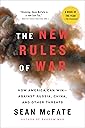
The New Rules of War: Victory in the Age of Durable Disorder – An Economist Book of the Year on Terrorism, Mercenaries, and the Future of Modern Warfare
Product ID: 214623498
Desertcart purchases this item on your behalf and handles shipping, customs, and support to South Africa.
"Stunning. Sean McFate is a new Sun Tzu." -Admiral James Stavridis (retired), former Supreme Allied Commander at NATO An Economist Book of the Year 2019 Some of the principles of warfare are ancient, others are new, but all described in The New Rules of War will permanently shape conflict now and in the future. By following them Sean McFate argues, we can prevail in this era of unconventional warfare. But if we do not, terrorists, rogue states, and others who do not fight conventionally will succeed—and rule the world. The New Rules of War is an urgent, fascinating exploration of war—past, present and future—and what we must do if we want to win today from an 82nd Airborne veteran, former private military contractor, and professor of war studies at the National Defense University. War is timeless. Some things change—weapons, tactics, technology, leadership, objectives—but our desire to go into battle does not. We are living in the age of Durable Disorder—a period of unrest created by numerous factors: China’s rise, Russia’s resurgence, America’s retreat, global terrorism, international criminal empires, climate change, dwindling natural resources, and bloody civil wars. A master of military strategy, Sean McFate has been on the front lines of deep state conflicts and has studied and taught the history and practice of war. He’s seen firsthand the horrors of battle and understands the depth and complexity of the current global military situation. This devastating turmoil has given rise to difficult questions. What is the future of war? How can we survive? If Americans are drawn into major armed conflict, can we win? McFate calls upon the legends of military study Carl von Clausewitz, Sun Tzu, and others, as well as his own experience, and carefully constructs the new rules for the future of military engagement, the ways we can fight and win in an age of entropy: one where corporations, mercenaries, and rogue states have more power and ‘nation states’ have less. With examples from military history including the Roman conquest, World War II, Vietnam, and Afghanistan, he tackles the differences between conventional and future war, the danger in believing that technology will save us, the genuine leverage of psychological and ‘shadow’ warfare, and much more. McFate’s new rules distill the essence of war today, describing what it is in the real world, not what we believe or wish it to be. The New Rules of War deconstructs the strategic atrophyplaguing Western armies and provides a playbook for victory in this new era of global threats: Conventional War is Dead: Learn why World War II-style warfare is obsolete and how clinging to it guarantees defeat against today’s unconventional enemies, from rogue states to terrorist organizations. The Return of Mercenaries: Explore the rise of private military contractors and for-profit warriors, a booming industry that is changing the business of war and creating new kinds of superpowers. Shadow Warfare: Understand how modern conflicts are won not with firepower, but with plausible deniability, weaponized information, and strategic subversion designed to manipulate an enemy’s perception of reality. A New Grand Strategy: Move beyond battlefield tactics to grasp the new political nature of war, where victory is fungible and the most effective weapons may not fire bullets at all. Review: Well done - I recommend the book. I agree with the other reviewers. There is some overreaching at times, but overreach is part of being passionate about changes. I have four disagreements or perhaps added perspectives as disagreement is too strong a word: 1) The problem is not only an over reliance on technology vs human wits, but lacking the understanding of what is truly threatening from a technological perspective. A good example is an EMP. The author rightly so pointed out that the use of air carriers and the attack on Pearl Harbor were predicted, but these predictions dismissed by the establishment. The money spent on the F35 would have been enough not only to better protect the grid and having spare parts available, but also to protect nuclear reactors, military bases dependent on electricity and, as battery technology evolves, to provide large household batteries and renewables to most households in the US. The F35 is the battleship of yesterday. But again, this is technology vs. technology + imagination. 2) Borrowing from Kissinger, it is possible to divide the world in three historical moments: places where war as a political tool is unthinkable (e.g. between West European states), places where national interests and alliances resemble the 1st World War (e.g. the Asia of China, Japan, etc.) and places where the 30-year war did not take place as yet (e.g. the islamic world). Of course this is a simplification, but the increased complexity of warfare is not only be due to the rise of non-state actors but also to the multidimensional interaction of different historical moments. 3) The author stresses that the rise of non-state agents, the use of subterfuge and weaponization of information and the impact of mercenaries will change how war is waged. In fact, it has already changed. He stresses that the laws of war will not or may not be followed if one is to be victorious. However, the doctrine of jus in bello and jus ad bellum precedes nation states. My understanding is that the Catholic Church developed these ideas to assist Christian Princes to wage war in moral way in a world characterized by disorder. Of course this is not a book about the moral of warfare, but I am sure that the author gave some thought to the issue. A new understanding of jus in bello and ad bellum will be necessary for democratic societies to succeed, not a utilitarian dismissal of the subject. 4) I am a civilian and by no means know how military education is delivered. However, I suspect that the necessary changes of education must go much deeper than the early introduction to strategy studies. The ability to think differently depends in part on the ability to not believe one's opinions too strongly. There is benefit of having doubts. I suspect that the strength of certainty is a preferred quality in the military career. This is surely difficult to change. To a degree, these are straw man arguments. The author's positions are fluid enough to accommodate all four points. I enjoyed the book very much. I am sure his classes are not only informative, but truly formative of officers and others lucky enough to meet him in person. Review: Outstanding Strategic Vision of the Future - The author, Sean McFate, provides a truly insightful and thought provoking look at the future. He draws on his experience both in the US Army and as a contract security officer to present a strategic vision that involves all elements of government, not just the Defense Department. Influence through information warfare and the use of mercenaries are becoming the way of the future. His analysis is supported by numerous historical events. For example, an interesting comparison is made to the nature of warfare prior to The Thirty Years War and the Treaty of Westphalia. The book is an easy read at about 250 pages on my Kindle edition. The author’s writing style is clear and the narrative moves quickly. He frequently uses historical events to make specific points. He hypothesizes that the US is essentially trying to re-fight the last war. An illuminating comparison is made to Billy Mitchell. Prior to World War II, Mitchell was ridiculed for advocating that air power would supersede battleships in naval power. History has now proven him correct and his contemporaries wrong. The book highlights ten “rules” or chapters. The author proposes that conventional war is dead and that future conflict will likely adhere to the principles of Sun Tzu, not Clausewitz. The real gem of this book is that the author effectively ties together historical events and strategic vision in a manner that makes these ideas obvious. Bottom line: This is one of the best books I have read on this topic. The clarity of Mr. McFate’s strategic analysis is excellent and anyone involved in national security should get something out of this book.
| Best Sellers Rank | #439,257 in Books ( See Top 100 in Books ) #187 in Russian & Soviet Politics #194 in Espionage True Accounts #282 in United States Military Veterans History |
| Customer Reviews | 4.5 out of 5 stars 638 Reviews |
P**N
Well done
I recommend the book. I agree with the other reviewers. There is some overreaching at times, but overreach is part of being passionate about changes. I have four disagreements or perhaps added perspectives as disagreement is too strong a word: 1) The problem is not only an over reliance on technology vs human wits, but lacking the understanding of what is truly threatening from a technological perspective. A good example is an EMP. The author rightly so pointed out that the use of air carriers and the attack on Pearl Harbor were predicted, but these predictions dismissed by the establishment. The money spent on the F35 would have been enough not only to better protect the grid and having spare parts available, but also to protect nuclear reactors, military bases dependent on electricity and, as battery technology evolves, to provide large household batteries and renewables to most households in the US. The F35 is the battleship of yesterday. But again, this is technology vs. technology + imagination. 2) Borrowing from Kissinger, it is possible to divide the world in three historical moments: places where war as a political tool is unthinkable (e.g. between West European states), places where national interests and alliances resemble the 1st World War (e.g. the Asia of China, Japan, etc.) and places where the 30-year war did not take place as yet (e.g. the islamic world). Of course this is a simplification, but the increased complexity of warfare is not only be due to the rise of non-state actors but also to the multidimensional interaction of different historical moments. 3) The author stresses that the rise of non-state agents, the use of subterfuge and weaponization of information and the impact of mercenaries will change how war is waged. In fact, it has already changed. He stresses that the laws of war will not or may not be followed if one is to be victorious. However, the doctrine of jus in bello and jus ad bellum precedes nation states. My understanding is that the Catholic Church developed these ideas to assist Christian Princes to wage war in moral way in a world characterized by disorder. Of course this is not a book about the moral of warfare, but I am sure that the author gave some thought to the issue. A new understanding of jus in bello and ad bellum will be necessary for democratic societies to succeed, not a utilitarian dismissal of the subject. 4) I am a civilian and by no means know how military education is delivered. However, I suspect that the necessary changes of education must go much deeper than the early introduction to strategy studies. The ability to think differently depends in part on the ability to not believe one's opinions too strongly. There is benefit of having doubts. I suspect that the strength of certainty is a preferred quality in the military career. This is surely difficult to change. To a degree, these are straw man arguments. The author's positions are fluid enough to accommodate all four points. I enjoyed the book very much. I am sure his classes are not only informative, but truly formative of officers and others lucky enough to meet him in person.
M**H
Outstanding Strategic Vision of the Future
The author, Sean McFate, provides a truly insightful and thought provoking look at the future. He draws on his experience both in the US Army and as a contract security officer to present a strategic vision that involves all elements of government, not just the Defense Department. Influence through information warfare and the use of mercenaries are becoming the way of the future. His analysis is supported by numerous historical events. For example, an interesting comparison is made to the nature of warfare prior to The Thirty Years War and the Treaty of Westphalia. The book is an easy read at about 250 pages on my Kindle edition. The author’s writing style is clear and the narrative moves quickly. He frequently uses historical events to make specific points. He hypothesizes that the US is essentially trying to re-fight the last war. An illuminating comparison is made to Billy Mitchell. Prior to World War II, Mitchell was ridiculed for advocating that air power would supersede battleships in naval power. History has now proven him correct and his contemporaries wrong. The book highlights ten “rules” or chapters. The author proposes that conventional war is dead and that future conflict will likely adhere to the principles of Sun Tzu, not Clausewitz. The real gem of this book is that the author effectively ties together historical events and strategic vision in a manner that makes these ideas obvious. Bottom line: This is one of the best books I have read on this topic. The clarity of Mr. McFate’s strategic analysis is excellent and anyone involved in national security should get something out of this book.
R**R
Enjoyed the Read
Enjoyed the read, very informative from our current situation to a military history context. Only reason why I didn't give it 5 stars, is because the author has recently written an Op Ed in WSJ, and in it states, "If Mr. Putin’s mercenaries do something worthy of disapproval, he can simply disavow them, as he did after the Wagner Group got shellacked by U.S. troops at the Battle of Kasham in 2018 in eastern Syria." Yet in this book he states that our forces weren't able to take out the Wagner Group in this same battle -- so which is it? The lack of uniformity in this certain situation somewhat bothered me, but besides that I'd recommend the read.
F**G
The Westphalian Order collapses and old rules become new
Sean McFate served in the 82nd Airborne, served as a mercenary, and later secured a Ph.D from the London School of Economics, an unusual combination of achievements. He is a Professor of Strategy at the National Defense University. I got the hardback which has 251 pages excluding the Annex, Notes and Acknowledgments. The author writes well, takes a historical view of the subject and doesn't shrink from hard judgements. The Westphalian Order was established in 1648 in Europe by the Treaty of Westphalia and it's major effect was to reserve the right to field armies to states. Prior mercenary armies raised and fielded by lesser economic and political bodies were banned. With the expansion of European influence over the globe, the Westphalian Order became for the West the normal order of warfare (the author notes that we have to ignore the British East India Company to make this statement, but nonetheless, in the West, this became model through which it looked at warfare). This model reached its apogee in World War 2. The book reviews the sorry history of the Westphalian Order since 1945 and concludes, correctly in my judgement, that change of the West's view of warfare is essential if we are to fight and win in the future. To do so, we must abandon the concept that war is only a state on state act. To do this takes us back to a world in which many actors fought for power and treasure. The most surprising aspect of the book to me was the author's discussion of the rise of mercenaries as recognized warfighters in many conflicts, including mercenaries who fought for U.S. interests. If you think that Blackwater is the only entity providing these services, this book will expose you to many others. According to the book, one Mideast group hired about 1500 mercenaries from South America who had honed their skills in the drug cartel battles (wars?) in South America. This group brought tactics and fighting skills to the Mideast, which had not previously been seen. What is "war"? On page 179, the book poses this question: "The only think experts agree on is this: to be considred "war," an armed conflict must be fought for purely political aims, which is why narco-wars don't count. ..."The use of force to curb criminal behavior such as piracy is not war," writes one expert, "because pirates seek material gains rather than political aims." This is the considered opinion of generals, scholars, and dictionaries. And it is wrong." Pg. 179. The author is not afraid to take a strong stand. The book is well-written, takes a long historical view, and provides a careful critique of the United States' approach to war. He argues that disorder is increasingly durable. New players in conflict arise who are like the players that existed before the Westphalian Order arose. What if large international corporations hired large mercenary forces to advance their economic interests as did the British East India Company? Our strategic views have caused the U.S. to lose in the struggle against disorder and will continue to cause us to lose unless we change. If this topic is of interest to you, I most strongly encourage you to read the book.
D**T
An Essential Guide to the Age of Durable Disorder
The New Rules of War is an outstanding am long-overdue corrective to modern American strategic thinking, which remains obsessed with technology and the drive for decisive victory using conventional military force. It is not without flaws, but these are more than offset by the scythe that McFate brings to the conventional wisdom. McFate’s essential premise is that conventional warfare is dead and that strategists need to focus on the tools that our adversaries use to circumvent conventional strength. This is not in itself a groundbreaking assertion—its become a de rigueur statement amongst strategists since the rise of insurgencies in Iraq and Afghanistan. But as McFate points out, the chorus of voices making this point has done nothing to change the military’s emphasis on technical solutions to non-technical problems. This has only worsened since DoD reprioritized great power competition. McFate’s understanding of the coming “durable disorder” and the changing character of warfare is refreshing and should be considered deeply and at length by all involved in defense policy. The book’s imperfections come not in McFate’s assessments, but in his tone and style. He often comes across as overly polemical, almost as though he has an axe to grind. While this doubtless makes for quicker reading--perhaps especially to a lay audience--it leads to blanket statements that undermine the strength of his arguments. For example, McFate dismisses the utility of Clausewitz to discussions of modern conflict, labeling him the “high priest of conventional warfare,” despite having recapitulated Clausewitz’s own distinction between the immutable nature of war and the changing character of warfare only a few paragraphs earlier. This is sloppy: while Clausewitz’s discussion on the conduct of warfare from the Napoleonic era is obviously divorced from conflict today, his understanding of war’s political nature, and that its conduct is governed by the blending of passion, reason, and chance remain as timeless as ever. Indeed McFate’s whole book could be read as an answer to the Prussian’s statement that the first and most important act of strategy is to understand the nature of war one is engaging in, neither mistaking it for nor attempting to change it into something alien to its nature. Similar statements are sprinkled throughout the book, but they pale in comparison to the fresh thinking he brings to the table. Ultimately, the US and its allies are doomed to suffer failed strategies and increasing insecurity unless they understand, as McFate does, that the utility of conventional force is declining and that new method of advancing the national interest are required.
A**T
Some good points. Bad presentation and critique.
If I had to describe this book in one word: "hyperbole." The purpose of McFate is to criticize some popular approaches to war, and specifically the way that the US does grand strategy. Specifically, his target is Clausewitz, who is the source of all our problems. Clausewitz is evil, and conventional war is dead. But wait, doesn't conventional war still happen? Sure, but its still "dead" whatever that means. Hyperbole #1 has been found. Conventional war happens, is still relevant, it just isn't the only thing. Is McFate correct that we sometimes treat it as the only thing, and doing so is fatal? Absolutely. However, to simply describe it as "dead" and relegate it to the dustbin is inaccurate and unhelpful, and comes across as simply a way to provoke and gather attention, rather than to make a serious point. Let's see why Clausewitz is evil. McFate: "the nature of war remains the same, but the means change." Apparently Clausewitz disagrees. However, Clausewitz himself is the one who said that very thing, so one wonders if McFate got Clausewitz secondhand, misread him, or simply hasn't read him. In fact, if one reads Clausewitz' "On War," one will find that Clausewitz fully acknowledges that "conventional war" is simply one small part of international politics and strategy. He then focuses on it, but only after situating it in the larger context. Specifically, he focuses for much of his book on infantry tactics. Now here's McFate's problem: if Clausewitz had argued that his book was the sum of international politics and grand strategy, Clausewitz would be wrong. However, Clausewitz says the exact opposite, and instead says the same thing that McFate tries to advocate! What are the new rules of war then? Mostly old rules, from a pre-Clausewitz time, and war outside of 19th century European context. Sun Tzu is referenced approvingly. Very good points: McFate at one point refers to AI and the F-35 as "tech porn." This seems accurate. Reality is not hollywood. AI is literally just statistics. The concept that a commander needs a way to synthesize and understand "all" the available information 1) apparently denies any quality commanders throughout history, and 2) is directly opposed to the concept of "decentralized" command, and proper roles. McFate also brings up the point that when war is perceived only as "on / off" and military force is unable to be used in the "off" setting, this opens us to vulnerabilities. Military force can, and should, be used during peacetime, as military forces (one could argue that this is already the case, since the US is actively conducting operations without any declaration of war, but I digress). So McFate is extremely helpful in correcting a narrowsighted view of international politics and war. I think this can also be found in Clausewitz already. Interesting: McFate highlights some problems inherent in democracy as pursuant to grand strategy. I think there's fruitful discussion here. Is the purpose of a democracy's grand strategy anything externally directed, or mostly to achieve internal ends (such as affirming the legitimacy / respectability of the gov to the people)? In a society where the people are rulers instead of the ruled, the shape and ends of strategy are necessarily going to be different. Does McFate want us to return to a society where the people are ruled instead of rulers, specifically so that we can "win wars" that are not conventional? Ironic: McFate criticizes (rightly) the view that says that a few, tech-equipped, special-forces types doing their own thing will basically win wars through one action - like we see in movies / TV. I find it amusing that he has written fiction books about this very thing.
V**R
The New Rules of War should be Book of the Year.
I have bought this book more than once to give to others, and the reviews have been unanimous: Phenomenal writing delivering new, vital substance. Unfortunately, Dr. Sean McFate makes tremendous sense. I say unfortunately because the presentation he makes of "durable disorder" is chilling to the bone and persuasive in the same measure. And yet, with all that on board, Professor McFate still offers positive solutions that light the path going forward in this new world. The only downside to this book is it will ruin any plans you may have made before you opened it because once you start reading you won't put the thing down. A rare treat. This is a paradigm-changing contribution on a subject that is both immense and indispensable. Uncommon brilliance, terrifically informative, and absolutely fascinating this book will change forever how you think about war. Dr. McFate is a genuine warrior-scholar. His years of active duty in covert ops all over the world he then formalized with a PhD in the study of war. His informed understanding of the world as it is now helps us make better sense of it all, but the new coherence we get from reading this book arises from dark places. That is exactly what makes this work so valuable and also so deeply disturbing. O. Zambrano
G**D
This book captures the essence of the wars we are fighting and will fight in the future
Sean has done a brilliant job of capturing the essence of modern warfare. He describes why the American military's preferred form of warfare has failed over the past 50 years to win a single war, and how our enemies are out-thinking us and winning, often without engaging us in direct combat. He proposes ten new rules for waging war in an era of durable disorder in which states and non-state actors fight without regard for our geographic, organizational, and functional boundaries; how they use information much more skillfully; and how private military corporations are commercializing war and relegating Westphalian warfare to the scrap heap of history. This is graduate-level military art, but Sean simplifies the complexity of modern warfare so that novices can understand it, while experienced practitioners can expand their professional horizons and make sense of the last 18 years of wars in the Middle east and elsewhere. This book should be mandatory reading in professional military education currricula, and in the library of every national security professional.
F**O
Livro espetacular
Livro muito bom
M**.
Interessante, scritto bene, una certa superficialità nell'analisi
Ottimo libro, mi è piaciuto molto. Sean McFate scrive molto bene, ha le idee chiare e sa come comunicarle. Unico punto debole, a mio avviso, è la tesi dell'autore secondo cui gli Stati Uniti e l'Occidente sarebbero strategicamente svantaggiati nel mondo attuale, caratterizzato da "disordine durevole", aziende militari private, gruppi armati non statali e un campo di azione caratterizzato da operazioni nell'ombra - perché troppo ancorato a un assetto strategico convenzionale, di grande guerra fra stati nazione. Si e no direi - per decine di anni dopo la fine della seconda guerra mondiale, gli Stati Uniti e i suoi alleati si sono dedicati con passione a operazioni nell'ombra, incluso fomentare rivoluzioni popolari, cambi di regime, crescita e soppressione di insurrezioni armate - ed altro. Il punto dolente, credo, è che altre potenze hanno imparato le stesse arti e dimostrano di sapere giocare nello stesso campo - vedi il crescente peso dell'Iran in Medio Oriente, l'estensione egemonica della Russia nei territori confinanti (sempre negabile ufficialmente), e la cosiddetta influenza russa nelle elezioni americane o nel referendum Brexit. Una gran bella lettura comunque.
C**M
Fascinating
This is an amazing read. There are so many insights into how war has changed in recent years. A definite must-read for anyone interested in history.
D**F
total interessant
total interessant
D**A
Keep it up
Good
Trustpilot
1 week ago
3 weeks ago