
Buy anything from 5,000+ international stores. One checkout price. No surprise fees. Join 2M+ shoppers on Desertcart.
Desertcart purchases this item on your behalf and handles shipping, customs, and support to South Africa.
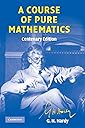
Buy A Course of Pure Mathematics (Cambridge Mathematical Library) Centenary edition by G.H. Hardy (ISBN: 9780521720557) from desertcart's Book Store. Everyday low prices and free delivery on eligible orders. Review: The CLASSIC !!!, - The book that anyone interested in maths must have on his bookshelf : the prelude to any other book on analysis ! Hardy's crystal-clear, no fuss, precise and concise style at its best. My preferred chapter to be found nowhere else : chapter X, on the general theory of the logarithmic, exponential and circular functions When in doubt, I always go back to Hardy. Review: What style! This book will live forever! - G H Hardy's book is the pioneer in the field of introducing the formal and rigorous principles of Mathematical Analysis. By Hardy's own admission, the book sprang from the void that existed prior to its publication in 1907. In a word, the hallmark of this book is "style", and Hardy must be the original style guru as far as Pure Mathematics goes. The book covers all the essential elements one would expect to see in an introductory course in the subject, namely the notion of a limit and its application to sequences, series, a comprehensive yet elementary exposition of convergence and its use in the definition of functions, differentiation and integration. All of the main theorems of the calculus of the real variable are covered. The latter chapters address the general theory of logarithmic, exponential and circular functions. Despite the glut of books on the subject of Real Analysis that are on the market, and there are some VERY GOOD ones, this is the classic text that every serious student of Pure Mathematics should begin with. Texts with more general coverage of real analysis such as Tom Apostol's Mathematical Analysis can follow thereafter. This book is nearly 100 years old. You can bet that it will still be around 100 years from now!
| Best Sellers Rank | 421,057 in Books ( See Top 100 in Books ) 5,266 in Popular Mathematics 17,824 in Scientific, Technical & Medical |
| Customer reviews | 4.2 4.2 out of 5 stars (27) |
| Dimensions | 15.21 x 3.38 x 22.91 cm |
| Edition | Centenary edition |
| ISBN-10 | 0521720559 |
| ISBN-13 | 978-0521720557 |
| Item weight | 750 g |
| Language | English |
| Part of series | Cambridge Mathematical Library |
| Print length | 530 pages |
| Publication date | 13 Mar. 2008 |
| Publisher | Cambridge University Press |
A**A
The CLASSIC !!!,
The book that anyone interested in maths must have on his bookshelf : the prelude to any other book on analysis ! Hardy's crystal-clear, no fuss, precise and concise style at its best. My preferred chapter to be found nowhere else : chapter X, on the general theory of the logarithmic, exponential and circular functions When in doubt, I always go back to Hardy.
J**A
What style! This book will live forever!
G H Hardy's book is the pioneer in the field of introducing the formal and rigorous principles of Mathematical Analysis. By Hardy's own admission, the book sprang from the void that existed prior to its publication in 1907. In a word, the hallmark of this book is "style", and Hardy must be the original style guru as far as Pure Mathematics goes. The book covers all the essential elements one would expect to see in an introductory course in the subject, namely the notion of a limit and its application to sequences, series, a comprehensive yet elementary exposition of convergence and its use in the definition of functions, differentiation and integration. All of the main theorems of the calculus of the real variable are covered. The latter chapters address the general theory of logarithmic, exponential and circular functions. Despite the glut of books on the subject of Real Analysis that are on the market, and there are some VERY GOOD ones, this is the classic text that every serious student of Pure Mathematics should begin with. Texts with more general coverage of real analysis such as Tom Apostol's Mathematical Analysis can follow thereafter. This book is nearly 100 years old. You can bet that it will still be around 100 years from now!
C**N
Not everything that is old is a Classic
It is a classic Book in terms of ideas but very dated in terms of problem solving support.....a modern book of Pure Maths would do more than just cover ideas then expect you to solve a collection of challenging problems; I would be very surprised if anyone praising it here could solve 50% of problems Hardy sets??
A**R
Absolutely shocking print quality
The book is an classic, but the quality of this centenary edition is absolutely atrocious. Graphs that should show several points on them only show 1 or 2, bold letters can be so faint as to be confusing (e.g. an uppercase A looks like the uppercase Greek letter lambda). There are numerous other examples I could give. The overall print makes reading it exceedingly tiresome. Worse still, the errors in printing can lead to misunderstanding of either the text or diagrams resulting in much time wasted, trying to work out what should be there. Thankfully I was able figure things out thanks to an earlier edition that is freely available on the project Gutenberg website. My big regret is that, as it has been quite a while between purchasing this book and me actually using it, I doubt if Amazon would consider a refund. Other reviews suggest this issue is not a one-off. I would give it zero stars if it were possible. DO NOT BUY THIS EDITION !!!
J**E
Hardy
In fact, it is a very classical text on Pure Mathematics, clear, interesting. Good edition, and it is not too expensive.
C**S
Hardback or Paperback?
This is an excellent work which I have used for over half a century, but I'm glad that as a student I bought the hardback for 30 shillings - a paperback would have fallen to loose pages years ago.
M**C
The fact is they never have and never will. This is the reason you should read old textbooks. What really makes this great is Hardy's connection with the reader. The entire book reads like a discussion between a professor and a student. He is not simply instructing, but he is offering his complete justifcation and analysis. He provides exactly what information you need in a very methodical order. And he does not waste time on trivial proofs for the obvious, and graphs are limited to only the essentials. He does not waste his time or the readers time and there is not one wasted page in this book. Ironically his concise instruction is by no means superfical. He spends 30 pages discussing what a function of real variables actually means. And his discussion goes beyond a set of rules presented on a few pages of a modern textbook. Honestly I think if you used his definition in today's courses you would get the question wrong. However, you would have a complete understanding from Hardy so you could probably argue it with your professor and get the credit back. This is by no means an easy read. It is very difficult, but the reader will be rewarded with a knowledge beyond modern courses. I read alot of old textbooks, and sometimes it is a waste, but more often it presents techniques long forgotten with the age of calculators. As another reviewer mentioned this makes modern textbooks with neat graphics and colors look like a complete joke. ( most probably are anyway ). I am only two chapters into this, so I cannot say how much of it is relevent with modern techniques, but I think it is a priceless resource.
F**R
Good material, terrible printing. Not recommended.
レ**ー
Not only is this book a classic but the copy I was sent is beautifully printed. There’s a certain texture and glow to the ink that makes the reading of it even more enjoyable. Congratulations on such a great printing.
N**M
This is the most beautiful book that I have ever read. This is coming from someone who was average at math in school and hated it to the bone in university. If I had read this book while I was at university I would have definitely switched from engineering to math. I really cannot describe how this book makes me feel. Korner ends the foreword with the following: "May this book give as much pleasure to you as it has given to me". Hardy is a master of the subject as well as a master of prose. The only person that I think writes better than him is Russell. Open the book on a random page and chances are that you will see one equation and many paragraphs. The way Hardy describes the construction of the rational and irrational numbers is beyond description. Also, for the first time in my life I truly understand the true meaning behind the words 'limit' and 'convergence'. Previously, I could easily find whether a certain function converged or not by applying one of the many tests mechanically. Now, I actually understand how the function behaves just by looking at it and in many cases I know the answer without having to use any of the 'tools' which we memorize in school and university. The book is not easy, but it is very clear. There are many parts which I had to re-read over and over not because Hardy doesn't explain them right, but because the material is complicated. This book does not make analysis easy, because it is not (and many of the problems included prove that). What this book does is that it reveals the beauty of math while explaining the concepts clearly. This book will require effort on the part of the reader, but believe me, you will cherish every moment. I am at the end of the book and once I finish it I will go over it again. Why? Because I have never enjoyed another book more than this.
B**R
There are many stunning insights in G.H. Hardy's work. The book is extremely well written and has a number of examples that are thought-provoking, and concrete. It has the best description of the Dedekind cut I've ever read. Real numbers aren't assumed but built from rationals. It is not "abstract" as for instance the Baby Rudin is. Instead of metric spaces and topology, it uses the epsilon-delta method of proof. This book is a classic. It is meant to be read and lovingly reread. One gets an insight into not only mathematics but a unique and brilliant mind. It is of value to the applied mathematician, because of its concrete cases, despite the title talking about "Pure Mathematics." In terms of development of advanced calculus, it is comparable to Spivack and to Apostol, though unlike Apostol no discussion of linear algebra. I'd say the book is more leisurely than these classics, and goes deeper into interesting limits and calculations. I'm not saying it is the only analysis book you will ever need, or the only reference you will ever need. You will still need something like Rudin's Principles of Mathematical Analysis for a reference work, and you will need a book to serve as a reference to linear algebra, differential forms, manifolds, and other tools of modern analysis. What this book will give you is a beauty so deep it will make you weep with joy.
Trustpilot
1 day ago
3 weeks ago