


Desertcart purchases this item on your behalf and handles shipping, customs, and support to South Africa.
🔌 Power up smarter, not harder — stay charged, stay ahead!
The Victron Energy Orion-Tr Smart DC-DC Charger delivers 30A and 360W of professional-grade, non-isolated charging power. Featuring built-in Bluetooth connectivity, it allows real-time monitoring and control via the VictronConnect app. Designed for dual battery systems in vehicles and boats, it supports both lead acid and lithium batteries with a rapid 3-stage charging process. Easy to install with screw terminals, this charger is the ultimate flexible power solution for the modern adventurer.
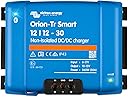


| ASIN | B086Q8YNJZ |
| Amperage | 30 A |
| Battery Charge Time | 2 hours |
| Best Sellers Rank | #43,828 in Automotive ( See Top 100 in Automotive ) #239 in Battery Chargers |
| Brand | Victron Energy |
| Built-In Media | Victron Energy ORI121236140 Orion-tr Smart 12/12-30 30a [360w] Non-isolated Dc-dc Or Power Supply |
| Color | Blue |
| Connector Type Used on Cable | Screw Terminals |
| Current Rating | 30 A |
| Customer Reviews | 4.4 out of 5 stars 963 Reviews |
| Input Voltage | 12 volts_of_direct_current |
| Item Dimensions D x W x H | 3.2"D x 7.3"W x 5.1"H |
| Item Highlight | Bluetooth Battery Charger for Dual Battery Systems |
| Item Type Name | Victron Energy ORI121236140 Orion-tr Smart 12/12-30 30a [360w] Non-isolated Dc-dc Or Power Supply |
| Item Weight | 1.3 kg |
| Manufacturer | Victron Energy |
| Mfr Part Number | ORI121236140 |
| Model Number | ORI121236140 |
| Number of Items | 1 |
| Output Voltage | 12 volts_of_direct_current |
| Product Dimensions | 3.2"D x 7.3"W x 5.1"H |
| Specification Met | UL, FCC, CE |
| Unit Count | 1 Count |
| Warranty Description | Warranty |
H**O
Bluetooth App Makes Setup Painless For A Second Battery Charging Off The Alternator
Installed this in my truck to keep an auxiliary battery topped off, tired of running a separate battery through a manual isolator that never seemed to charge it fully on shorter drives. Setup was straightforward once I had the wiring sized right, connect it between the starter and house battery and the Bluetooth app walks you through picking the right charge profile for your battery chemistry. Connectivity through the VictronConnect app is the best part honestly, I can check charge state and tweak settings from my phone without popping the hood every time. Compatibility is solid, it handles both my AGM and a buddy's lithium setup once he borrowed it to test, just a different profile selected in the app. Battery capacity charging feels appropriately matched too, at 30A it brings a deeper discharged battery back up at a reasonable clip on a normal commute, not glacially slow like my old setup. Only complaint is the unit runs warmer then I expected under a full 30A load, nothing that's tripped a shutdown but I'd keep it somewhere with airflow instead of buried under other gear. Reliable charger for anyone running a dual battery setup who wants real monitoring instead of guessing.
S**N
One of the best mods I've made to my camper van
We've been camping in converted vans for over ten years, with ever-evolving electric systems. All three of the vans I've converted have had a battery-based, solar charged electric system. The last van and our current one have both had ample battery capacity, with the limiting factor being our charging capacity, especially in less than ideal conditions. I finally decided to install a DC-DC charger, after kicking the idea around for the last three years or so. I'm so glad I did. We haven't had a chance to camp in the van yet, but it's already making a difference. It's early March as I'm writing this, and solar conditions are far less than ideal here in New England, but our batteries are staying fully charged, despite having some fairly heavy loads on them. I made a 3-gallon electric water heater over the winter, and I've been using that to test the charger. I installed a 200 watt element in it, so it takes a while to heat the water significantly - about 3-4 hours. 200 watts at 12 VDC is about 18 amps - a fairly good load on a small system like ours - but the charger keeps up with it no problem. I think this is going to make our off-grid camping much more comfortable. I considered the Renogy, which is cheaper and higher output. I decided on the Victron, partly based on reviews, partly on reputation, but mostly on physical dimensions. The installation was easy - the hardest part was running the 6 AWG wire to the starter battery. The unit gets a bit hot in use, but not dangerously so. I've installed a couple of 80mm fans on a temperature controller above the charger to cool it down. I'm not sure I needed to do that, but it provides peace of mind. The unit seems very rugged, and the Victron app is very convenient for monitoring the system as I drive, Overall, I highly recommend this unit.
S**D
High end durable DC to DC charger, perfect for Li-ion.
When it came time to upgrade my motorhome to Li-ion house batteries, there were two choices for protecting my alternator: a DC to DC charger or one of those timer-style systems. After reading and listening to many experts, I chose the DC to DC charger. Since I wanted a DC to DC charger, there was really only one top-of-the-line company, Victron. I was able to find the product that I needed for a little less than ordering directly. Same product, less money! The instructions were absolutely clear, and as I ordered, I was able to look ahead and get all the parts I needed. The only difficulty I ran into was separating the ignition and battery connect wires in my coach. Once I figured that out, the installation went quickly. To configure the charger, I just needed to install the application on my phone and connect via Bluetooth. The application walked me right through the setup to include whether you have a smart alternator, ignition wire, etc. There was NO trial and error, configuration was easy and right the first time. We are only part-time campers, so I have only used the system twice, and most of our driving, we use the generator to run the overhead AC units. This is primarily a secondary method to keep our house batteries charged. In the few tests, it does exactly what is advertised. The Li-ion battery is getting 14.5 volts while minimizing the draw on my alternator.
J**T
Works great, easy to configure
Bought this for my boat to charge a Lipo4 battery. It was very easy to install and configure using the bluetooth interface. It's not too big to be effectively installed in a small hatch but you'll need to watch out for airflow as the unit can get a bit hot. That said, it will charge just about any battery - it's quite versatile. It's not cheap but who wants cheap on the water? There's a reason you see victron on so many sailboats, etc.
P**E
No Bluetooth connection and sloppy terminals
Would not accept four or six gauge stranded wire. Not sure how the unit operated couldn’t get it to pair with my phone. The clamp type terminals are too close together and pretty wimpy compared to actually having a lug and bolt like some of the other others have. If you have the money by the CTEk 250 DS. I’ve had one in my other vehicle for five years now with no issues very lightweight no heat problems. No Bluetooth to deal with I get all my information I need from my battery. Has Bluetooth. Would not buy again.
J**L
Needed if you have lithium batteries in a motorhome.
If you don't have lithium batteries, you don't need this device. The chassis alternator can get fried if it tries to recharge the engine and lithium house batteries because the lithiums have very low internal resistance. There are a lot of videos on that. I highly recommend the Victron SmartBMV. Without it, you won't really know what the charger is doing. The Victron Connect app lets you program both the Smart BMV and the converter. How to install in a motorhome: The supplied instructions are confusing, but this is the advice from tech support given to me. You need to separate the circuits for the chassis and house batteries. There is likely a relay that on ignition power interconnects both systems so that your alternator normally charges both. You need to find that relay and deactivate it. In my coach, it was a large, White Rogers relay located under the inverter/charger. Once you find it, disconnect its grounding wire (probably white). You will later need to access the positive ignition wire attached to it (leave it attached). With that relay now unpowered, make sure it is really open by removing the cables on it and using your multimeter (mine was stuck closed and I had to replace the relay). If you put the cables back, they won't accidentally touch each other. Leave the ground wire to the relay off, forever. Next, you should use bus bars, sold here. You will use all 4 posts on both bus bars. You will want to mount the converter close to your chassis AND lithium batteries. You will need several sets of battery cables and they'll have to be long enough to reach from the ENGINE batteries whose positive will connect to a 60 amp fuse/circuit breaker and then go from there to the input on the converter. (The lithiums should have the SmartBMP shunt attached first. Check the app to make sure it's working and do the update online for it via your smartphone.) Look at the green switch plug (it comes in the little Ziploc bag) and see how it inserts into the converter. The left connector on it is L, the right one is H. Remove the wire loop from the H connector (let it dangle from the L) and run a wire to that H connector from the ignition wire attached to the unpowered interconnect relay. Plug the green switch module into the converter. Connect the cables from your inverter/charger and from the lithiums to the bus bar (you can determine where they come from by disconnecting them from lithium batteries and turning off the inverter/charger, checking voltages with your multimeter when turning them back on). Attach a cable from the ground connection on the converter to the negative bus bar, which should also have a battery cable from the lithiums negative. The cables to the bus bars from the lithiums should not come from just one battery (assuming you have at least 2). The positive should come from one battery and the negative from the other. Connect a cable from the converter output to the positive bus bar. The Blue LED on the converter should flash slowly. Start the Victron Connect app and do the update (it takes about a minute). Set up the converter for lithium batteries. Turn the ignition key to the on position. The app will say that the engine hasn't been started! Start the engine and the converter will go into bulk charge mode, which you can see on its app and also watch on the BMV app. The blue and green LEDs will now be flashing about once a second. Lastly, make sure the main power disconnect switch (usually located by your entry door), turns off and on your 12 system - ceiling lights, porch lights, water pump, etc.). If it's a toggle switch and it doesn't work, then there's either a problem with that latching solenoid (it may look like a relay, but it's not!!! - mine was a Cole Hersee 24200 latching solenoid that switches from open to closed back to open after each momentary contact power) or that solenoid isn't getting power from the CHASSIS batteries. My latching solenoid is located next to the interconnect relay (the White Rogers) under the inverter/charger. If your disconnect switch is a regular switch and not a toggle, then it probably goes to a real relay and you need to check its power and function. You should now be done!
J**8
Good charger if you have lithium
Works fine. Using it to charge my 100Ah Lifepo4 bank
M**H
Works well but...
Works well. Easy to install. Bit disappointing in the blue tooth range and the software. Doesn't cover anywhere the distance of other victron devices mounted right next to it. Would he nice to have more settings and data in the software. Like batter type, charging profiles
A**A
Ottimo prodotto
Apparecchiatura di alta qualità , preciso e affidabile. L'applicazione rende semplice la configurazione. Istruzioni chiare in italiano
G**T
Not cheap, but quality as a price!
Easy to install and to configure, works as expected, so I'm happy with it. Two negative points often come up in the comments, so here's my point of view on them. 1) The Bluetooth connection has a very limited distance range. True, but it's a non-issue since the primary use of the Victron app for the charger is to configure the device. Once done, it is most likely you'll never use the app again. 2) Device gets hot. I have yet to acknowledge that, but I didn't take an chance, so I added 2 small 12 V fans found on Amazon (see pictures). But I have hints that overheating issues are most likely because the charger is not properly installed. Not installing the charger in a vertical position in a small enclosure is a bad idea, as I saw in some DIY videos on youtube.
B**E
Victron quality product
Easy to install, Bluetooth monitoring on my iPhone is great. A good quality product
M**K
DC-DC charger 12-12 / 30
Great piece of kit, never really heard of these only split charge relay kits, but van has a smart alternator so you have to use one of these. only draws charge that it needs from the main battery when the vehicles running, I was told these get warm but mine doesn’t, might be how much load it’s pulling through, keeps my leisure battery topped up, very easy to install, and the Bluetooth feature is great too, there expensive to me but well worth the money
J**R
Shame on you Victron (Orion Tr Smart 12/12-30)
On the Orion-Tr Smart 12/12-30 I bought for €200, there is an extension contact for external on/off switch. But the connector (approximately €0,03) is not present. You have to find out yourself where to buy the connector. Penny Wise pound Foolish.
Trustpilot
1 week ago
2 months ago