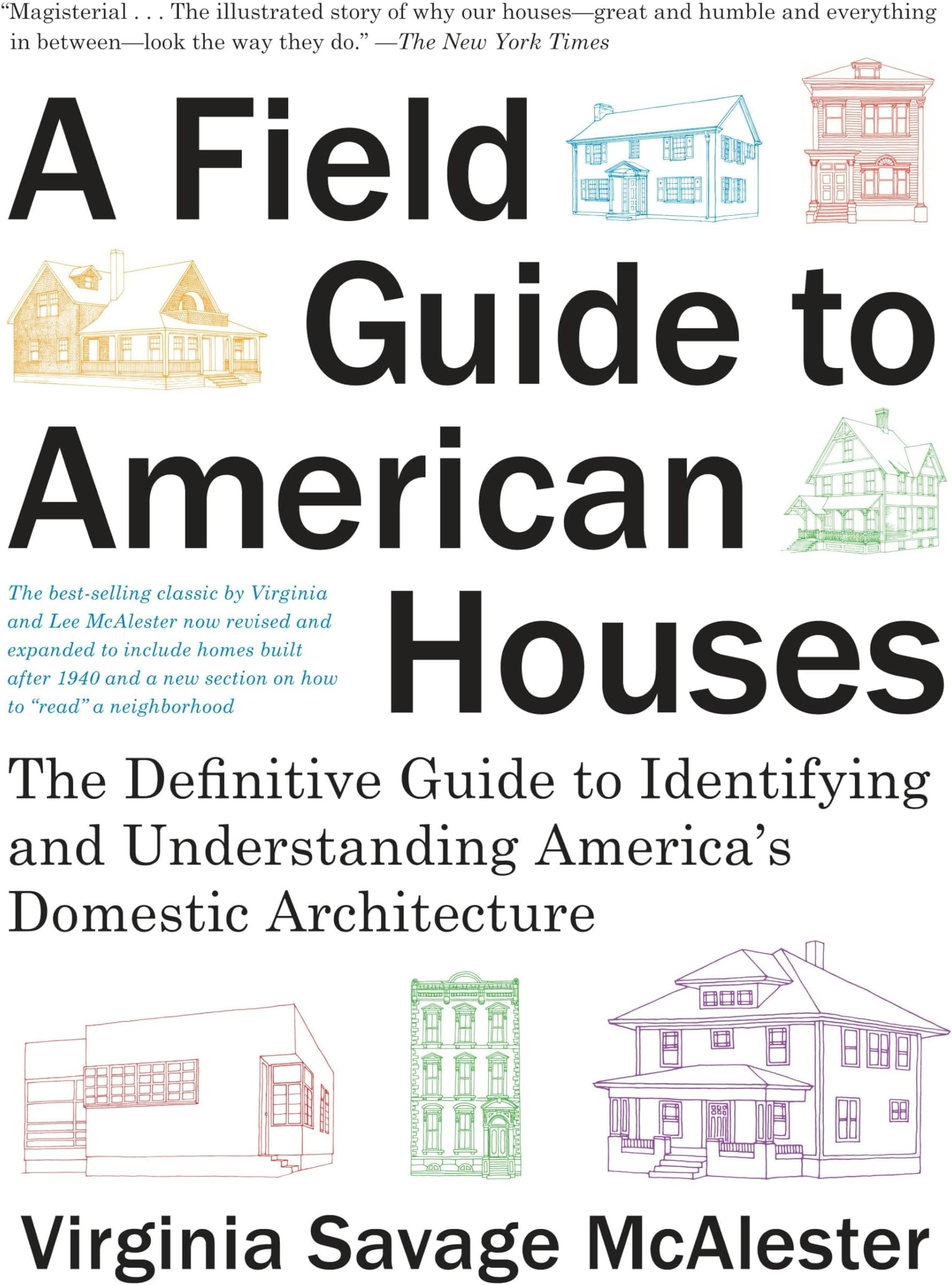
A Field Guide to American Houses (Revised): The Definitive Guide to Identifying and Understanding America's Domestic Architecture
Product ID: 20348589
Desertcart purchases this item on your behalf and handles shipping, customs, and support to South Africa.
The fully expanded, updated, and freshly designed second edition of the most comprehensive and widely acclaimed guide to domestic architecture: in print since its original publication in 1984, and acknowledged everywhere as the unmatched, essential guide to American houses. This revised edition includes a section on neighborhoods; expanded and completely new categories of house styles with photos and descriptions of each; an appendix on "Approaches to Construction in the 20th and 21st Centuries"; an expanded bibliography; and 600 new photographs and line drawings. Review: New and different; surprisingly the same - After a decade of consulting my softbound copy of the earlier edition, I eagerly awaited this one. It is, at once, both familiar and new. My first impression was, "Wow, it's big; and heavy!" It's probably now out of the "field guide" category in the sense of portability. Perhaps the current one is similar to the hardbound 1st edition I never knew but the smaller, lighter softbound book was easier to toss under my arm and take off. I'm a clinical pharmacist by training - not an architect or architectural historian - so content accessibility is very important to me. Like the earlier edition, the book shines in this department but even brighter. I find the layout more logical, with the pictorial key and glossary up front, not buried in the early pages. At first I couldn't figure the organization of the pictorial key but now I see it's clearly aimed at the sidewalk house viewer, e.g., me. Start at what you can see over the hedge and work down: Roof form, Dormers, Roof-Wall Junction, Chimneys, Porches, Windows, etc. Unfortunately, the typeface for the category headers is less eye-catching in the new edition, making it harder to skim to your section. The meat and value of the book is in the text. I haven't read it all, being most interested in the styles found here in southern California, but the content is again extremely accessible to the average reader. There continues the excellent use of line drawings, many that have been improved from the 1st edition. The photographs are much clearer on fine white paper than they were on the buff colored pages of the softbound previous edition. In my selective review I notice there are some new house photos and some different photos of 1st edition houses. There are also some photos deleted in this edition - so don't throw away your 1st edition! If I had to pick a single best new feature of the book, it would be the 45-page chapter, "Neighborhoods: The Grouping of American Houses," with historic photos, aerial line drawings and elevations of neighborhood types, and discussion of the history, growth and problems of neighborhood development. With some historic neighborhoods being nibbled to death by individual variances and code exceptions until they've lost their defining character, this chapter makes clear that individual houses - no matter how remarkable - are usually part of a collection worth recognition in its own right. Final assessment? This tome is no longer suitable for my backpack and the typeface choices make it less friendly for skimming but the expanded material is so good and so well integrated into the original [including the line drawings that look like they could have been there since 1984] that this "field guide" is still a must-have book for anyone interested in historic [or some-day historic] houses. Review: Great informative book! - Great informational book.


| Best Sellers Rank | #3,328 in Books ( See Top 100 in Books ) #1 in Architectural History #1 in Regional Architecture #2 in Residential Architecture |
| Customer Reviews | 4.8 out of 5 stars 1,241 Reviews |
R**.
New and different; surprisingly the same
After a decade of consulting my softbound copy of the earlier edition, I eagerly awaited this one. It is, at once, both familiar and new. My first impression was, "Wow, it's big; and heavy!" It's probably now out of the "field guide" category in the sense of portability. Perhaps the current one is similar to the hardbound 1st edition I never knew but the smaller, lighter softbound book was easier to toss under my arm and take off. I'm a clinical pharmacist by training - not an architect or architectural historian - so content accessibility is very important to me. Like the earlier edition, the book shines in this department but even brighter. I find the layout more logical, with the pictorial key and glossary up front, not buried in the early pages. At first I couldn't figure the organization of the pictorial key but now I see it's clearly aimed at the sidewalk house viewer, e.g., me. Start at what you can see over the hedge and work down: Roof form, Dormers, Roof-Wall Junction, Chimneys, Porches, Windows, etc. Unfortunately, the typeface for the category headers is less eye-catching in the new edition, making it harder to skim to your section. The meat and value of the book is in the text. I haven't read it all, being most interested in the styles found here in southern California, but the content is again extremely accessible to the average reader. There continues the excellent use of line drawings, many that have been improved from the 1st edition. The photographs are much clearer on fine white paper than they were on the buff colored pages of the softbound previous edition. In my selective review I notice there are some new house photos and some different photos of 1st edition houses. There are also some photos deleted in this edition - so don't throw away your 1st edition! If I had to pick a single best new feature of the book, it would be the 45-page chapter, "Neighborhoods: The Grouping of American Houses," with historic photos, aerial line drawings and elevations of neighborhood types, and discussion of the history, growth and problems of neighborhood development. With some historic neighborhoods being nibbled to death by individual variances and code exceptions until they've lost their defining character, this chapter makes clear that individual houses - no matter how remarkable - are usually part of a collection worth recognition in its own right. Final assessment? This tome is no longer suitable for my backpack and the typeface choices make it less friendly for skimming but the expanded material is so good and so well integrated into the original [including the line drawings that look like they could have been there since 1984] that this "field guide" is still a must-have book for anyone interested in historic [or some-day historic] houses.
L**.
Great informative book!
Great informational book.
A**G
Cheap at Twice the Price, Depending on the Price -- A Must-Have Regardless
I know of no single one-volume work on American architectural styles that has (a) established such a good track record in its previous editions, (b) added to much new information for this (2013) edition, and (c) is available significantly below retail at Amazon. This book is aimed at the layman -- obviously, an 880-page tome with over 600 pages devoted to text is not for people who want a quick looker-upper, but it is fascinating nonetheless and not over the heads of those motivated by curiosity. If you hear Jed Clampett's TV mansion referred to as "Beaux-Arts" (boze-ahrt) style -- well, it is, and this book will tell you about the history of such edifices, just as it does with "Second Empire," "Minimal Traditional," "Italianate," pretty much the whole range of American houses, old and new, vernacular and individually designed. Cheers to Virginia Savage McAlester and her hardworking staff for bringing the original 1984 volume -- itself no slouch -- gloriously up-to-date. I own not only the 1984 predecessor and this new volume, of course, but have been proud to make this one a gift to friends far and near. It's that good. Cheap at Twice the Price? Could be. Prices have been fluctuating lately, but are always well below the benchmark retail of fifty U.S. dollars. Hint: This would make a terrific present not only to an architecture student, but to someone who has just received her or his Real Estate sales broker's license.
B**D
A Stylish Guide to Styles
This book is a "must" for anyone who likes to look at houses. Its novel, central purpose is to aid in identifying the architectural styles of American homes. It does this in a manner analogous to "field guides" for birds, bugs or plants, but instead of wings and beaks or leaves and bark, it describes roof lines, window treatments and the many other visible characteristics that define each style. Introductory chapters offer an engaging historical background for floor plans, construction techniques and exterior features; these chapters are clear, concise and accessible even to a novice. The chapter on neighborhoods, new for the 2nd edition, presents a fascinating account of how geography and advances in transportation have influenced people's decisions to live in communities and the homes they were likely to build in a given locale. The author is well aware that illustrations are crucial in a volume of this nature; she provides hundreds of straightforward line drawings that clarify structural and decorative concepts, plus hundreds more instructive photographs of actual dwellings. In the chapters on individual styles these figures complement one another to convey both the essential elements of each style and the range of variations that may be encountered "in the field". Add an exhaustive reference section at the end and you have a versatile work that will enrich the afternoons of casual weekend wanderers while also serving the needs of serious students of architectural history.
E**A
Great book for architecture buffs and lovers of vintage homes.
As a fan of vintage homes and architecture, I think this book is very worthy of being on your bookshelf, if you are also a fan of vintage homes. It allows me to have a better understanding and be able to speak in an intelligent manner with others of the same mindset. I would have liked more photographs and examples, but that's not to say what was offered was inadequate, simply more of a "wish list" type item. ABOUT ME: I have been an Amazon Prime customer for quite a while and I really enjoy writing reviews – I love shopping actually, and love sharing my finds. My personal criteria for products: • 1 star (I do not like this item or product). I feel it's a waste of money. Would never use it again. Would not recommend. Either throw away or return it. • 2 star (Not a big fan): Would not purchase again nor share it with my friends, but may still have at least 1 positive thing about it. • 3 star (It’s Fair): Product has both positives and negatives, and I may or may not continue using it. It might be a better item for another person. If I think of who may like it better I will likely write about who I think it would work for. • 4 star (Pretty, pretty, pretty good – to quote Larry David): Item is accurately described. May have 1 or 2 things I might potentially change, but not a deal breaker. Would recommend it to friends and family. • 5 star (It is perfect and I LOVE it!) Practically perfect. Amazing quality and a must have. It means I’m “Over the Moon” with it and would not only recommend, but would purchase for others and continue to purchase for myself.
E**A
Nice book. Wish it was available as a hardcover.
I bought this as a gift for my daughter when she was an architectural student. Now that she’s a pro it’s on her bookcase and she refers to it occasionally.
A**R
a must have for historic preservation projects
I'm working on an historic preservation project as part of a neighborhood group. Virginia Savage McAlester's A Field Guide to American Houses (Revised): The Definitive Guide to Identifying and Understanding America's Domestic Architecture has proved invaluable. With a detailed pictorial key and glossary, numerous photos and drawings, and clear and comprehensive descriptions, this has become our essential reference guide in identifying and describing the various architectural styles found in our neighborhood. A Field Guide to American Houses (Revised) is a must have for any individuals and groups interested in exploring the fascinating history of American architecture.
M**9
For Anyone Curious about Houses
My dearly beloved is a big fan of houses. He loves to study the architecture and details of housing everywhere we go. So, when I saw this book reviewed in the Wall Street Journal, I knew it would be perfect for him. At the beginning of the book, there are charts with diagrams to help the reader identify the type of house he/she is looking at. For example, a sketch of a roof with a 2 or 3 word description, and the book recommends looking at one or more type of house to see which it is. However, it's also very good for reading, with chapters on the layouts of early towns and so forth. There is also a section on the housing used by various Native American groups. Each chapter about a style of houses includes a few pages of history, etc, before sketches, details about characteristics of the type, and photos of actual houses of each style from various parts of the country. Good for a long reading session, but it's also a fast and easy reference for when you just want to know what you've just seen.
F**O
The detail, the detail!
Everything you could ever want to know about American houses is here. The most comprehensive book on this subject you could hope to find. Excellent.
J**N
Anschaulich und informativ
Das Buch hat sehr viele anschaulich Grafiken in schwarz-weiß und ist ausführlich sowie informativ verfasst.
F**A
Un libro de consulta clásico
Contenido muy extenso, gran cantidad de ilustraciones, explicaciones sencillas y correctamente estructurado. La manufactura excelente, tanto la tipografía como la calidad del papel, la tinta y la impresión.
R**B
CONCISE & WELL ORGANIZED
Detailed illustrations, hundreds of photos and examples.
R**S
Recomendadíssimo.
Recomendo muito para aqueles que querem se aventurar nos estilos arquitetônicos Norte-americanos. Muito didático. Necessita conhecimento intermediário em inglês.
Trustpilot
5 days ago
3 weeks ago