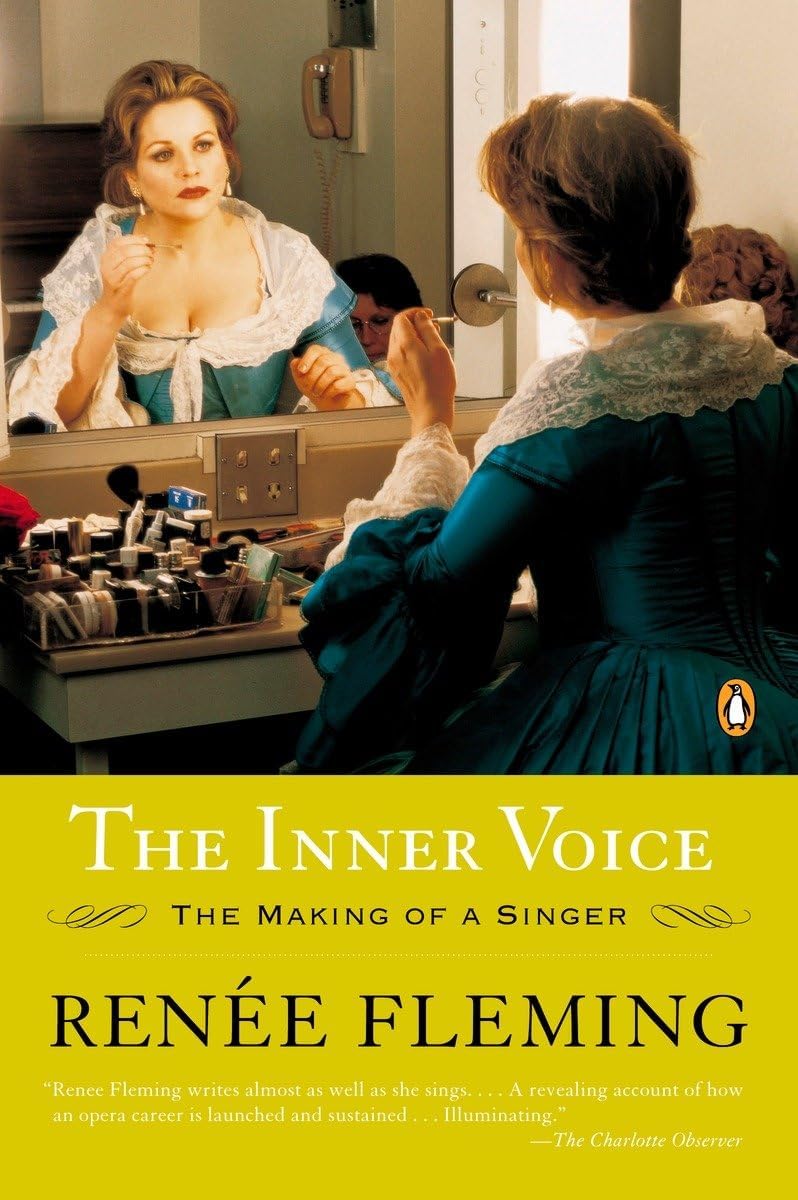
The Inner Voice: The Making of a Singer
Desertcart purchases this item on your behalf and handles shipping, customs, and support to South Africa.
Description
The fascinating personal story of one of the most celebrated talents in today’s music scene The star of the Metropolitan Opera's recent revival of Dvorak's Rusalka, soprano Renée Fleming brings a consummately beautiful voice, striking interpretive talents, and compelling artistry to bear on performances that have captivated audiences in opera houses and recital halls throughout the world. In The Inner Voice —a book that is the story of her own artistic development and the “autobiography” of her voice—this great performer presents a unique and privileged look at the making of a singer and offers hard-won, practical advice to aspiring performance artists everywhere. From her youth as the child of two singing teachers through her years at Juilliard, from her struggles to establish her career to her international success, The Inner Voice is a luminous, articulate, and candid self-portrait of a contemporary artist—and the most revelatory examination yet of the performing life.
Specifications
| Dimensions | 5.31 x 0.55 x 8 inches |
| Edition | Reprint |
| Isbn 10 | 0143035940 |
| Isbn 13 | 978-0143035947 |
| Item Weight | 2.31 pounds |
| Language | English |
| Print Length | 240 pages |
| Publication Date | September 27, 2005 |
| Publisher | Penguin Publishing Group |
Reviews
User
A Memoir For Those Who Deeply Appreciate the Arts
Renée Fleming is generally acclaimed as the reigning operatic soprano of the day, enjoying a worldwide stature comparable to that afforded only a few divas of the past: e.g., Joan Sutherland, Maria Callas, Beverly Sills, et al. Renée Fleming's "The Inner Voice: The Making of a Singer", is a compelling autobiography that recounts Ms. Fleming's remarkable career as a "three-prong singer" who not only sings opera, but also sings recitals with piano and concerts with orchestras. Without glorifying herself, Ms. Fleming describes how she has achieved success via hard work, tenacity, resilience and luck. As Ms. Fleming states (of her memoir), "What I came up with in the end was not the story of my life, but the autobiography of my voice". Notwithstanding her enormous talent, extraordinary vocal abilities, stature as a world-class musician and opera star (and the associated rewards), Ms. Fleming candidly reveals her ongoing struggles to master her craft, and to combat various obstacles/challenges/failures encountered along the way: e.g., stage fright, rejection, panic attacks, isolation/loneliness, self-doubt, et al. Interestingly, this book is almost devoid of operatic gossip (i.e., the really `juicy stuff'); instead, it might be better described as a `How-To', and `Lessons Learned' manual that aims to mentor/instruct young aspiring operatic singers and help them to deal with challenges, and avoid some of the pitfalls encountered in the difficult and highly competitive world of opera.Ms. Fleming (today a divorced mother of two girls, Amelia and Sage) introduces the reader to her early family life, growing up in a suburb of Rochester, New York, with her parents, Edwin and Patricia, her younger sister, Rachelle, and her brother, Ted. Both of her parents were music teachers who enjoyed singing in the home. Music was an integral part of her public school education; educators understood, intuitively, that the discipline and joy of music fostered creativity in children, and provided a deepening and broadening experience in their lives.Although Ms. Fleming was accepted to Oberlin College (a top-flight conservatory), she was unable to attend due to insufficient financial aid. Instead, she ended up attending the Crane School of Music of the State University of New York, Potsdam. Ms. Fleming points out that this `disappointment' turned out to be the first great break of her career. At the Crane School of Music Ms. Fleming was taught by Patricia Misslin, a `no-nonsense' teacher who provided her with strict vocal training, putting a great deal of emphasis on resonance, focus, and `placing the voice'. Ms. Misslin taught her that a singer has different options for `placing the voice' (i.e., directing air combinations to different parts of the body, and thereby creating different sounds), including: (a) Head - This creates a light child-like sound; (b) Mouth - This creates a different sound; (c) Mask (nose and cheekbones) - This creates a nasal sound; (d) Chest - This creates a very low sound, like Sarah Vaughn. Ms. Misslin taught Ms. Fleming that an opera singer must typically maintain an enormous amount of focus in `the mask' so as to be able to project the voice to the back of the hall without strain. Ms. Misslin taught Ms. Fleming how to practice, and had a great influence on her regarding her repertoire. While at Potsdam, in addition to classical music, Ms. Fleming fell in love with jazz. While still a sophomore she auditioned for, and landed, a job as a big band singer. Singing with the band taught her how to let go of her fears, experiment vocally, and perform.After graduating from Potsdam, Ms. Fleming moved on to Eastman to study for a master's degree in music. At Eastman she had the opportunity to perform in many operatic roles. Ms. Fleming states, "And while I had some successes at Eastman, I had my share of dismal failures as well."---she failed her Met audition. But, fortunately, her parents had instilled in her the code of "Never Give Up." Ms. Fleming discusses her postgraduate apprenticeship at Julliard in a program called the American Opera Center, and a follow-up Fullbright grant in Germany where she learned to speak German fluently.Ms. Fleming pays homage to her mentors (e.g., Renata Scotto, Joan Sutherland, Marilyn Horne, Leontyne Price). She shares her experiences after attaining success, her major challenges (e.g., scheduling travelling, work/life balance, traveling with and raising two daughters, etc.), the business aspects of her career (e.g., bookings, interviews, cancellation policies, etc.), and ways to achieve longevity as an opera singer. Ms. Fleming emphasizes the importance of taking charge of one's image on stage, and shares her experience during actual performances before live audiences. She discusses how she prepares for new roles, and shares with the reader what typically goes on backstage during the preparation for a performance.I thoroughly enjoyed this wonderful memoir which took me on a remarkable journey through the eyes of an opera star and recitalist. Ms. Fleming's memoir is, indeed, a portrait of the artist at work. It is a moving story that is well-written, fascinating, vigorous, and fresh---I learned a lot. Ms. Fleming humanizes the `diva', debunking (in a lighthearted manner) many of the stereotypes often associated with the term `diva' (e.g., "prima donna"; "selfish"; "high maintenance"; "hugely demanding"; speak in high voices, à la Julia Child, in a "continental" nonaccent; etc.) by those who are unfamiliar with the world of opera. She exhibits a keen awareness of the connection between the past, present, and future---an understanding that the world of opera did not begin with her, nor is it likely to end with her. More specifically, Ms. Fleming states,"...there must be at least one note in my range that belonged to my grandmother, and certainly my mother's soprano and my father's deep love for new music have given much of the color and depth to my sound. Their voices are our inheritance, part of the amalgamation of who we are and what we have learned. We are unique, each human voice, not because we are completely self-generated, but because of how we choose to assemble the countless factors that made us. My voice carries in it the generations before me, generations of my family, of brilliant singers I have admired, of dear friends. It goes on in this book, not the sound of my singing but certainly the work and thought and passion of the discipline. Tiny slivers of my voice will be incorporated into a student I teach in a master class or into the young singer who listens carefully, just as little glimmers of Leontyne Price's shining high C and Dietrich Fischer-Dieskau's expansive breath came into me. If this is the past of my voice, then I must believe it is the future as well. My voice will go forward in the same way, not only through recordings but through my daughters and through their daughters and sons as far as the line will take us. It doesn't mean that everyone will be a singer, but that every one of us will find a passion in life to drive us ahead, and just maybe part of that passion will rest in the voice. People will hear it even in a word that is spoken: the wealth and wonder of all the music that came before."One of the main reasons why this memoir is so effective is that it is focused; Ms. Fleming does not `bite of more than she can chew'. In writing this memoir Ms. Fleming evidently followed the adage that it is better to do a `high quality' job on a focused topic, than to do a `mediocre' job on a topic that is too broad. I would highly recommend this book for aspiring opera singers, opera-buffs and, in general, anyone who has a deep appreciation for the arts.
User
An Insiders Look At A Little Known World
Often celebrity memoirs(especially those involving singers) are light gossipy and fun. Sure there's a chapter or two about the drug addiction and rehab, but for the most part the genre deals in champagne parties and red carpet fashions. As Renee Fleming warns us in her introduction, this is not your average celebrity memoir and Fleming is not your average celebrity. Rather, "the Inner Voice" is very much a portrait of an artist at work, as well as an introduction to the artistic and the commercial aspects of the career of an opera singer. Yes, Fleming does mention what it's like to do interviews and choose gowns for gala performances. But these are mere mentions.The bulk of the book deals with Fleming's preparation of her roles as an actress and as a singer, from going through the score pre-performance, to interpreting the emotions of a character. She deals with the creative side of her work with more vigour than almost any other- how does an actress approach a role like Juliet or Ophilia that's been played by hundreds of predecessors? The question we learn is the same for an opera singer with one addition: how does one add something unique and individual to the music while still remaining true to what's written?To answer this question Fleming takes us though her education from her early childhood music classes, through college, grad school, and her early career, introducing us to her teachers and mentors and sharing their advice. Other issues that are central to Fleming's memoir is balanceing her professional life and personal life (primarily as a mother), avoiding inadvertant damage to her vocal chords and living with the knowledge that if her voice goes, her career is over in a snap of the fingers.Many people listen to opera and are unable to "get it"- to understand why it's beloved by so many. Fleming makes that love clear in her passion for her work and her description of the painstaking labor that goes into each and every element. First and foremost you come away with the impression that the human voice is an instrument just as much as the violin or the cello and that opera singers are masters of their individual instruments- a mastery that comes from decades of hard work. Even if you don't love opera after reading this, it's very hard not to respect it.Nothing Fleming discusses in inaccessable to the layman, nor is it condescending to the professional or the connaiseur . It's simply a depiction of an art, and a profession which few people glimpse
User
Singers can learn a lot
Very interesting book. I highly recommend it. Thank you Renée
User
Everyone's Opera Singer
Renee Fleming is certainly Everyone's Opera Singer - an interesting elevation in a culture without much interest in opera in general. Without doubt she's created a successful singing career, has a beautiful singing voice and plenty of technique, and maintains an admirable appreciation of the art of which she is a prized exponent.So I feel a little badly not liking this book much. True, she avoids gossip, is accessible (I'm not sure what that really means), sells a great many CD units (she's even helped recast the idea of 'crossover artist') AND writes well, with unexpectedly deft touches artfully sprinkled here and there. But for me, there's something bland and lacking in the book, in all the success, accessibility, and golden child praise universal. I find the same unfortunately characteristic of her musical art, when all is said and done. I hear a wonderfully displayed sound, a carefully construed art, yet feel very little. I heard Fleming remark (during a 60 Minutes interview) that "opera, after all, is basically screaming". An odd intimation for an opera singer to make, I thought. In this book, more evidence is at hand that Fleming's is an art not patient with profoundness. Not a crime, but it IS unpleasantly ironic, leaving a listener with few choices.The great sopranos of the 20th c. she does not surpass. How near she has come to their contribution is a question ill viewed in the light of so many of her passing views about music and opera found in this book. I read it through, and maybe my receptors are way off mark. Who am I to argue with the world? Her often repeated views on the importance of a perfect passagio are commendably argued. For me, ultimately, her art itself fares less well. I wanted to offer 3 stars, but couldn't bring myself to do it. An interesting enough book for those interested in singers.
User
Wow! What a great book!
On top of a stellar career in opera she writes a deeply thoughtful and insightful book. This is a woman who has thought deeply about every aspect of her music, acting, art, her personal struggles, and is so open and generous in sharing it so beautifully with us.Anyone who has made music their passion will be able to relate to this book, and those who have chosen a life in any of the arts, or who has taken a path in life that's different from what their friends did.I'm going to read this book again and listen to the arias she talks about - especially the ones she struggled with.If you've never been a musician, this book will take you deep inside a world you never dreamed existed - a way of living that's completely different from the kind of life you see around you.I can't recommend this book highly enough!
User
Part Autobiography, Part "How-To", Part Masterclass
This book is designed to be read by aspiring divas and like-minded individuals, not by those wanting a biographical account of Ms. Fleming's life and career. In this little book, Fleming flows easily from personal acocunt to technical explanation of vocal technique.I was impressed at the grace and modesty in which Ms. Fleming wrote, even about the less favorable situations such as her divorce and the death of her dear friedn and mentor. Her obvious adoration for her children, and her candid account of her multiple failures was real enough for anyone to grasp.It is the simplicity of this book that draws me. Not consisting of complicated or flowery language, but written briefly and in an easily read language, Fleming bares enough of her soul to inspire the aspiring singer, but avoids the trap of tabloid details.
User
Get out of your comfort zone to succeed
Phenomenal biography, interspersed with practical personal and professional guidance, no matter what career you choose.
User
Beautiful Book!
This book is one that I would reccomend to all singers-- professional or not!As an experienced singer recognizing how fickle the voice can be, she shares stories and insights that are very validating to young singers struggling with the voice.That people can sing at all, is a miracle.This book will help one to appreciate singing, and give one a glimpse of all the details that go into the making of a world-class vocalist!
User
The Inner Voice
Excellent! I learned much of what I hadn't imagined is behind the training of an operatic voice and presence. Plus Renée's behind-the-scene anecdotes are hysterical!
User
great book!
very comfortable to read on kindle, and the book itself is fascinating and informative! go read it as soon as possible if you are a singer
User
Amazing book written by an inspirational artist.
Amazing!
User
I even got a few tips and how best to send my current production of Turandot by Puccini
I am an opera singer myself and found her story very enlightening encouraging inspirational. I even got a few tips and how best to send my current production of Turandot by Puccini. It seems I was really tightening my jaw so referring to Renée in tweaking her voice instead of tightening my jaw and my neck seizing up I pulled it back and unhinged it and sound came out much easier . I have highlighted and underlined in the book and really enjoyed to know that we singers have similar problems that need to be constantly tweaked and worked on. Loved the book and have recommended it to many people who are singers.
User
great
The book is very interesting, she is clear and honest about her past, about "no" she took, and about work she made for becoming a Diva.Thank you Renee!
Common Questions
Trustpilot